The Hunger Artist
November 24, 2005
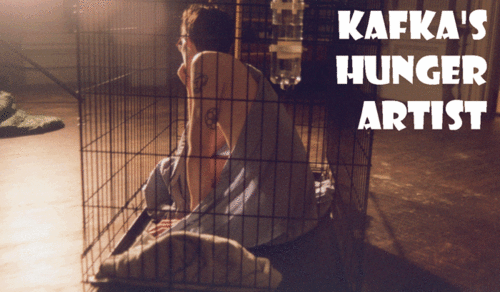
Here's one for the archives: Google (images) 'Hunger Artist'
Happy Thanksgiving, by the way.
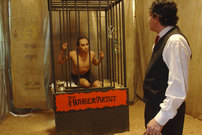
Please read more... "The Hunger Artist"
Posted by debra at 08:04 AM | Comments (3)
Everything but the squeal
November 15, 2005
Sometimes in a recipe, you want to instruct the cook to go outside her normal boundaries of food preparation. I used the term 'everything but the squeal' to describe the use of every single living part of a beet and a radish in an entry titled Yurt and Garden and in an entry on Indian Leafenware earlier this year.
"Everything but the squeal" is a quote attributed to the meat-packing industry and it was first signalled in Upton Sinclair's 1906 novel, the Jungle which described the vile and unhygenic working conditions under which meat was reaching American consumers 100 years ago. If we can believe PETA (People for the Ethical Treatment of Animals), and Eric Schlosser's Fast Food Nation (and I do), not a whole heq of a lot has changed. I do not recommend visiting this site if you plan on eating any part of any animal, wearing fur, leather and even wool, or even drinking the fruits of an animal's existence, any time soon. The PETA organisation is all about the squeal, and I have to say, the practices that they document are abhorrent.
But one needn't result to scare tactics to make me reduce my intake of animal protein and feel guilty for wearing a fur hat during winters up here in the polar circle. Mark Kurlansky's Cod doesn't mention once the issue of animal suffering. In Cod, it's all about extinction dot dot dot.
Please read more... "Everything but the squeal"
Posted by debra at 10:41 AM | Comments (2)
Shedding light upon the dim
November 04, 2005
A rectification is in order. In my initial article about the Food Facility I said that it ' ... marks the first time that diners can experience their urban menu in performance format at one dining location.' This is simply not true, and Pieter van der Werf and Esther Plomp from MPD Export were on top of it enough to point this out to me. Apparently they have carried out this same concept several times since 1998, with enormous success. This is surely a sign from the gawds that it's time high time I started rereading Lucy Lippard. Has it been six years already? Don't believe everything you read.
Posted by debra at 12:35 PM | Comments (0)
A belly full of raw food facility, reviewing a conceptual restaurant
November 02, 2005
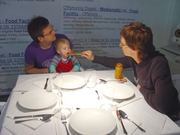
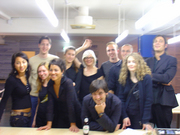
images l to r: smart babies bring their own food to a restaurant opening, the Food Facility staff (aka Mediamatic and Marti Guixé) giddy and a'blur
It's probably fair to assert that last Saturday was an all-time first in Amsterdam: two interesting culinary events in one day. I made sure to attend both Juliano Brotman's Raw Food UnCooking workshop as well as the restaurant launch of Marti Guixé & Mediamatic's Food Facility at the Post CS. Yoga and raw food in the afternoon, black clothing, pearl-swinging, wine drinking, cigarette smoking, take-away food in the evening. Time in between to change costumes I mean outfits, and I had the fixings for a well-balanced day.
Just like normal people, raw food chefs can run a little late, and we were still busy with the results of the uncooking workshop two hours after it's scheduled end. I thought it wouldn't be a problem, assuming that raw food could in no way be complex or filling, but I was mistaken. At 19.00h when I arrived at the Food Facility, I had no desire to eat. Luck would have it that my belly full of raw would turn out to be a blessing.
Luck wouldn't have it that my erstwhile best-friend-with-a-deadline would call to say that she couldn't show up for dinner that evening. GASP, alone at a restaurant opening with a big fat reservation for two! The ever-on-the-ball Mediamatic nouvelles maîtres Arne en Jans, arranged a dinner date for me on the spot (and a delightful one). That, dear reader, is what I call excellent service!
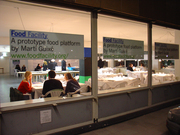

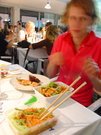
images l to r: graphic designers guesting Food Facility catching the early bird special, Guixé designed chairs, Katarina eating spada on rosemary sticks well within three hours of ordering
The restaurant was glowing with all manner of mixed spot and flourescent lighting, bright white, with HTML blue, black and green columns in the centre. Draped on the walls were large print-outs of the results of a Google search; 'food', 'food facility', 'Marti Guixé' and 'Mediamatic'. Of course this search yields lots of culiblog entries, and I have to say, there's nothing like seeing the name of your blog plastered all over an interior to warm your heart and coax out a favourable review. Designers, do like Marti does.
In the centre of the room Guixé placed a food island, where the delivery boys on scooters brought in the orders and from where the restaurant staff would bring the dish to it's rightful owner. The tables were laid with damaste (not real damaste), with large tumbler glasses, generous cutlery, and large cloth napkins (not real cloth). All of the guests were pregnant with expectation, and some were actually pregnant. Marti G. described the evening thusly, 'It was like attending my own wedding...'
My dining buddy Katarina and I ordered from a well-designed menu based upon the takeout menus from twelve different restaurants in Amsterdam. By 'based upon' I mean photo copied and by twelve I mean nine. We were having an excellent time, drinking and talking, waiting and drinking and talking, smoking and drinking and drinking and smoking and talking and waiting and drinking. Talking all the while, the friends were dropping by for a chit chat, we were being visited by extremely attentive maîtres and wait staff. Waiters are for waiting.
And then we did some more of that waiting. Which was fine. I still wasn't the least bit hungry with my belly full of raw, but some guests were starting to get peckish, and by peckish, I mean uppity. Certain tables began to organise exuberant betting pools as to who would get their food first.
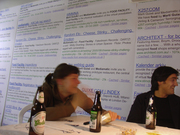
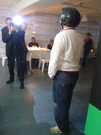
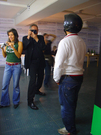
images l to r: the bride and bridegroom Guixé giggling at all the betting going on, the arrival of the first delivery boy with one baggie of takeout food, the paparazzi can't contain themselves
And then the first delivery boy entered the restaurant. Helmet on, a little white baggy filled with Chinese takeaway in his hand, and the entire facility went berserk. Cameras were flashing, guests were laughing and many stood up to applaud and 'whoop whoop'. All this for one little white bag of grits. This scenario repeated itself as each delivery boy entered the Food Facility until the very end of the evening. That, dear reader, is good restaurant interface design.
My sashimi arrived, well within one and a half hours. An hour, two glasses of wine and one and a half cigarettes later my green papaya salad arrived. You can see by my menu choices that I was doing my dangdest to keep the raw thing going. Ordinarily this amount of wait would be unacceptable, a good reason to do some non-positive wing-flapping. But this particular evening, I would have to categorise this as perfect timing. Perfect amount of drama and excitement, entertaining guests entertaining themselves just fine, excellent conversation (one of my waitresses turned out to be a sufi), food for thought and merriment abounding. Guaranteeing an excellent experience is also a part of restaurant design, and it's silly to go to a restaurant opening with the actual intention of getting fed.
Guixé and Mediamatic's Food Facility is open Fridays and Saturdays until December 11, 2005 and I highly recommend at least one visit. I have chosen Food Facility as the location to celebrate the one year birthday party of culiblog.org during Saturday's Museum Night. It was one year ago (Museum Night 2004 at Mediamtic) that culiblog launched it's domain. We're going to fill up on nibbles beforehand at my house.
Food Facility open Friday and Saturday from 18.00h - 22.00h
November 4 - December 11, 2005 at Post CS, Amsterdam.
Read Mediamatic's announcement here or call +31 (0)6 3376 8810 for reservations.
Please read more... "A belly full of raw food facility, reviewing a conceptual restaurant"
Posted by debra at 10:31 AM | Comments (0)
Guixégasbord Food Facility
October 29, 2005
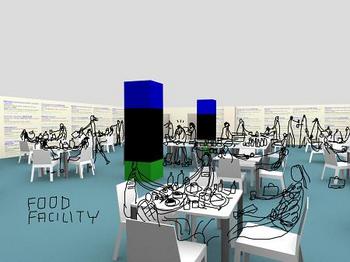
If you haven't already made a reservation for the opening of Marti Guixé's Food Facility at Mediamatic (Post CS) this Sunday evening, you are plum out of luck because I just made the last one. You can still make reservations for every Friday and Saturday evening between the 4th of November and the 11th of December. This is one conceptual restaurant you could never visit too often.
Food Facility, the title of Guixé's working prototype restaurant, has no kitchen. Instead the central kitchen is replaced by kitchens of existing take-out restaurants in the area. Talk about locative eating! As a guest you can choose menu items compiled from Guixé gleaned take-out restaurants and consume the order at the glammy Food Facility. Of course there are already existing restaurant hubs on the web. Waiters on Wheels representative Sharad Agarwal told me that although it is possible to order one entree from one take-away restaurant and desserts and entremets from others, Delhi's Waiters on Wheels customers never seem to do this. Food Facility marks the first time that diners can experience their urban menu in performance format at one dining location. (Rectification: the above statement is wholly untrue! Read about it here.)
Food Facility open Friday and Saturday from 18.00h - 22.00h
November 4 - December 11, 2005 at Post CS, Amsterdam.
Read Mediamatic's announcement here or call +31 (0)6 3376 8810 for reservations.
Posted by debra at 01:10 PM | Comments (2)
Honey, rockin' my world
October 27, 2005
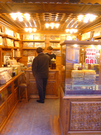
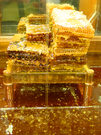
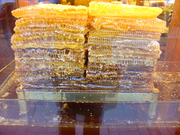
A honey shop in the Kadiköy market in Istanbul is visited by wasps.
Posted by debra at 03:47 PM | Comments (0)
I love smoking everything in moderation
October 22, 2005
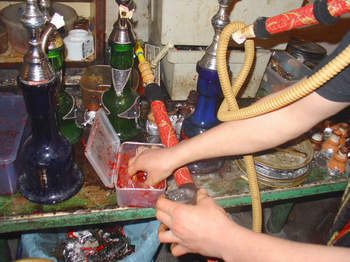
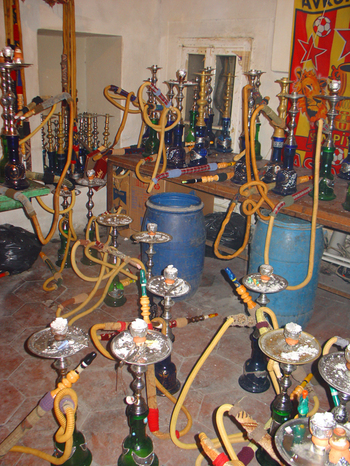
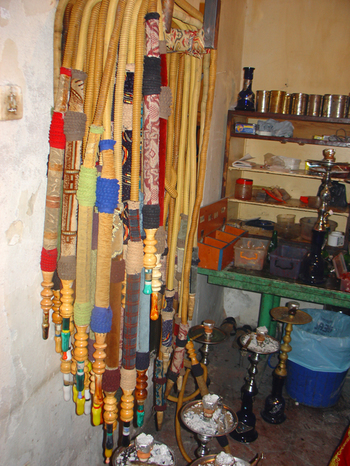
Last year in Delhi I reported on why it's a good idea to keep a positive attitude while experimenting with stimulants. This year I simply throw myself into the task. By the volume of the blueish haze, one wouldn't suspect that we were entering an outdoor tea house, but the tea house, (and by tea, I mean smoke) of the Balkan Student Union is a vaulted-ceilinged wonder of kilim pillowed couches and abundant eastern aesthetic occupying a maze of very confusing little stone courtyards. There are only four things on the menu here: tobaccos, teas (apple, mint, black) or coffee, and a game resembling backgammon. After a long day's walk through the Istanbul Biennale locations, it was wonderful to get into a heady relax with a bowl full of nargileh. That's Turkish for waterpipe tobacco drenched in apple, mint or rose syrup. Smoking a waterpipe is like inhaling jewelry, so delicious. Dip your finger in the tobacco straight out of the tin and you'll taste that it's sweet as candy.
Everything in moderation, including moderation.
images l to r: an employee of the Istanbul University Balkan Student Union Smokehouse fills a waterpipe bowl with apple flavoured tobacco, a tangle of waterpipes in the storage room await new customers, the pipes unplugged
Please read more... "I love smoking everything in moderation"
Posted by debra at 02:36 PM | Comments (3)
Amphora types according to culiblog
October 20, 2005
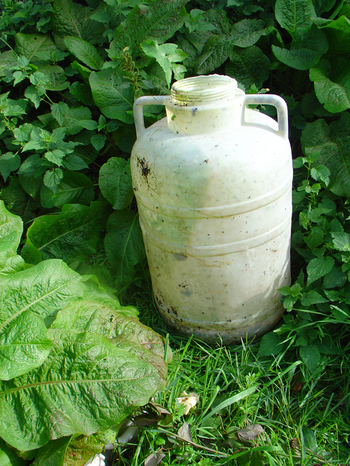
In one of the artist-in-residence gardens of the future Santral Istanbul, we found a plastic amphora, looking not dissimilar to the amphorae of old.
Posted by debra at 04:19 PM | Comments (0)
Hairy dairy
October 19, 2005
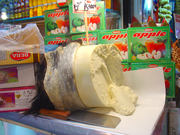
Turkish goat cheese packaged and sold in an animal skin, just the way it was originally produced. Shepherds discovered that animal milk carried in animal skins curdles, (especially the skins of baby animals) and the rest is culinary history. This tube of tulum cheese was being portioned at the Egyptian Spice Market in Istanbul. For some reason the practice of preserving and selling cheese in an animal skin is not echoed by the producers of cow's milk cheeses.
Posted by debra at 01:25 PM | Comments (0)
Papabubble is pure sugar finger lickin'
October 18, 2005
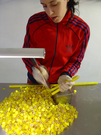
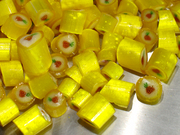
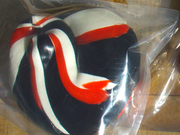
Loyal culiblog readers know that I'm not a big fan of sweets, but sometimes sugar is coaxed by masterful hands into shapes and colours so beautiful, and with flavours so delicious, that it's all I can do to keep from hauling off and giving it a good lickin'. At the moment of writing, I'm popping acid drops, one after another into my mouth and sucking them so violently, that I shall surely be giving myself a blister.
Which brings me to papabubble, the source of these acid drops that are doing all the damage to the roof of my mouth. When I returned to Amsterdam this Autumn, a new shop had occupied Harlemmerdijk 70, and I became a fan of their candy straight away. Inside the contemporary interior, a noble candy is being produced right before your very eyes. You feel like a child oggling the sculpturally shaped sugar. The concept belongs to Australian papabubble originators, Tommy Tang and Christopher King, who opened the first shop in Barcelona in June 2003, but it was Marieken van den Brink, who studied artisanal candy-making with them, that brought the concept to the Netherlands in 2004. For this she won a Marie Claire Starters Award in 2004, turning her dream and her lolly import business (Lulu Loves Lollies) into papbubble Amsterdam. Nice one. Here's some money, now go and make some candy.
But it's not just candy. It's a very pure, playful and artisanal product that she and her partner, Dominik Otto, and his sister Marie Otto, are making in the Amsterdam shop. It's all very old-fashioned and sweet. They live upstairs above the shop, and just like in a fairy tale, afternoons the place is a'swarm with children and single women, straight from school and yoga class, that have come in to watch the candy making process and get offered tastes of free candy by the smiling sugar pullers.
What I most love about what is going on at papabubble (aside from the high level of craftsmanship and amazing flavours of sour) was that the molten sugar is truly played with by the candy makers, Dominik and Marie (brother and sister). They don't throw away the candy ends but turn them into blobbous sculptures and sell them in that form. These blobs of sugar will make a beautiful centrepiece (did I just use the word centrepiece?) at my next dinner party as a communal after-dinner sugar-lick.
More conventionally (but not really) are the hard candy rings, which of course make a right mess if you wear them, but if you're a child, or if you're in love and in the mood, they'll be just the ticket.
'Hon, lick my finger?'
papabubble
Haarlemmerdijk 70
1013 JE Amsterdam
tel +31 (0)20 6262662
fax +31 (0)20 6267654
www.papabubble.nl
images l to r: Candymaker Marie Otto cuts rolls of hardened sugar into pineapple hard candy, closeup of pineapple candy, a blob of sugar that will feature at my next dinner
Please read more... "Papabubble is pure sugar finger lickin'"
Posted by debra at 02:13 PM | Comments (1)
All I really really want is locative food
October 01, 2005

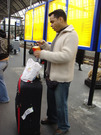
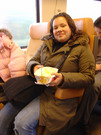
That is, food that tells me where I am and where it's from by it's very name and nature (without the use of an RFID tag). And all I really really want is to have one major train station and one major airport in one country that sells food that is not created by food product designers but by local people from local ingredients and reflecting the diverse local food culture already present.
Imagine Amsterdam's Schiphol Airport... Could the experience of Schiphol be enriched if you knew that this was the only airport in the world where you could exclusively buy locally grown and produced Dutch food and regional specialities? Was it already one and a half years ago that Doors of Perception and Urban Unlimited organised a cultural experts meeting for the city of Breda, a new node on the line of the High Speed Train. If I recall correctly, we recommended just this very thing.
The images above were taken within a period of 4 minutes. Friday afternoon, chip eaters abound at Amsterdam Centraal Station. Just imagine the possible effect on the environment and the state of agriculture and upon the local economy if these chips were made from a diverse range of local potatoes, fried in oil grown and produced locally. Imagine if you could order chips from a menu sporting 8 different kinds of potato! Imagine if the product of the finger fried potato embraced diversity.
And then there's the mayo...
And the knowledge economy that could sprout up from bringing the local boutique producer's products to the transportation hubs of the world...
Frites eaters: images of people eating chips taken on Friday September 30, 2005 from 16:23-27 at Amsterdam CS and on the train to Rotterdam.
Posted by debra at 09:53 AM | Comments (2)
Oh to utter the words, food design...
September 28, 2005
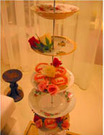
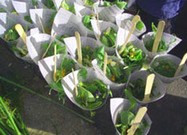
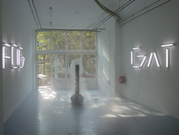
Well it's about bloody time! Coinciding with all manner of design events going on right now in Amsterdam, the Stedelijk Museum hosted a symposium titled Food Design at the ubiquitous Club 11, featuring three speakers and three completely different interpretations.
Marije Vogelzang (Proef) is doing some very interesting work from her studio slash catering laboratory and counts the stars of Dutch design (such as the Ladies Hella Jongerius, Marlies Dekkers and Li Edelkoort) amongst her clients. After a stunning portfolio presentation, I can't wait to visit Vogelzang's restaurant in Rotterdam Proef and get down to the business of tasting and nibbling. (Proef means 'taste' or 'taste it', in Dutch.) Vogelzang's work is all about engaging the eater in the underlying concept of the food and its presentation. I loved her daring in a recent catering project in which she used WWII ration ingredients to invoke memories about this bleak period. She elegantly walks the fine line between being thought provoking and utterly disarming when she stated, 'It's design that someone puts in their mouth, and absorbs into their body. It's all very intimate'. That's what I call a laudable attitude!
Although it wasn't the most pleasant message to hear, I can't stop thinking about the corporate presentation by Hans van Trijp from Unilever. Food design according to the multinational means designing the market context in which a food product exists, and has very little to do with actual food. Van Trijp described Honig's SpongeBob pasta as the perfect marriage of food design and marketing. Predictably, I found van Trijp's take and food and food design extremely disturbing, but I am so very eager to get in touch with him to hear more of what he has to say about how multinationals, even when we wouldn't dream of buying their products, influence our every day life right down to the iggly niggly bit of designing a country's infrastructure. This means that while Marije Vogelzang is designing a lunch using 'forgotten vegetables', Unilever, by the very virtue of it's market share, is determining which races of grains farmers will be growing and how food will be manufactured and distributed in decades to come. I just can't help but think it's a wise idea to keep in close contact with the suits. I'm just as much a stakeholder as the next Lady, right?
Ex-designer and unwitting stand-up comedian Marti Guixé as per usual wowwed the audience with a portfolio presentation of more than a decade's worth of food-related projects. He is the well-known Catalunian ex-designer that has worked extensively with shoe brand Camper, and ultimately designed their flagship restaurant, Foodball, in Barcelona. Balls are something of a leitmotif in Marti G's gastro-design as you can see from this author's review. It might have been just the unfortunate lighting, but while presenting images of his 'corporate sponsored food', (in this case an omelette with a sauce-stamped Calvin Klein logo), Guixé claims to have noticed van Trijp's lip twitch.
Although I'm not willing to spill the beans just yet, I am looking forward to Guixé's collaboration with Mediamatic in just a few week's time. Guixé and Mediamatic will be opening up a temporary restaurant in the basement of the former TPG builiding where you'll... read about it in culiblog.
images from l to r: Vogelzang's salad course of city leafy greens (served with grilled pigeon breast), hanging etagères made of 2nd hand plates designed by Vogelzang for Dutch fabric producer de Ploeg, Gin and Tonic Fog Party by Marti Guixé (artificial indoor fog made of gin and tonic at Casco, Utrecht). The above images are from the (ex-)designers' websites, © and hopefully also courtesy of Vogelzang and Guixé.
Posted by debra at 09:03 AM | Comments (6)
French disaster relief local food challenge
September 10, 2005
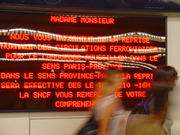
I should have cancelled heading up north last Wednesday morning when by 6 a.m. I had already made my way across two rivers, almost ruining the treasured Martin Margiëla heels! The bus ride down to Montpellier was spectacular, spectacular meaning that there's something in the scene that can kill you. And although it was in no way on the order of the weather going on across the pond, my return to the Low Country was defined by big Occitanian weather. Curtains of lightening illumniated the pre-dawn Pic St. Loup valley into liver coloured snapshots of wild boar narrowly escaping death by our bus.
It didn't occur to me that this weather would have any affect on me until we arrived at the transferium Occitanie in Montpellier where the gushing, thundering and lightening took on new proportions. Stuck in a hoard people seeking unavailable shelter, I was quickly soaked down to the innermost microfibres of my culotte and suffered the onset of hypothermia for an hour until summoning the courage to change into my dryest clothes au plein publique. Montpellier was one meter under water and all transportation had been halted until... no one knew.
Please read more... "French disaster relief local food challenge"
Posted by debra at 11:43 AM | Comments (3)
Products without words
July 01, 2005
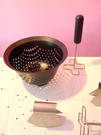
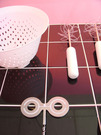
The kitchen line, KLOP by freshly graduated product designer, Sharon Geschiere from Arnhem. Klop in Dutch means to beat or whip (as in whipping cream). These products instruct the user in how to use them. Plus they're black. And white.
Posted by debra at 04:32 PM | Comments (0)
Lolly Lab
June 28, 2005
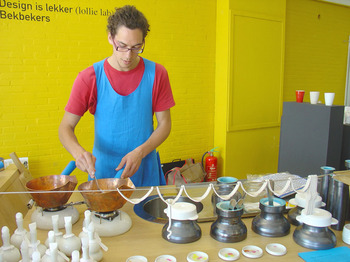
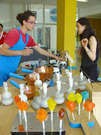
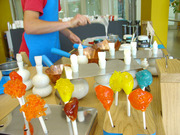
Imagine my delight last Sunday when the very first work I see at Arnhem's exam show is Bas Kools' Lolly Lab. Kools is a freshly graduated designer with fine prospects for the future. He'll attend the RCA in London next year.
What I loved most about Kools' setup was that he put the prototypes into a playful context. He seemed to have thought of everything; the playful array of lolly sticks, sugar melting copper pans, ceramic pots and recepticals, the vessels containing the flavours and colours, palet dishes, a working lab unit with gas burners (water?), air blowers, lolly holders in metal and rubber, bottle stops, display, etc... Kools has an interest in finding ways to make 'design' 'accessible'. But some of the sexier shapes of the lolly holders and the rubber slings reminded me immediately of the details hidden (and thus showcased) in a Matthew Barney work. Not bad.
And this leads me to my wee critique of the work. Kools designed a lolly laboratory, a perfect context for his range, so where are the experimental lollies? It is a pity that in this instance, Bas used standard flavours, colours and non-designed shapes for the lollies themselves. It would be worthwhile investigating working with a chef or someone with a developed and outspoken culinary aesthetic to create flavours, colours, textures and shapes as alluring and expressive as the other parts of this lab and installation. The well-designed utensils, if they are meant to be accessible, should serve and even contribute to the experimentation that is going on in the lab. There is still plenty of space for this to happen in the future. I certainly would be willing to give it a go; the Lolly Lab gave me itchy fingers.
Please read more... "Lolly Lab"
Posted by debra at 10:21 AM | Comments (4)
Lolly Lab
Imagine my delight last Sunday when the very first work I see at Arnhem's exam show is Bas Kools' Lolly Lab. Kools is a freshly graduated designer with fine prospects for the future. He'll attend the RCA in London next year.
What I loved most about Kools' setup was that he put the prototypes into a playful context. He seemed to have thought of everything; the playful array of lolly sticks, sugar melting copper pans, ceramic pots and recepticals, the vessels containing the flavours and colours, palet dishes, a working lab unit with gas burners (water?), air blowers, lolly holders in metal and rubber, bottle stops, display, etc... Kools has an interest in finding ways to make 'design' 'accessible'. But some of the sexier shapes of the lolly holders and the rubber slings reminded me immediately of the details hidden (and thus showcased) in a Matthew Barney work. Not bad.
And this leads me to my wee critique of the work. Kools designed a lolly laboratory, a perfect context for his range, so where are the experimental lollies? It is a pity that in this instance, Bas used standard flavours, colours and non-designed shapes for the lollies themselves. It would be worthwhile investigating working with a chef or someone with a developed and outspoken culinary aesthetic to create flavours, colours, textures and shapes as alluring and expressive as the other parts of this lab and installation. The well-designed utensils, if they are meant to be accessible, should serve and even contribute to the experimentation that is going on in the lab. There is still plenty of space for this to happen in the future. I certainly would be willing to give it a go; the Lolly Lab gave me itchy fingers.
Please read more... "Lolly Lab"
Posted by debra at 10:21 AM | Comments (4)
Fortunately the food was slow and dry
June 10, 2005
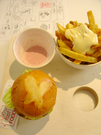
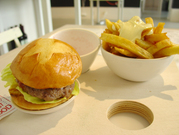
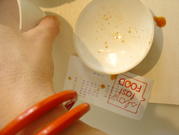
When the 'slow' is the Slow Food Movement and the 'dry' is Dutch design agents Droog Design, the combination of slow and dry is a good thing. In Dutch, droog means 'dry', and it refers to the dry humor of many of their designed objects. Droog is celebrating their Amsterdam Staalstraat location by hosting a temporary 'fastfood' restaurant to showcase their food-related design items (open until Sunday 12.06). The menu is quintessential fast food; burgers, chips, shakes, but all the ingredients are sourced from local ingredients, made by artisanal suppliers and prepared with the love and attention of Slow Food Movement volunteers. I decided to be a lady who lunches and give their grub a try.
The foodstuffs arrive in round-bottomed ceramic bowls - all of which you may take home with you after eating! The strawberry shake contained a goodly portion of fresh, local strawberries. The burger bun was made from brioche dough, the burger, real chopped all-organic beef, dripping real meat juices! And so the story goes, good ingredients prepared with love from barnyard to burp. The restaurant is primarily about letting folks try out design objects in a real food context so not surprisingly the portions are mini-petit. This sweet and small design choice reminded me of the way Pee Wee Herman used to eat baby corn on TV; kernel for kernel typewriter style! After finishing my slow fastfood lunch, I wasn't hungry but I did have a little hunquering to take home some more of those cute little round-bottomed bowls.
Please read more... "Fortunately the food was slow and dry"
Posted by debra at 12:17 AM | Comments (0)
Leafenware is everything but the squeal
June 02, 2005
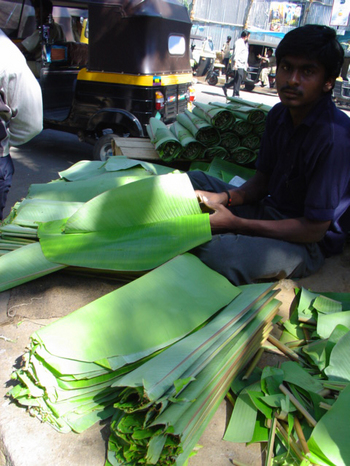
A banana leaf is a plate in Bangalore. The image above left shows a Ghandibazaar plate maker producing and selling leafenware on the street. The waste products of his production are eaten by noshing cows. This is 'everything but the squeal' vegetarian-style.
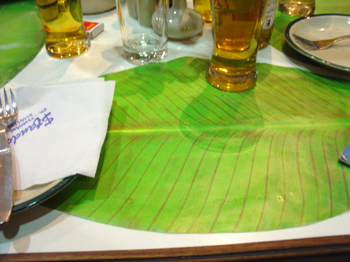
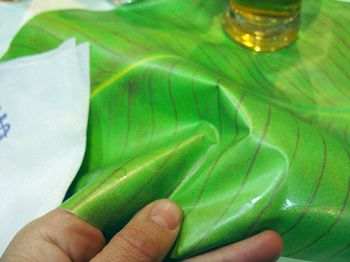
But Delhi is far far away from the banana climes of the South and an artificial banana leaf plate seems to be a logical substitute. This fabric photoshop job was doing duty as a placemat at drinking club, the Standard at CP before we procured it from the owners for the culiblog packaging archive.
Faithful culiblog readers are familiar with the entry just a few weeks ago of the pepesan sans pep dish, wrapped in bamboo leaves. I am curious about whether bamboo leaves bought at a Chinese supermarket in Amsterdam, imported from somewhere deep in the guts of PRChina qualify as ecologically sound plate choices, but I would like to hear from someone with a strong opinion - or better yet - some actual knowledge on this subject.
Q1: Is a one-use banana leaf plate a more sustainable choice than a ceramic plate in a place where banana trees are harvested?
Q2: Is a pack of dried bamboo leaves a more ecologically sound dinner party option than ceramic plates when the bamboo leaves are imported from PRChina and the dinner party is in the Netherlands? or Occitania?
Q3: Is a re-usable (maybe 100 times) fabric plate more ecological than a ceramic plate if the fabric plate is produced locally? (The plate can be rinsed in soapy water and rinsed clean.)
Q4: Are recycled paper plates like the ones shown in this culiblog entry or the tetra-pak plates more ecological than the different sorts of leaf plates if all of the materials come from local sources?
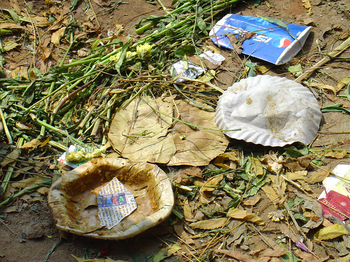
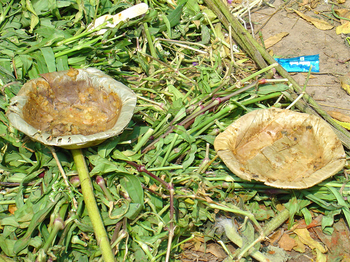
Pictured above are images of leaf plate and other vegetable (and non-veg) trash on the streets of Delhi.
How does one calculate the sustainability of a given object? Ceramic or stainless steel plates are produced under industrial conditions, raw materials possibly imported, packaging distribution all factor in. Imported dried bamboo leaves do quite a lot of travelling. Banana leaves seem ecological (if locally grown) but what are the conditions of the banana plantation and how are the leaves harvested? And what if you already own some plates? And what if you live in the city and don't have a compost pile or animals with four stomaches roaming the streets?
Please read more... "Leafenware is everything but the squeal"
Posted by debra at 09:47 AM | Comments (6)
Leafenware is everything but the squeal
A banana leaf is a plate in Bangalore. The image above left shows a Ghandibazaar plate maker producing and selling leafenware on the street. The waste products of his production are eaten by noshing cows. This is 'everything but the squeal' vegetarian-style.
But Delhi is far far away from the banana climes of the South and an artificial banana leaf plate seems to be a logical substitute. This fabric photoshop job was doing duty as a placemat at drinking club, the Standard at CP before we procured it from the owners for the culiblog packaging archive.
Faithful culiblog readers are familiar with the entry just a few weeks ago of the pepesan sans pep dish, wrapped in bamboo leaves. I am curious about whether bamboo leaves bought at a Chinese supermarket in Amsterdam, imported from somewhere deep in the guts of PRChina qualify as ecologically sound plate choices, but I would like to hear from someone with a strong opinion - or better yet - some actual knowledge on this subject.
Q1: Is a one-use banana leaf plate a more sustainable choice than a ceramic plate in a place where banana trees are harvested?
Q2: Is a pack of dried bamboo leaves a more ecologically sound dinner party option than ceramic plates when the bamboo leaves are imported from PRChina and the dinner party is in the Netherlands? or Occitania?
Q3: Is a re-usable (maybe 100 times) fabric plate more ecological than a ceramic plate if the fabric plate is produced locally? (The plate can be rinsed in soapy water and rinsed clean.)
Q4: Are recycled paper plates like the ones shown in this culiblog entry or the tetra-pak plates more ecological than the different sorts of leaf plates if all of the materials come from local sources?
Pictured above are images of leaf plate and other vegetable (and non-veg) trash on the streets of Delhi.
How does one calculate the sustainability of a given object? Ceramic or stainless steel plates are produced under industrial conditions, raw materials possibly imported, packaging distribution all factor in. Imported dried bamboo leaves do quite a lot of travelling. Banana leaves seem ecological (if locally grown) but what are the conditions of the banana plantation and how are the leaves harvested? And what if you already own some plates? And what if you live in the city and don't have a compost pile or animals with four stomaches roaming the streets?
Please read more... "Leafenware is everything but the squeal"
Posted by debra at 09:47 AM | Comments (6)
Play with a mandolin
May 14, 2005
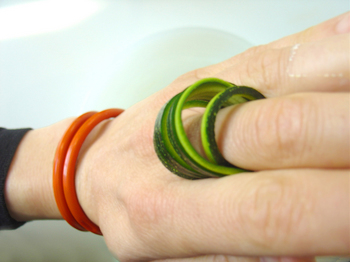
The original recipe for Pasta that is not pasta is coming. But first you need to own a mandolin.
Please read more... "Play with a mandolin"
Posted by debra at 01:30 PM | Comments (4)
Chicken jail
May 12, 2005
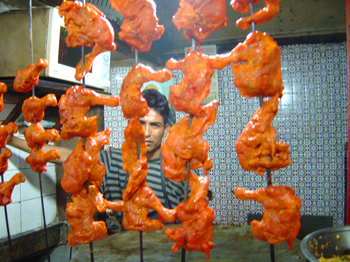
A man languishing behind bars of chicken. This image was taken near Connaught Place in Delhi and is part of an archive compiled by participants of the Nomadic Banquet workshop, Delhi March 14-26, 2005. For more blog entries and image archives, please check out the official Nomadic Banquet website as well as that of the Doors of Perception. Doors 8 Delhi: Platforms for Social Innovation.
Posted by debra at 03:49 PM | Comments (0)
Another short supply chain
April 26, 2005
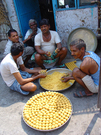
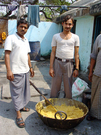
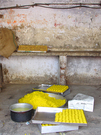
This time it's dessert! Ladoos, to be exact. These gentlemen are working in the temple compound (Hanuman Mandir, CP, Delhi) 30 metres from the dung fuel sales and manufacturing woman. Their whole production setup takes place within 10 metres, their point of sale is 30 metres away.
A ladoo is a graham flour sweet, sometimes made with puffed rice. If someone would explain to me why one always finds ladoo near temples I would be most appreciative. I think it has to do with religiously sanctioning things that people like to do anyway, and I mean that in the most generous possible way.
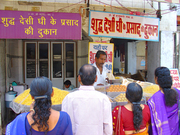
Please read more... "Another short supply chain"
Posted by debra at 09:07 AM | Comments (3)
Love those short supply chains
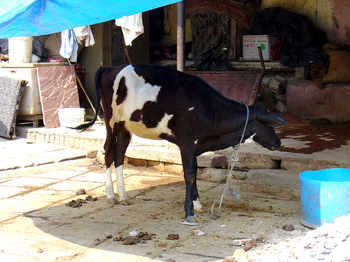
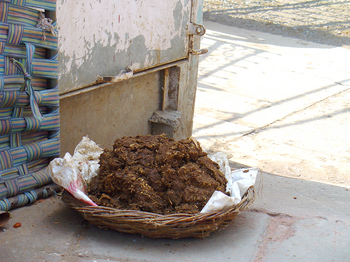
Here in Europe we can't stop talking about 'food miles', that is to say, how many kilometres our food travels before we actually get to touch it. There's that quite famous study of the strawberry yoghurt, It's the same for all products, including cow dung fuel. The images shown were all taken within 20 metres (!) of eachother in the Hanuman Mandir temple complex near CP, Delhi.
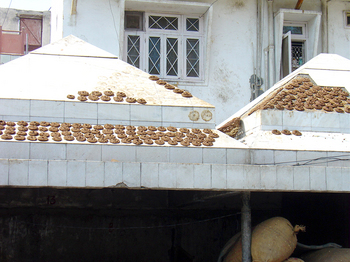
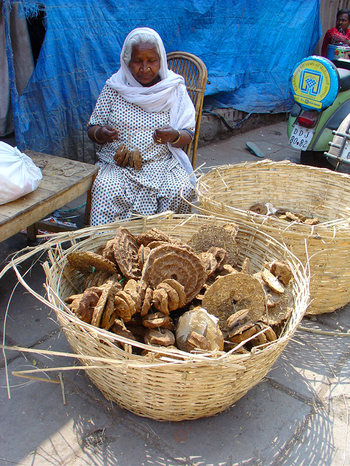
Cow - dung collection - patty cake patty cake dry dry dry - fuel saleswoman
Please read more... "Love those short supply chains"
Posted by debra at 08:24 AM | Comments (0)
Sticking to the streets
April 16, 2005
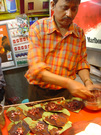
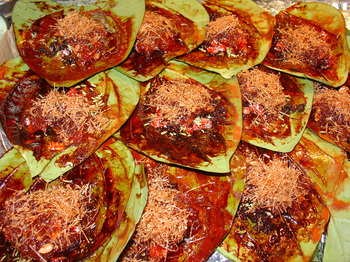
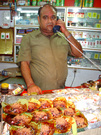
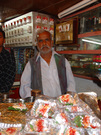
Delhi- Clustering their services in one Connaught Place kiosk are four paan salesmen, each selling a different recipe of this perfumed and intoxicating digestive leaf from the kiosk's cardinal points.
One very interesting thing we learned from two of the Nomadic Banquet participants, John Vijay Abraham and Sanjeev Shankar's street food research at the IIT Bombay, is that street food vending is not always a step on the path to restaurantdom. A case in point, they stated is Muchhad Paanwallah, a paan kiosk in Mumbai named after an impressive ear to ear mustache of the owner's father. The current owner, Jaishankar Tiwari has been immensely successful in his street-side paan business, so much so that his and the families of his four sons all live from it. If you can't visit his kiosk in Mumbai it's well worth checking out his website, where you can place orders for paan online.
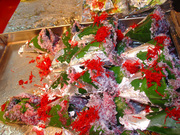
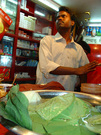
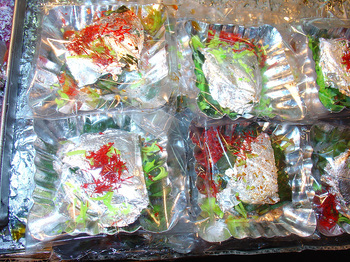
In the Nomadic Banquet workshop in Delhi, we discovered street food vendors are an integral part of the social fabric and this is likely to be the greatest asset they offer a community. Muchhad Paanwalla is immensely successful and Tiwari chooses to continue selling from his kiosk instead of going upmarket like oh so many smart cigar shops. This is important for us to realise as the perception persists that the street is an undesirable place (for a vendor) - as if the street is merely a stepping stone on the road to 'something better'. The success of Muchhad Paanwallah and others like him prove that exactly the opposite is true.
Muchad Paanwallah http://www.paan.com/about.htm
Posted by debra at 09:33 AM | Comments (2)
Delhi Water Bar
April 02, 2005
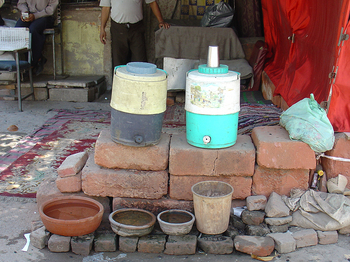
A water bar on a sidestreet of Janpath. 20 metres down the street is a pump and a well. This was actually just a service on offer to draw customers into a shop selling Kashmiri handicrafts and other small shops hidden from the street. I love the pavillion shared by several shop keepers and the water bar because it offers a place for shopkeepers to gather and chat in the shade.
Posted by debra at 11:51 PM | Comments (0)
Delhi recycling, in all fairness
March 15, 2005
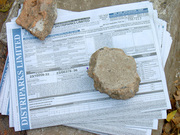
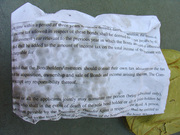
When is recycling not really recycling? When the recycled or re-purposed item never really had a purpose in the first place. These papers, have been left on the ground (location across the street from Jantar Mantar, Delhi), as far as I can tell, for no other purpose than to be repurposed. The image on the left is a stack of paper left on the street as an offering to the gods of the recycled chaat-bag-makers.
Packaging for chaat is often nothing more than a bag made from old newsprint or repurposed paper, or for the wetter stuff, a leaf plate. The bag pictured on the right was made from some terribly interesting literature about bonds. One can see the imprint of the deep-fried sweet peas contained within being absorbed into the paper making a pretty pattern.
Posted by debra at 01:07 PM | Comments (0)
Paan virgin spits like a girl
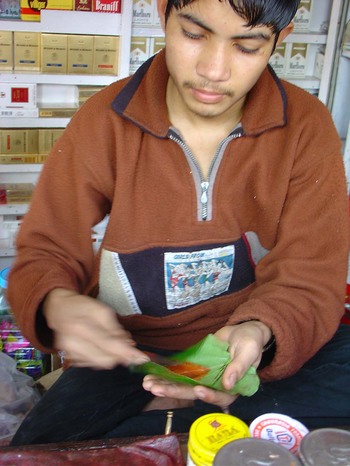
Everywhere in Old Delhi, on every cornerpost of every building there is a terracotta haze. For a while I thought it was just the build-up of iron oxide dirt and dust - and so much of the architecture (for example the Jantar Mantar observatory) has this colour. But after a few hours of walking around I saw a few fresh splotches of red and realised what it was. Paan spit.
Paan is a 'digestive'. A leaf, painted with all manner of spices, flecks of gold leaf, sugar crystal and proportedly even opium. You take the leaf roll in your hand from the paan-wallah who has lovingly prepared his special version from 20 or so fine tins of ingredients and ingest it like chaw, I think. This morning, before the coffee I tried my first chew.
Please read more... "Paan virgin spits like a girl"
Posted by debra at 06:57 AM | Comments (2)
A street snack called chaat
March 14, 2005
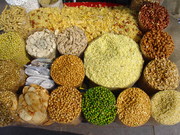
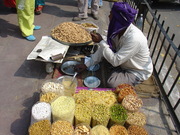
In Delhi street vendors sell chaat, that is to say snacks consisting of all manner of puffed, roasted and deepfried legumes, grains, pasta products and broken crackers. Nibbles to go, nibbles to take home, nibbles that remind one of the street. A chaat vendor will sell his beans and bobs dry to take home, or if you've got the right guy he'll mix up a little chaat-snack for you right then and there with some very much needed chaat-moisturizer i.e. sweet chilli sauce.
Look at (click on) the image on the left closely and you'll see the bags in which the chaat is sold folded neatly between the goods. The bags are made of recycled newspaper and other redundant paper glued into bags for packaging.
Please read more... "A street snack called chaat"
Posted by debra at 07:27 PM | Comments (2)
Delhi street food vendors benchmark good health practices and urban planning
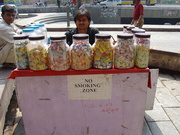
This Delhi street vendor has set up a much needed no smoking zone right in front of his stand (located in front of the state emporia across the street from the Hanuman Mandir near CP). I believe he is selling little packets of flavoured chewing tobacco.
Posted by debra at 06:30 PM | Comments (0)
Brain Food
January 20, 2005
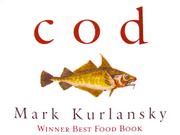
This terribly sad but well written book by Mark Kurlansky is a gripping history from the perspective of the cod. Kurlansky tells how fishing for this gadiform has deeply affected the wealth and development of many nations and technologies. I'm thinking the Flounder by Gunther Grass that I read back in the day but even more I'm thinking Fish Story, the mega-artwork by Allan Sekula, about the 'sweatshop called the Pacific'. (Sekula's visual history Fish Story was part of the the last Documenta XI in Kassel. One photograph in particular gave me goosebumps. You see a ship painter giving the Exxon Valdez a new name...fishy stuff.)
It turns out that cod in the form of stokvis (wind dried cod) turned out to be some good thinking-man's protein for the Norsemen. That extra portable brain-power enabled them to encounter New Foundland in 1000, where they also encountered the Beothuk People who had already discovered it and were not enamoured with the idea of sharing their space with the pink and hairy people from across the puddle.
Basques added salt to the stokvis recipe to make salt cod increasing the quality of the preservation and enabling Basque fishermen to to travel even farther - to the mouth of the St. Lawrence river. When explorer Jacques Cartier got there raring to claim his 'discovery' he encountered almost a thousand Basque fishing vessels. And a bunch of angry native Beothuk people getting pissy about the incessant attention.
Cod is inextricably tied to land (to dry it) and salt (to preserve it) and Salt is in fact the title of another one of Kurlansky's wonderful books.
Posted by debra at 08:54 PM | Comments (3)
Dabba Wallah - git yer tiffin while it's HOT
December 10, 2004
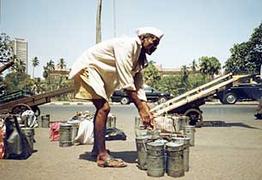
You're a dutiful wife (actually I'm temporarily in-between relationships) and nothing short of your own love-imbued cuisine will suffice to nourish your office-bound husband for his lunchtime meal. Problem is you're out in the suburbs of Mumbai and he's situated downtown for the lunchtime hours. How are you going to get something hot in Lovey's tummy?
Easy. You pay 150 rupees (EUR2,55/GBP1.70/USD3.40) per month for a Dabba Wallah service and let the 'tiffin guy' or lunchbox carrier bring the Mr. his grub.
Please read more... "Dabba Wallah - git yer tiffin while it's HOT"
Posted by debra at 12:02 PM | Comments (0)
The Banquet Years
November 16, 2004
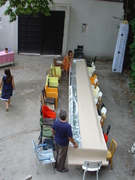
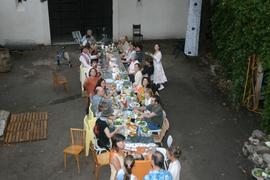
Guess what we did last summer... we had a banquet!
Maybe because my last entry looked so pitiful, the colourful cakes and the leaden November sky. I thought it was high time to upload some images from this summer's culinary activities - and not just to some dank place in the culiblog archives.
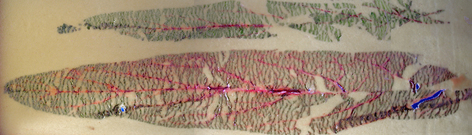
As a community we ate off two, 8 metre long rolls of homemade pasta lasagna, into which sage and beet leaves had been pressed (see composite photo above) and when we were done, we rolled up the entire table.
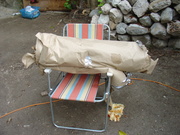
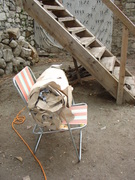
Click for the slideshow here. The images in it are all photographs by Kristine Malden, a friend who thankfully was our guest that August evening.
Posted by debra at 05:44 PM | Comments (0)
Fade to Beige
November 06, 2004
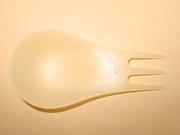
What, you don't like my spork? It is designed by Pandora Design in Italy and is called Moscardino.
Please read more... "Fade to Beige"
Posted by debra at 08:26 AM
Fashion Food
October 03, 2004
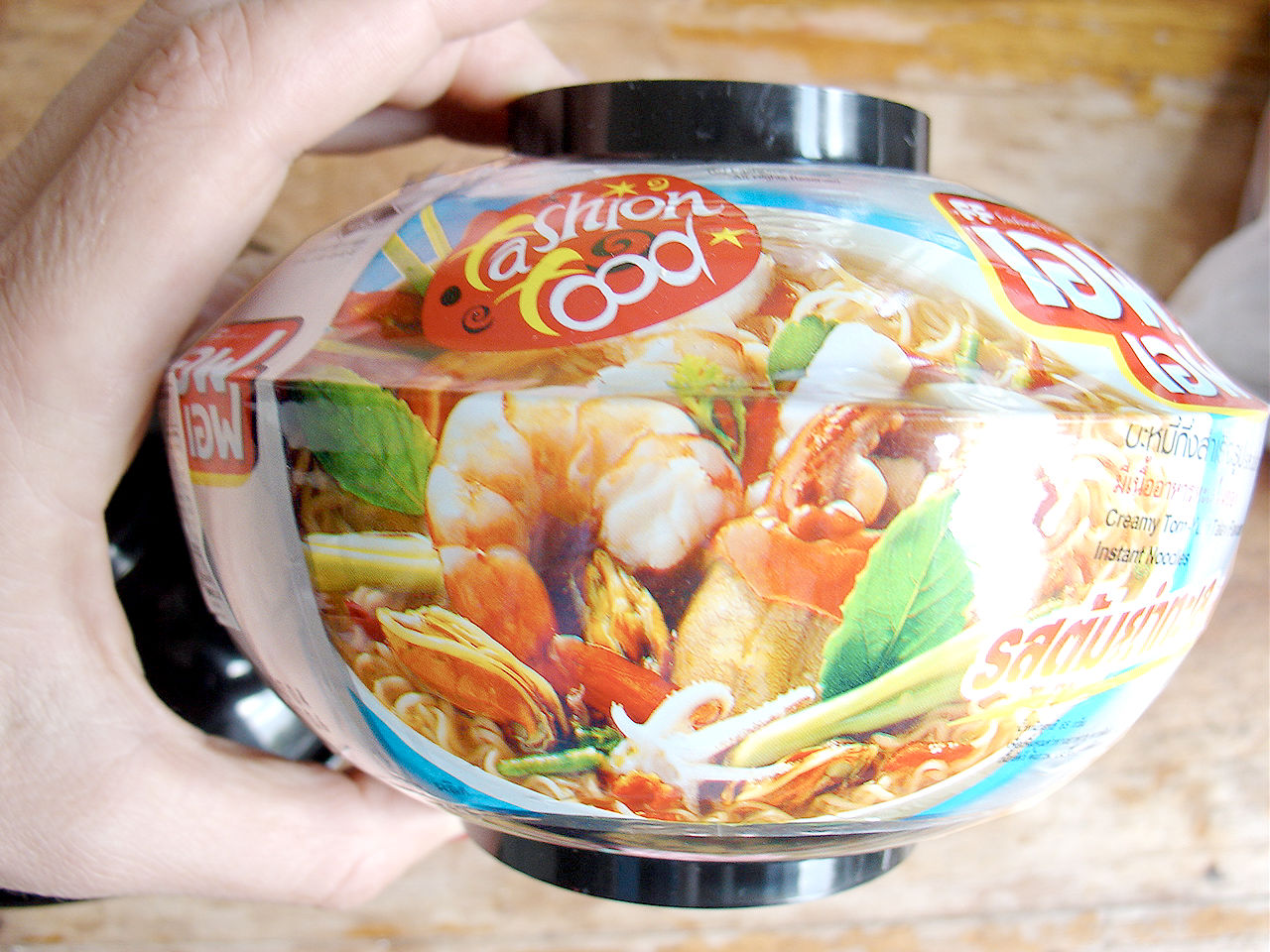
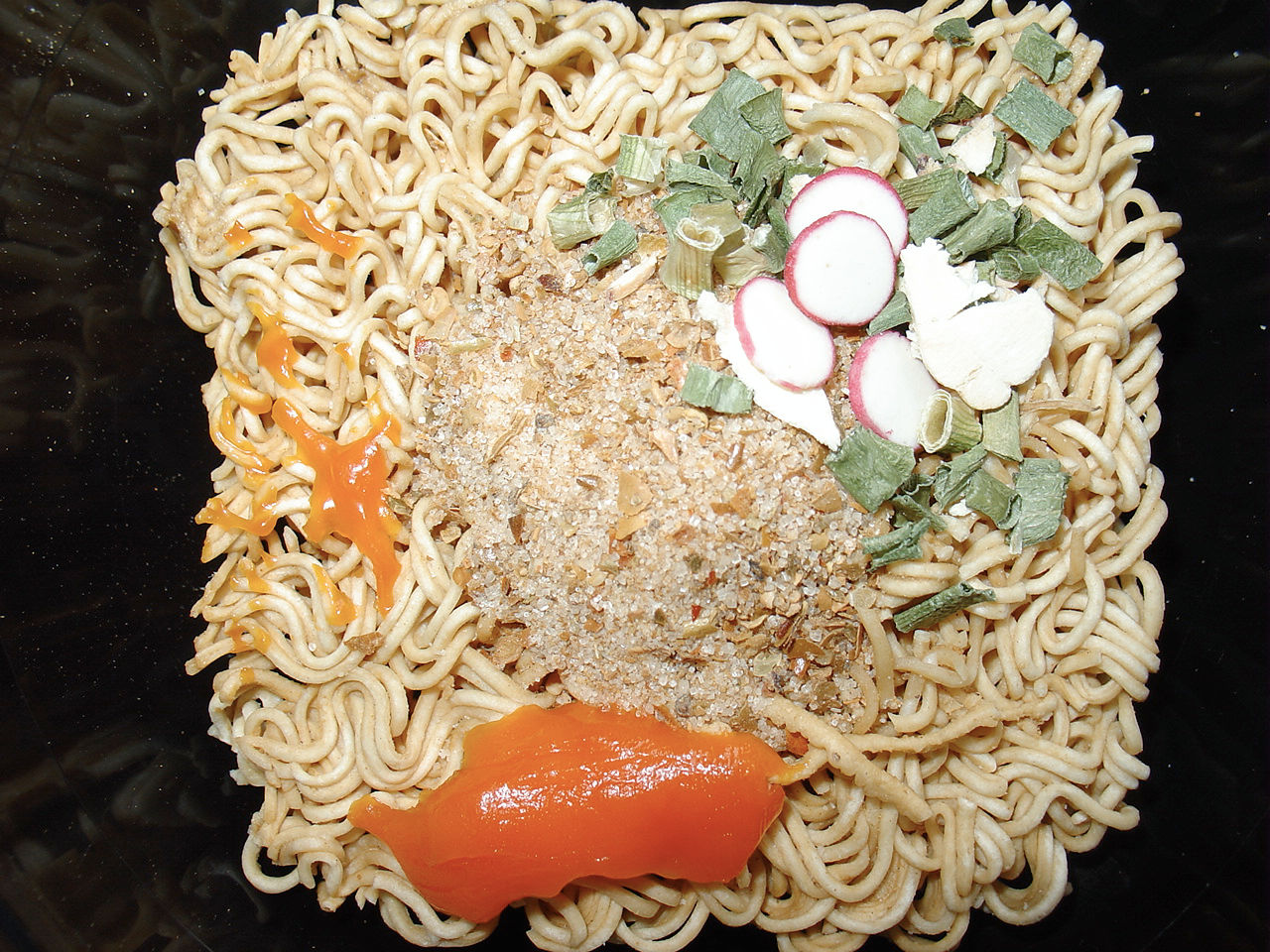
And indeed, what is UNfashionable about a fake black lacquer bowl filled with instant Tom Yum noodles? Especially if you recycle the fake lacquer bowl and use it again and again for your own stylish soup lunches.
I came across this product researching what I will do for my contribution to Museum N8. J.P. of Mediamatic has asked me to come up with something for the theme pret a porter. Unlikely that I'll do something related to the noodles (because I'm leaning towards fruit leather) but I am amused by the product design.
Please read more... "Fashion Food"
Posted by debra at 12:04 PM | Comments (6)
Presentation is Everything
July 14, 2004
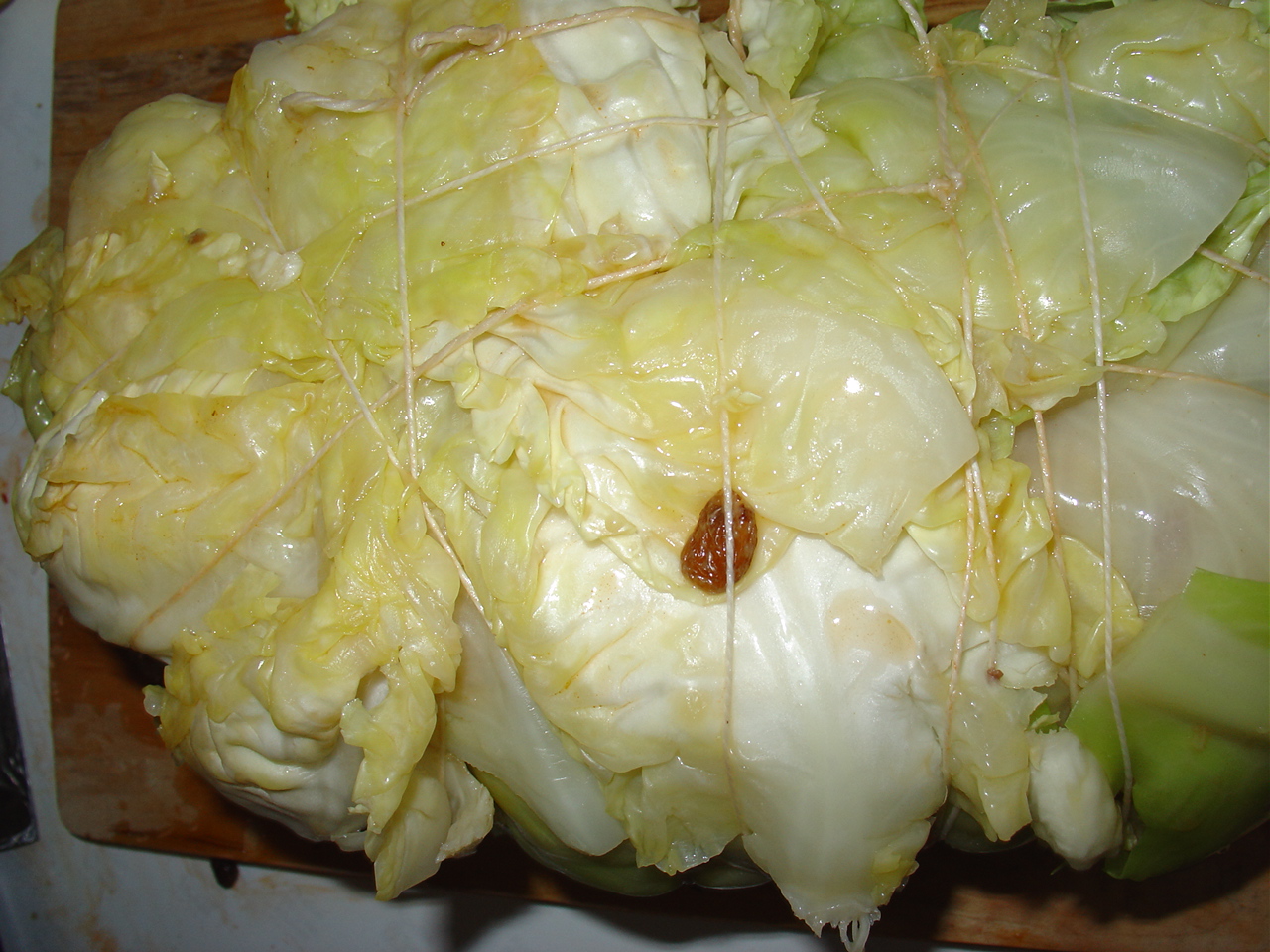
I feel like this little raisin.
Please read more... "Presentation is Everything"
Posted by debra at 11:38 PM | Comments (0)
No Rest for the Rugged
July 13, 2004
There you are, a pre Iron Age chef and you want to whip up a fine bouillon for tonight's f�ete. It's easy as pie... read on.
Please read more... "No Rest for the Rugged"
Posted by debra at 10:42 AM | Comments (0)
If it Bleeds, it Leads
July 12, 2004
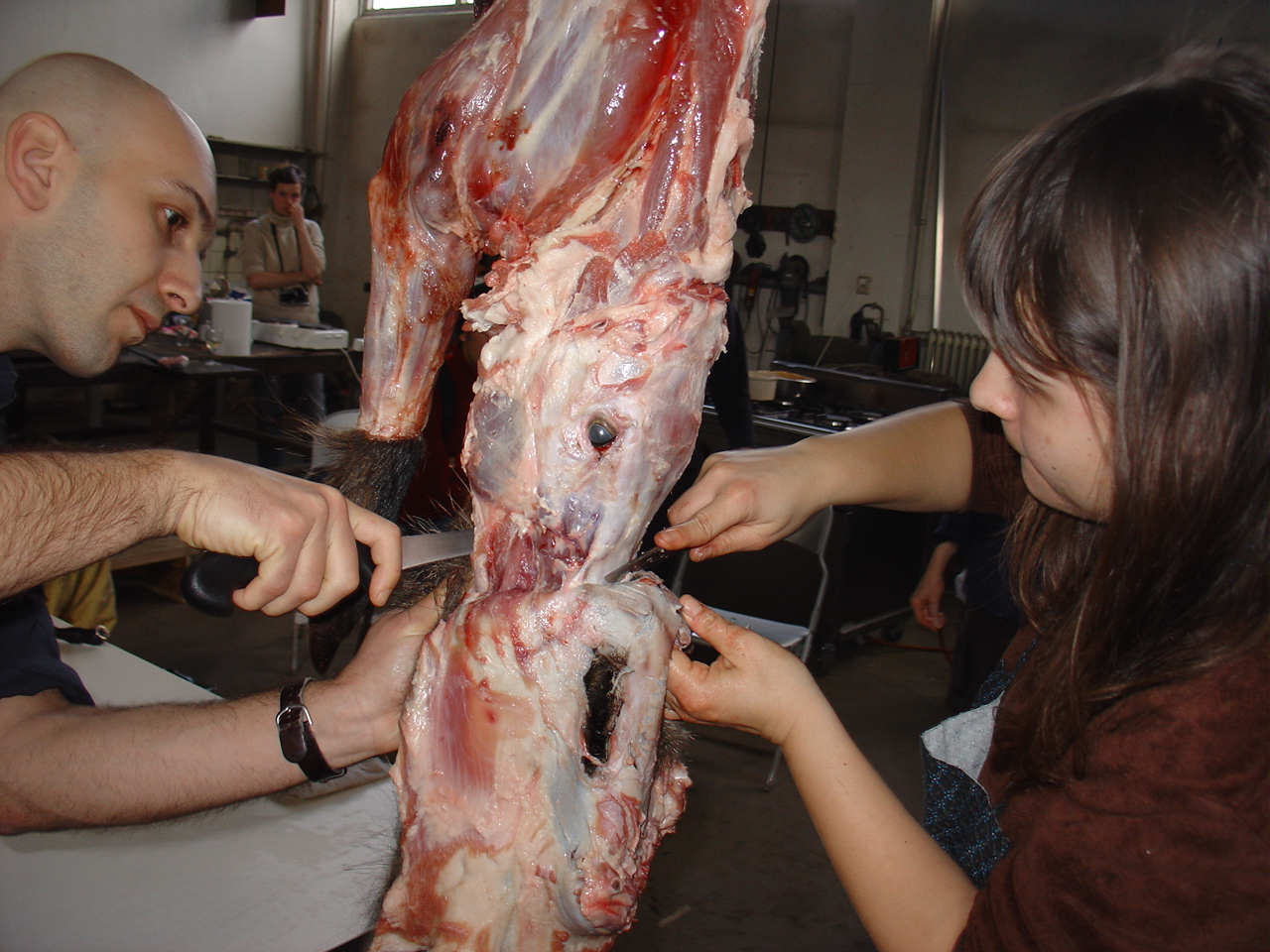
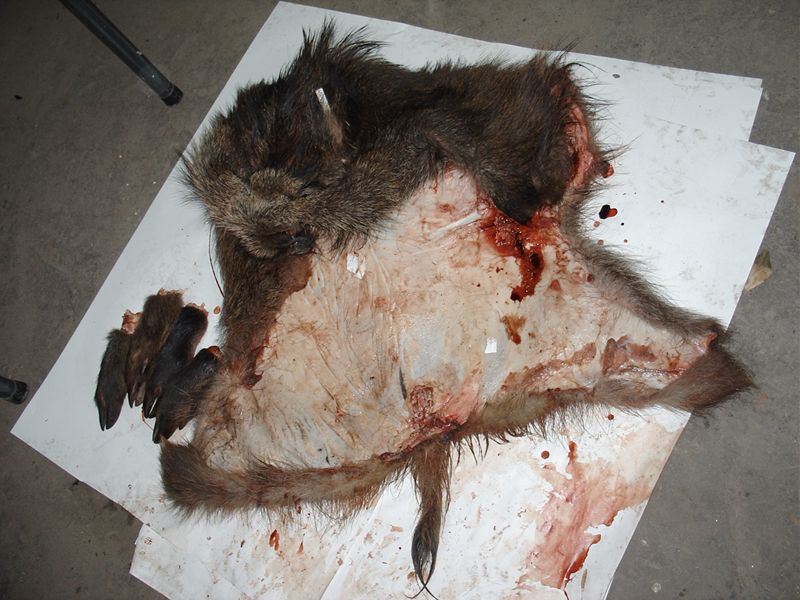
That's was one of the more memorable lines in Michael Moore's, 'Bowling for Columbine'. Moore is speaking to a TV producer, asking him to explain why there are so many fear evoking images on the US nightly news. The TV producer replies self-evidently, 'If it bleeds, it leads'.
I thought the line was a fitting title to the next few entries of Culiblog in which I will document a workshop that I followed at the Jan van Eyck Academie in Maastricht this last February. Onno Faller led a workshop titled, 'Cooking as Genre' the last two days of which were devoted to a little dead wild boar. Above you see Natasha and a handsome bald bloke, BOTH VEGETARIANS, skinning the poor dead beast.
Although I have killed hundreds of animals for food and skinned them and prepared them, I never find this an easy task. I find myself gritting my teeth as I remove their jackets. I am not repulsed, but I feel sad for the animal, I feel the extreme tension of the killing and of a death that I initiated by wanting to eat the animal. Every animal, even a lobster, fights for its life as we would do. And it never ceases to amaze me that once the animal is skinned, it becomes just a piece of meat to me and my mind switches to the matter of the marinade.
If you want to see the entire process, click further.
Please read more... "If it Bleeds, it Leads"
Posted by debra at 01:28 PM | Comments (4)
Taiwanese Bean Beverage
July 01, 2004
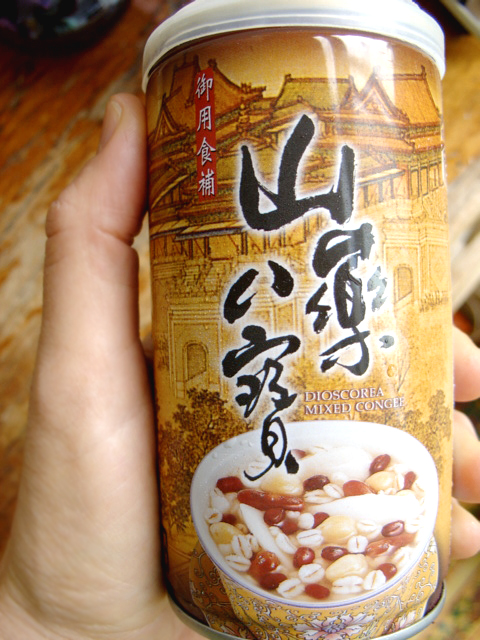
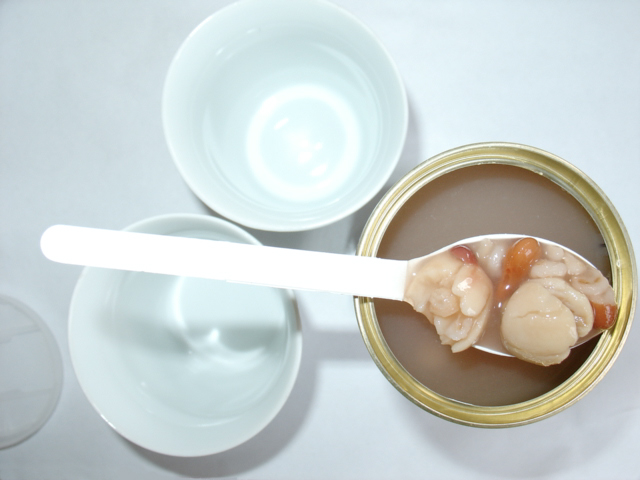
Yesterday Dan said that Latvians are lucky.
But today is another day and for breakfast I decided to serve up this Taiwanese Bean Beverage to my Latvian guest *Emils. Just a little good morning experiment. Emils remained cheerful throughout the tasting although shortly after fulfilling his task as guinea pig he dashed out of the house supposedly to buy a shirt - but I think he hauled off and got a bagel.
Discorea Mixed Congee ingredients: water, sugar, adlay(?), discorea rhizome (?), chickpeas, glutinous rice, red beans, kidney beans, millet, oatmeal, oats.
* Emils Rode is a Latvian artist currently participating in the show BREAKTHROUGH in Den Haag. This exhibition in the Grote Kerk spotlights artists from the new European member states. http://www.grotekerkdenhaag.nl
Posted by debra at 02:41 PM | Comments (3)
Smart Taiwanese Packaging (because you never know when you're going to want to tuck into that Discorea Mixed Congee snack that you've been stowing away in your purse for special occasions)
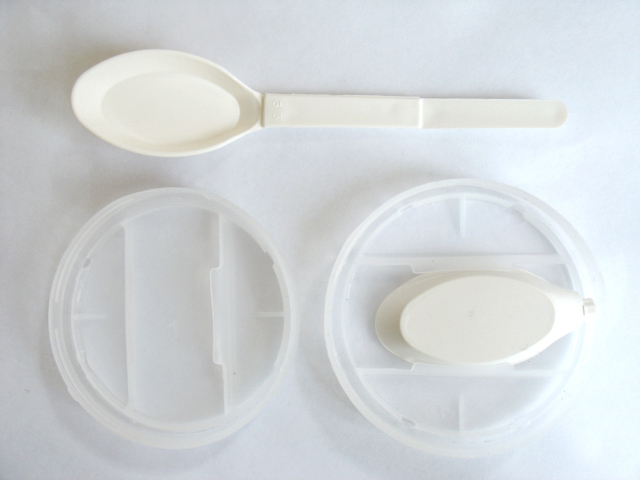
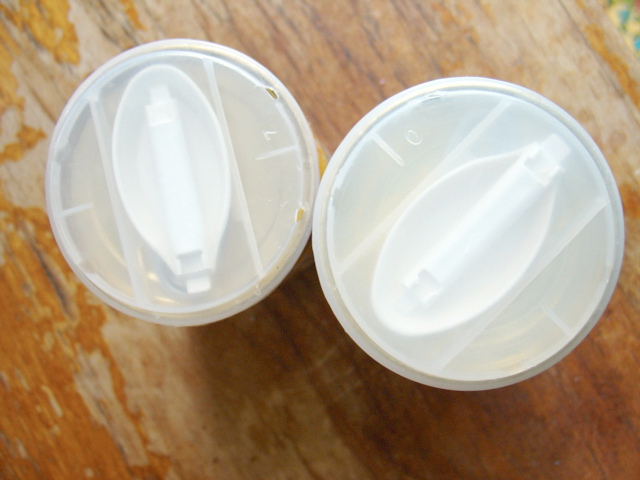
The spoons that come with the Taiwanese bean beverages that I bought yesterday snapped neatly into the lid. Unfold and click and you're ready to suck up all the goodness.
Posted by debra at 02:04 PM | Comments (2)
Smart Taiwanese Packaging (because you never know when you're going to want to tuck into that Discorea Mixed Congee snack that you've been stowing away in your purse for special occasions)
The spoons that come with the Taiwanese bean beverages that I bought yesterday snapped neatly into the lid. Unfold and click and you're ready to suck up all the goodness.
Posted by debra at 02:04 PM | Comments (2)
More Chinese Food!
June 25, 2004
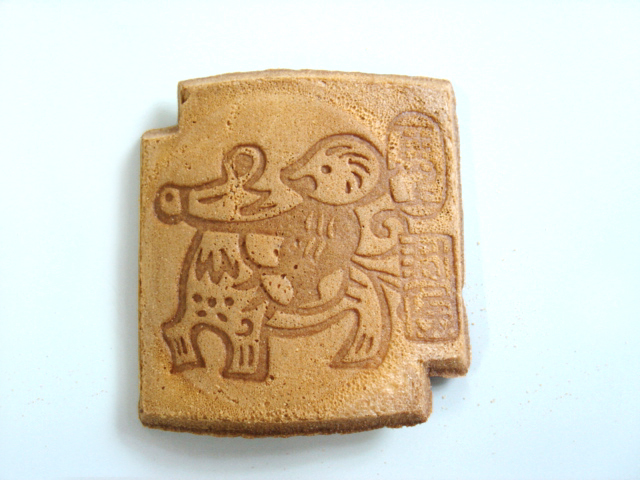
Yes, that's a hedgehog riding a donkey! This Chinese cookie is made from fortune cookie dough. Normally I never eat fortune cookies, but these were so beautiful... that I can't eat them either.
Please read more... "More Chinese Food!"
Posted by debra at 11:59 PM | Comments (4)
Tonijn voor het Publieke Domein
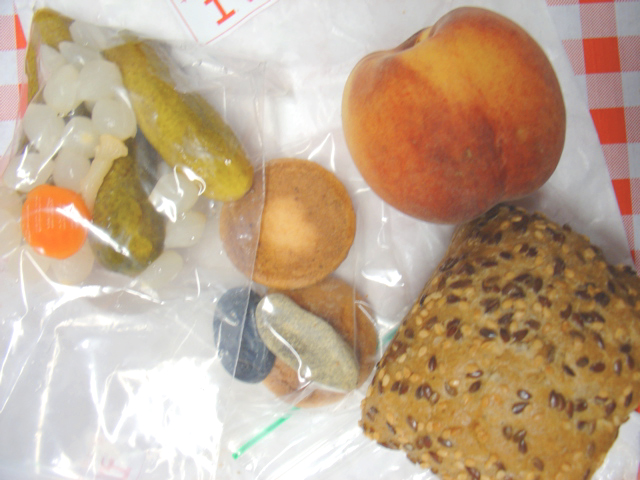
That's Dutch for Tunafish Salad for the Public Domain, the title of the bad weather picnic that I designed (and produced with the generous help of Tracey Prehay and Anne Schiffer) for the opening of my student's exhibition at the Balengebouw in Roombeek (Enschede). (Website is forthcoming!)
tunafish sandwich (broodje tonijn voor het publieke domein)
baggie of pickles (zakje zuur - pickles, zilver uitjes)
baggie of sweeties (zakje zoet - bitter koekjes, nep ouderwetse drop)
peach (perzik)
water
Please read more... "Tonijn voor het Publieke Domein"
Posted by debra at 11:48 PM | Comments (2)
Camper's Flagship Restaurant
June 07, 2004
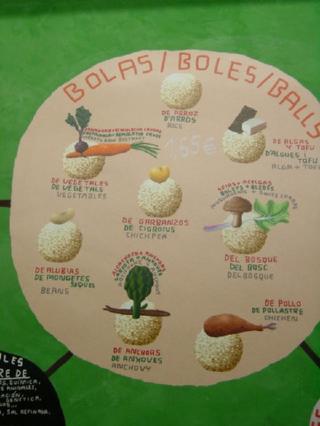
The wall mural menu at 'Foodball'. These last days in Barcelona I had the opportunity to meet up with designer Marti Guixé to talk about our food-related projects. He showed me the newly opened Camper flagship restaurant that he designed.
Please read more... "Camper's Flagship Restaurant"
Posted by debra at 11:34 PM | Comments (1)
Edibility Stamp
May 29, 2004
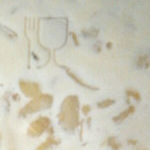
Stamp found on a block of tempeh.
Edible, drinkable.
You can eat it, and apparently you can also drink it.
Posted by debra at 01:11 PM
Edibility Stamp
Stamp found on a block of tempeh.
Edible, drinkable.
You can eat it, and apparently you can also drink it.
Posted by debra at 01:11 PM
Nomadic Banquet
May 03, 2004
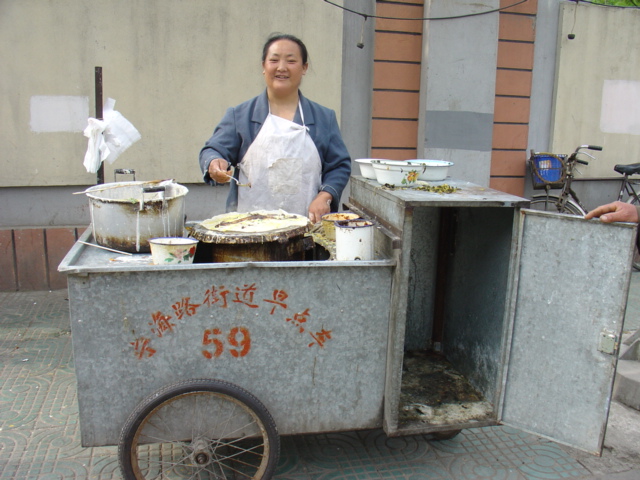
Mobile kitchen number 59.
Please read more... "Nomadic Banquet"
Posted by debra at 01:43 PM
Don't Spit Everywhere
May 01, 2004

No one seemed to be paying a whole lot of attention to these wonderful posters.
Please read more... "Don't Spit Everywhere"
Posted by debra at 01:32 PM
Cooking out of doors
April 30, 2004
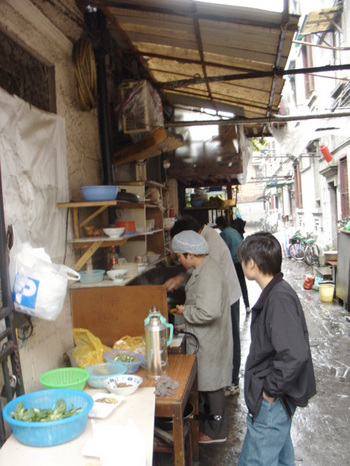
An outdoor kitchen on a Shanghai street corner. This restaurant was serving breakfast, lunch and dinner.
Please read more... "Cooking out of doors"
Posted by debra at 01:30 PM
New Logo
April 27, 2004
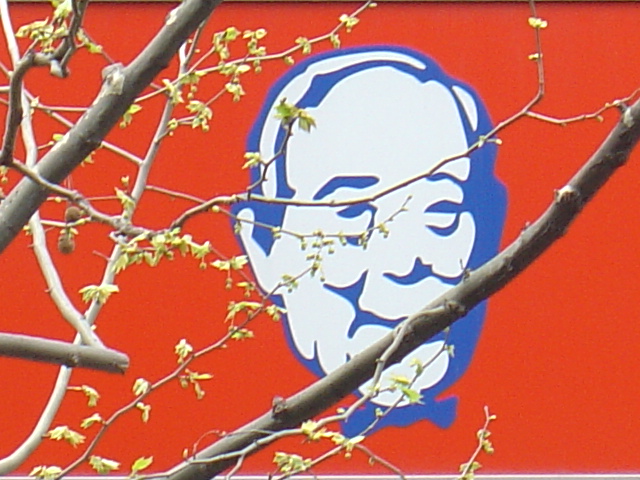
This is not a KFC.
Posted by debra at 01:18 PM
A Single Grain of Rice
April 25, 2004
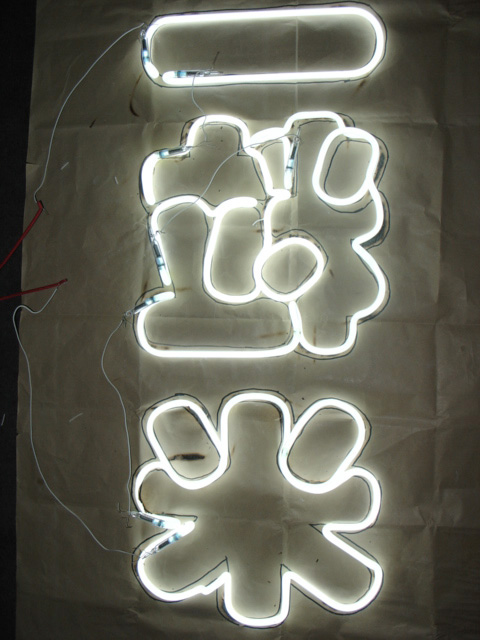
Yi Li Mi = A Single Grain of Rice in mandarin neon. A Single Grain of Rice is a project for a culinarily oriented fasting restaurant that I am initiating. Future entries will explain this project in greater depth, but at least I've got the neon sign.
Posted by debra at 12:49 PM | Comments (1)
Water Distribution by Bike
April 24, 2004
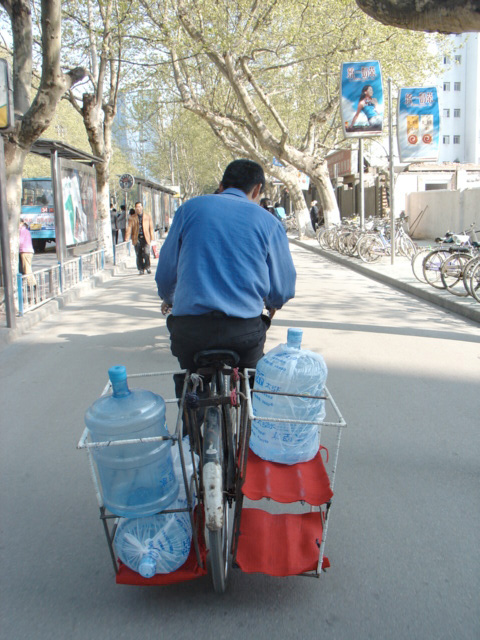
2L PP PD = Two litres per person per day.
Get it out there.
Posted by debra at 06:09 PM
Nomadic Banquet
April 20, 2004
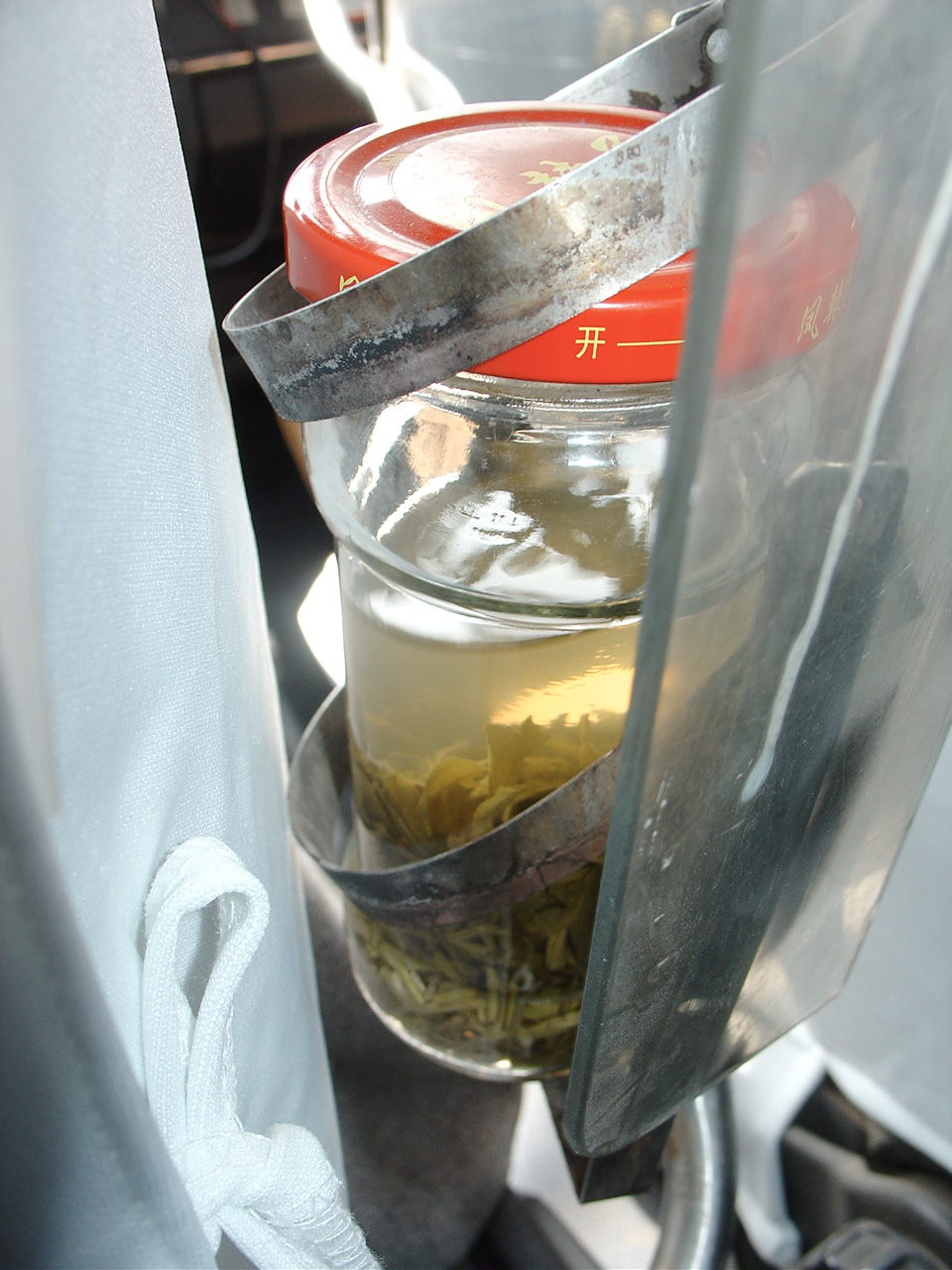
A tea jar holder in a taxi.
Posted by debra at 12:24 PM
No Drinks in the Lecture Hall
April 11, 2004
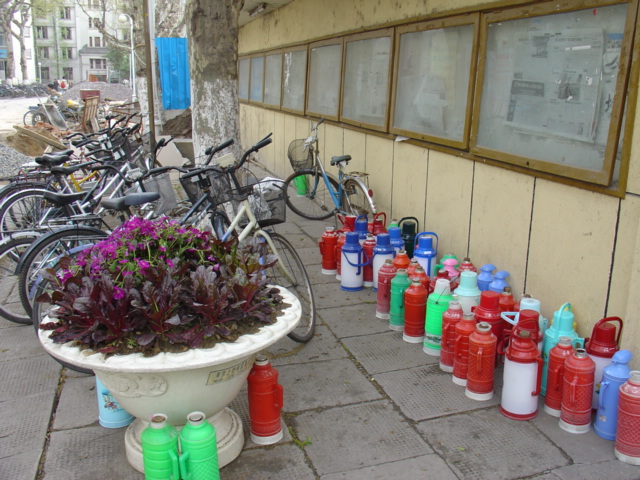
Nanjing University Students leave their thermos' of hot water outside the lecture hall and somehow remember which one is theirs when they leave the building after the lecture.
Posted by debra at 11:21 AM
Chinese Frozen Food Code De-mystified
April 06, 2004
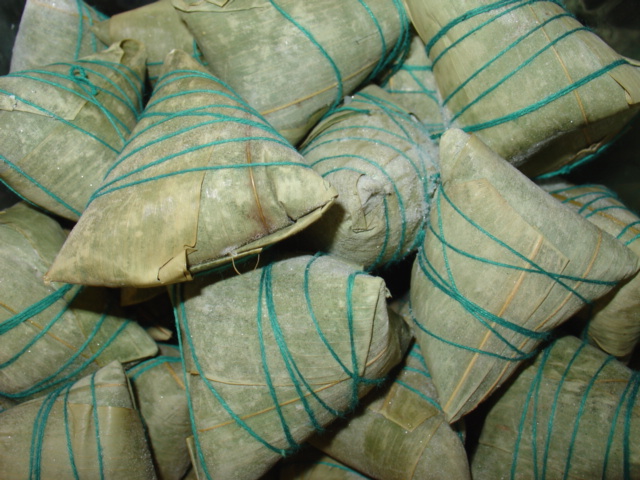
Packets of sticky rice in the frozen food section of the supermarket. The green string tying it all together indicates a vegetable interior, the pink string signals pork and the yellow string is a sign for chicken. In the supermarket there is a GREAT assortment of these in a frozen foods section which seemingly stretches for miles.
Posted by debra at 10:59 AM
Duck Entier en plastique
March 25, 2004
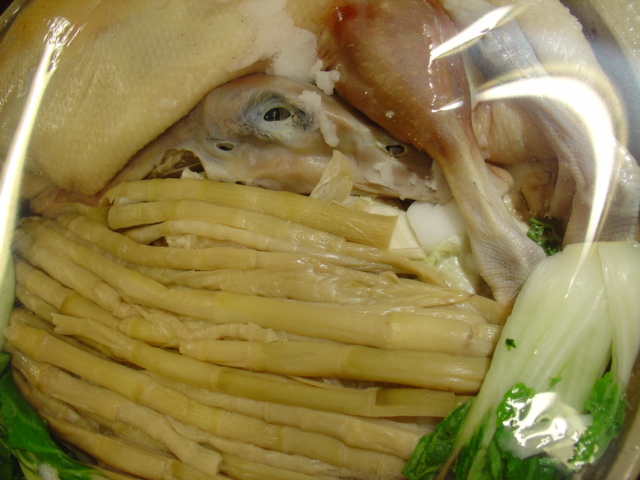
Duck under plastic wrap at a food-court style restaurant in Nanjing, PRC
Posted by debra at 08:12 AM
00ze: GooseFood4HumanFood
September 15, 2003
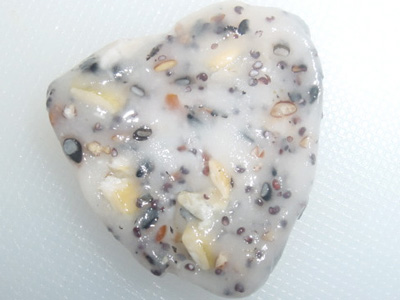
00ze. That's zoo spelled backwards, sort of. Natalie Jeremijenko has asked me to be the culinary artistic director of her 00ze project - bat bars and goose-steraunts. Animals and humans come into more competitve contact in a situation in which they actually share the same menu.
The Goosesteraunt is gearing up for a November gig. I have been experimenting and so far there is high-res documentation and 24 distinct recipes. Invite yourself over if you're interested in a taste-testing session. Recipe testers needed.
'Mock Larva' Dumplings
(description: rice flour dumplings. Looks like larva)
- Watercress dumpling
- Seeds (black seeds) dumpling
- Sea coral (nl. zeekraal) dumpling
- Seed and sea coral 'worm-cigar' dumpling
Posted by debra at 05:50 PM | Comments (2)