
May 09, 2005
Which one is the fish skin wedding anniversary?
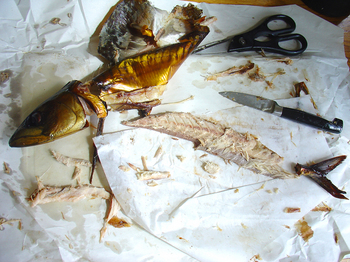
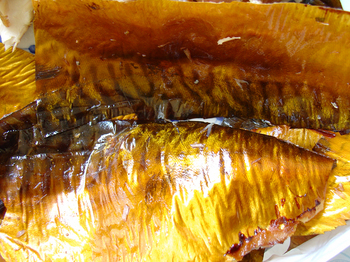
5th Wedding Anniversary Menu for John and Kristi
Pasta that is not pasta
- courgette spaghettini
- courgette ravioli
- roasted and pickled pepper coulis
- rocket emulsion
- even creamier cheese in a can
Pepesan sans pep
- grated coconut tamale with
- smoked mackerel marinated in tamarind and lime leaves
- sweet potato
- not very much sambal djeroek taking into account the delicate Northern palates
- coconut cream
Charlie Trotter's Banana and Chocolate Lava Cake
- w/ roasted mini bananae
John and Kristi have been married for 5 years and a celebration amongst friends is Saturday evening's event. Present: Debra, John, Kristi, Aya, Marseille, Lynne, Ivo, Little Lord Lloyd, Carolien, Alex and a surprise appearance by Sonia all the way from Delhi!
Posted by debra at 10:19 AM | Comments (1) | TrackBack
March 15, 2005
Paan virgin spits like a girl
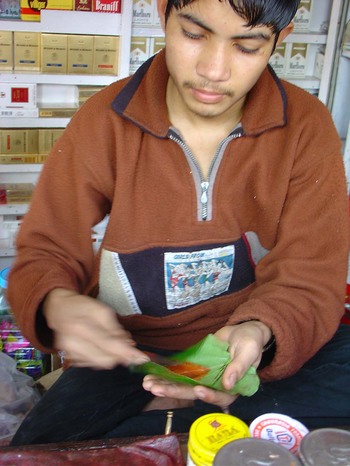
Everywhere in Old Delhi, on every cornerpost of every building there is a terracotta haze. For a while I thought it was just the build-up of iron oxide dirt and dust - and so much of the architecture (for example the Jantar Mantar observatory) has this colour. But after a few hours of walking around I saw a few fresh splotches of red and realised what it was. Paan spit.
Paan is a 'digestive'. A leaf, painted with all manner of spices, flecks of gold leaf, sugar crystal and proportedly even opium. You take the leaf roll in your hand from the paan-wallah who has lovingly prepared his special version from 20 or so fine tins of ingredients and ingest it like chaw, I think. This morning, before the coffee I tried my first chew.
What a timid taster I was, and this was entirely ridiculous because PAAN IS GOOD. Paan tastes like perfume and of delicious spices and sugar, bitter, every now and again a bit of sour. Riding around in a rickshaw in Delhi, between whiffs of exhaust and... well let's just say mostly exhaust, you get a whiff of heavily perfumed air. That's what paan tastes like. Delicious. The texture is as grainy and juicy although every paan is different.
And the buzz? Well, I notice a slight tingling in the back of my throat which is probably clove related, and the mind-altering quality is less than that of a cup of coffee. Of course I'm immediately interested in getting into something a bit heavier. Next time I'll attempt a truly peaceful savouring of the paan and will be working on my spitting technique. It turns out, surprise surprise, I spit like a girl!
Posted by debra at 06:57 AM | Comments (2) | TrackBack
February 08, 2005
Lacking and craving
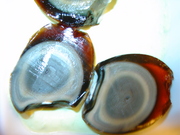
Supposedly craving a certain food is your body telling you that your diet lacks a certain something. But what is it that my diet lacks if I get cravings for 1000 year eggs with Cheese in a Can Soup? Could the lack of light and earthy outdoor fun up here in the Polar Circle have made me wood ash and lime deficient? Do I need to get my tochas down to Occitania where I never crave these elegant looking duck eggs?
1000 year eggs are raw duck eggs that have been coated with a paste of salt, wood ash and lime and then rolled in rice chaff to keep them from cementing together. They are placed in a ceramic pot and rotated every few days for two weeks. After this time the insides of the eggs have become 'softboiled' and turned dark transluscent amber (the white) and greenish greyish black (the yolk).
The design of my old Mac G3 laptop (a Pismo) always reminded me of a 1000 year egg. I find this colour combination extremely elegant - the 'white' of the 1000 year egg is like a golden amber aspic, sometimes with fractal designs forming in it!
Doesn't it just make you wonder how a preservation technique like this develops?
Last night's Cheese in a Can soup was made a little bit differently than this earlier culiblog recipe. It was equally delicious.
Cheese in a Can Soup (takes minutes)
Blend together until satiny smooth:
1/2 round sheep's cheese in brine.
The sort of cheese I'm referring to is sold in North African and Turkish shops (here in the Netherlands) with a clear picture of a sheep on the outside. Don't use goat or cow feta for this recipe, it doesn't taste good.
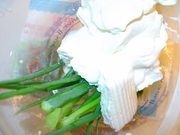
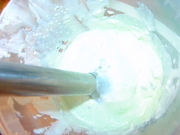
2 big dollops of yoghurt (as always, the fattier the better)
2 big dollops of creme fraiche
4 whole green onions
some milk to taste (to thin the consistency)
Serve 1000 year eggs floating in this cold 'soup'. The pale green colour of the soup contrasting the sultry dark of the egg is a sight to behold - and flavours are combine perfectly. I can assure you that the taste of 1000 year eggs is much milder than that of ordinary hardboiled chicken eggs. Don't let the deep colours scare you away, this is delicious.
Posted by debra at 10:23 AM | Comments (8) | TrackBack
February 07, 2005
Cooking Challenge, Pôts de Crumble
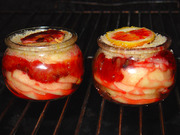
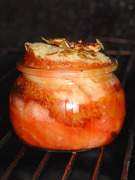
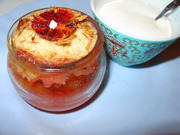
In French that's pronounced poh and the term can mean everything from a pot to piss in to a pot to plant some blood orange apple crumble in. Recycling fool that I am, these pôts originally contained storebought creme caramel but serve as excellent ramekin substitutes.
This past weekend was the Paper Chef Challenge, a little game some food bloggers like to play not dissimilar from the BBC television show Ready, Steady, Cook. The group agrees to use a group of ingredients in a recipe over a finite course of time. Wheat flour, cinnamon, blood oranges and creme fraiche, with extra points for using broccoli, chorizo, stale bread and something else. After a botched batch of stale cornbread French Toast (which in Dutch amusingly translates into a dessert called Turning Bitches), I decided to do something very un-Debra and stick to the menu.
Desserts based on the apple crumble principle have always been my back-up dessert. I actually never eat dessert but perform it exclusively when I have guests and consequently dot dot dot. The blood oranges in this dessert give it extra tang, for those of us that truly don't have a sweet tooth.
One thing - the only kind of orange I like is a blood orange, and I use every single part separately.
Another thing - there are many sorts of cinnamon but for baking only Sri Lankan stick cinnamon will do. Ignore the dried pre-powdered kind and buy a proper stick of very thin bark. The thick stuff is for making meat stews anyway. You pulverise the cinnamon into splinters between your fingers - and there are few things finer than biting into a cinnamon bit, an explosion of flavour reminiscent of the RedHots candy of my childhood.
Oh and another thing - Whole meal chappati flour 'is not just for hippies anymore'. This finely ground wholemeal is definitely light enough to use for baking.The trick is to work with a light hand and to not over-mix the thing that should not be over-mixed, in fact, to become light yourself.
Ohm and one last thing - Creme fraiche (d'Isigny) is best taken straight up, with a spoon.
Pôts de Crumble (serves 6)
(for the crumble)
1/2 cup whole wheat chappati flour
2 tbs sugar
zest of one blood orange
5 cm of pulverised Sri Lankan cinnamon
pinch of sea salt to taste
2-3 tbs semi salted butter
(for the filling)
2 apples, peeled cored and sliced (I used Topaz because of their semi-sour flavour)
2 oranges (cut-sectioned, seem images)
0-2 tbs sugar (if you like it sweet - I don't)
extra cinnamon
creme fraiche
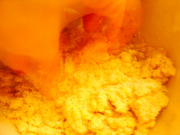
Preheat the oven to 375°F/190°c. Mix the dry crumble ingredients in a bowl including the zest of the blood orange. Chop the butter into the dry ingredients with the business end of a fork. Continue mixing the crumble with your fingers until little pea-size balls form more or less naturally. Set aside.
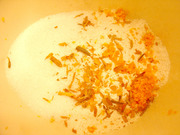
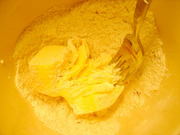
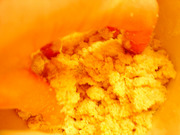
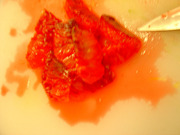
Peel, core and slice the apples. Section the oranges by lopping off the top and the bottom until there is no white showing and then shaving off the peel from the sides so that the membrane is cut through. It looks like there is a lot of waste - but you can use this juicy stuff for something else - like marmalade or candied peel. Hold the bloody orange in your hand and with the knife cut along the section to the centre and then back again - to remove the perfect little section - with no pith and no membrane.
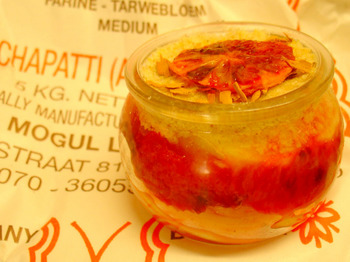
Layer the apple slices and orange sections in fireproof pots 7/8ths of the way up the pot. If you want to add some sugar, do it now. Over the crumble bowl dump 1-2 tbs of crumble mixture into the pots and press it down HARD. Add some more and press again. Decorate if you like sith some of that orange 'waste material' and some more cinnamon, pressing it also into the crumblecrust. You have now sealed off the pots.
Place the pots in the oven for about 15 minutes. When done they will have puffed up and are piping hot ready. Serve with a little bowl of creme fraiche on the side and a teaspoon. Or a tablespoon. Or a ladle.
Posted by debra at 10:05 AM | Comments (3) | TrackBack
February 04, 2005
I hate bread
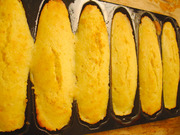
Except sometimes and some breads.
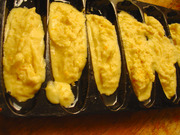
I love cornbread and I love my little cornbread iron. Maybe because it's bound up in a possibly made-up memory or maybe it was something that really happened. But I believe that I became covetous of my Auntie S's when she dished up some cornbread 'ears' for Thanksgiving at least 2 decades ago.
A cornbread iron is a perfect iron age tool. You heat it up, grease it up, heat it up some more and then pour in the cornbread batter. Shove the lot in the oven and the cornbread takes half the time and finishes with an excellent texture and crumb.
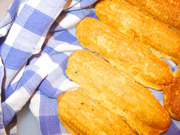
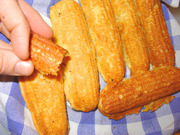
This recipe I like to use originated from the various versions of the Rombauer Sisters' Joy of Cooking. It's the 'Northern Corn Bread' and I just know that's got to be some sort of an insult somewhere... I have changed the recipe quite a bit to suit my tastes, using butter instead of oil, chucking in the zest and juiice of an orange, substituting... ah hell, you can tell I can't follow instructions to save my life!
Debra's Cornbread (makes 14 ears plus one little loaf, takes 10 minutes excluding baking)
Preheat the oven to 425°F/220°c position the wrack in the middle.
Place the cornbread iron and any other receptical you're planning on using for baking in the oven now to get it hot.
1 1/4 cups fine yellow cornmeal
3/4 cup fine whole wheat chapati flour (or white flour or whatever sort of flour)
2 tbs sugar
2 tsps baking powder
1/2 tsp baking soda
1/2 tsp salt
Mix these dry ingredients together in a large bowl with a fork. Fluff it up.
In another bowl mix the following wet ingredients until creamy:
2 eggs
zest and juice of one orange (be brutal)
1/2 cup yoghurt (the higher the fat content, the better)
1/2 cup kwark (or more yoghurt, or buttermilk, or milk - it's all good, it all works)
4 tbs melted butter
Take the cornbread iron out of the now-hot oven and grease it up in earnest. I use peanut oil. Drizzle the oil into the iron and pat away the excess (or don't) with an old tea towel.
Place the empty (but greased!) cornbread iron back into the oven.
What you are going to do next is NOT MIX THE WET AND THE DRY VERY WELL. You are going to mix them poorly. This is the key to light and fluffy cornbread (and all quickbreads in fact). With a rubber spatula fold the batter together in maximum 7 hand motions. Each time you fold and cut, you turn the bowl a quarter with your other hand. Sound complicated? It isn't. Just don't mix very well.
Remove the hot hot hot cornbread iron from the oven and dump a few tbs in each 'ear'. Don't over fill because the mixture will puff up a bit at some point. (You may notice it puffing up in the bowl already.) Bake for 10-15 minutes or until golden and cooked through and through.
Turn the ears out onto a tea towel. They can be kept warm in the oven (and rewarmed the next day) in this tea towel when you've finished baking the cornbread and returned the oven to a more relaxed temperature.
Theoretically you shouldn't need to put butter on these ears of corn. But that's the difference between theory and practice now isn't it! In theory, practice and theory are the same. In practice, they aren't.
Smakkelijk!
Posted by debra at 10:37 PM | Comments (5) | TrackBack
January 31, 2005
More raw beets for the neighbours
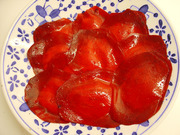
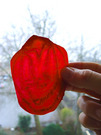
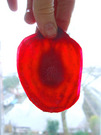
Raw beet ravioli. Delicious, beautiful and here I am hybernating. It was time for all of my vegetarian architect neighbours to meet over dinner. Click below for recipe.
Raw Beet Ravioli Solomonova (serves 4) (marinating time 4 hrs, hands-on prep 25 min)
1 large RAW red beet (scrubbed and peeled)
5 tbs good virgin olive oil
3 cloves of garlic
2 tbs rice wine vinegar, OR blood orange juice squeezed from the orange, OR lime juice...
sea salt
1/2 cup homemade cashew cheese or 1/2 cup sheep cheese in a can mashed together with milk for moist and sliced green onion for that glowly colour we all like so much.
In a heavy bottomed skillet lightly warm the olive oil. Don't cook it, W A R M it. Press the garlic into the WARMed oil, remove the skillet from the flame and swish the pan around to mix in the garlic.
In a deep bowl slice the raw beet root with the aid of a mandolin into paper thin slices. This means you could read the paper through the slices if it weren't for the beet's dark colour. Work quickly. Pour the still warm olive oil over the beet slices, add the rice wine vinegar or orange squeeze or lime squeeze, sprinkle with sea salt and swish around to mix. Cover and leave for some hours (or even days) to marinate.
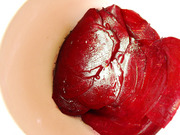
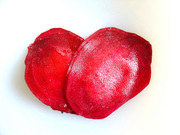
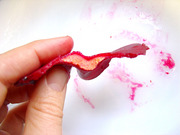
When you are ready to serve lay out the plates in your workspace. Take a slice of beet and sloppily scrape off the excess oil on the side of the bowl. Using a teaspoon carve a mini quenelle of cashew cheese from the cheese lump and place it in the centre of the beet slice. Take another beet slice, remove excess oil and place neatly on top of the other slice. Seal the edges gently, mushing the cheese to form a little ravioli. Arrange the raviolis on a plate, 3-5 raviolis per person is a nice way to start a dinner.
Posted by debra at 11:36 PM | Comments (10) | TrackBack
January 24, 2005
Gullet Girl
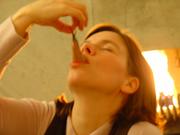
This is the correct Dutch way to eat a herring.
By firelight.
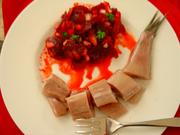
And this is the correct way to serve it. Well almost. Kristi chose to cut it up out of love for her British husband who can't get his head around swallowing a herring like a seal. But in her heart of hearts Kristi wanted to serve it whole.
Serve herring as a first course with a salad of chopped pickled beets, finely chopped onions, curly leaf parsley and a little silver fork.
Posted by debra at 09:31 AM | Comments (5) | TrackBack
January 19, 2005
Keeping one's vows
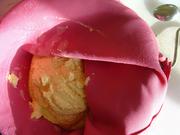


Remember in October when I had just bought Roxanne Klein's R A W and I reported how it made me homesick for Laurel's Kitchen? And then upon rereading Laurel's Kitchen I made a vow to 'take cashew cheese seriously' from now on?
Well, I have been taking cashew cheese making very seriously indeed, and I believe I have improved upon the Good Ladies' recipes. Pictured above are some of the steps in this easy process (from l to r: placing the blended cashew butter in a cheese cloth, cheese cloth hanging in the window, cheese cloth dripping with cashew milk and dark winter sky).
Cashew Cheese Solomonova (makes one cheese)
(process time: 3 days, hands-on: 30 minutes)
2 cups raw cashews (soaked in cold water for 1 day and drained)
3 tbs water
3 tbs fresh and bubbling kimchi juice (secret ingredient)
sea salt
Blend the cashews, water, juice and salt until extremely smooth. This takes about 4-6 minutes.
Prepare the cheese cloth. In this case that means any sort of loose weave cloth that will let liquids pass through - it can be a tea towel. Wet the cheese cloth thoroughly and devise a way to hang it somewhere where the 'cashew whey' can drip into a container. I like to use my window handle and a meat hook probably because it appeals to my quirky nature.
In a bowl place the open cheese cloth and dump in the wet cashew butter, tie it up, hook it up and let 'er drip. Now is the time to quit obsessing about this dang cashew cheese. Let the cheese drip at least 8 hours or whatever is convenient. (If you start in the afternoon, the cheese is 'dry' the next morning.)
When the cheese is dry, take down the cheese cloth trying not to disturb its' form. Gently peel the ball of cheese away from the sides so that you can place the cloth without too many folds into a container - like a recycled yoghurt tub. Fold the cloth over the tub 'to close it' and place the cheese in the fridge for at least 24 hrs.
After 24 hrs the cheese is finally ready. You can eat it now or save it up to a week in the fridge - it will just get better as it 'ages' because of the cabbage juice fermentation. Cashew cheese made like this is similar to a soft new dairy cheese and you can serve it without any shame as part of a cheese course with young goat and sheep cheeses. Of course you'll soon want to experiment with flavouring it in different ways but I found that the kimchi juice gave the 'cheesiest' flavour.
Posted by debra at 05:09 PM | Comments (3) | TrackBack
January 18, 2005
Like raw beans in a hippy's beard
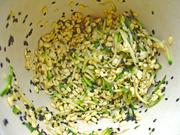
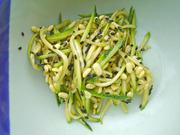
In less than 2 months I will be heading off to India again and as I prepare the Indian version of the Nomadic Banquet Workshop I find myself hunquering for Indian food. I'll be writing about the Nomadic Banquet in future culiblog entries.
Hippy Beard is the nickname I gave to the Southern Indian (Karnatakan) mung dal salad that I adored in Bangalore and adapted to my own liking once back in the Heimatt. If you thought that nothing good could ever come from eating raw beans, you really need to try this simple recipe. The salad is very light and the good kind of crunchy with no negative... uh, aspects.
The cukes I replaced with zukes and unfortunately I had to omit the 'curry leaf' because I can't find it anywhere in Europe. It doesn't take a whole lot of imagination to figure out why I call this salad Hippy Beard and just like in a real hippy beard this salad keeps for a few days. I'll ask my buddy Zeenat Hassan (who is neither a hippy nor does she sport a beard) for the real name of this refreshing snack with the cheerful 'mouth-feel'. It was her menu choice for that fine afternoon in Bangalore... (recipe follows).
Mung Dal (or Hippy Beard) Salad (serves 6, prep time 4 minutes excluding soaking)
1 cup mung dal (split yellow mung beans)
1 zucchini
2 tbs black sesame seeds
1 tbs pumpkin seed oil
6 tbs of sesame oil
2 tbs of rice wine vinegar
sea salt
In a deep bowl wash the dal thoroughly in cold water. Often the yellow mung dal is dyed with yellow pigment so just wash it off with cold water until the water remains clear. This will take a minute. Soak the mung in cold water for at least 2 hours. (But if you're not going to use the mung beans immediately refresh the cold water and place the bowl in the fridge for up to 2 days.) Drain the mung beans thoroughly.
Using the thinnest cross blade on your mandolin, slice the zucchini into to thin strips. If you don't have a mandolin slice the zuke as if you did. This is your chance to practice making julienne and to realise it's high time to invest in a mandolin.
Add the zucchini and the rest of the ingredients to the mung and stir until just barely mixed. You know the rules: do not over-stir the thing that doesn't need a lot of stirring. (Begin Yiddish accent.) What, you want every bite to taste exactly the same? (End Yiddish accent.)
Serve the mung dal salad in little mountains.
Posted by debra at 07:01 PM | Comments (2) | TrackBack
January 03, 2005
Enough with the raw food already
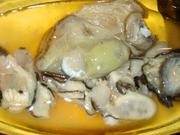
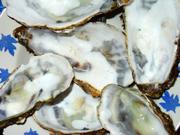
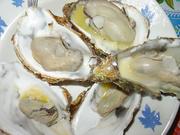
We just couldn't eat them all so they've been in the fridge in a wet tea towel since the 31st. I wouldn't have guessed that after so much time you could still eat them raw, although upon opening more than 2/3rds of them were perfectly delicious looking, smelling and tasting. Those deemed not perfect were only a bit dehydrated, not unlike ourselves after overdoing the champies.
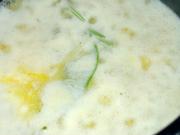
I decided to warm them in some melted butter, chopped garlic, rosemary sprig and bay laurel from le chateau.Gawd damn do I love oysters! It was J's first time on New Year's and we told him that eating an oyster is like biting into fresh and solid seawater. Now he sees oyster eating as a superior option to actually going swimming.
Oh and here's what else was going on... JT, Kristi, Fred, Kristine, un grand tour de leur chateau, aussi la Palmiére, la cascade, et toutes pour lui.
Oh and here's what else was going on... JT, Kristi, Fred, Kristine, un grand tour de leur chateau, aussi la Palmiére, la cascade, et toutes pour lui.
Posted by debra at 05:10 PM | Comments (0) | TrackBack
November 16, 2004
La Peche qui brule
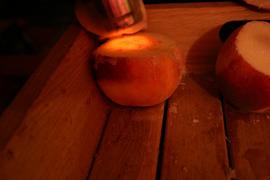
That was the title of the smoldering peach course on that eventually sultry August evening. We placed the carmelised peaches on the pôts de creme au chocolate brulée. You can't eat one without eating the other.
And that's exactly what a French speaker would say, 'You can't heat one without heating the other.'
As with the previous slideshow, these photos are courtesy of Kristine Malden.
Posted by debra at 05:59 PM | Comments (1) | TrackBack
The Banquet Years
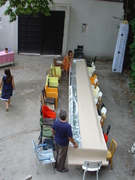
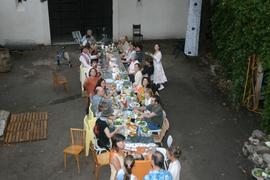
Guess what we did last summer... we had a banquet!
Maybe because my last entry looked so pitiful, the colourful cakes and the leaden November sky. I thought it was high time to upload some images from this summer's culinary activities - and not just to some dank place in the culiblog archives.
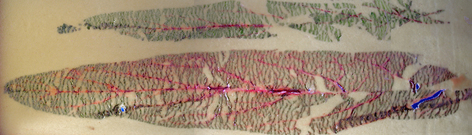
As a community we ate off two, 8 metre long rolls of homemade pasta lasagna, into which sage and beet leaves had been pressed (see composite photo above) and when we were done, we rolled up the entire table.
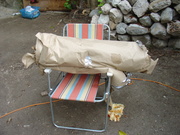
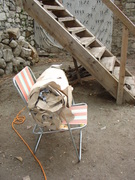
Click for the slideshow here. The images in it are all photographs by Kristine Malden, a friend who thankfully was our guest that August evening.
Posted by debra at 05:44 PM | Comments (0) | TrackBack
November 14, 2004
Sunday Tea, Fruit Boom
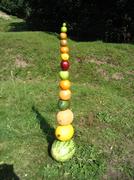
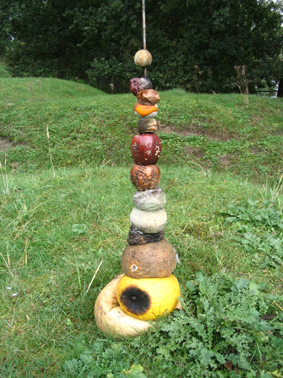
We can all use a bit more para so a visit to the Witte de With Paraeducation Department was the order of the day, this Sunday. The salon-format programme titled Facts of Chance (authored by artists Anne Schiffer, Marcel van den Berg, and Frank Koolen) was satisfying, like when the cookie tin stays open; an interesting collection of videos, slideshow, film and included a performance by Koolen. Pictured above is an inadvertent recipe featured in the slideshow titled Fruit Boom or in English, Fruit Tree. Now is that fruit + balance or fruit + skewer + time?
(image courtesy of Frank Koolen)
Try as I might I couldn't find a link online to the Paraeducation Department on the Witte de With site. The Programme van Heute Leute (Today's Programme, Folks!) opened with the context creating film by writer B.S. Johnson, titled Fat Man On A Beach. Che Guevarra graced the afternoon twice as guest of honour, and it is debatable if Maria also made an appearance; the event being in the throes of cutaways to bananas. These banana cutaways lent structure to the chaos, the well-defined theme of the event. Exuberant discussion followed... of course.
(Digital photographs of Fruit Boom courtesy of Frank Koolen who does not fall under my Creative Commons License.)
Posted by debra at 07:44 PM | Comments (0) | TrackBack
November 07, 2004
The Wild Boar Thing
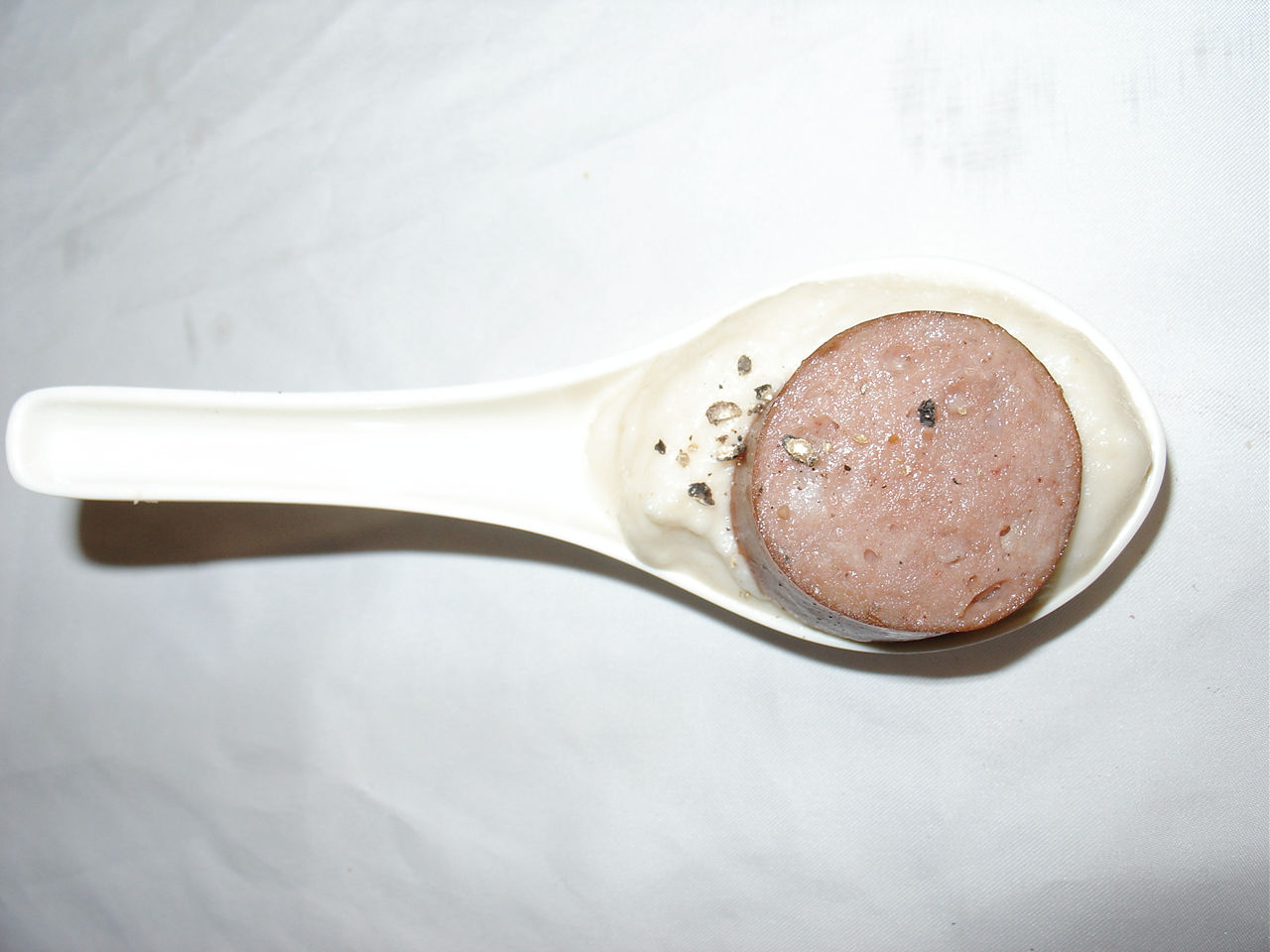
It was the leitmotif, right down to the marrow. For the 5th annual Museum Night (Museum N8 and pronounced Museum Nacht) Mediamatic hosted a salon including presentations by Esther Polak (locative media MILK), MIT's Kelly Dobson with her Blendie (a blender that grinds to the gutteral), Henk Boverhoff's wild boar charcoal drawn dresses, Rob van Kranenburg's wild ideas, and the RE-launch (until you re-learn) of the Culiblog at it's BRAND NEW DOMAIN - right heah, right now, by the author of this very culinary weblog.
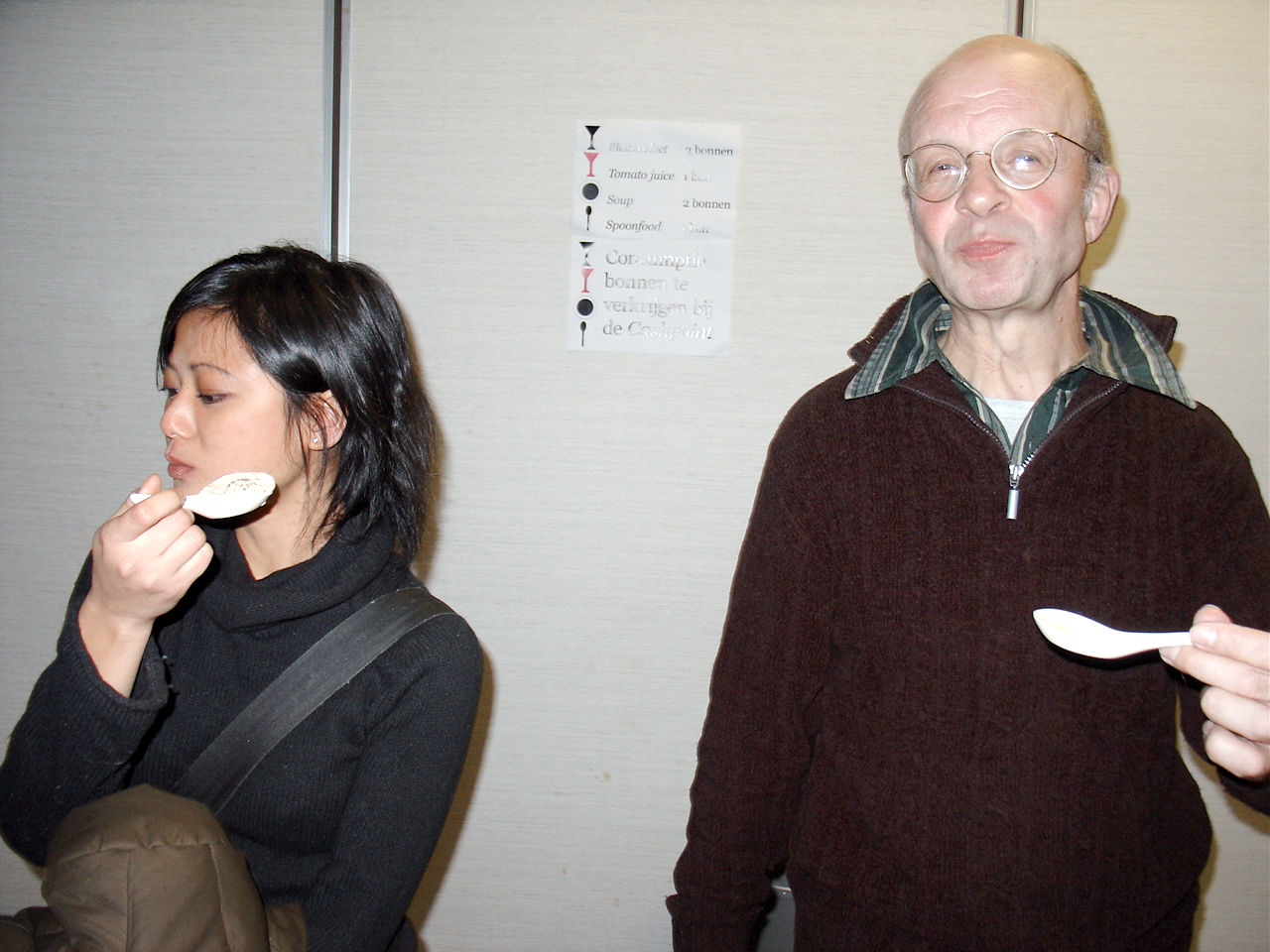

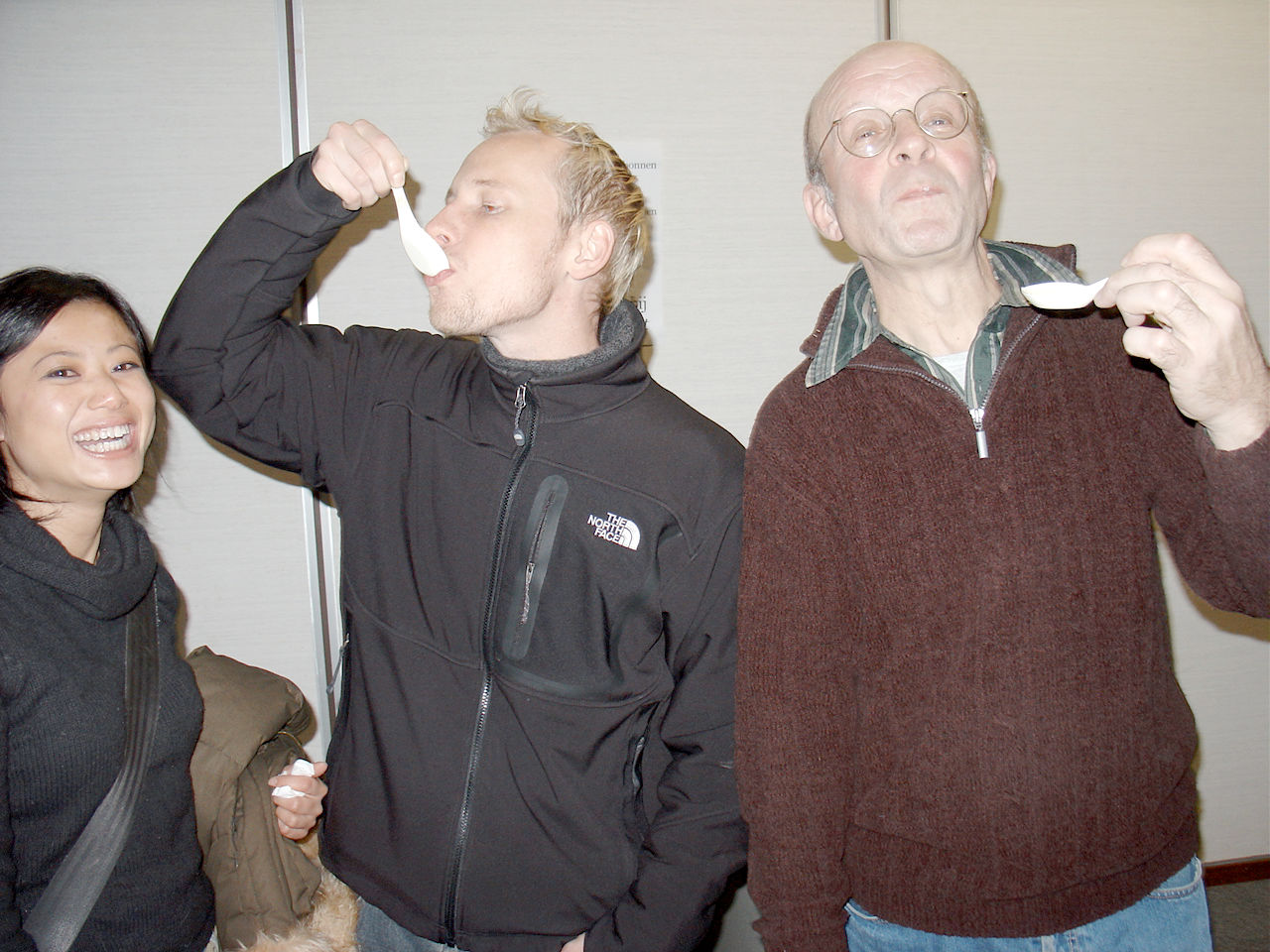
In the above pictures see Paul Groot enjoying a bit of wild pork. I see his smile and I feel the urge to feed him every single day of my life. (Maar ja...)
Kelly Dobson operated Blendie, her blender tweaked to listen to growls and gutteral emissions of the operator. Together Blendie and Kelly helped make the classic Celeriac Purée satiny smooth. I served it with slices of wild boar smoked sausage (after a fashion). Customers could buy the dish per spoonful for a measly euro.
Celeriac Purée (serves 8 - after a bracing day of iceskating or woodchopping)
1 celeriac (also called celery root)
1/2 ltr wholefat milk
250 ml cream
3 knobs (!) of lightly salted butter (demi sel)
salt
pepper and freshly ground juniper berries to taste
In a fat-bottomed pan put the milk and cream on the lowest possible flame. Peel and cut the celeriac into 1cm cubes (brunoise) and add it to the milk and cream mixture.
Remember:
DO NOT SCALD THE THING THAT MUST NEVER BE SCALDED.
DO NOT CURDLE THE THING THAT MUST NEVER BE CURDLED.
Therefore...
DO NOT COVER THE THING THAT MUST NEVER BE COVERED.
Cooking the celeriac takes an hour, get the hell out of the kitchen, try to forget about it and go do something meaningful.
When the celeriac is tender blend it together with the milk and cream adding butter and salt along the way. The mixture should feel satiny in the mouth. Sprinkle with freshly ground pepper and juniper berries. This is the ultimate comfort food especially when served with 1/2 an organic smoked pork sausage. It was certainly a great way to break the vegan fast I've been on the past week.
Posted by debra at 02:22 PM | Comments (6) | TrackBack
November 05, 2004
Hash Shakes are sooooooooo passée

Well, what were You eating one and a half years ago?
Bhang Shake (serves 3)
Aditya and Arjun (not their real names) dosed me with the vivid high of this sublime hash milkshake one and a half year's ago.
What were we THINKING!!!
Make thusly:
- milk (1 ltr.) (the higher the fat content the better)
- hash (1 centimetre - how much is that? I am so old.) (warmed and crumbled)
- sugar (to taste, substitute with honey or maple syrup)
- cloves (freshly crushed in a mortar)
- saffron (don't skimp on the saffron)
- cinnamon (the finer the better - pulverise with your fingers first)
- cardamom (open the green pods - grind the black seeds.... throw the pod husks in with your coffee beans for tomorrow morning)
With a staff-mixer in a tall container blend the hell out of all of the dry ingredients together with 3 tbs. of the milk. Slowly add the rest of the milk and make sure you work up a good head of foam. Ice is for pussies. This bhangshake gets you gradually stoned in a really gentle but increasingly psychedellic way. Good afternoon drink but don't mix with alcohol.
-=-=-=-=-=-=-=-====--- - - - - - - -====-=-=-=-=-=-=-=-=-
A Dinner for Two Massively Gay Indian Babe Magnets - (Go to Sleep, Radiohead 2003, Hail to the Thief)
- japanese frozen landscape borscht with quickles and creme fraiche
- summer thai-spiced sfoglia layered with lime-pickled beets, mint mojo, rocket and cheese-in-a-can
- the burgus course :: white burgus, baby crayfish in butter, roasted new potatoes, tea egg and tea bearnaise
- saffron hang-op with mango blood-orange sunset granité, rosewater crystals and oven-dried blood orange crackers
UPDATE: View March 26, 2005 Holi pictures online here. (Images l to r: Author high as a kite in a handblocked silk scarf, a gift from Aditya, a fuzzy photograph of a traditional clay pot filled with bhang ice cream. The top of the ice cream is sealed with dough.)
Posted by debra at 08:58 PM | Comments (7) | TrackBack
November 04, 2004
Taking Cashew Cheese Seriously This Time
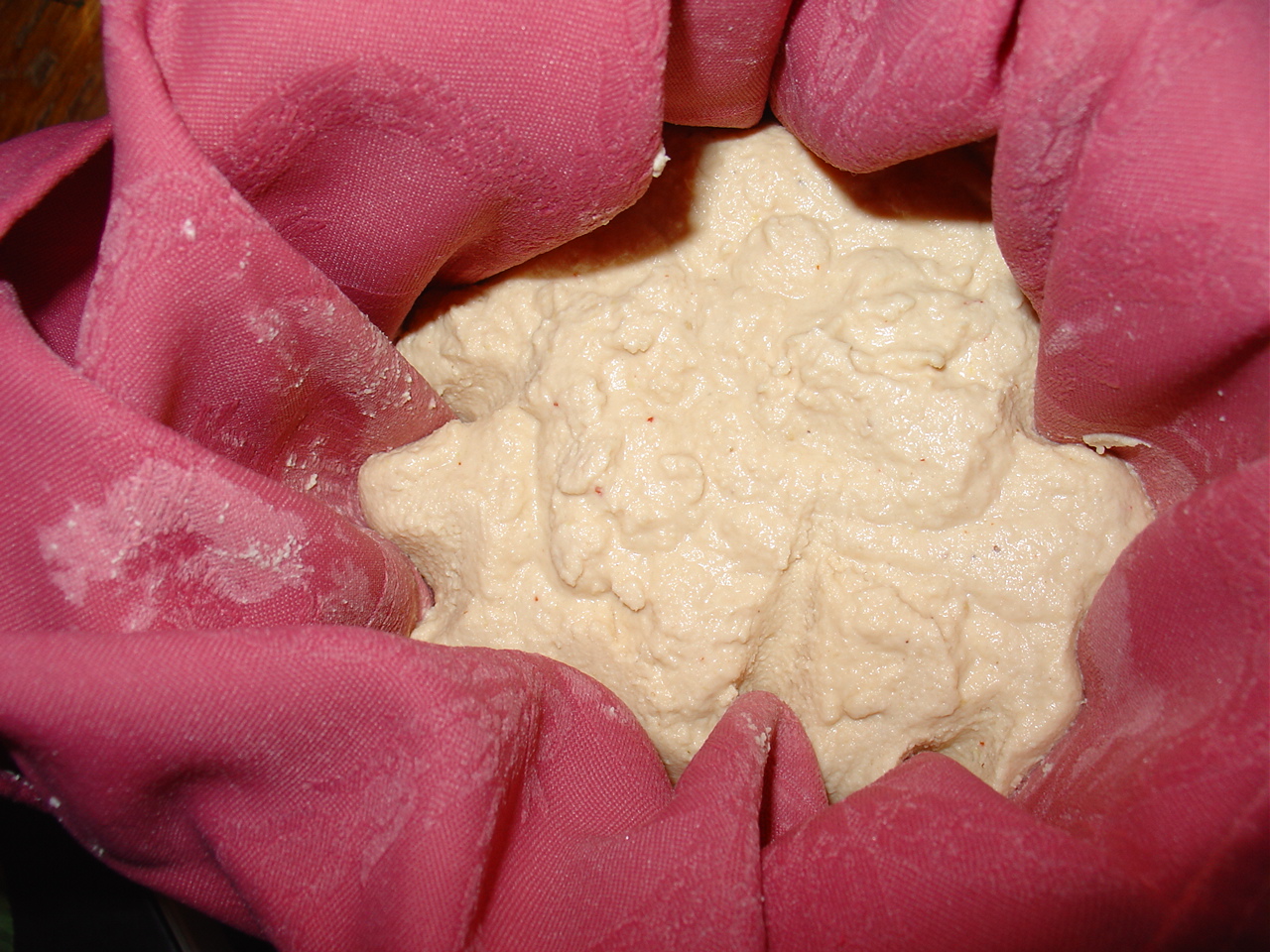
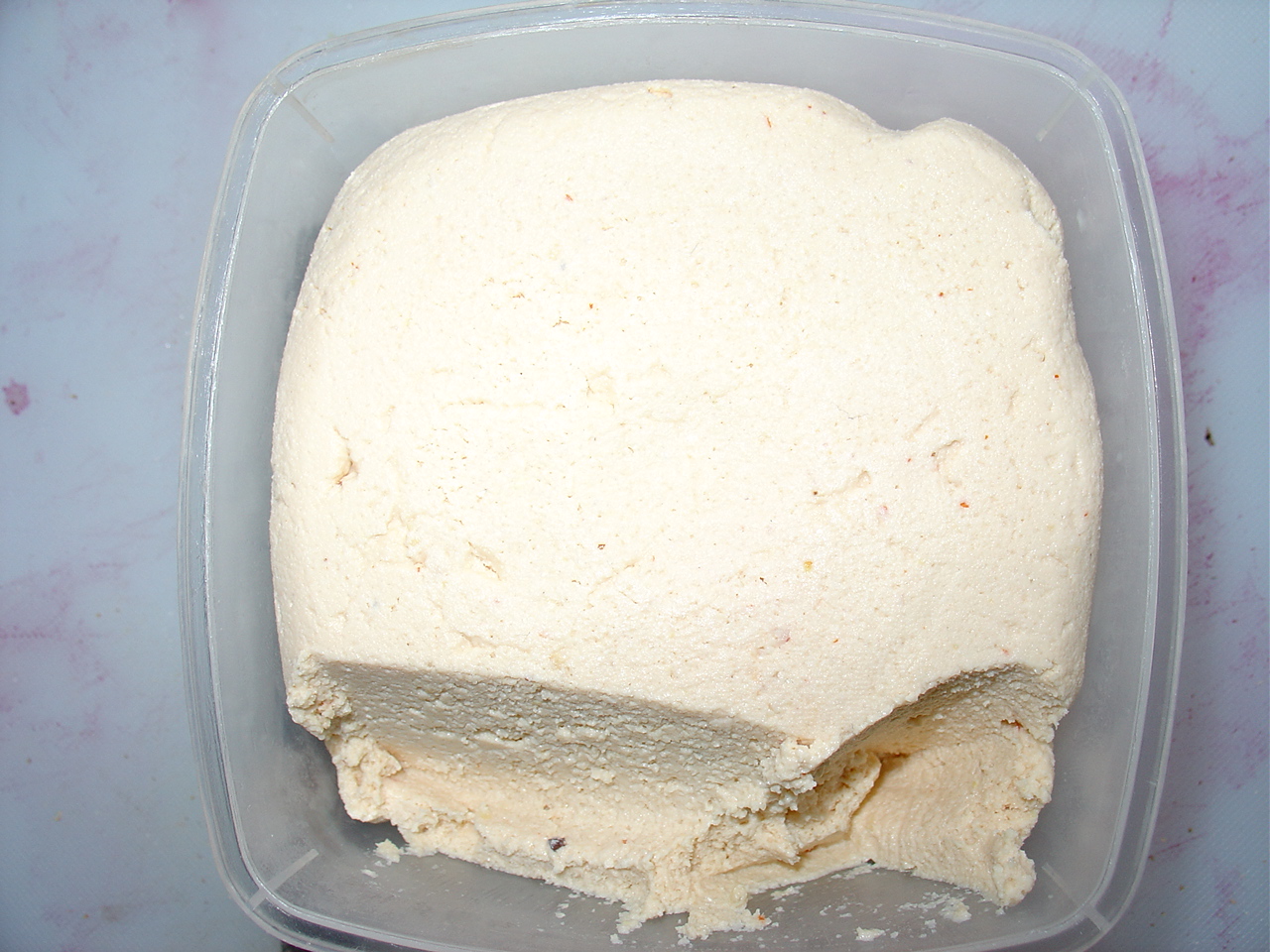
In my October 6th entry I report on buying R A W and how it made me nostalgic for the vegetarian classic, Laurel's Kitchen. I said I was going to take cashew cheese seriously these time and I am a woman of my word. Roxanne Klein's recipe calls for 'fermented bean water' but I just used kim chi (pickled cabbage) juice to sour the nut mash - worked great.
It's not called cheese because it tastes or feels anything like cheese - but it's really delicious, delicious enough to eat frequently. It will suffice for comfort food in these grim days.
Cashew Cheese:
1 cup cashews (and almonds) SOAKED FOR 10 hours and drained
salt
some water
something sour (like Kim Chi juice, sauerkraut juice)
Blend until extremely smooth. Place goop in a wet cheese cloth and suspend to drain out the cashew/almond milk. You can drink this, it's yummy. After 12 hours put the now dry cheese ball in a container in the fridge and let it sit at least 1 day - but preferably 3-4 days. It will start to ferment slowly and pleasantly and become something else entirely.
I experimented with a pumpkin seed cheese and this didn't pan out as well. The seeds aren't fatty enough and it's the emulsion of fat and water that makes the nut cheese recipes creamy enough to call cheese.
Posted by debra at 09:28 AM | Comments (2) | TrackBack
October 26, 2004
Poppyseed Mustard


It tastes just like it looks, dark and musty. Even though I mixed this batch with a roasted garlic clove I still think it would taste great with chocolate! Poppyseed 'mustard' makes me long for strudel and as soon as I am done with this juice fast I'll develop a savoury strudel with poppy seeds and mushrooms.
Posted by debra at 10:46 PM | Comments (4) | TrackBack
Autumnal fasting has begun


Today I started the Autumnal Fast. I'll be recording my menus and recipes (!) here. If you always thought fasting was a torture read here to see that the opposite is the case. SO far it is the first day and I'm not interested in juicing, very interested in cooking - so I made some cashew cheese and poppyseed mustard.
Day 1 (of 6)
- coffee (don't say it...)
- sauerkraut juice (Brother Aaron and I used to fight eachother to drink this.)
- fresh orange juice
- apple mint juice
- miso soup with roasted garlic (see nature's garlic entry)
- mushroom bouillion with roasted garlic (idem ditto)
- pear ginger juice with jogi tea
- sleepytime tea
Posted by at 09:58 PM | Comments (0) | TrackBack
October 05, 2004
Possible Epiphany
She's going to try one of my recipes. And I'm scared.
What if she doesn't understand and makes a dog's breakfast of the thing. She might stop trying my recipes forever.
Although I have cooked since I was a child, I am new at writing recipes for other people. I am new at explaining cooking to people that have a different experience level or culinary background than I. What if I use too few words? Too many words are confusing. I don't know if someone will understand, 'the shoulders of the cabbage', or not. I want to convey my enthusiasm for cooking but I know that folks that don't make a sport of expanding their cooking repetoire also don't have the sticktoitiveness of someone who does. (stick-to-it-ive-ness - it's a real word).
I was thinking about this this morning, when she told me she had bought some ingredients to try the chalupsies when I realised, most cooking is taught by example. Most often you have seen and tasted the dish before you try to make it. You have watched it being prepared, seen the in-between stages. You build upon the techniques you learned at home when you try to copy something you have eaten in a restaurant or when you follow a recipe.
I learned how to cook because my father, who loves cooking, fried omelets every Saturday morning using daring combinations of food. My Aunties and Grams used to 'practically' compete with one another to see who could make the most delicious, most beautiful dinners. My Mom, a self-admitted non-cook, learned how to make her excellent tomato sauce based dishes from my Dad's friend Campinella.
Reading a recipe, even with explicit imagery will not bring ease into the kitchen. Ease comes from practice, ease comes from enjoying every moment of touching, smelling and looking at the marvels of the food. Ease comes when folks hang out in the kitchen and start 'yakkin' (that has nothing to do with yaks or the 'Y' word). Like with anything, ease comes when you make 'it' your own.
Posted by at 10:11 AM | Comments (3)
October 04, 2004
Changes


This recipe for Chalupsie has been hybridised to the hilt. Pronounce it however you like, it's just Stuffed Cabbage or Chou Farci and up here in the Polar Circle we need hearty winter fare like this.
C H A N G E S :
It was my Gramma's recipe from the 'old country', from HER mother, but Grams used minutemaid frozen lemon juice concentrate ? something the 'old country' never had. I dropped 'that ingredient' like a load of so much cement over Tchernobyl and replaced it with a spoonful of thai green curry paste plus every single part of a fresh lime.
Some other changes that I have made include fractalising the prep time from 2hrs to 20 minutes. Now instead of reminiscing about chalupsies we can actually eat them. I also replaced the old country hamburger helper and changed the kind of cabbage to one that can be denuded of its leaves in one fell swoop.

Debra's Chalupsies (serves 4)
S T U F F I N G :
- 250g ground lamb
- 4 coarsely chopped cloves of garlic
- 4 spring onions, chopped
- black pepper freshly ground
- sea salt
- 3/4 large (type 'winter peen') carrot, freshly grated
mix sloppily
C A S I N G :
- 1 napa cabbage
chop off the bottom and let the leaves fall, stems first, into a pot of salted boiling water. let them slide in all the way or help them do so.
fill a bowl with icy cold water and with some tongs pick the leaves out of the boiling water. if you do this in one straight go - it takes 3 minutes. the leaves should be very bright green in colour.
S A U C E :
- olive oil
- 2 yellow onions
- 2 tins of pomodori pelati (just like in the old country)
- the rest of the grated carrot
- 1 grated raw beet
- the juice and zest of 1 lime - plus throw in the carcasses
- 1 handful of dried apricots, chopped coarsely
- 1 handful of prunes, pitted and halved
- 1 handful of smashed juniper beries
- sea salt
- freshly ground black pepper
- 4 bay laurel leaves
>>>>>>SECRET INGREDIENT<<<<<<<<<<
- 1 tbs of thai green curry paste
>>>>>>SECRET INGREDIENT<<<<<<<<<<
(I know, isn't it awful! But it makes the chalupsies ROCK! It's the new minutemaid.)
- some water
in a heavy bottomed pan get the onions frying in the olive oil and when they look somewhat golden just dump in the tins of pomodori. add the rest of the ingredients as you make them, followed by the water, stir a few swishes, cover and get rolling on those chalupsies!
take a cabbage leaf in the palm of your hand and put a dollop of meat mixture on the stem part. start rolling the stem in and occasionally fold in the sides, giving the entire roll a little squeeze at the end to create a 'vaccuum'.
when you've used up the meat mixture, give the sauce a swish or two and place the stuffed cabbages VERTICALLY into the sauce. they should be covered or almost covered in sauce. cover slightly - leaving a crack.
do not stir the thing which must never be stirred.
the dish is done when:
- the tomato sauce has become more orange in colour
- there is evidence of lamb fat floating up and mixing into the bubbling sauce
- WHEN THE AROMA OF THE DISH DRAWS YOU BACK INTO THE KITCHEN FOR A TASTE!
Now you can do one of two things. You can tuck in straight away, or you can do the right thing and turn off the gas, cover the chalupsies completely and reheat the lot in 4 hrs but preferably the next day. If you do this, ? the WAIT thing ? everyone will burst into tears of elation when they take their first bite of chalupsie. I swear.
Posted by at 11:15 AM | Comments (6)
October 02, 2004
Google Recipe Finder
The fabulous R.vT. came up with this Google Recipe Search link.
http://theory.stanford.edu/~amitp/recipe.html
Forget typing in turkey, or wild boar. It's just a search engine, go crazy and try tofurkey + lemon curd or monkey + banana + camenbert! Suddenly nothing seems wierd anymore. (Does this mean that I miss China?) Anyway, it's Sukkah, a Jewish harvest holiday conveniently scheduled each Autumn when 'God wants you to try eating something new'. Yeah.
Which reminds me, my brother Aaron made up a game when we were little in which the sole aim was to make the other person barf. The rule was that you had to concoct a mixture of edible substances (no poison allowed) and dish it up to your sibling � and they had to eat or drink it. Yes. Try it sometime, it's much harder than it sounds.
In this game we discovered that toothpaste is surprisingly versatile as an ingredient. Aaron came up with a toothpaste-orange juice and tabasco sauce smoothie that was fairly effective in getting me to gag and I came up with a peanutbutter and toothpaste sandwich which was impossible to swallow. Toothpaste, who would've thunk it?
R.vT. offered to shop for me since my ankle was sprained Wednesday in a bike accident. It's difficult for me to accept graciously because I am able to stand and walk. Even so, he was a right sweetie today and helped me do my shopping at the hippy market. This is what it's going to be like being an old lady. Carrying a shopping bag with the aid of a friend.
(Respect also to the super lief MM, who cooked and shopped and was a rock of gezelligheid when I couldn't walk, as well as neighbours GS and BK who brought packs of frozen beans to discourage swelling.)
Did you mean: lemon curd + turkey?
(Actually I didn't, I really mean lemon curd PLUS tofurkey!)
Posted by at 10:35 PM | Comments (0)
September 28, 2004
Autumnal Juice Fast Experiments


On the left, a mixture of opal basil, spearmint, and apple juices. On the right, beet and red pepper juices. I'm getting ready for a culinary juice fast in 3 weeks time:
apple + mint = great
apple + opal basil = great
apple + beet = great
apple alone = great
apple + red pepper = yuck, (hollow, woody and burpy)
beet alone = too intense, too sweet, woody, badly needs something sour
beet + mint + apple = good
beet + opal basil = too dark, needs to be cut with sour
beet + red pepper = delicious, nectaresque, versatile (soup?)
red pepper + mint = wonderfully fresh, cheerful
red pepper + basil = yuck (woody and burpy)
red pepper alone = delicious


Every year a this time I am struck by the necessity to find new culinary impulses. I seek innovation once or twice a year in limitation, the Automnal Juice Fast. I will start in a few weeks but I want to get a jump on some flavours and forms to perfect.
Last year my big discoveries were the juice foams resulting in a borscht made from beet and apple juices with miso covered with green apple juice foam and dotted with spring onion juice.
Clockwise from 14h: beet, mint, opal basil, apple + opal basil, red pepper. In the centre is apple + mint. All juices were slightly oxidised at the point of taking this photograph.
Posted by at 10:41 AM | Comments (0)
August 16, 2004
Leafy Greens
Up here at the Chateau there is no shortage of appreciation for leafy greens. Tonight we eat our salad with rapt attention as Kristine sings the praises of yesterday's salad, plucked by a visiting chef. Claire and Valerie recount that their Grandmere not only goes mushroom hunting but salad green hunting in the mountains. They tell us that they have eaten salads of wild greens plucked from the environs with more than 20 species of leaf.
We sprinkle a very subtle vinaigrette onto Fred and Kristine's homegrown leaves, some bitter, some succulent, some meaty. I eat each besprinkled leaf with my fingers. It is ten o'clock at night and the skies have just opened up their guts. We eat the salad together in contented silence, the 5 us, as a precious dessert under an umbrella'd table in the rain.
Posted by at 11:56 AM | Comments (0)
July 28, 2004
Regime Change

Now that the Tour de France is over we've decided to cut down on our calorie intake. Gazpacho for lunch. Blend ingredients, chill and serve.

Posted by debra at 01:07 PM | Comments (0)
July 26, 2004
Will Weed for Food

Ikea's new packaging strategy. Actually this is part of an elaborate sneaky garden design by Kristine and Fred. We're looking forward to the recipes but by the looks of these leafy babies we'll only be making weed butter.
To make weed butter or any other sort of 'medicinal' butter, take greedy handfulls of the fresh leaves of mature plants at harvest time and boil them in an enamel pot generously filled with water and 2 kilos of your favourite butter. Boil these 3 ingredients gently for at least an hour. Lift out the spent leaves and discard them. Pour the opaque green mixture into a glass bowl and place in the fridge in order to let the butter and water separate. By the next morning you will be able to lift the cooled weed butter off the greenish water. Discard the water, the THC has already bonded with the fat in the butter and this murk is of little use to you. Now you can use the butter in any recipe as you would normal butter. It'll give a gentle medicinal buzz with no fowl-tasting effects on the food.
WARNING: Be a sweetie and always inform people that you have used the medicinal butter before they tuck in. I suggest not making the same sorts of food with the butter. Make weed butter banana bread and then a normal carrot cake so that no one can confuse the two.
The effects of weed butter come on slowly and may differ greatly from person to person. The effects can last up to 8 hrs. Be careful about combining foods made with the weed butter and drinking alcohol, and definitely don't combine with driving. Here is an indication: one slice of banana bread is enough to keep a curvy 40 yr. old buzzed for the better part of a day.
Posted by debra at 11:53 AM | Comments (2)
July 24, 2004
Surf and Turf


The results of our adhoc fish and sausage fry, on a private beach along the shaded banks of the Vis. It was a perfect summer's day, a wonderful and unusual conglommeration of people, each one more interesting to me than the next. The day unfolded from pleasure to pleasure, the company, conversation food and location(s) all were perfect. I am so happy to be here.
Posted by debra at 12:30 PM | Comments (4)
July 22, 2004
Aligot

Aligot is melted Aubrac cheese, chunky mashed potatoes, and coarsely chopped garlic stirred and stirred and stirred in a special p�t d'Aligot until it gets nice and stringy.
Kristi, JT and I ate this delicious goo accompanied respectively by sausage, a confit du canard, and a big plug of Aubrac beef sprinkled with rock salt.

Posted by debra at 09:24 AM | Comments (1)
July 14, 2004
Presentation is Everything

I feel like this little raisin.

Bet you can't find the raisin now...
I'm off to Ganges.
At 6.00h tomorrow.
A bien tot ziens.
Posted by at 11:38 PM | Comments (0)
July 13, 2004
No Rest for the Rugged

There you are, a pre Iron Age chef and you want to whip up a fine bouillon for tonight's f�ete. It's easy as pie... read on.


Have a fine young man carry the skin of the boar you just slaughtered outside. Ask him sweetly to dig 2 holes in the ground. Have him start a hardy fire in one hole and line the other hole with the boar skin. Dirty to dirt. Wet to wet. You can nail it to the earth before filling it with cold water.
Put some stones into the fire. Make sure that they are proper igneous rock or they could explode in the heat and take out the fine young man's eye. You will need about 7 stones for the size skin pictured here below.

Click on this image for nice detail - you can see the cut marks of the vegetarian butchers and as well a reflection of the trees and sky in the water.


Fill the skin with cold water, chop up some delicious vegetables and toss them in with a goodly deal of salt. Now to get this bloody water piping hot just place the now red hot stones in the water. One at a time. The soup will sputter and this is all very dangerous so pay good attention to what you are doing and how the materials you are using behave. (Don't be overly cautious either or your tribe will starve or worse, someone else will become supreme chef.) When the stones don't seem like they are heating anymore, take them out and toss them back into the fire to heat up again. Keep adding the hot stones and taking out the cold ones until the soup is hot. A bigger hole, a bigger fire and you've got yourself a nice bath!

You will not be able to avoid getting ashes and dirt into the soup. Don't worry about this. Just like preparing bouillion on a gas stove, you will skim the crud from the top and discard, and the mud will fall to the bottom. You will simply not scoop this out when you transfer the soup to a serving terrine. Before the folks had serving terrines they probably just squatted around the hole and dipped in with their own vessel.
Posted by at 10:42 AM | Comments (0)
July 12, 2004
If it Bleeds, it Leads

That's was one of the more memorable lines in Michael Moore's, 'Bowling for Columbine'. Moore is speaking to a TV producer, asking him to explain why there are so many fear evoking images on the US nightly news. The TV producer replies self-evidently, 'If it bleeds, it leads'.
I thought the line was a fitting title to the next few entries of Culiblog in which I will document a workshop that I followed at the Jan van Eyck Academie in Maastricht this last February. Onno Faller led a workshop titled, 'Cooking as Genre' the last two days of which were devoted to a little dead wild boar. Above you see Natasha and a handsome bald bloke, BOTH VEGETARIANS, skinning the poor dead beast.
Although I have killed hundreds of animals for food and skinned them and prepared them, I never find this an easy task. I find myself gritting my teeth as I remove their jackets. I am not repulsed, but I feel sad for the animal, I feel the extreme tension of the killing and of a death that I initiated by wanting to eat the animal. Every animal, even a lobster, fights for its life as we would do. And it never ceases to amaze me that once the animal is skinned, it becomes just a piece of meat to me and my mind switches to the matter of the marinade.
If you want to see the entire process, click further.

When skinning a boar (or most furry animals for that matter) you begin by cutting around the foot. You want to cut through the skin layer, and then a line down the arm vertically so that you can 'get in there' with your knife. Your damn sharp knife.


Taking great care not to puncture the skin (because you're a pre-Iron Age chef and you're going to make soup in it tomorrow) you 'shave' close to the meat, pulling away the skin with the other hand.


Oddly enough, the Jan van Eyck Academie metal shop was the perfect place to skin a boar. The overhead tackling system made skinning a lot easier than it would have been if we had just used the table. Whenever possible, try to get gravity on your side.


Here's a very handy tip for your work surfaces: cover the tables with THICK (240 grams) paper. This is an easy solution to solving the hygiene issues associated with preparing (wild) animals. You will still need to thoroughly wash the tables afterwards, but maybe a little bit less throughly than if there weren't a layer of paper. By the way, its the outside of the animal that's really dirty.


Tomorrow I'll show you what we did with the big pieces of meat but I promised marinade, and marinade you shall have. Beer, onions, lemons. That's Russian for kebab marinade. And as it says in the Talmud, 'Do not refridgerate the thing that must not be refridgerated'. That is to say, 'wine cellar cool' is cool enough for marinating overnight. Whenever possible try to get the enzymes on your side.
Posted by at 01:28 PM | Comments (4)
July 11, 2004
I Love Smoking: Tea-smoked Salmon and a Dessert Borscht fit for a Foot Massage


In 6 steps from upper left;
1. Line a wok with aluminium foil and place a handful of any sort of rice on the bottom.
2. Place a goodly amount of delicious loose tea on top of the rice. Earl Grey is the best choice. You are about to create a smoker in which the rice and the tea are the smoldering fuel.
3. Place some granulated sugar on top of the tea.
4. Set a slab of salmon in a bamboo steamer over the rice, tea and sugar heap (other fatty fish work well too). Dust the fish with sea salt, freshly ground pepper, lime zest and sprinkle with lime juice. Cover with the top part of the steamer.


5. Wrap the entire contraption in alu foil so that the smoke from the soon-to-be-smoldering rice and tea can only go through the bottom of the bamboo steamer and delicately smoke the fish.
6. Place the wok+steamer on a large flame and blast the hell out of it for a good *2-3 minutes. Turn the flame down almost as low as possible and wait until you smell the heady burning tea escaping from the smoker. Every now and again place your hand on top of the bamboo steamer - it should be hot hot hot. After 15-20 minutes open up the smoker and poke your finger through the fattest part of the flesh. It should be cooked or almost cooked.
Serve immediately.
*(Be careful not to smolder the tea too vigourously or you will get a bitter smokey flavour. Instead, just relax.)


Guest and composer Daniel Carney has come all the way from Baltimore and said that this tea-smoked salmon is the best thing he's ever eaten 'ceptin the last dinner you made me'. (Better count the silverware.) His t-shirt says, 'I love the Korean alphabet!' The dessert borscht (actually just hangop, lime zest, lime juice and a wee bit of the 'ol white death - baroquely drizzled with beet caramel) is inspired by the chilled Polish summer fruit soups and as well the Polish summer borscht. One bite of borscht and Daniel exclaims, 'Dang, I do believe this is the wierdest dessert ever to have crossed my lips!'
Orly is ecstatic with the dessert borscht and asks, 'What, you want a foot massage?'
(not pictured, Orly's husband and Waimes piano restorer, Gijs Wilderom)
Posted by at 04:14 PM | Comments (2)
June 20, 2004
Moralist Hangups

Its a day for raucous rejoicing when an immigrant to the Netherlands can help the natives remember their culinary traditions. Hangop is a Dutch summer dessert. It is simply joghurt hung up in a wet tea towel until all of the whey has been drained out of it, thickening the joghurt in the process.
'Why drain joghurt yourself?' you may ask. Indeed, why hang up joghurt when we can now buy perfectly delicious, hyper-thick, fatty joghurt at Turkish shops. The Turkish version even comes in a handy tub that when recycled works brilliantly as vernacular tupperware.
The reason you should drain your own joghurt is that this process is beautiful to behold and it yields a urine coloured water called 'whey'. Drink whey as a thirst quencher. Served ice-cold, there is no subsititute for piercing through the thick wall of mucous produced by an 80 kilometer cycling adventure than a good glass of whey.
Citrus Hangop
- 1 litre of jogurt 'well-hung' means at least 6 hours of hanging in a pre-moistened tea towel. Knot the corners of the towel around something high up and pour the johurt into this 'sack'. Put a container underneath to catch the precious whey dripping through the cloth.
- 1 teacup of syrup from the orange marmalade as a sweetener
- zest of 1/2 a lemon
- juice of whole lemon
Whisk until satin smooth.
Fold in:
- a few grains of saffron
- a few squirts of rosewater
Set aside to chill for at least 2hrs.
Posted by at 04:35 PM | Comments (3)
June 14, 2004
Carrot Caramel with Poached Peaches

Sometimes you make something so tasty it just boggles the mind.
Carrot Caramel with Poached Peaches
Have ready at hand:
- peaches: poached, peeled and portioned
- fresh carrot juice
- juice of one lemon
- a great deal of white sugar
- a big sheet of baker's parchment laid out on a heat resistant surface
Scatter the sections of peach on the baker's parchment.
Put the sugar in an enamel pot with just enough water to moisten it into 'wet sand'. Place the enamel pot on a high flame and start stirring. For the next 10 minutes you will be only doing this. Melting sugar can be dangerous - take measures beforehand to keep your working environment calm.
Stir the sugar mixture and observe the changes that are taking place. The sugar will start to boil and eventually become a crystal clear syrup. Note when this change takes place and continue stirring taking care to not let the mixture boil over. Reduce the heat slightly if this threatens to occur.
After 5 minutes of this you may notice that the mixture starts to get a slight touch of colour. At first sign of this pour in the fresh carrot juice. (If you used 1 cup of sugar, pour in 1 cup of juice.) and be careful, this will produce a lot of steam that could potentially burn you. Don't hover your face above the pot.
Keep stirring and playing with the flame to keep the mixture just under bubbling up. After about 2 minutes of this take your spoon and dribble a few drops of the mixture onto the baker's parchment. Test these in a minute with your finger. Are they hard already? Do they peel off easily? If not, keep stirring and up the flame. Continue to test until you can get a brittle 'hardball' of sugar.
When the sugar is ready pour the bubbling caramel over the peaches, covering each one.
Let cool. You can break this piece of caramel into bits or serve the crunchy and gooey tangyness with Citrus Hangop.
Posted by at 04:52 PM | Comments (0)
June 12, 2004
Comfort Food

Since I was 14 I've been a huge fan of kimchi (korean pickled cabbage). And lately not a day goes by when I don't eat it. And lately I eat it with noodle-cut tofu, 'white cheese soup', black sesame seeds and wasabi peanuts.
I love the way the different textures of cabbage and daikon radish feel on my tongue, the prickling of the ferment, the mild, soothing tofu, the crunchy sesame seeds and the pungency of the wasabi peanuts. A pool of 'white cheese soup' (recipe follows) with spring onion provides contrast to the kimchi, balancing the flavours.
- fresh bubbling kimchi
- fresh raw tofu cut into 'noodles'
- a white cheese soup (recipe follows)
- sprinkling of black sesame seeds and wasabi peanuts

White Cheese (in a can) Soup
I often use this white soup as a foil to kimchi or as a puddle in which to float a 1000 year egg. Blend the following ingredients. For extra colour use a few leaves of coriander, not too many or you'll get specks of green and... I think that looks silly.
1/2 round sheep cheese in brine (drained)
4 sloppy dollops of kwark
4 big glugs of full-fat joghurt
1-2 spring onions (use everything, even the green part)
a dash of ume su (salted plum brine) if you need to up the salt
Posted by at 04:11 PM | Comments (0)
June 01, 2004
Rhubarb Marmalade Terrine

Because I grew up in a California household in which the sweet granules were often referred to as 'White Death', I sometimes encounter a little psychological barrier walking 500 metres to the market and dishing out 1 euro 40 to buy some sugar. Meanwhile, I seem to be the only one in my family to have taken the 'White Death' bit seriously.
Luise coming to dinner and I'm plum out of sugar because I used it all up last week making a massive batch of orange marmalade. My situation is not unlike the Weapons of Mass Destruction Scenario that was plaguing 'that Man'. I have lots of marmalade, and I know that it's just chock full of sugar because I put the sugar there in the first place.
I served this Rhubarb Marmalade Terrine with a stiff hangop (joghurt from which the whey has been drained) sweetened liberally with THAT's RIGHT homemade marmalade! I spiced the hangop with saffran and rosewater and spooned it into quenelles to serve next to the Rhu.

(Pity, this is not a very flattering picture! The Rhu Terrine looks like rack of lamb and the Hangop Marmalade looks like pickled herring in cream!)
To make the Rhubarb Marmalade Terrine:
serves 4-6
- 4 stalks of rhubarb (finely cut into finger-length slices)
- homemade orange marmalade (in which you didn't decimate the oranges but sliced them neatly into wedges)
- homemade crumble mixture for the crust (dice equal parts of flour, butter and sugar into crumbles, add orange zest and crumbled cinnamon)
- peanut oil
- fine stick cinnamon (= fine enough to pulverise with your fingers)
- one terrine pan
Preheat oven to 175�c.
Slice the rhubarb into a neat stack. Place this neat stack in an almost smokey-hot pan with molten peanut oil and fry. DO NOT STIR THAT WHICH MUST NEVER BE STIRRED. The rhubarb should lay in the hot hot hot frying pan just the way you want to see it on your plate.
To flip the stack, mash it down with the flat of the spatula so that the juices goop it together. Crumble some stick cinnamon on top of the still-neat-although-slightly-mashed stack and FLIP IT IN ONE GO - you will need to use your fingers. Once the rhubarb is seared set it aside.
Line the bottom of a terrine with parchment and press the crumble mixture into the form. Alternately layer the terrine with rhubarb (still in neat stacks - because neatness counts in this recipe) and the beautiful orange slices that you have dredged out of the marmalade jar. Neatness counted a second ago but it doesn't count now. Be sure to be slather lots of the orange syrup into the terrine, because that's where the sugar is. The rhubarb will be inpalatable unless you do this. Layer, layer, layer, just like you would a lasagne. Finish by drizzling some of the orange syrup onto the terrine.
Turn the oven down to 150�c and place the terrine inside. Bake until the creation lures you to open the oven. That will be about 75 minutes. Turn off the oven and leave the terrine inside until ready to serve... with little quenelles of marmalade hangop.
Posted by at 09:10 PM | Comments (2)
May 31, 2004
KimChi Monkfish Papillot

On a piece of parchment place 6 cloves of roasted garlic, a hunk of monkfish, fresh kimchi, butter, scatter with fermented salted soybeans, and drizzle with beer.
Fold and staple the parchment to form a sealed package. Place in preheated oven at 200� for 15 minutes. When it smells good, its ready.
Sunday afternoon Spring Dinner for Luise and Debra
30.05.2004
- edamame rock salt and beer
- Kim Chi Monkfish en Papillot
- with carrot and spinach paper with black rice/black bean sushi
- Rhubarb and Marmalade Terrine with Marmalade Hangop
KimChi Monkfish Papillot

Posted by at 09:53 AM | Comments (0)
May 18, 2004
Nature's Bouillon Cubes

Roasted cloves of garlic thrown into salted water seem to work as nature's bouillon. I roasted the cloves for about an hour in a hot oven (200� c) and had been adding them to soups like bouillon cubes, but now I'm just popping them into my mouth and eating them like raisins.

Posted by at 08:42 AM | Comments (0)
March 20, 2004
Juice fasting, Soup fasting
In preparation of my trip to PRChina I am fasting this week. Liquids only� primarily fruit and vegetable juices, but also broths and froths. It is exciting to present myself with the opportunity of creating new juice and soup recipes as well doing a survey on rice, soy, and barley 'milks'. I had never fasted during the winter and this gives me the opportunity to focus on developing satisfying and warming liquid foods of culinary interest.
Enoki mushroom and roasted garlic broth:
Although this soup takes an hour to make, it only requires 10 minutes of actual work.
1 bulb of garlic (separated but not peeled)
olive oil (a few good 'glugs')
sesame oil (a few good 'dashes')
organic onions (2 thinly sliced)
jerusalem artichoke (2 thinly sliced)
shitake mushrooms (4 thinly sliced)
water (1,5 ltrs)
dashi (3 tbs)
enoki mushrooms (2 bouquets)
Roast the garlic in a ceramic dish for at least 30 minutes (~200�c).
In the soup pan heat the olive oil and some sesame oil over a good flame until the oil threatens to smoke. Add the onions, stirring sloppily and occasionally. Add the jerusalem artichoke slices doing the same and after a while add the shitake slices. Let these ingredients almost carmelise.
Dump in the water - it should sizzle pretty violently. Stir in the dashi and taste/adjust seasoning with soy sauce or ume su.
Lower the flame and ignore the entire pot until it starts to beckon with a warm nutty aroma (30 mins later?). By now the garlic cloves in the oven should also be beckoning. Carefully undress a few of the roasted cloves of their outer skins and chuck them in the brew.
In a frying pan heat some olive oil and a few dashes of sesame oil until almost smokey and place the enoki mushroom bouquets in the pan. They should sizzle and release a wonderful smell. Fry over a high flame turning occasionally until all the sides of the mushroom bouquets are golden. This takes less than a minute if the flame is high. When the enoki is done throw it in the soup and enjoy watching it sizzle. Let the soup simmer for 15 minutes longer and scoop out the broth into pre-warmed bowls.
If you're eating with someone who is not fasting, it goes without saying that they might want to eat the solids of this soup!
Posted by at 10:32 PM | Comments (0)
September 29, 2003
culinary experimentation dream
last night I had a very long and vivid dream that I won't get into just now, (because it was long and vivid and completely unsuitable for a culinary blog, that's why!) but one of the funniest parts of this dream was a cooking moment making it my first ever culinary-experimentation dream.
<dream>
I was preparing an informal dinner for my extended family and friends in what seemed to be our communal home, tastefully decorated in entirely too much white. le plat du jour? a bolognese of jumpers on a duck-feather duvet!
happily I began the preparation of this gargantuan pizza-like course on top of the large white (naturalement) kitchen work-surface that somehow invisibly contained a heating element. I was carefully warming the duvet (no, not a new one) on the large surface, cheerfully ladling liberal amounts of an excellent homemade bolognese sauce onto the jumpers that I had laid out on top of it. the jumpers were soaking up the sauce greedily and I seemed satisfied with the direction the meal was going. mmmmm mmmmm good. my cousin rebecca looked on and we chit-chatted as I continued with the cooking process.
at some point I left the duvet to fend for itself (yes, on a low flame) and became pre-occupied with the re-purchase of our neighbour's recently stolen brompton folding bike from some junkies. (they were only asking 25 EUnits and if you changed gears in a certain way the brompton became amphibious, sporting a self-inflating colourful rubber dinghy.) an amazing shower of events ensued (the vivid part) but eventually I returned to my cooking only to find that my darling duvet bolognese..... was burnt on the bottom. damn! how the gods punish the non-chalant cook!
</dream>
Posted by at 03:12 PM | Comments (2)