
June 02, 2005
Leafenware is everything but the squeal
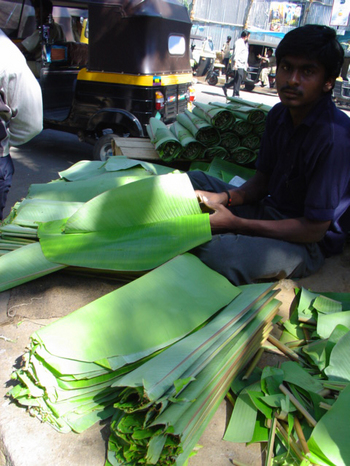
A banana leaf is a plate in Bangalore. The image above left shows a Ghandibazaar plate maker producing and selling leafenware on the street. The waste products of his production are eaten by noshing cows. This is 'everything but the squeal' vegetarian-style.
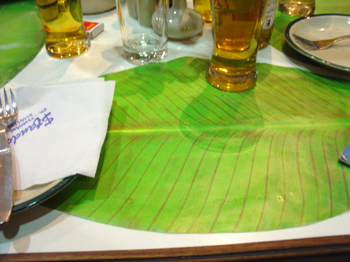
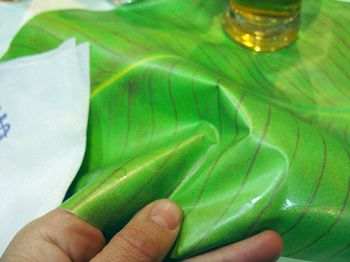
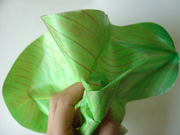
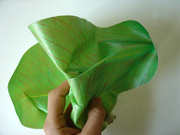
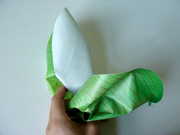
But Delhi is far far away from the banana climes of the South and an artificial banana leaf plate seems to be a logical substitute. This fabric photoshop job was doing duty as a placemat at drinking club, the Standard at CP before we procured it from the owners for the culiblog packaging archive.
Faithful culiblog readers are familiar with the entry just a few weeks ago of the pepesan sans pep dish, wrapped in bamboo leaves. I am curious about whether bamboo leaves bought at a Chinese supermarket in Amsterdam, imported from somewhere deep in the guts of PRChina qualify as ecologically sound plate choices, but I would like to hear from someone with a strong opinion - or better yet - some actual knowledge on this subject.
Q1: Is a one-use banana leaf plate a more sustainable choice than a ceramic plate in a place where banana trees are harvested?
Q2: Is a pack of dried bamboo leaves a more ecologically sound dinner party option than ceramic plates when the bamboo leaves are imported from PRChina and the dinner party is in the Netherlands? or Occitania?
Q3: Is a re-usable (maybe 100 times) fabric plate more ecological than a ceramic plate if the fabric plate is produced locally? (The plate can be rinsed in soapy water and rinsed clean.)
Q4: Are recycled paper plates like the ones shown in this culiblog entry or the tetra-pak plates more ecological than the different sorts of leaf plates if all of the materials come from local sources?
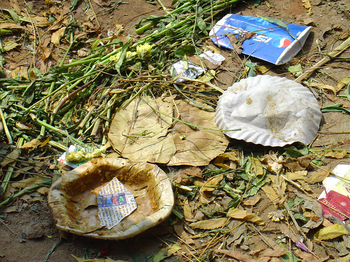
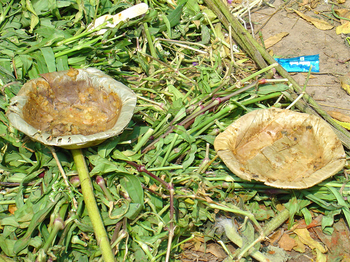
Pictured above are images of leaf plate and other vegetable (and non-veg) trash on the streets of Delhi.
How does one calculate the sustainability of a given object? Ceramic or stainless steel plates are produced under industrial conditions, raw materials possibly imported, packaging distribution all factor in. Imported dried bamboo leaves do quite a lot of travelling. Banana leaves seem ecological (if locally grown) but what are the conditions of the banana plantation and how are the leaves harvested? And what if you already own some plates? And what if you live in the city and don't have a compost pile or animals with four stomaches roaming the streets?
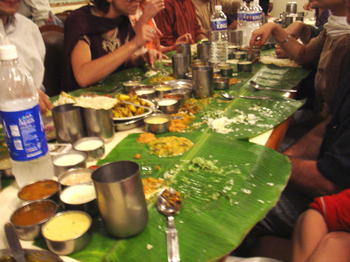
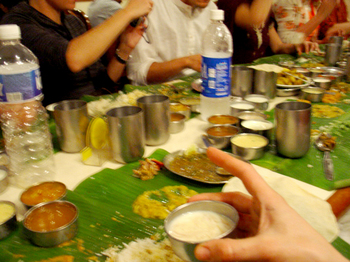
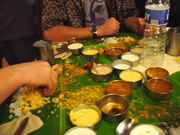
At an 'Andhra-style' restaurant in Bangalore we ate from real banana leaves. It took some getting used to getting a technique together that worked for this sort of wet food.
Posted by debra at 09:47 AM | Comments (5) | TrackBack
May 27, 2005
Pasta that is pasta
1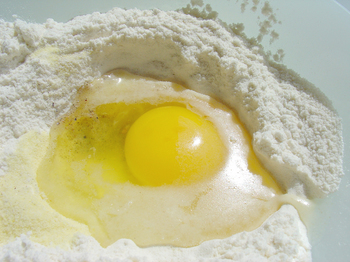
2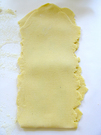
3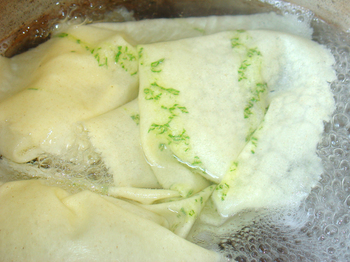
4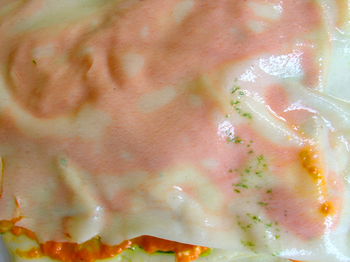
5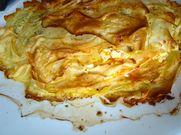
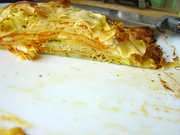
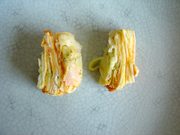
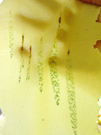
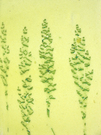
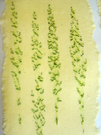
Last night the ladies Quirine, Helena and Sonia were over for dindin. We ate:
- Burgus and green mayonnaise
- Hippy's beard and inari-shitake rolls
- Pasta that is not pasta
- Passion fruit, juniper berry and ume boshi shaved ice with gjetost cheese and more ume boshi
and bubbles the whole time!
Posted by debra at 11:01 AM | Comments (7) | TrackBack
Pasta that is not pasta
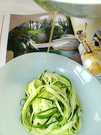
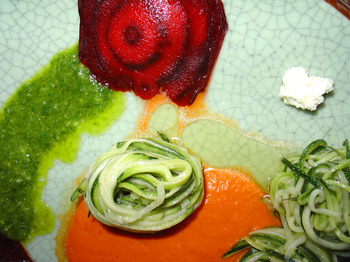
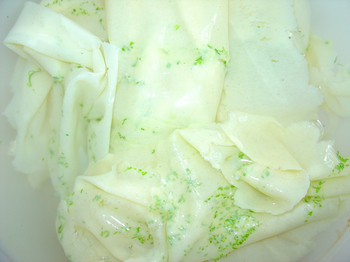
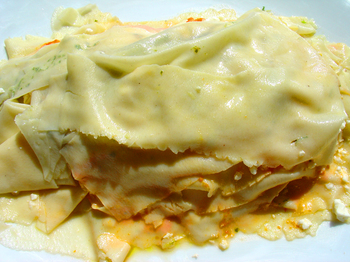
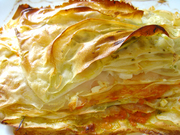
Finalement, Pasta that is not pasta. In this recipe I use thinly sliced raw courgette/zucchini as spaghettini, and courgette/zucchini and beet slices as ravioli. The main ingredient of the sauce is Turkish pickled and roasted peppers, a product I love because of the bits of charred skin still sticking to the pepper flesh. There is nothing like fire to add flavour to food, as our ancestors, if only they could respond to this blog entry, would readily agree.
Pasta that is not pasta
- courgette spaghettini
- courgette ravioli
- beet ravioli
- roasted and pickled paprika coulis
- rocket emulsion
The beet ravioli recipe you can find here. For the courgette spaghettini, please click Please read more to read more.
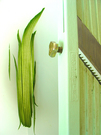
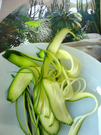
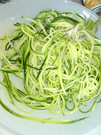
Pasta that is not pasta: courgette spaghettini (serves 2)
- 1 medium courgette/zucchini, ends chopped off, well washed and dried
- olive oil, use your cooking olive oil, not your fruitiest for this recipe
- garlic
- fleur de sel, because it doesn't dissolve and it 'crunches' nicely... or use sea salt
In this recipe, length matters and you will have to press the courgette firmly into the mandolin while slicing. Work carefully and securely so as to avoid injury using this extremely dangerous but handy kitchen tool.
Place the fine-toothed blade in the mandolin, working over a deep bowl, test the mandolin to make sure you can achieve a fine slice. You will get about 5 slices before getting into the pithy bit of the courgette. Once this threatens to happen, turn the courgette over and begin on the other side. Then flip the courgette 90° and do the other two 'sides'. You can recycle the pithy core of the courgette into a soup for tomorrow.
In a frying pan gently warm 5 long 'glugs' of olive oil throwing in mashed garlic at the last moment. If the garlic sizzles, the oil is on the warm side and you can cool it down by removing it from the flame and swirling the contents of the pan around to distribute the garlic. Pour the oil over the courgette and toss in the fleur de sel. Set the spaghettini aside for up to 2 hrs.
To serve, spear the spaghettini with a fork and wrap it around until you get a little nest of 'pasta'. Nestle the tangle of spaghettini in a puddle of pickled roasted paprika coulis (recipe below).
Paprika coulis
- pickled, roasted paprika (comes in a jar at a Turkish supermarket or butcher)
- olive oil (1tbs per pepper)
Sloppily drain 1 or 2 of the red peppers. Remove any seeds that may still be inside and blend with a bit of olive oil. Blend until straining isn't necessary, or strain.
To make the courgette ravioli follow the recipe here.
Rocket emulsion (serves 2)
- rocket leaves (one handful)
- olive oil (3 long glugs)
- garlic (to taste)
- juice of 1/2 a lime
- sea salt to taste
Blend all of the ingredient until emulsified.
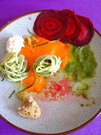



From l to r: a yet unfinished plate is still pretty, guest Michael Burke, guest and culinary historian/food writer Patrick Faas, guest and chef-inspirateuse Marlein Overakker.
Since October 2004 I have been working through the recipes in Klein and Trotter's RAW, an extremely vegetarian raw food cookbook. Because I am also in the process of writing a cookbook I know how difficult it is to make a cohesive set of recipes that represent a certain style of cooking. It is for this reason that I find it such a pity that RAW leaves out recipes using the technique of 'warm marinating'. This is when one warms up oils or infusions to around 50°c and puts the raw foods in them with the purpose of combining or intensifying flavours. In light of Klein and Trotter's abundant use of the dehydrator I find this technique more appropriate to the idea of of preserving the enzymes in foods and that is the foundation of raw food cooking.
Posted by debra at 09:01 AM | Comments (2) | TrackBack
May 14, 2005
Play with a mandolin
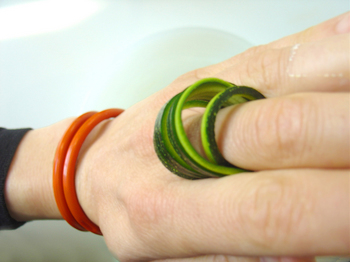
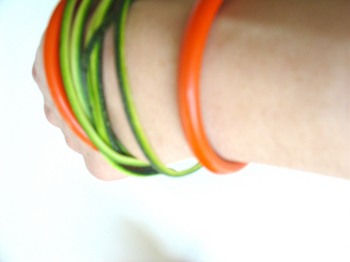
The original recipe for Pasta that is not pasta is coming. But first you need to own a mandolin.
Orange rubber bangles, model's own, courgette rings and bangles, model's own.
Posted by debra at 01:30 PM | Comments (4) | TrackBack
May 13, 2005
Garlic and beetroot
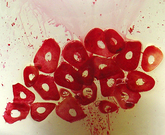
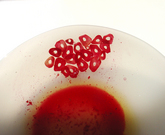
Sliced garlic, marinated with beetroot, lime zest, lime juice, fleur de sel and extra virgin olive oil.
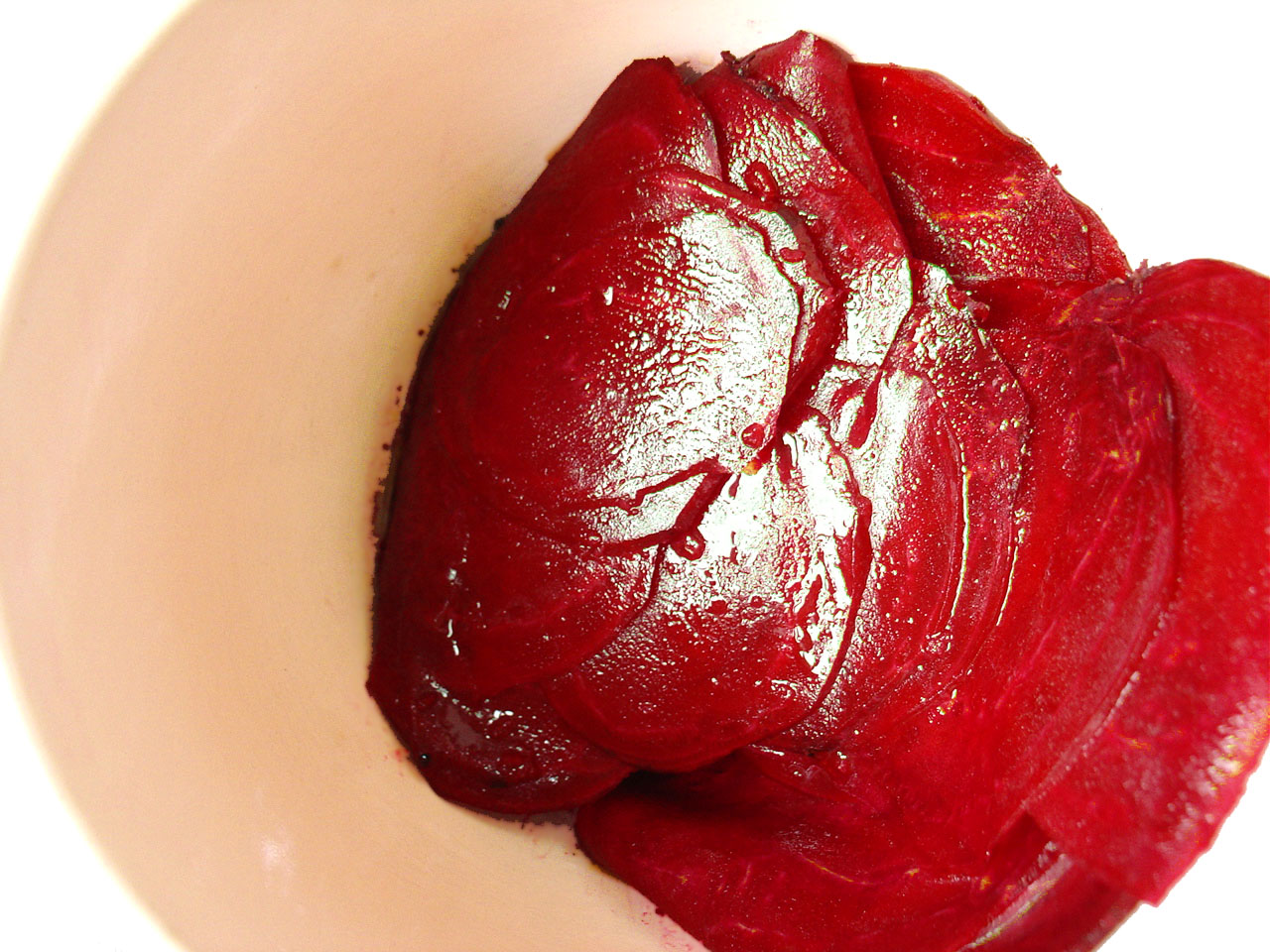
Sliced beetroot, marinated with garlic, lime zest, lime juice, fleur de sel and extra virgin olive oil.
See how that works!
Posted by debra at 01:23 PM | Comments (5) | TrackBack
May 09, 2005
Which one is the fish skin wedding anniversary?
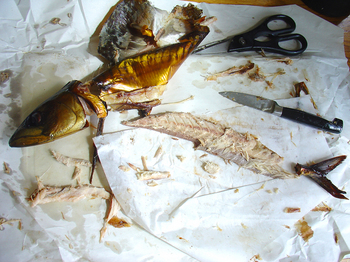
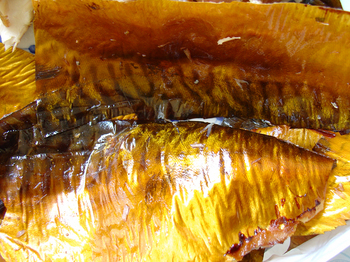
5th Wedding Anniversary Menu for John and Kristi
Pasta that is not pasta
- courgette spaghettini
- courgette ravioli
- roasted and pickled pepper coulis
- rocket emulsion
- even creamier cheese in a can
Pepesan sans pep
- grated coconut tamale with
- smoked mackerel marinated in tamarind and lime leaves
- sweet potato
- not very much sambal djeroek taking into account the delicate Northern palates
- coconut cream
Charlie Trotter's Banana and Chocolate Lava Cake
- w/ roasted mini bananae
John and Kristi have been married for 5 years and a celebration amongst friends is Saturday evening's event. Present: Debra, John, Kristi, Aya, Marseille, Lynne, Ivo, Little Lord Lloyd, Carolien, Alex and a surprise appearance by Sonia all the way from Delhi!
Posted by debra at 10:19 AM | Comments (1) | TrackBack
April 16, 2005
Sticking to the streets
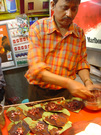
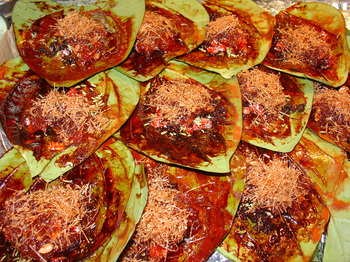
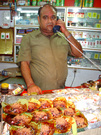
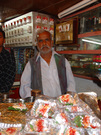
Delhi- Clustering their services in one Connaught Place kiosk are four paan salesmen, each selling a different recipe of this perfumed and intoxicating digestive leaf from the kiosk's cardinal points.
One very interesting thing we learned from two of the Nomadic Banquet participants, John Vijay Abraham and Sanjeev Shankar's street food research at the IIT Bombay, is that street food vending is not always a step on the path to restaurantdom. A case in point, they stated is Muchhad Paanwallah, a paan kiosk in Mumbai named after an impressive ear to ear mustache of the owner's father. The current owner, Jaishankar Tiwari has been immensely successful in his street-side paan business, so much so that his and the families of his four sons all live from it. If you can't visit his kiosk in Mumbai it's well worth checking out his website, where you can place orders for paan online.
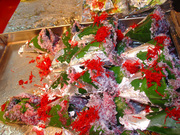
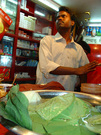
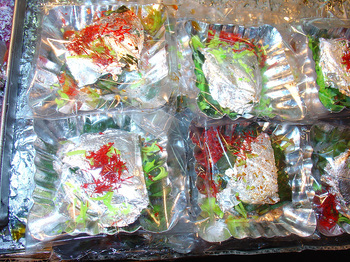
In the Nomadic Banquet workshop in Delhi, we discovered street food vendors are an integral part of the social fabric and this is likely to be the greatest asset they offer a community. Muchhad Paanwalla is immensely successful and Tiwari chooses to continue selling from his kiosk instead of going upmarket like oh so many smart cigar shops. This is important for us to realise as the perception persists that the street is an undesirable place (for a vendor) - as if the street is merely a stepping stone on the road to 'something better'. The success of Muchhad Paanwallah and others like him prove that exactly the opposite is true.
Muchad Paanwallah http://www.paan.com/about.htm
Posted by debra at 09:33 AM | Comments (2) | TrackBack
March 15, 2005
Delhi recycling, in all fairness
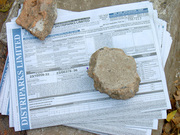
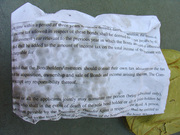
When is recycling not really recycling? When the recycled or re-purposed item never really had a purpose in the first place. These papers, have been left on the ground (location across the street from Jantar Mantar, Delhi), as far as I can tell, for no other purpose than to be repurposed. The image on the left is a stack of paper left on the street as an offering to the gods of the recycled chaat-bag-makers.
Packaging for chaat is often nothing more than a bag made from old newsprint or repurposed paper, or for the wetter stuff, a leaf plate. The bag pictured on the right was made from some terribly interesting literature about bonds. One can see the imprint of the deep-fried sweet peas contained within being absorbed into the paper making a pretty pattern.
Posted by debra at 01:07 PM | Comments (0) | TrackBack
March 07, 2005
Black Beauties, wafting truffles from Occitania
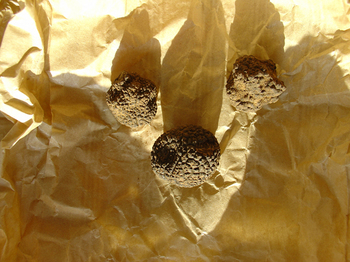
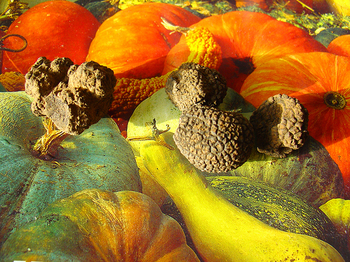
It wasn't a conventional Valentine's Day gift, but I do think it should become one. I am lucky enough to have dear friends that live in a part of the world where these elephant-skinned nuggets grow underground. Fortune would have it that 2 days before their arrival up here in the Polar Circle a local Occitanian Truffle Fête was in full-swing. and JT and Kristi were wise to bring a bag filled with the little nodules.
They present me with the bag, grinning from ear to ear. I put my face inside, and inhale deeply.
I am confronted with the most glorious, heady aroma, a combination of rich, loamy earth, wafting diesel fuel, fresh ground peanut butter, and fart. Now in just the right combination, that's a good thing.
Here's what I prepared for the 3 of us the very next day:
- Knolsla (celeriac cole sla) with truffled mayonnaise and beet ravioli
- Truffled Chicken in salt crust with 'basically raw broccoli' and truffle butter
- Pots de Crumbly Crumble (truffle-free)
Never have I received such a wonderful Valentine's Day gift; I was given an object but got an evening-filling experience. Thank you JT and Kristi!
Last summer (2004) I had the fortunate occasion to meet one of the creatures responsible for unearthing these lovelies. She is a dog named Tina, and like the majority of women in Occitania, her name is a derivative of Christine.
Posted by debra at 09:42 PM | Comments (3) | TrackBack
January 31, 2005
More raw beets for the neighbours
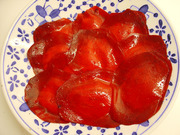
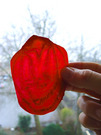
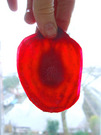
Raw beet ravioli. Delicious, beautiful and here I am hybernating. It was time for all of my vegetarian architect neighbours to meet over dinner. Click below for recipe.
Raw Beet Ravioli Solomonova (serves 4) (marinating time 4 hrs, hands-on prep 25 min)
1 large RAW red beet (scrubbed and peeled)
5 tbs good virgin olive oil
3 cloves of garlic
2 tbs rice wine vinegar, OR blood orange juice squeezed from the orange, OR lime juice...
sea salt
1/2 cup homemade cashew cheese or 1/2 cup sheep cheese in a can mashed together with milk for moist and sliced green onion for that glowly colour we all like so much.
In a heavy bottomed skillet lightly warm the olive oil. Don't cook it, W A R M it. Press the garlic into the WARMed oil, remove the skillet from the flame and swish the pan around to mix in the garlic.
In a deep bowl slice the raw beet root with the aid of a mandolin into paper thin slices. This means you could read the paper through the slices if it weren't for the beet's dark colour. Work quickly. Pour the still warm olive oil over the beet slices, add the rice wine vinegar or orange squeeze or lime squeeze, sprinkle with sea salt and swish around to mix. Cover and leave for some hours (or even days) to marinate.
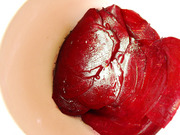
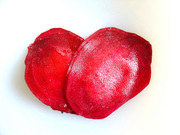
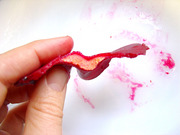
When you are ready to serve lay out the plates in your workspace. Take a slice of beet and sloppily scrape off the excess oil on the side of the bowl. Using a teaspoon carve a mini quenelle of cashew cheese from the cheese lump and place it in the centre of the beet slice. Take another beet slice, remove excess oil and place neatly on top of the other slice. Seal the edges gently, mushing the cheese to form a little ravioli. Arrange the raviolis on a plate, 3-5 raviolis per person is a nice way to start a dinner.
Posted by debra at 11:36 PM | Comments (10) | TrackBack
January 20, 2005
Brain Food
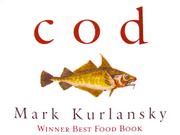
This terribly sad but well written book by Mark Kurlansky is a gripping history from the perspective of the cod. Kurlansky tells how fishing for this gadiform has deeply affected the wealth and development of many nations and technologies. I'm thinking the Flounder by Gunther Grass that I read back in the day but even more I'm thinking Fish Story, the mega-artwork by Allan Sekula, about the 'sweatshop called the Pacific'. (Sekula's visual history Fish Story was part of the the last Documenta XI in Kassel. One photograph in particular gave me goosebumps. You see a ship painter giving the Exxon Valdez a new name...fishy stuff.)
It turns out that cod in the form of stokvis (wind dried cod) turned out to be some good thinking-man's protein for the Norsemen. That extra portable brain-power enabled them to encounter New Foundland in 1000, where they also encountered the Beothuk People who had already discovered it and were not enamoured with the idea of sharing their space with the pink and hairy people from across the puddle.
Basques added salt to the stokvis recipe to make salt cod increasing the quality of the preservation and enabling Basque fishermen to to travel even farther - to the mouth of the St. Lawrence river. When explorer Jacques Cartier got there raring to claim his 'discovery' he encountered almost a thousand Basque fishing vessels. And a bunch of angry native Beothuk people getting pissy about the incessant attention.
Cod is inextricably tied to land (to dry it) and salt (to preserve it) and Salt is in fact the title of another one of Kurlansky's wonderful books.
Posted by debra at 08:54 PM | Comments (3) | TrackBack
January 19, 2005
Keeping one's vows
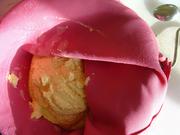

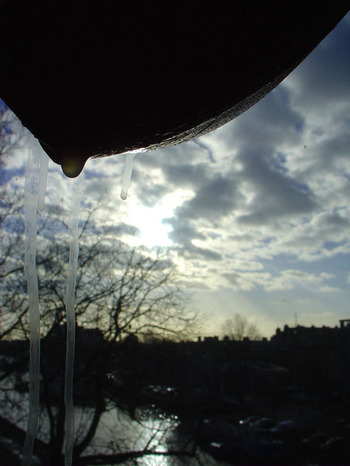
Remember in October when I had just bought Roxanne Klein's R A W and I reported how it made me homesick for Laurel's Kitchen? And then upon rereading Laurel's Kitchen I made a vow to 'take cashew cheese seriously' from now on?
Well, I have been taking cashew cheese making very seriously indeed, and I believe I have improved upon the Good Ladies' recipes. Pictured above are some of the steps in this easy process (from l to r: placing the blended cashew butter in a cheese cloth, cheese cloth hanging in the window, cheese cloth dripping with cashew milk and dark winter sky).
Cashew Cheese Solomonova (makes one cheese)
(process time: 3 days, hands-on: 30 minutes)
2 cups raw cashews (soaked in cold water for 1 day and drained)
3 tbs water
3 tbs fresh and bubbling kimchi juice (secret ingredient)
sea salt
Blend the cashews, water, juice and salt until extremely smooth. This takes about 4-6 minutes.
Prepare the cheese cloth. In this case that means any sort of loose weave cloth that will let liquids pass through - it can be a tea towel. Wet the cheese cloth thoroughly and devise a way to hang it somewhere where the 'cashew whey' can drip into a container. I like to use my window handle and a meat hook probably because it appeals to my quirky nature.
In a bowl place the open cheese cloth and dump in the wet cashew butter, tie it up, hook it up and let 'er drip. Now is the time to quit obsessing about this dang cashew cheese. Let the cheese drip at least 8 hours or whatever is convenient. (If you start in the afternoon, the cheese is 'dry' the next morning.)
When the cheese is dry, take down the cheese cloth trying not to disturb its' form. Gently peel the ball of cheese away from the sides so that you can place the cloth without too many folds into a container - like a recycled yoghurt tub. Fold the cloth over the tub 'to close it' and place the cheese in the fridge for at least 24 hrs.
After 24 hrs the cheese is finally ready. You can eat it now or save it up to a week in the fridge - it will just get better as it 'ages' because of the cabbage juice fermentation. Cashew cheese made like this is similar to a soft new dairy cheese and you can serve it without any shame as part of a cheese course with young goat and sheep cheeses. Of course you'll soon want to experiment with flavouring it in different ways but I found that the kimchi juice gave the 'cheesiest' flavour.
Posted by debra at 05:09 PM | Comments (3) | TrackBack
December 13, 2004
Re-enact creaming

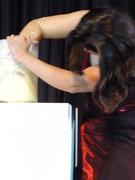
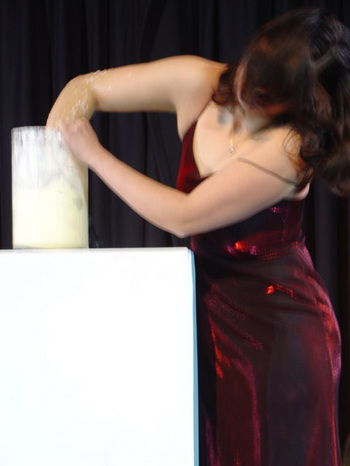
Mediamatic and CASCO's performance night titled Re-enact was rife with food related performance art. My absolute favourite performer was Nezaket Ekici who oh so diva-liciously turned cream into butter with her bare right hand. It took 24 minutes or thereabouts. Everyone was aswoon!
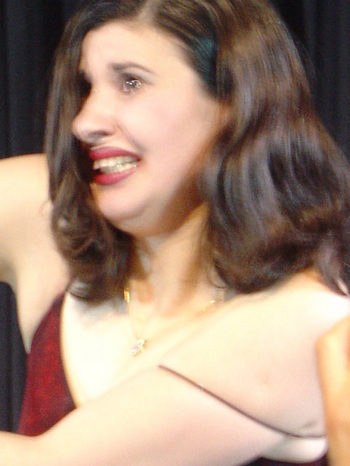
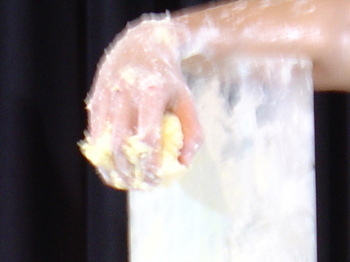
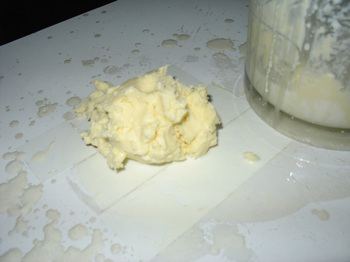
Here's a review by art critic Paul Groot in Dutch.
Posted by debra at 01:47 PM | Comments (0) | TrackBack
December 10, 2004
Dabba Wallah - git yer tiffin while it's HOT
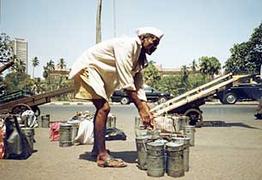
You're a dutiful wife (actually I'm temporarily in-between relationships) and nothing short of your own love-imbued cuisine will suffice to nourish your office-bound husband for his lunchtime meal. Problem is you're out in the suburbs of Mumbai and he's situated downtown for the lunchtime hours. How are you going to get something hot in Lovey's tummy?
Easy. You pay 150 rupees (EUR2,55/GBP1.70/USD3.40) per month for a Dabba Wallah service and let the 'tiffin guy' or lunchbox carrier bring the Mr. his grub.
In Mumbai (pop +16 million) there are reported to be more than 5,000 Dabba Wallahs. A "Dabba" is a 'tiffin' or 'lunch box', a 'Wallah' is a man or the carrier. The Dabba Wallahs deliver home cooked meals, picked up piping hot each morning from suburban households, and distribute them to more than 170,000 office workers spread across the entire city. This system relies on multiple relays of Dabba Wallahs, and a single tiffin box may change hands up to three times during its journey from home to office.
No matter that few Dabba Wallahs can read or write, they interpret a series of colour coded dots, dashes and crosses on the lids of the lunch containers, indicating the area, street, building and floor of the Dabba's final destination. The Dabba Wallah margin of error has been calculated at an one mistake in eight million deliveries, an accuracy that has earned the Dabba Wallah system a Sigma 6 rating by Forbes magazine. 'Sigma' is a term used in quality assurance if the percentage of correctness is 99.9999999 or more. Here comes the math: for every six million tiffins delivered, only one fails to arrive. This error rate means that a Mumbai tiffin goes astray only once every two months. Anyone else we know who got this same Sigma rating? Oh that would have to be Motorola.
Dabba Wallah distributed system has been going strong since 1890 according to some sources. In doing the 'research' for this entry I came across the term twice in a list of internet innovators under the header 'packet protocol'.
For more information take a look at the following urls:
Tiffin Bites, the package, but not the distribution. This English company sells neat lunch packages that one can buy from stores not yet stalls and definitely not delivered to office. Their tiffin containers are made of plastic and not aluminium because, 'We're not made of money!'
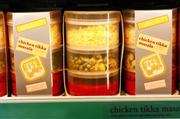
Here's a nice story on the Tiffin Bites website about the Dabba Wallahs.
Dear Jouke tipped me this film: Dabba Wallahs.
A well written article about the Dabba Wallah.
Posted by debra at 12:02 PM | Comments (0) | TrackBack
November 16, 2004
The Banquet Years
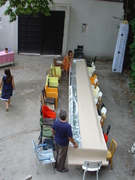
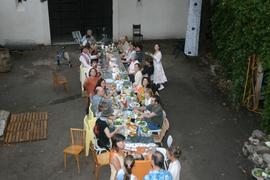
Guess what we did last summer... we had a banquet!
Maybe because my last entry looked so pitiful, the colourful cakes and the leaden November sky. I thought it was high time to upload some images from this summer's culinary activities - and not just to some dank place in the culiblog archives.
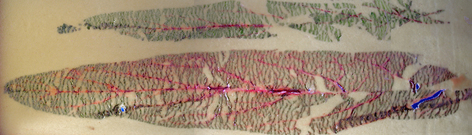
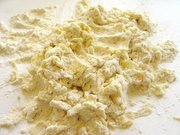
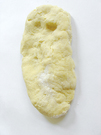
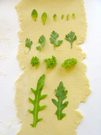
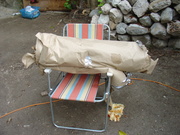
As a community we ate off two, 8 metre long rolls of homemade pasta lasagna, into which sage and beet leaves had been pressed (see composite photo above) and when we were done, we rolled up the entire table.
Click for the slideshow here. The images in it are all photographs by Kristine Malden, a friend who thankfully was our guest that August evening.
Posted by debra at 05:44 PM | Comments (0) | TrackBack
November 05, 2004
Hash Shakes are sooooooooo passée
Well, what were You eating one and a half years ago?
Bhang Shake (serves 3)
Aditya and Arjun (not their real names) dosed me with the vivid high of this sublime hash milkshake one and a half year's ago.
What were we THINKING!!!
Make thusly:
- milk (1 ltr.) (the higher the fat content the better)
- hash (1 centimetre - how much is that? I am so old.) (warmed and crumbled)
- sugar (to taste, substitute with honey or maple syrup)
- cloves (freshly crushed in a mortar)
- saffron (don't skimp on the saffron)
- cinnamon (the finer the better - pulverise with your fingers first)
- cardamom (open the green pods - grind the black seeds.... throw the pod husks in with your coffee beans for tomorrow morning)
With a staff-mixer in a tall container blend the hell out of all of the dry ingredients together with 3 tbs. of the milk. Slowly add the rest of the milk and make sure you work up a good head of foam. Ice is for pussies. This bhangshake gets you gradually stoned in a really gentle but increasingly psychedellic way. Good afternoon drink but don't mix with alcohol.
-=-=-=-=-=-=-=-====--- - - - - - - -====-=-=-=-=-=-=-=-=-
A Dinner for Two Massively Gay Indian Babe Magnets - (Go to Sleep, Radiohead 2003, Hail to the Thief)
- japanese frozen landscape borscht with quickles and creme fraiche
- summer thai-spiced sfoglia layered with lime-pickled beets, mint mojo, rocket and cheese-in-a-can
- the burgus course :: white burgus, baby crayfish in butter, roasted new potatoes, tea egg and tea bearnaise
- saffron hang-op with mango blood-orange sunset granité, rosewater crystals and oven-dried blood orange crackers
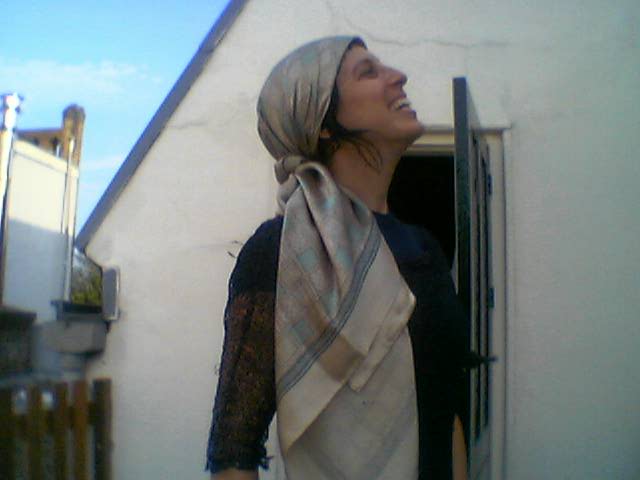
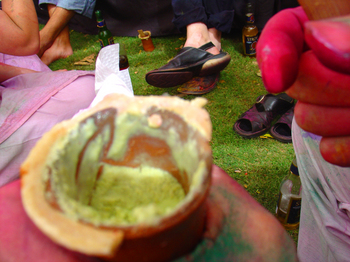
UPDATE: View March 26, 2005 Holi pictures online here. (Images l to r: Author high as a kite in a handblocked silk scarf, a gift from Aditya, a fuzzy photograph of a traditional clay pot filled with bhang ice cream. The top of the ice cream is sealed with dough.)
Posted by debra at 08:58 PM | Comments (7) | TrackBack
October 08, 2004
Learning through your Ass: The Return of Laurel's Kitchen


When I became a vegetarian at the tender age of 13, my parents, fearing that I would stunt my own growth gave me what was considered at the time to be a good introduction to vegetarian nutrition, amino acid chains and global food politics. It was my first cookbook ever and its pictureless recipes for soy-milk, cashew cheese and other 'technically advanced' foodstuffs threw me completely for a loop.
It was California in the 70's but my Mom wasn't about to go foodshopping in a store filled with goat-knitting long-hairs smelling like garbanzo farts, and I didn't know that you could simply go to an Asian supermarket and BUY a ready-made block of tempeh. So when one of Laurel's recipes called for say, soy milk and said, (see recipe page 138) I would actually make the soy milk - often with unsavoury results.
Due to a series of 'intrusive kitchen disasters' my mother decided that I could only do the big preparations for the week's food on Sunday. (Not the fresh things, just the... legume-rich things.) Considering that I had turned the family kitchen into a soybean laboratory it wasn't entirely the cruel thing to do. I would prepare my vegetarian food for the week ahead and microwave it warm each day. For an experienced cook, preparing food in advance wouldn't have posed much of a problem but I had very little PRACTICAL cooking experience. I couldn't tell beforehand if a recipe was difficult and mistakes I made on Sunday were the grits on the table the livelong week. This educational technique is known in some cultures as 'learning through your ass'.
I was cooking outside the repetoire of my family and Laurel wasn't helping. Laurel's Kitchen, although an amazing source of 1970's California anthropology was absolutely a crap book for an inexperienced cook.
But yesterday when I brought home Roxanne Klein and Charlie Trotter's R A W, the first thing I did was pull Laurel from my shelf for one more read.


This is the text on the inside flap:
"An original and, to me, irresistible presentation, as useful as it is inviting."
-The New York Times Book Review
Ten years ago, Laurel Robertson, Carol Flinders, and Bronwen Godfrey decided to raise their families on natural foods. They had discovered that good eating habits lead to good health and made people feel stronger, happier, more alert, and more alive.
Laurel and her friends wrote this book because they wanted to share their unique kitchen experiences and pass on a solid collection of tempting, inexpensive vegetarian dishes. But Laurel's Kitchen is not just a cookbook. It is a handbook of vegetarian nutrition. Filled with practical information on viatmines and minerals, the four food groups for a meatless diet, weight control, and ways to preserve nutrients in your cooking, Laurel's Kitchen is the book Laurel and her friends wished they'd had when they took their first tentative steps into the world of vegetarian cookery.
Posted by at 01:09 AM | Comments (6)
August 31, 2004
Harvest begins and Summer leaves off

At Fred and Kristine's the tomato harvest is in full-swing. This is my adhoc collection of pear tomatoes, the beans are at my feet. They planted 19 other sorts of heirloom varieties but old-fashioned girl that I am, I just prefer the cherry tomatoes. This is evidenced by that fact that I don't appear to have any in my skirt. I have eaten every last one of them.


Earlier that day I had packed my yurt up for the winter and my upperbody ached from lifting yak felt. I was too tired to do any innovative cooking that night.
Posted by at 12:16 AM | TrackBack
July 13, 2004
No Rest for the Rugged

There you are, a pre Iron Age chef and you want to whip up a fine bouillon for tonight's f�ete. It's easy as pie... read on.


Have a fine young man carry the skin of the boar you just slaughtered outside. Ask him sweetly to dig 2 holes in the ground. Have him start a hardy fire in one hole and line the other hole with the boar skin. Dirty to dirt. Wet to wet. You can nail it to the earth before filling it with cold water.
Put some stones into the fire. Make sure that they are proper igneous rock or they could explode in the heat and take out the fine young man's eye. You will need about 7 stones for the size skin pictured here below.

Click on this image for nice detail - you can see the cut marks of the vegetarian butchers and as well a reflection of the trees and sky in the water.


Fill the skin with cold water, chop up some delicious vegetables and toss them in with a goodly deal of salt. Now to get this bloody water piping hot just place the now red hot stones in the water. One at a time. The soup will sputter and this is all very dangerous so pay good attention to what you are doing and how the materials you are using behave. (Don't be overly cautious either or your tribe will starve or worse, someone else will become supreme chef.) When the stones don't seem like they are heating anymore, take them out and toss them back into the fire to heat up again. Keep adding the hot stones and taking out the cold ones until the soup is hot. A bigger hole, a bigger fire and you've got yourself a nice bath!

You will not be able to avoid getting ashes and dirt into the soup. Don't worry about this. Just like preparing bouillion on a gas stove, you will skim the crud from the top and discard, and the mud will fall to the bottom. You will simply not scoop this out when you transfer the soup to a serving terrine. Before the folks had serving terrines they probably just squatted around the hole and dipped in with their own vessel.
Posted by at 10:42 AM | Comments (0)
July 12, 2004
If it Bleeds, it Leads

That's was one of the more memorable lines in Michael Moore's, 'Bowling for Columbine'. Moore is speaking to a TV producer, asking him to explain why there are so many fear evoking images on the US nightly news. The TV producer replies self-evidently, 'If it bleeds, it leads'.
I thought the line was a fitting title to the next few entries of Culiblog in which I will document a workshop that I followed at the Jan van Eyck Academie in Maastricht this last February. Onno Faller led a workshop titled, 'Cooking as Genre' the last two days of which were devoted to a little dead wild boar. Above you see Natasha and a handsome bald bloke, BOTH VEGETARIANS, skinning the poor dead beast.
Although I have killed hundreds of animals for food and skinned them and prepared them, I never find this an easy task. I find myself gritting my teeth as I remove their jackets. I am not repulsed, but I feel sad for the animal, I feel the extreme tension of the killing and of a death that I initiated by wanting to eat the animal. Every animal, even a lobster, fights for its life as we would do. And it never ceases to amaze me that once the animal is skinned, it becomes just a piece of meat to me and my mind switches to the matter of the marinade.
If you want to see the entire process, click further.

When skinning a boar (or most furry animals for that matter) you begin by cutting around the foot. You want to cut through the skin layer, and then a line down the arm vertically so that you can 'get in there' with your knife. Your damn sharp knife.


Taking great care not to puncture the skin (because you're a pre-Iron Age chef and you're going to make soup in it tomorrow) you 'shave' close to the meat, pulling away the skin with the other hand.


Oddly enough, the Jan van Eyck Academie metal shop was the perfect place to skin a boar. The overhead tackling system made skinning a lot easier than it would have been if we had just used the table. Whenever possible, try to get gravity on your side.


Here's a very handy tip for your work surfaces: cover the tables with THICK (240 grams) paper. This is an easy solution to solving the hygiene issues associated with preparing (wild) animals. You will still need to thoroughly wash the tables afterwards, but maybe a little bit less throughly than if there weren't a layer of paper. By the way, its the outside of the animal that's really dirty.


Tomorrow I'll show you what we did with the big pieces of meat but I promised marinade, and marinade you shall have. Beer, onions, lemons. That's Russian for kebab marinade. And as it says in the Talmud, 'Do not refridgerate the thing that must not be refridgerated'. That is to say, 'wine cellar cool' is cool enough for marinating overnight. Whenever possible try to get the enzymes on your side.
Posted by at 01:28 PM | Comments (4)
June 20, 2004
Moralist hangups

It's a day for raucous rejoicing when an immigrant to the Netherlands can help the natives remember their culinary traditions. Hangop is a Dutch summer dessert. It is simply yoghurt hung up in a wet tea towel until all of the whey has drained out of it, thickening the yoghurt in the process.
'Why drain yoghurt yourself?' you may ask. Indeed, why hang up yoghurt when we can now buy perfectly delicious, hyper-thick and fatty yoghurt at Turkish shops. The Turkish version even comes in a handy tub that when recycled works brilliantly as vernacular tupperware.
The reason you should drain your own yoghurt is that this process is beautiful to behold and it yields a urine coloured water called 'whey'. Drink whey as a thirst quencher. Served ice-cold, there is no subsititute for piercing through the thick wall of mucous produced by an 80 kilometer cycling adventure than a good glass of whey.
Citrus Hangop serves 4-6)
- 1 litre of yoghurt 'well-hung' means at least 6 hours of hanging in a pre-moistened tea towel. Knot the corners of the towel around something high up and pour the yoghurt into this 'sack'. Put a container underneath to catch the precious whey dripping through the cloth.
- 1 teacup of syrup from the orange marmalade as a sweetener (or maple syrup)
- zest of 1/2 a lemon
- juice of whole lemon
- 500 ml of whipping cream, well-whipped
Whisk together until satiny smooth.
Fold in:
- a few grains of saffron
- a few squirts of rosewater
Set aside to chill for at least 2hrs.
Posted by at 04:35 PM | Comments (3)
May 08, 2004
Eat Yer Snakes

"Well because my Auntie was a Mormon missionary and she was actually E A T E N A L I V E by snakes. Ever since then I haven't had much apetite for snakes. "
"Nope, not even if they're skewered."
Posted by at 04:48 PM | Comments (0)
April 06, 2004
Chinese Frozen Food Code De-mystified

Packets of sticky rice in the frozen food section of the supermarket. The green string tying it all together indicates a vegetable interior, the pink string signals pork and the yellow string is a sign for chicken. In the supermarket there is a GREAT assortment of these in a frozen foods section which seemingly stretches for miles.
Posted by at 10:59 AM | Comments (0)
April 02, 2004
Feeding the Animals

A shellfish as large as your arm. That's good eatin'.
Posted by at 10:17 AM | Comments (0)
March 25, 2004
Duck Entier en plastique

Duck under plastic wrap at a food-court style restaurant in Nanjing, PRC
Posted by at 08:12 AM | Comments (0)