
Let farmers be bygones
June 17, 2006
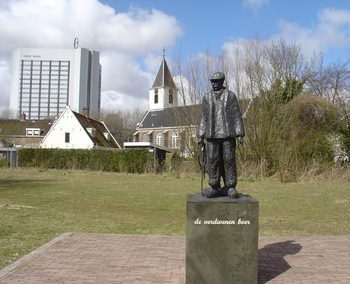
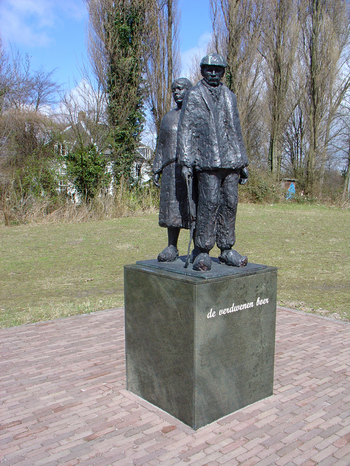
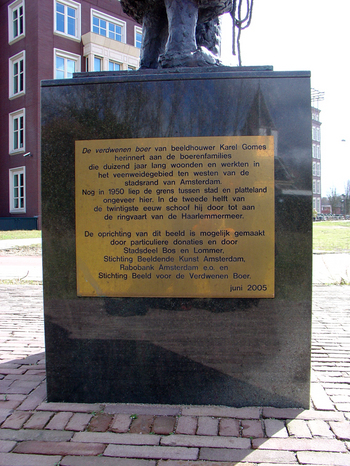
Let bygones be farmers? On the other side of my neighbourhood park there is a monument in honour of the 'lost farmer', farmers lost to change. The text on the back of the pedestal says, The Bygone Farmer by artist Henk Gomes commemorates the farmers that for thousands of years lived and worked in the fens to the west of Amsterdam's city limits. Until the 1950's this was the border between city and the country. In the 2nd half of the 20th century this border was pushed back to the peripheral waterway beyond the Haarlemmermeer.
The placement of this statue has been made possible by funding from private donations and with donations from the Amsterdam borrough of Bos en Lommer, the Amsterdam Foundation for Visual Arts, the Amsterdam Rabobank and also the Foundation for the Bygone Farmer.
The task of translating the Dutch verb verdwenen has been preventing me from writing this entry since I took these pictures back in April. Verdwenen can mean a lot of things, and none of which sound particularly as poetic in English as Verdwenen Boer does in Dutch.
Lost,
extinct,
vanished,
disappeared.
They used to be here.
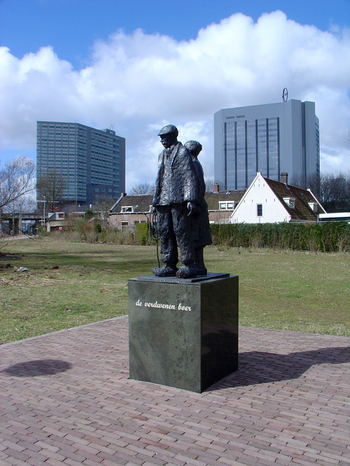
Nice that the artist included the boerin in the actual sculpture, although he left her out of the title. In Dutch, the female farmer has her own word. Maybe Gomes was using the term boer as a general term.
Speaking of Dutch public art commissions, check out the iron line drawing on top of the tax building.
Posted by debra at 06:48 AM | post to del.icio.us
Irrigate, ice skate
February 28, 2006
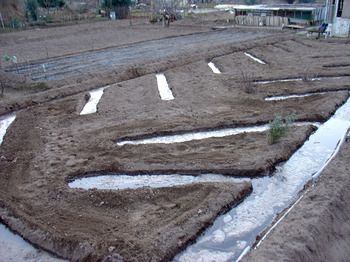
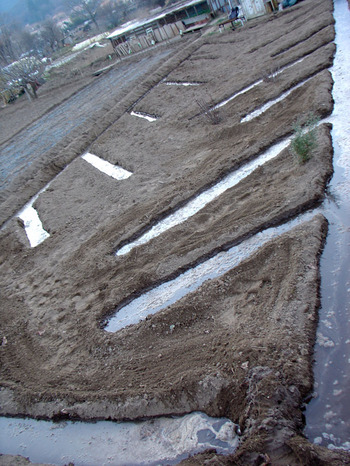
Took the new irrigation system out for a spin and it looks like I have a hunquering for the Netherlands. The idea is that all manner of plant life will grow along the borders, if it would just stop freezing for one day.
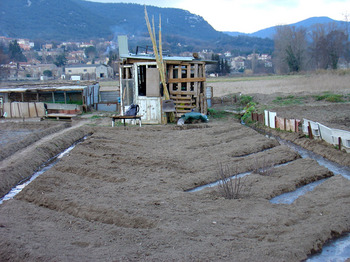
Vernacular architecture. Surely I have the ugliest shed in the gardens and hope that a good flood will wash it away.
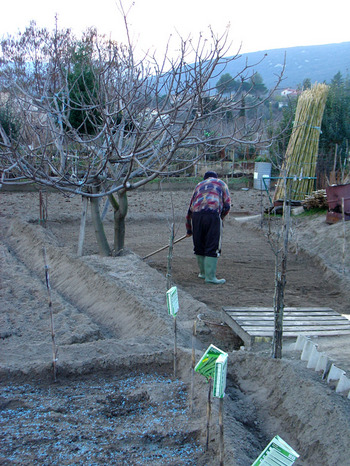
My sweet neighbour Sidi AlGouche, who saw me pissing about with the main canal structure, took the hoe from my hands, (Gimme that hoe, Ho!) and laid out the canal perimeter. He's so bored right now that he's raking his lands for the fourth time. Note, the blue pills that he gives his garden.
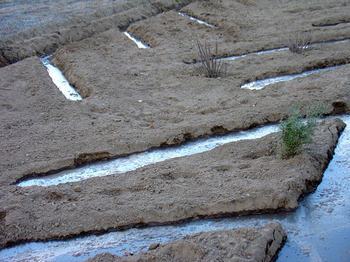
Irrigorgeous!
technorati tags: allotment, kitchen garden, irrigation
Posted by debra at 11:56 PM | Comments (3) | post to del.icio.us
Grow your own dang food
January 30, 2006
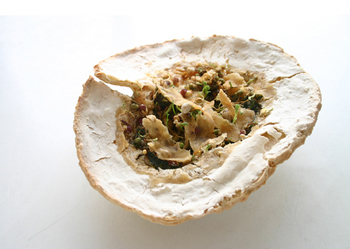
Back in the eighties, as a student at the University California at Santa Cruz, I lived in a vegetarian commune with a bunch of hippies. As hippies, we produced our own sprouts, yoghurt and salsa fresca for the entire commune, approximately thirty people. I had all but forgotten this part of my life until recently, when my Food Atelier students at the Design Academy Eindhoven started working on ways to grow their own food. The work of two enthusiastic students got my wings flapping enough for me to dare revisit my past. These are the images from the first trials, theirs and mine.
After initial attempts at growing mung sprouts in bread (see above), Cygalle Shapiro is successfully growing a ready-made 'salad on salad'.
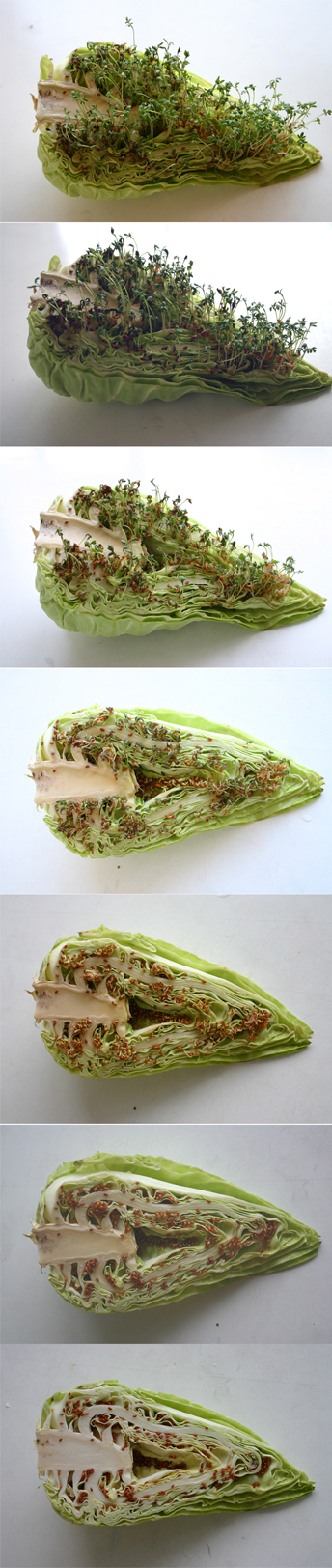
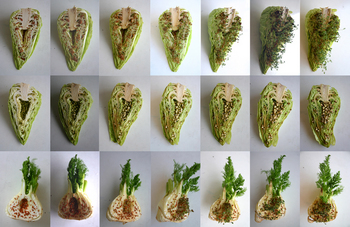
images top to bottom: sprouts in bread, salad on salad, sprouting experiments courtesy of Cygalle Shapiro, copyright Cygalle Shapiro 2005 - 2006. Contact culiblog for further information.
Liora Rosin is growing sprouts in labneh, a fresh yoghurt cheese, commonly made at home. For Rosin it is important that the seeds are grown within the labneh in order to transmit the flavour of the sprouted seed into the delicately tangy cheese.
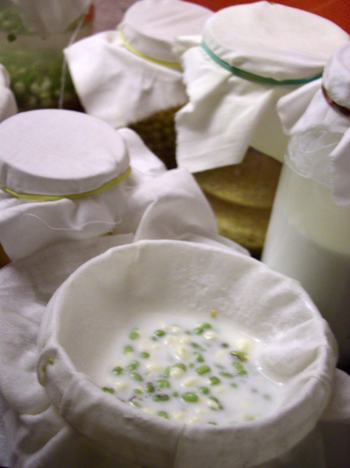
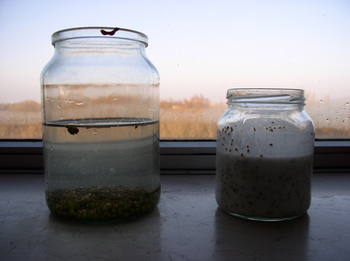
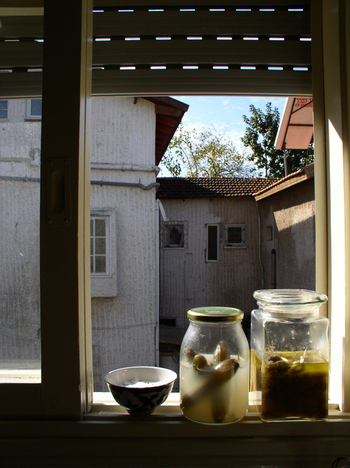
images top to bottom: home sprouting installation, soaking, lactic fermentation sill; courtesy of Liora Rosin, copyright Liora Rosin 2005 - 2006
Wouldn't the world be a better place if we all had a designated windowsill for lactic fermentation?
Having resolved to practice what I preach in 2006, I am also working on growing sprouts on labneh and find that the experiments coördinate nicely with my developing a good recipe for yoghurt ravioli.
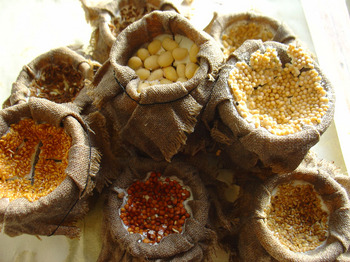
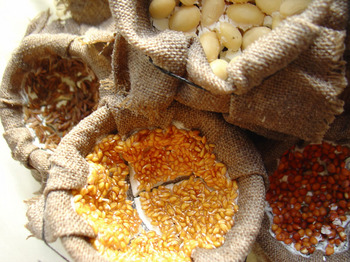
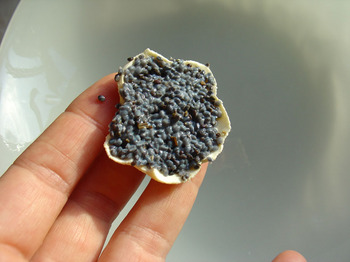
This is a cute disaster of basil seeds rotting into overly dry labneh. Seeds that become gelatinous when they are moistened (e.g., basil, buckwheat, watercress) are poor candidates for immediate immersion on or in the yoghurt medium.
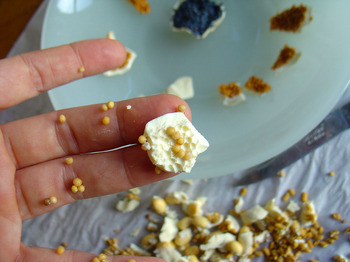
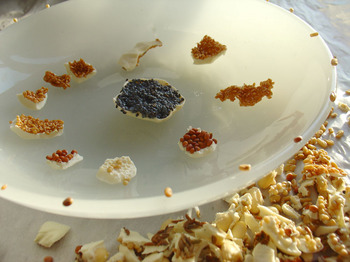
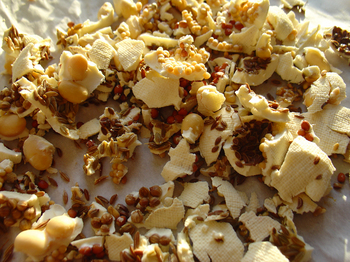
images top to bottom: sprout collection 2x, basil on labneh, playing with mistakes, pretending sampler, curd seed brittle; Debra Solomon
The results of an unsuccessful attempt at growing woody spice seeds (dill, coriander, cumin, kummel) in yoghurt medium with the intention of flavouring the labneh were not especially delicious, although visually exciting. The linen and the seeds texture the labneh beautifully and I look forward to spin a few successful recipes from these experiments soon.
Lori Alden's cheese definition site
N55: Manual for city farming plant modules
N55: Manual for home hydroponic unit
Sproutman's sprout bag. Any idiot can make one, but Sproutman is somehow selling them! My experience is that growing sprouts on wet linen works much better than growing them in jars. I have never tried sprouting in a linen bag.
Here are other urban gardening solutions, mostly rooftop gardening related:
- Rooftop Gardening link hub. Yes, it's a trend!
- Plant vegetables on your rooftops, like they do in Egyptian cities
- Toronto rooftop gardening project
- Greening Gothan Project, NYC also on the roof
- BLDG blog on rooftop farming in London
- Treehugger reports on Toronto rooftop gardening facts and figures
technorati tags: rooftop gardening, urban gardening, food security, sustainability, farming, food-related design, agricultural diversification
Posted by debra at 11:52 AM | Comments (8) | post to del.icio.us
Rural design conference scheduled for September 2006
January 21, 2006
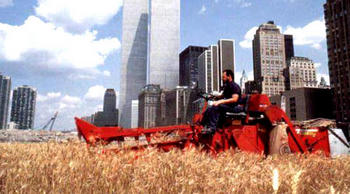
(above: Wheatfield, a large public work by Agnes Denes, image copyright Agnes Denes)
Chapeau to John Thackara at the Doors of Perception blog who reports today about a rural design conference scheduled to take place September 4-7 2006 (somewhere) in the UK. Just have a look at what's being developed for the programme! I am pleased to see that it is all about establishing and strengthening real connections between (urban) cultural producers and rural agriculture producers to the benefit of both.
In a conference forerunner in July of 2005, this is what they were talking about: farmers as curators - an international Rural Biennale for 2007, sustainable farm diversification, rural tourism, food marketing initiatives and staging the Rural Biennale as an integral part of a European Region of Rural Cultures and Farmer Creativity celebration.
To the list of interesting subjects already discussed and in the planning for September 2006, I would like to add: 'rural farmer to urban farmer advisory partnerships for urban gardening/farming initiatives'. I can't help but wonder if the experience and knowledge of the rural farmer can help urban farming inititives such as this wonderful urban farming project in East L.A from being under threat of closure due to urban land-use issues. Injecting (cultural) life into family farms suffering brunt of (European) Agricultural Policy might be just the ticket for rejuvenating a way of life under threat of extinction. Might not the urban farmer benefit from being part of this discussion and network?
- European Rural Culture events page
- Littoral - new zones for critical art practice. An excellent organisation website, with informative links on everything from an extremely mixed bag of individual artists and designers that use nature / agriculture / landscape as a creative platform, to cultural documents on foot and mouth disease!
- Cultural Documents of the Foot and Mouth Crisis in the UK
- Urban food gleaning project by Fallen Fruit
- The South Central Farms website is good reading if you want to get fired up!
- Pruned, weblog on landscape architecture and related fields.
- Pruned blog entry about South Central Farms in L.A.
- Pruned on artist Agnes Denes
- Brilliant films by Raymond Depardon about the demise of French farming communities in the Lozere were shown at the 2005 Int'l Documentary Film Festival in Amsterdam (IDFA) as part of a special tribute programme.
- Farming as a a landscaping trend in suburbia! (Landscaping is responsible for more than 80% of water use in the suburbs.)
- Doors of Perception review of urban farming proposal by Dutch architect Winy Maas
- Non-sanctioned urban gardening in Istanbul, entry in culiblog
- Innovation Network Rural Areas and Agricultural Systems
technorati tags: rural design, food security, sustainability, farming, food-related art, food-related design, food-related film, Raymond Depardon, agricultural diversification, agricultural policy, urban gardening
Posted by debra at 11:47 AM | Comments (1) | post to del.icio.us
Sort of public gardens
October 21, 2005
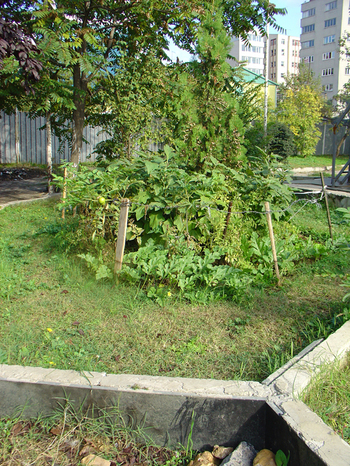
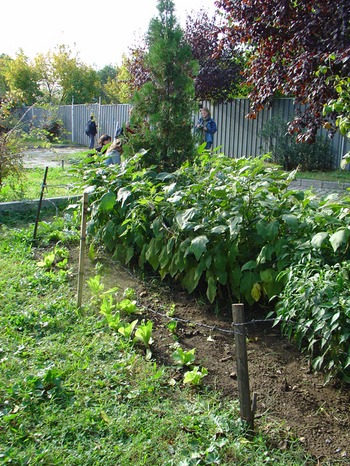
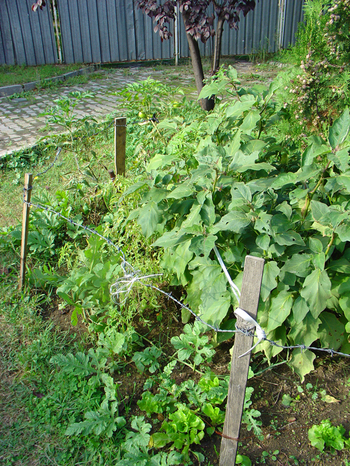
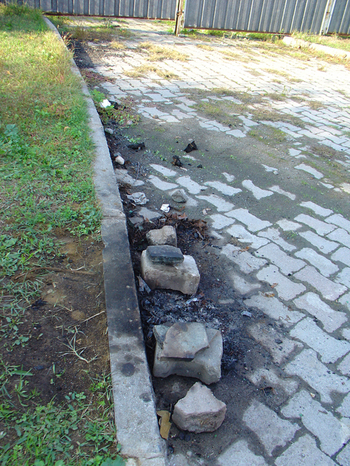
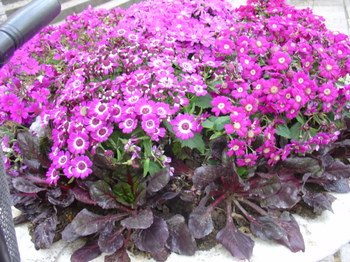
The urban garden is thriving in Istanbul. Walking around the Biennale's parallel programme locations in Karaköy, I spied some ad hoc agriculture in 'public' planters. These images show vegetables being grown amidst 'ornamental' city landscaping. Chapeau to the hacker-farmers growing squash, bell peppers, tomatoes and aubergines in their urban gardens. Look, they have even contructed a BBQ on which to do the grilling!
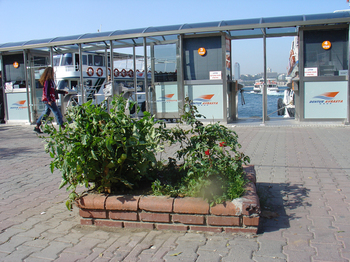
Smack dab in the middle of the Üskudar ferry terminal, ad hoc growers have cultivated tomatoes in all of the planters.
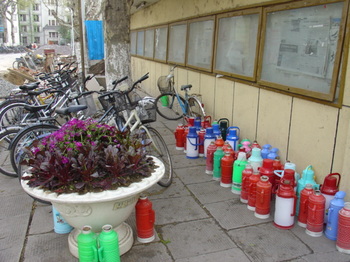
Images documenting beets being grown within public landscaping at a student housing complex in Nanjing in PRChina (April 2004).
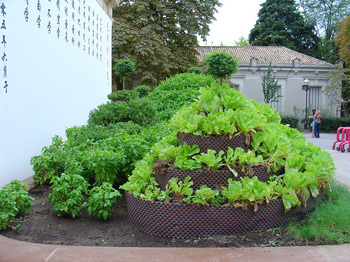
And in Montpellier this summer, PRChinese artist Song Dong's salad installation.
technorati tags: public domain, urban gardening, food security, farming, food-related art, hacking, public space agricultural diversification, agricultural policy
Please read more... "Sort of public gardens"
Posted by debra at 04:04 PM | Comments (0) | post to del.icio.us
Brain Food
January 20, 2005
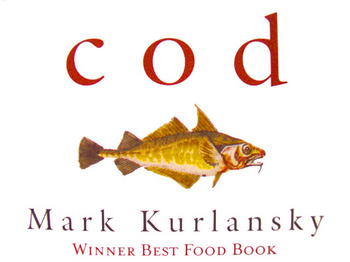
This terribly sad but well written book by Mark Kurlansky is a gripping history from the perspective of the cod. Kurlansky tells how fishing for this gadiform has deeply affected the wealth and development of many nations and technologies. I'm thinking the Flounder by Gunther Grass that I read back in the day but even more I'm thinking Fish Story, the mega-artwork by Allan Sekula, about the 'sweatshop called the Pacific'. (Sekula's visual history Fish Story was part of the the last Documenta XI in Kassel. One photograph in particular gave me goosebumps. You see a ship painter giving the Exxon Valdez a new name...fishy stuff.)
It turns out that cod in the form of stokvis (wind dried cod) turned out to be some good thinking-man's protein for the Norsemen. That extra portable brain-power enabled them to encounter New Foundland in 1000, where they also encountered the Beothuk People who had already discovered it and were not enamoured with the idea of sharing their space with the pink and hairy people from across the puddle.
Basques added salt to the stokvis recipe to make salt cod increasing the quality of the preservation and enabling Basque fishermen to to travel even farther - to the mouth of the St. Lawrence river. When explorer Jacques Cartier got there raring to claim his 'discovery' he encountered almost a thousand Basque fishing vessels. And a bunch of angry native Beothuk people getting pissy about the incessant attention.
Cod is inextricably tied to land (to dry it) and salt (to preserve it) and Salt is in fact the title of another one of Kurlansky's wonderful books.
Posted by debra at 08:54 PM | Comments (3) | post to del.icio.us


