
Chaat Pack for street nibbles
December 16, 2005
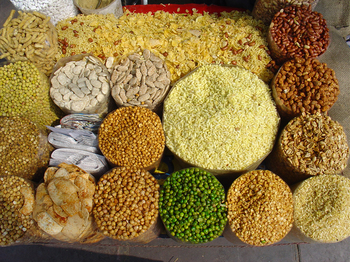
Here is a chaat array being sold on the streets of Delhi. Check out the packaging stuffed in between the sacks of chaat.
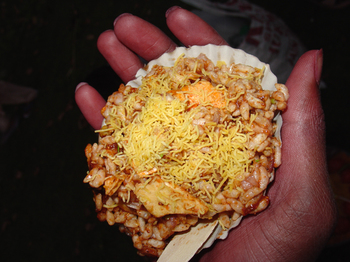
You buy some chaat, the vendor mixes it up with some piquante sauce, and you're good to go.
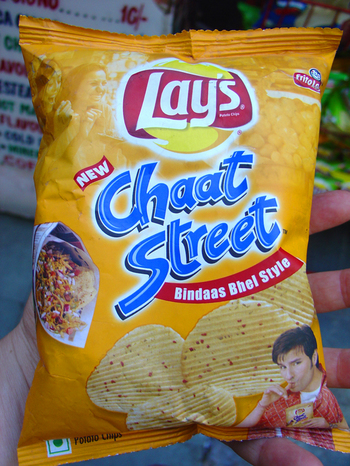
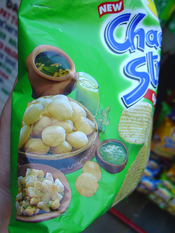
This is an example of how a food manufacturer together with a forward-thinking food designer used street food to inspire a new product for its street food-appreciative market in India. The chips are flavoured and (loosely) styled to reference ‘chaat’, a term describing all manner of street food snacks. If you look closely on the packaging, you'll see an image of the traditional street chaat packaging on the left side. Within 10 metres of the stand where I photographed this package, there were five different traditional chaat vendors selling proper chaat.
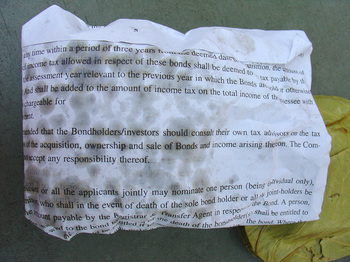
Packaging for chaat is usually a bag made from old newspaper, a neatly cut piece of recycled paper, or a leaf plate. This bag was made from some terribly interesting literature about bonds, you can see the imprint of the peas (and the grease in which they were deep-fried) absorbed through the paper. Grease shadows, or oily pea portraits, if you will.
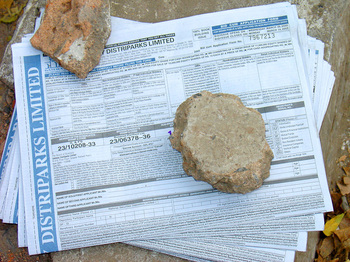
In this image you see a stack of paper left on the street as an offering to the gods of the recycled chaat-bag-makers.
Posted by debra at 09:16 AM | Comments (4) | post to del.icio.us
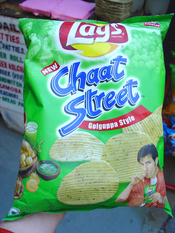
Chaat Street, Indian chips mimic street food golgappa
December 13, 2005
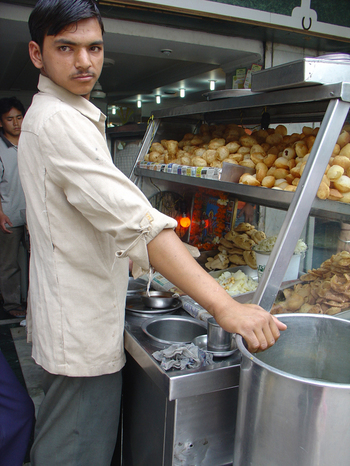
Nine months ago I was in Delhi and not in the Polar Circle at midwinter, and it was there that I was introduced to golgappa, one of the top ten amazing things you could ever hope to put into your mouth. The more I re-peruse the images of food from ElBulliFatDuckAlineaMoto and the likes, the more I can’t get this unpretentious street food out of my mind.
Golgappa is a deep-fried pastry pillow, neither sweet nor savoury, which is served up in a most intimate way. The street vendor pokes a hole in the deep-fried puff, gives you a metal or leafenware bowl and then asks you if you are ‘ready’.
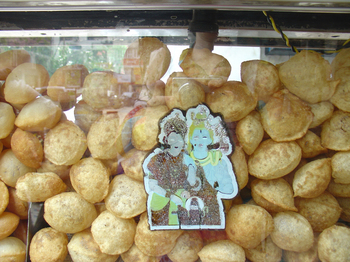
Ready? you say, *lifting one eyebrow.
And he takes that as a 'yes'.
The vendor proceeds to ladle a liquid into the golgappa that quite strongly resembles brackish pond water. In actuality it is a tasty, thirst-quenching tamarind drink with crispy puffs and bits of melon or turnip floating around in it. Neither sweet nor savoury, this soupy mixture is best described as ‘refreshing’.
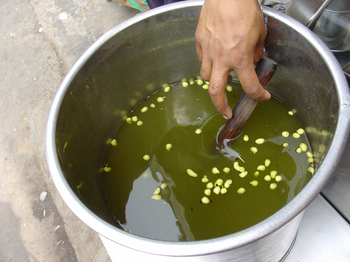
The vendor then hands you an about-to-drip-and-disintegrate golgappa filled with the liquid and you have to pop the entire thing into your mouth where it implodes instantly, crunch and rinse, and you can do nothing but laugh and sop up the dribble on the shoulder of your friend's blouse.
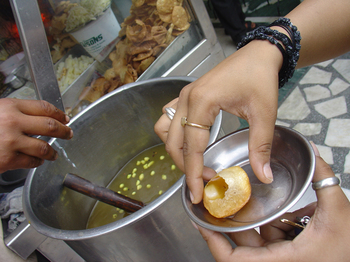
By this time the vendor has already started to dish up another one, (pop, crush, rinse and swallow) and another one, and another one. The idea is that you are popping golgappa into your mouth as fast as you can until you beg him to stop by motioning with your tamarindily dripping fingers. A recent study on street food has proved that ninety-four percent of first-time eaters of golgappa say ‘wowwy’ in response to the experience.
How wise it is then that Frito-Lay should be inspired by golgappa for their Street Chaat line of chips in India. Poke-free. Drip-free.
* - Poetic license. I can't lift only one eyebrow.
Posted by debra at 06:04 PM | Comments (7) | post to del.icio.us
Recycled tetraware and even more leafenware
June 03, 2005
The image on the left shows (clockwise from 10 o'clock) a repurposeed surplus tetra-pak plate, a banana bark pressed bowl, a paper plate made out of 'surplus' film poster and the underside of the tetra-pak plate showing its origins as a tomato paste container for an arab-speaking country. In the centre is the underside of a banana bark bowl.
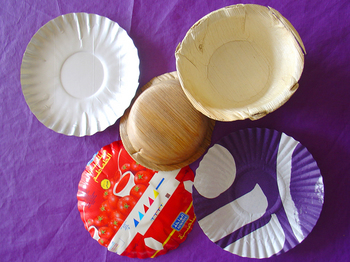
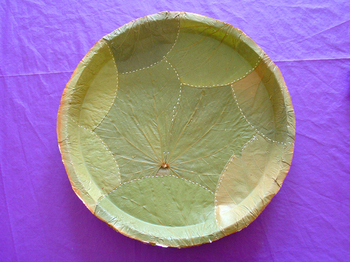
The image on the right shows a beautiful sewn leaf platter (~50cm diam) backed with surplus printed plastic originally produced for juice packaging. Alternating layers of leaf and plastic make the platter just sturdy enough to carry a few things as long as those things don't happen to weigh anything.
Please read more... "Recycled tetraware and even more leafenware"
Posted by debra at 11:53 AM | Comments (0) | post to del.icio.us
Leafenware is everything but the squeal
June 02, 2005
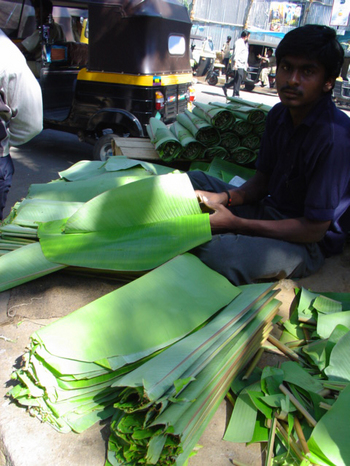
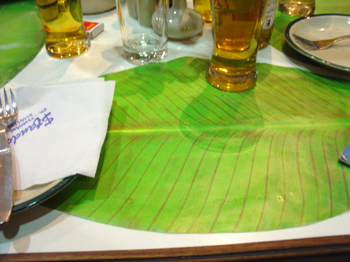
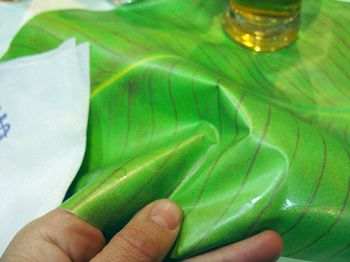
A banana leaf is a plate in Bangalore. The uppermost image shows a Ghandi bazaar (Bangalore) plate maker producing and selling leafenware on the street. The waste products of his production are eaten by noshing cows. This is 'everything but the squeal' vegetarian-style.
But Delhi is far far away from the banana climes of the South and an artificial banana leaf plate seems to be a logical substitute. This fabric photoshop job was doing duty as a placemat at drinking club, the Standard at CP before we procured it from the owners for the culiblog packaging archive.
Faithful culiblog readers are familiar with the entry just a few weeks ago of the pepesan sans pep dish, wrapped in bamboo leaves. I am curious about whether bamboo leaves bought at a Chinese supermarket in Amsterdam, imported from somewhere deep in the guts of PRChina qualify as ecologically sound plate choices, but I would like to hear from someone with a strong opinion - or better yet - some actual knowledge on this subject.
Q1: Is a one-use banana leaf plate a more sustainable choice than a ceramic plate in a place where banana trees are harvested?
Q2: Is a pack of dried bamboo leaves a more ecologically sound dinner party option than ceramic plates when the bamboo leaves are imported from PRChina and the dinner party is in the Netherlands? or Occitania?
Q3: Is a re-usable (maybe 100 times) fabric plate more ecological than a ceramic plate if the fabric plate is produced locally? (The plate can be rinsed in soapy water and rinsed clean.)
Q4: Are recycled paper plates like the ones shown in this culiblog entry or the tetra-pak plates more ecological than the different sorts of leaf plates if all of the materials come from local sources?
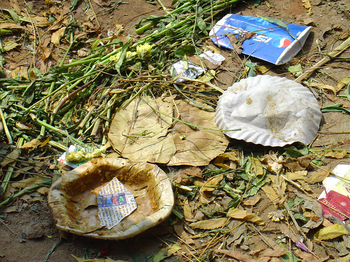
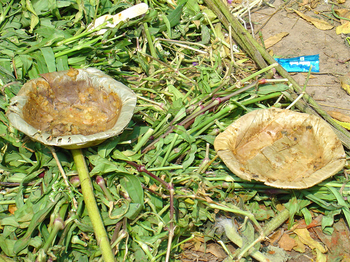
Pictured above are images of leaf plate and other vegetable (and non-veg) trash on the streets of Delhi.
How does one calculate the sustainability of a given object? Ceramic or stainless steel plates are produced under industrial conditions, raw materials possibly imported, packaging distribution all factor in. Imported dried bamboo leaves do quite a lot of travelling. Banana leaves seem ecological (if locally grown) but what are the conditions of the banana plantation and how are the leaves harvested? And what if you already own some plates? And what if you live in the city and don't have a compost pile or animals with four stomaches roaming the streets?
technorati tags: leafenware, Delhi, sustainability
Please read more... "Leafenware is everything but the squeal"
Posted by debra at 09:47 AM | Comments (8) | post to del.icio.us
Chicken jail
May 12, 2005
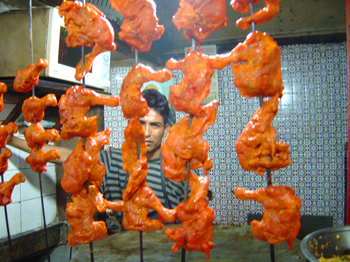
A man languishing behind bars of a chicken jail. This image was taken near Connaught Place in Delhi and is part of an archive compiled by participants of the Nomadic Banquet workshop, Delhi March 14-26, 2005. For more blog entries and image archives, please check out the official Nomadic Banquet website as well as that of the Doors of Perception. Doors 8 Delhi: Platforms for Social Innovation.
Posted by debra at 03:49 PM | Comments (0) | post to del.icio.us
Scared of a little granola perfume
May 06, 2005
In Dutch we have a term, 'doorheenbijten' that means literally 'to bite through something'. We use this term to describe the painful process of exploring unchartered territory. Think for just a moment about what could have motivated someone to invent such an idiom. Now, think about the circumstances that would have caused an entire culture to embrace this idiom enough to use it regularly!
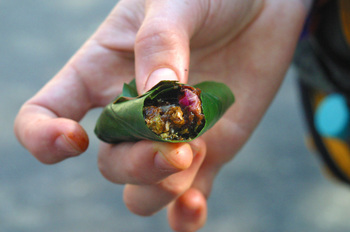
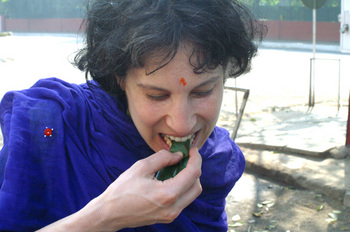
The images above show the author about to take her first bite of paan without any idea what paan could possibly smell, taste or feel like. It is quite strange to try something with very little previous reference, and having never tried chewing tobacco, paan was unchartered territory for me.
In a neat little kiosk by the side of the road the paan wallah prepared the leaf for me with all manner of goos, crystals, flakes, shavings and sprinkles - none of which seemed familiar. Although I would like to say that I bravely put the roll into my mouth and enthusiastically started chomping away, the photograph above reveals the utter lack of trust and relax I had in approaching this new foodstuff. You can also see how such an utter lack of trust and relax results in a particularly unaesthetic portrait. That fact alone should be motivation enough to drop some food taboos.
Good news is that as I reported earlier, paan is delicious, something like eating granola perfume. And like the photograph that I keep of myself in the freezer to remind me of what I looked like in a bikini in 1998 (to avoid an over-consumption of ice-cream), I have decided to keep this picture at hand to remind myself to be more trusting of new foods.
Please read more... "Scared of a little granola perfume"
Posted by debra at 12:36 PM | Comments (1) | post to del.icio.us
Another short supply chain
April 26, 2005
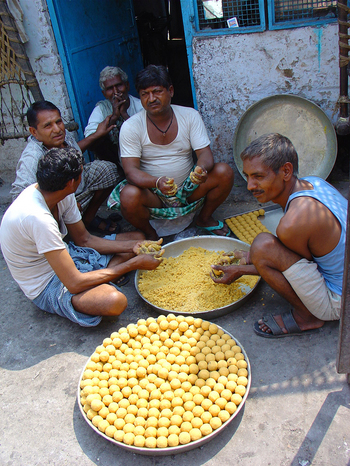
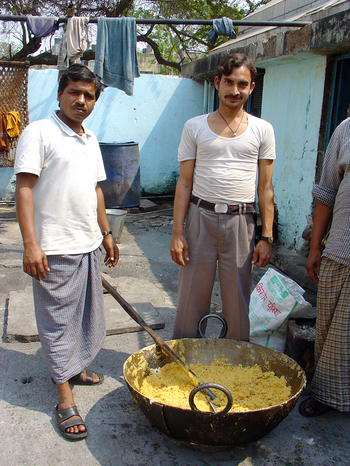
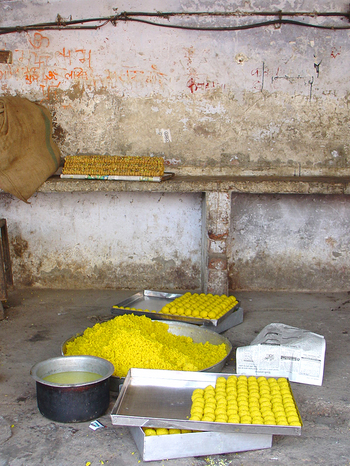
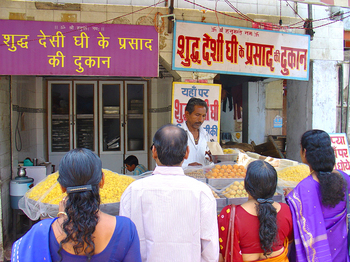
This time it's dessert! Ladoos, to be exact. These gentlemen are working in the temple compound (Hanuman Mandir, CP, Delhi) 30 metres from the dung fuel sales and manufacturing woman. Their whole production setup takes place within 10 metres, their point of sale is 30 metres away.
A ladoo is a graham flour sweet, sometimes made with puffed rice. If someone would explain to me why one always finds ladoo near temples I would be most appreciative. I think it has to do with religiously sanctioning things that people like to do anyway, and I mean that in the most generous possible way.
Please read more... "Another short supply chain"
Posted by debra at 09:07 AM | Comments (3) | post to del.icio.us
Love those short supply chains
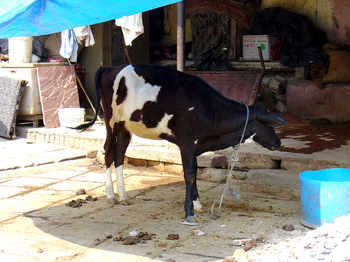
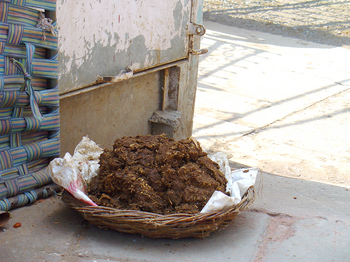
Here in Europe we can't stop talking about 'food miles', that is to say, how many kilometres our food travels before we actually get to touch it. There's that quite famous study of the strawberry yoghurt, It's the same for all products, including cow dung fuel. The images shown were all taken within 20 metres (!) of eachother in the Hanuman Mandir temple complex near CP, Delhi.
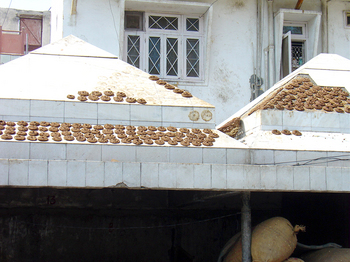
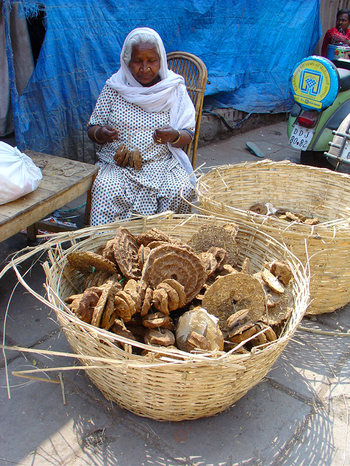
From top to bottom: Cow - dung collection - patty cake, patty cake, dry dry dry - fuel saleswoman
Please read more... "Love those short supply chains"
Posted by debra at 08:24 AM | Comments (0) | post to del.icio.us
Chopping block
April 20, 2005
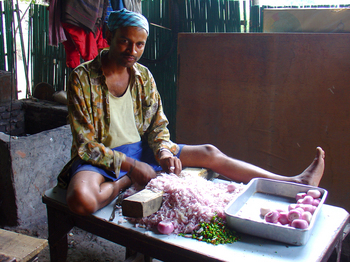
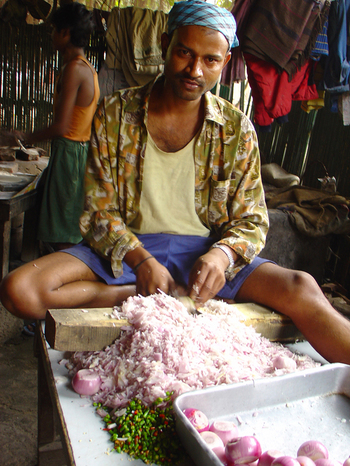
In Delhi, right outside our house by the Jantar Mantar monument is a nameless restaurant that serves rickshaw drivers, bus chauffeurs and around 400 various people each day - including ourselves. At the crack of dawn, which in Delhi means a civilised 9 o'clock, the kitchen staff sets to work on the mise en place. The man in the image above has developed a way to do yoga and chop onions at the same time. I particularly love the self designed chopping block he's using. Vegetables spill over on either side, a perfect object and technique to cut one's way through mountains of onions.
technorati tags: India, Delhi, street food, outdoor kitchen, vernacular design, culiblog
Posted by debra at 11:57 PM | Comments (0) | post to del.icio.us
Sticking to the streets
April 16, 2005
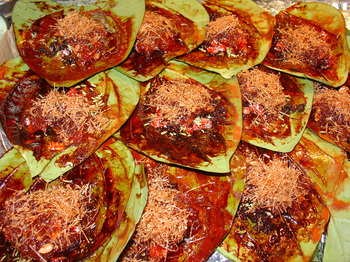
Delhi- Clustering their services in one Connaught Place kiosk are four paan salesmen, each selling a different recipe of this perfumed and intoxicating digestive leaf from the kiosk's cardinal points.
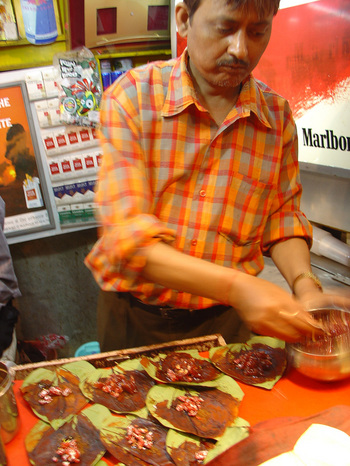
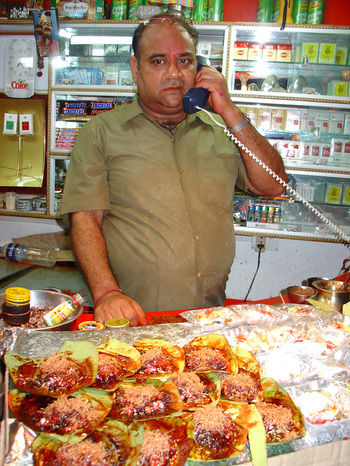
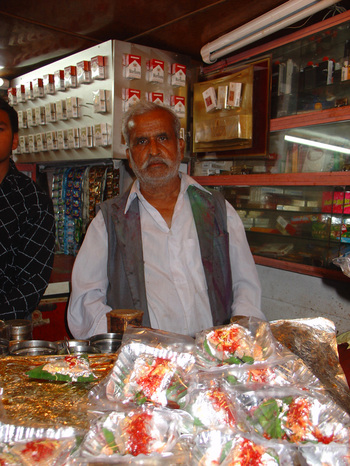
One very interesting thing we learned from two of the Nomadic Banquet participants, John Vijay Abraham and Sanjeev Shankar's street food research at the IIT Bombay, is that street food vending is not always a step on the path to restaurantdom. A case in point, they stated is Muchhad Paanwallah, a paan kiosk in Mumbai named after an impressive ear to ear mustache of the owner's father. The current owner, Jaishankar Tiwari has been immensely successful in his street-side paan business, so much so that his and the families of his four sons all live from it. If you can't visit his kiosk in Mumbai it's well worth checking out his website, where you can place orders for paan online.
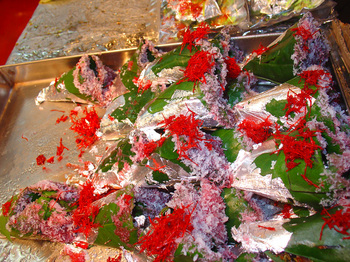
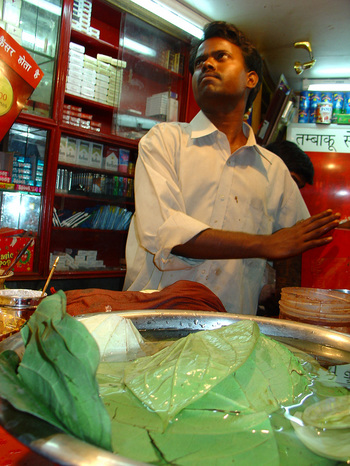
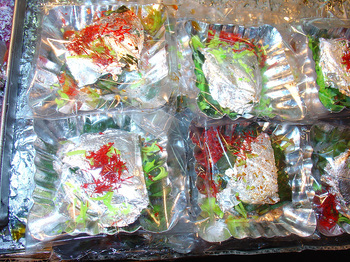
In the Nomadic Banquet workshop in Delhi, we discovered street food vendors are an integral part of the social fabric and this is likely to be the greatest asset they offer a community. Muchhad Paanwalla is immensely successful and Tiwari chooses to continue selling from his kiosk instead of going upmarket like oh so many smart cigar shops. This is important for us to realise as the perception persists that the street is an undesirable place (for a vendor) - as if the street is merely a stepping stone on the road to 'something better'. The success of Muchhad Paanwallah and others like him prove that exactly the opposite is true.
Muchad Paanwallah http://www.paan.com/about.htm
Posted by debra at 09:33 AM | Comments (2) | post to del.icio.us
The most beautiful teapot in the world
April 11, 2005
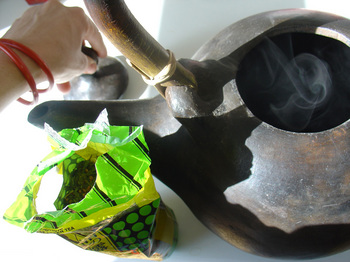
Finally I can sit quietly with the several thousand images from my trip to Delhi and reflect.
WIth a pot of tea.
A giant pot of tea.
In a teapot from Bihar.
Bought at a craftsmarket in Delhi.
Made from dark clay, neither fired very hot, nor glazed.
Looks like it was fashioned by a caveman with a large extended family.
The lid doesn't fit.
It's perfect.
Posted by debra at 01:36 PM | Comments (5) | post to del.icio.us
Delhi Water Bar
April 02, 2005
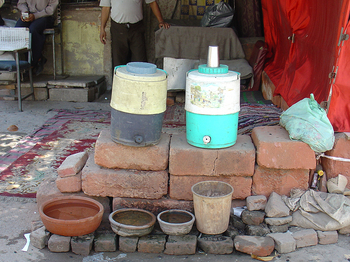
A water bar on a sidestreet off Janpath in Delhi. Twenty metres down the street is a pump and a well. This water bar is actually a service on offer to draw customers into a shop selling Kashmiri handicrafts and into an alley with other small shops hidden from the street. I love this tented pavillion shared by several shop keepers and its water bar offering a cool place to gather and chat in the shade.
Posted by debra at 11:51 PM | Comments (0) | post to del.icio.us
Eating street food at home
March 19, 2005
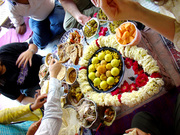
Losing the fear of street food in one simple lunch. The lesson is 'presentation is everything'. The Nomadic Banquet workshop participants dig in to street tucker. All of the dishes for this meal were gleaned from within a 200 meter radius of Nomadic Banquet HQ. It was the first time in a week that I witnessed one of the DAI students eat heartily.
Please read more... "Eating street food at home"
Posted by debra at 10:45 AM | Comments (1) | post to del.icio.us
Eating street food at home
Losing the fear of street food in one simple lunch. The lesson is 'presentation is everything'. The Nomadic Banquet workshop participants dig in to street tucker. All of the dishes for this meal were gleaned from within a 200 meter radius of Nomadic Banquet HQ. It was the first time in a week that I witnessed one of the DAI students eat heartily.
Please read more... "Eating street food at home"
Posted by debra at 10:45 AM | Comments (1) | post to del.icio.us
Delhi recycling, in all fairness
March 15, 2005
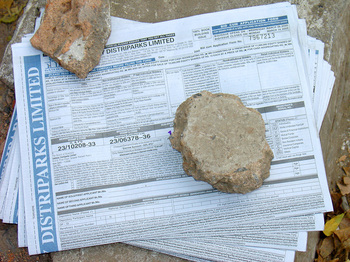
When is recycling not really recycling? When the recycled or re-purposed item never really had a purpose in the first place. These papers, have been left on the ground (location across the street from Jantar Mantar, Delhi), as far as I can tell, for no other purpose than to be repurposed. The image on the left is a stack of paper left on the street as an offering to the gods of the recycled chaat-bag-makers.
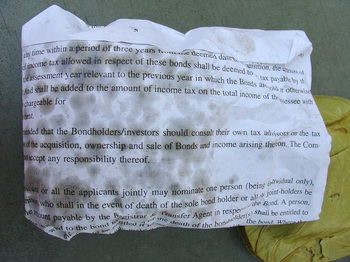
Packaging for chaat is often nothing more than a bag made from old newsprint or repurposed paper, or for the wetter stuff, a leaf plate. The bag pictured on the right was made from some terribly interesting literature about bonds. One can see the imprint of the deep-fried sweet peas contained within being absorbed into the paper making a pretty pattern.
Posted by debra at 01:07 PM | Comments (0) | post to del.icio.us
Paan virgin spits like a girl
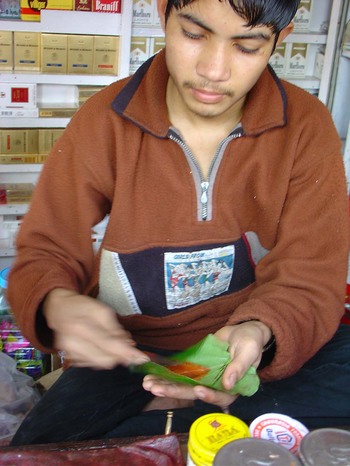
Everywhere in Old Delhi, on every cornerpost of every building there is a terracotta haze. For a while I thought it was just the build-up of iron oxide dirt and dust - and so much of the architecture (for example the Jantar Mantar observatory) has this colour. But after a few hours of walking around I saw a few fresh splotches of red and realised what it was. Paan spit.
Paan is a 'digestive'. A leaf, painted with all manner of spices, flecks of gold leaf, sugar crystal and proportedly even opium. You take the leaf roll in your hand from the paan-wallah who has lovingly prepared his special version from 20 or so fine tins of ingredients and ingest it like chaw, I think. This morning, before the coffee I tried my first chew.
Please read more... "Paan virgin spits like a girl"
Posted by debra at 06:57 AM | Comments (2) | post to del.icio.us
A street snack called chaat
March 14, 2005
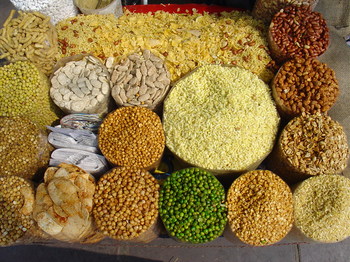
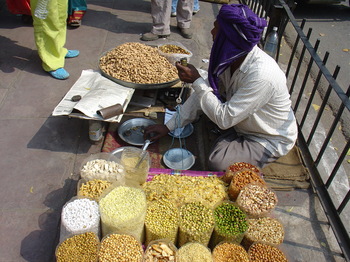
In Delhi street vendors sell chaat, that is to say snacks consisting of all manner of puffed, roasted and deepfried legumes, grains, pasta products and broken crackers. Nibbles to go, nibbles to take home, nibbles that remind one of the street. A chaat vendor will sell his beans and bobs dry to take home, or if you've got the right guy he'll mix up a little chaat-snack for you right then and there with some very much needed chaat-moisturizer i.e. sweet chilli sauce.
Look at (click on) the image on the left closely and you'll see the bags in which the chaat is sold folded neatly between the goods. The bags are made of recycled newspaper and other redundant paper glued into bags for packaging.
Please read more... "A street snack called chaat"
Posted by debra at 07:27 PM | Comments (2) | post to del.icio.us
Delhi street food vendors benchmark good health practices and urban planning
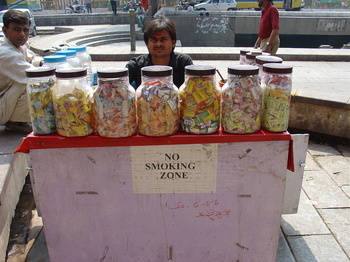
This Delhi street vendor has set up a much needed no smoking zone right in front of his stand (located in front of the state emporia across the street from the Hanuman Mandir near CP). I believe he is selling little packets of flavoured chewing tobacco.
Posted by debra at 06:30 PM | Comments (0) | post to del.icio.us
In the hood
March 12, 2005
I have arrived safely in Delhi and my students and I are playing a little game in which we hit the streets rather intensively and then find little havens in all different forms to come back to our senses. The streets here are LAUNCH pads, and you need a place, a peace, to come down every now and again. For our little group of 6, the time limit seems to be 45 minutes per jaunt. But we've been exceeding this quite a bit.
Tomorrow I'll try to find an internet cafe where I can upload some of the amazing images. Finding such a place is proving difficult, we may have to resort to moblogging with telephone. Poo.
Posted by debra at 03:40 PM | Comments (1) | post to del.icio.us
Dabba Wallah - git yer tiffin while it's HOT
December 10, 2004
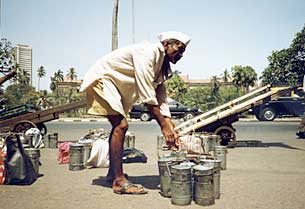
You're a dutiful wife (actually I'm temporarily in-between relationships) and nothing short of your own love-imbued cuisine will suffice to nourish your office-bound husband for his lunchtime meal. Problem is you're out in the suburbs of Mumbai and he's situated downtown for the lunchtime hours. How are you going to get something hot in Lovey's tummy?
Easy. You pay 150 rupees (EUR2,55/GBP1.70/USD3.40) per month for a Dabba Wallah service and let the 'tiffin guy' or lunchbox carrier bring the Mr. his grub.
Please read more... "Dabba Wallah - git yer tiffin while it's HOT"
Posted by debra at 12:02 PM | Comments (0) | post to del.icio.us
Hash Shakes are sooooooooo passée
November 05, 2004

Well, what were You eating one and a half years ago?
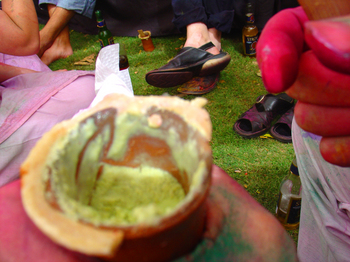
Bhang Shake (serves 3)
Aditya and Arjun (not their real names) dosed me with the vivid high of this sublime hash milkshake one and a half year's ago.
What were we THINKING!!!
Please read more... "Hash Shakes are sooooooooo passée"
Posted by debra at 08:58 PM | Comments (7) | post to del.icio.us


