
CPULs
when bad acronyms
happen to good people
June 09, 2006
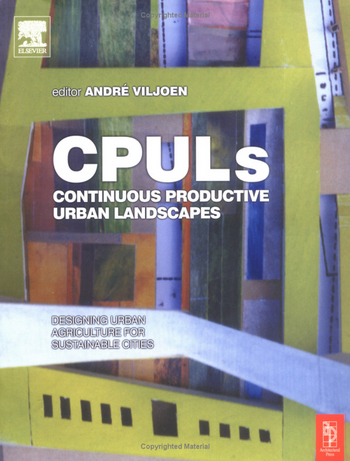
It's pronounced 'SEE, PULSE' and stands for Continous Productive Urban Landscapes. Architects Viljoen, Bohn and Howe's postively radical notion of combining productive urban landscapes with continuous landscapes, proposes a new urban design strategy that would change the appearance of contemporary cities towards an unprecedented naturalism. Think urban agriculture, allotment gardens, increased biodiversity, decreased carbon emissions and strategically connected green space - and you will start to get an idea of what the authors are suggesting. Although this is in no way within the scope of the book, never have I encountered a more holistic approach to urban planning that so thoroughly takes into account our imminent plunge into energy descent and the extreme effect that this will have on our food supply.
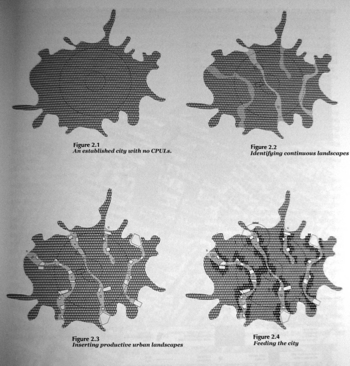
Diagrams showing a projected development of CPULs © Bohn & Viljoen Architects, reformatted for culiblog and used entirely without permission
Despite sporting a singularly unsexy title and a graphic design utterly devoid of charm, CPULs is a compelling vision for urban planners and (landscape) architects. The book is loaded with truly useful facts and case studies yet somehow remains a rivetting read for layfolk, comme moi. The authors were wise enough to begin the book with a succinct glossary defining all of the concepts so that within five pages you're already an adept at juggling terminology like vertical and horizontal intensification and you know the difference between an organiponico and a heurto intensivo.
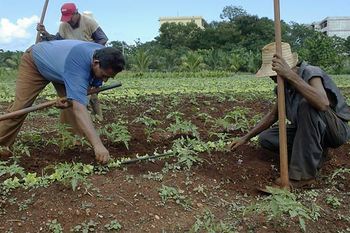
According to people who are in a position to compare, CPULs offers a rich documentation of UK allotment history and vivid reports of successful urban agriculture in contemporary Cuba, one of the few countries to have yet experienced peak oil. In 1990 when Cuba stopped receiving cheap juice from the Mothership and subsequently lost its largest client for agricultural produce, Havana citizens suddenly found themselves without access to sufficient food as expressed in 30% fewer calories in their diet! Instead of engaging in some futile rioting, they took up gardening en masse, and by gardening, I mean organic gardening. Later the government jumped on the bandwagon and started facilitating the urban agricultural effort in the form of responsible planning and infrastructure development. Presently Cuba is considered to be a living laboratory of how small urban farms and gardening collectives can successfully provide a significant portion of the urban food supply in spite of energy descent. Listen up, everybody! The CPULs authors were enlightened enough to note that a population accustomed to collectivism is more likely to be successful at community projects and that Northern European urban agricultural initiatives of the future will need to develop a native form to ensure their success.
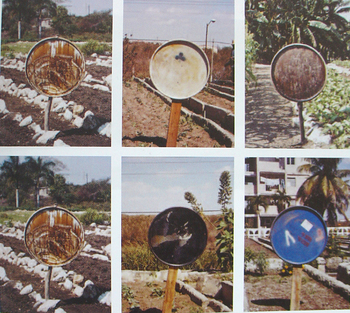
Oil drum lids used as markers in Havana organiponicos. Photos by Tom Phillips from CPULs used entirely without permission
CPULs' authors articulate the benefits and obstacles to their proposal and offer cogent strategies for creating city land use policy in which urban green and brown are treated as productive space, considering the unbuilt as an event of equal intensity as the built. A vision of a thriving CPULs in London 2045 provides a powerful scenario that I can imagine myself being a part of at any stage in my life. This is something I would not characterise as a common feature in most urban planning. In CPULs city planning the well-being of people is a central and distinguishing factor. In fact, its completely seductive.

A map of London expanded to accomodate mini- and SUPER-market gardens, from a 1998 study © Viljoen and Bohn Architects, photographed from the book and used entirely without permission
Robert Hopkins from Transition Culture weblog notes, 'It is only in the last 30 or so years that we have perfected the art of creating totally useless landscapes. New industrial estates and business parks typify this, planted with 'low maintenance' shrubs, specifically bred to be entirely unproductive.' Bohn and Viljoen point out that though European cities have planned for a variety of approaches to open space including urban parks, urban river fronts, urban squares, urban stages, urban forests and urban beaches, there are as yet no urban fields. 'Living and growing food in the contemporary urban space, CPULs could formally be similar to urban parks.' I am inspired by the notion that landscape architecture could be pivotal in designing for a future in which peak oil will have tremendous impact on the urban food supply.
As someone who writes about food and culture and as an an art and design educator, I cannot recommend this book highly enough. I hope that its concepts are embraced by those who are in a position to implement urban planning of this nature. The notion of CPULS deserves to feature prominently in design and architecture curricula, informing a new generation of people designing our cities and potentially our well-being through our access to healthy food.
CPULs do not yet exist.
In type, they will be new,
in type they will be productive.
See, pulse, with a silent meow at the end.
- Continuous Productive Urban Landscapes. Designing Urban Agriculture for Sustainable Cities. Andre Viljoen (ed) 2005. Architectural Press
- Biography of Andre Viljoen at the Royal Institute of British Architects website
- Robert Hopkins' brilliant Transition Culture review of CPULs. The review also questions why Viljoen doesn't use the term permaculture when the ideas in this book are so clearly informed by it. Hopkins points out that THIS book is exactly where permaculture needs to be. Although CPULs author Graeme Sherriff addresses permaculture rather thoroughly in Chapter 22 (Permaculture and Prodcutive Urban Landscapes) I can imagine that editor Viljoen felt a need for a new definition (and therefore produced that unfortunate acronym) because the notion of permaculture does not specifically address urban planning and land use policy.
- Permaculture according to Wikipedia
- Permaculture according to CPULs authors - quoting Robert Hopkins!: 'Permaculture has evolved into a system for the conscious design of sustainable productive systems which integrate housing, people, plants, energy and water with sustainable financial and political structures.' (Robert Hopkins, 2000, p.203)
- CPULs according to wikipedia. Oh how odd, there is as of yet no entry.
- Energy descent
- James Howard Kunstler, author of the Long Emergency
- Eat the suburbs - an Energy Descent Primer
- Some of the more positive aspects of peak oil:
Healthier food
More active lifestyles
Greater self-reliance
A sense of connection to place and products
The re-emergence of local identity
An emphasis on quality over quantity
A means of overcoming addictive behaviours such as over-consumption - Permaculture Activist, the magazine - excellent read!
- Energy Descent Primer
- An MP3 of permaculture 'proponent' David Holmgren lecturing on permaculture and peak oil
- Robert Newman's History of Oil (stand-up comedy) on Google Video. Hilarious and not-so-hilarious at the same time.
Posted by debra at 01:51 PM | post to del.icio.us
The vertical
kitchen garden
May 12, 2006
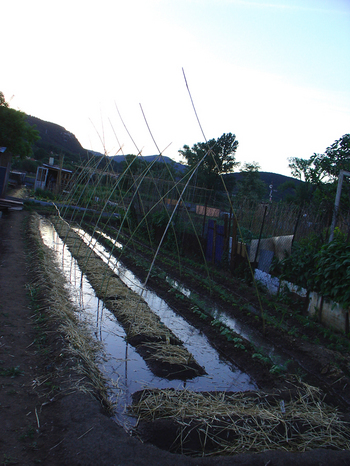
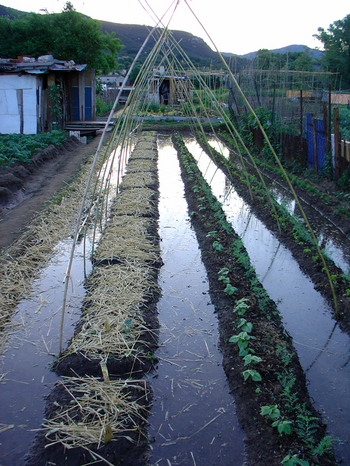
Spring planting is finished but before returning to the Polar Circle, I took this image of the bamboo framework for my vertical gardening concept. The plan is to train the wandering plants (melons, gourds, squash) to grow up the wide end of the frame, allowing them optimum sunlight, saving roaming space in the garden and eventually providing a tunnel of dappled light to walk through or linger in on hot August afternoons. An added benefit will be that my hanging calabas will grow with straight necks.
On the 'short end of the stick' side, morning glory will wind its way up the poles and produce blue and purple flowers. If everything goes according to plan (!) there will be yellow flowering plants climbing up the 'wide end' of the framework (left - in these images) and purple/blue flowering plants on the 'short end of the stick' side.
This idea is inspired by the Dutch architects MVRDV who also write about vertical farming in their book on density, KM3. I know, I know, they would never favour such vernacular materials or style.
Posted by debra at 10:14 AM | Comments (2) | post to del.icio.us
Street food waste =
street food packaging
April 29, 2006
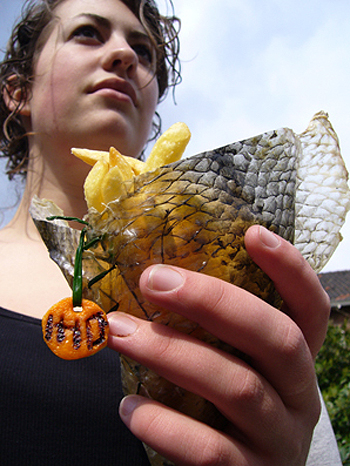
Fish and chips: image of street food packaging concept 'IHO', © Païvi Kovanen, Eva Arts and Caroline van Teeffelen 2006, used courtesy of the designers. Please respect student work, contact culiblog for updates.
(This is the second in a series of entries about the Street Food Workshop developed and conducted together with Katja Gruitjers for our students from the Design Academy Eindhoven and the HAS den Bosch.)
Just the simple fact of making street food creates tonnes of food waste. Students Païvi Kovanen, Eva Arts and Caroline van Teeffelen used food waste materials to develop packaging for street food. Katja and I were really impressed with their packaging concept IHO, which means skin in Finnish. Even mo' bettah, when you turn the letters around to spell OHI, you get the Finnish word for leftovers.
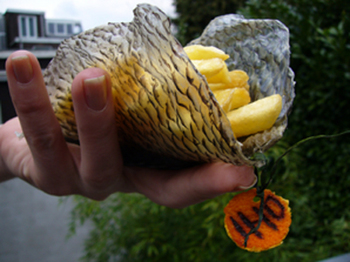
Image of street food packaging concept 'IHO', © Païvi Kovanen, Eva Arts and Caroline van Teeffelen 2006, used courtesy of the designers. Please respect student work, contact culiblog for updates.
The fish and chips sack is brilliant. Hand-sown dried fish skin imparts a nice fish aroma to the chips and you know how the Northern peoples love their (dried) fish. Katja and I are imagining a dusting of vinegar powder on the inside of the sack for a perfect flavour.
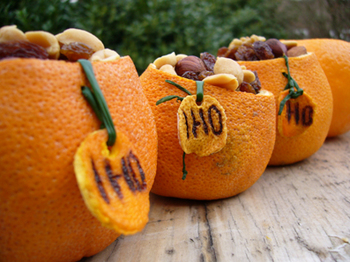
Image of street food packaging concept 'IHO', © Païvi Kovanen, Eva Arts and Caroline van Teeffelen 2006, used courtesy of the designers. Please respect student work, contact culiblog for updates.
Urban juice bars produce orange rind and pulp waste that is normally turned into silage to feed animals that us omnivores love to eat. Kovanen, Arts and van Teeffelen assured us that there's plenty of rind and pulp to go around and they dried the rinds into snack containers. The pulp they turned most amazingly into a palm plate that has a wonderful hand feel to it.
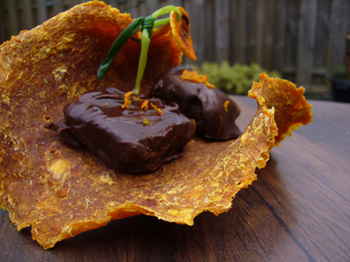
Image of street food packaging concept 'IHO', © Païvi Kovanen, Eva Arts and Caroline van Teeffelen 2006, used courtesy of the designers. Please respect student work, contact culiblog for updates.
As if this weren't enough for one half-term street food assignment, the ladies Kovanen, Arts and van Teeffelen developed a new ceramic material produced from eggshells and potato starch and that can be formed into any possible shape. Here, the material has been formed into a palm plate.
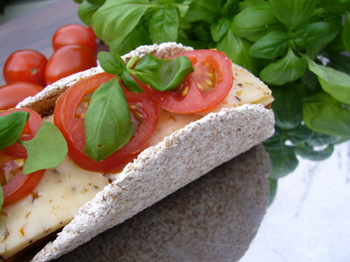
Fish and chips: image of street food packaging concept 'IHO', © Païvi Kovanen, Eva Arts and Caroline van Teeffelen 2006, used courtesy of the designers. Please respect student work, contact culiblog for updates.
IHO street food packaging concept by Kovanen, Arts and van Teeffelen.
Posted by debra at 11:06 AM | Comments (3) | post to del.icio.us
Love difference,
as in we love difference
April 24, 2006
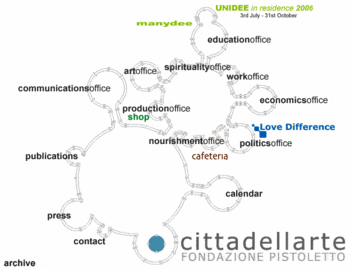
Of course the artistic movement for an intermediterranean politic is into food. And it sports a big fat Citta del Arte logo right on it's homepage. Which led me to click on the Ministry of Nourishment link because I always wonder what folks mean by the word nourishment.
I'm none the wiser, but the Love Difference folks did done organise a Food Market Festival in which food markets (and their organisers) from around the world met this weekend in Turin. I wonder what they've got cookin' for the next event, hopefully something megamaniacal. (Thank you, Julie Upmeyer, who sent this link on time.)
Posted by debra at 08:00 AM | Comments (0) | post to del.icio.us
Will swap saliva for a home, the problem with bird nest soup
April 04, 2006
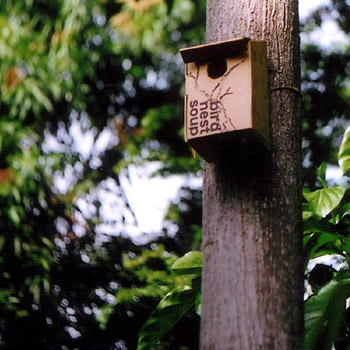
image from Hoko Studio design collaborative, cropped and used entirely without permission
If you were a bird living in a cave in Thailand, would you rather
1. live in a house of your own making constructed from spit and twigs?
or
2. live in a gifted house made out of recycled cardboard?
Bad question. Here comes a better one.
If your house was under threat of confiscation, would you rather
1. be given a house built out of recycled cardboard?
or
2. be left to your own devices to emotionalise enough angry bile and spit to produce a new casa de saliva?
It may be yesterday's news to some, but I was surprised to read that swiftlets are suffering forced eviction due to gourmand greed! Swiftlets are the little birds whose nests are prized for bird nest soup. Some varieties of Thai swiftlet construct nests comprised of 80% lugie! Homelessness seems like a poor reward for resourcefullness.

image from Hoko Studio design collaborative, cropped and used entirely without permission
Design collaborative Hoko Studio has a partial solution. And by 'partial', I mean partial. Use birdhouses to package and distribute the nests. When the cook is done leaching the saliva out of the nest, the customer can hang the packaging on a tree (or high up in a cave in Thailand) and commence slurping with a partially clean conscience!
Partial solutions are only half the beauty of critical design.
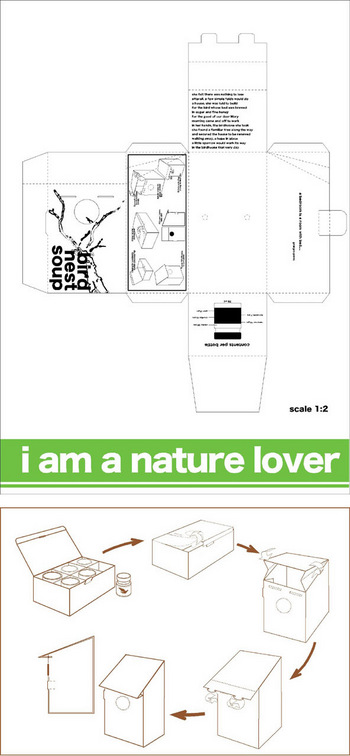
image from Hoko Studio design collaborative, cropped and used entirely without permission
Know your bird nest
Know your birds' nests even more
Hoko Studio's 'Eat Bed' bird nest proposal at Platform 21
Meet Hoko Studio Design Collaborative, the designers of 'Eat Bed'
Wikipedia bird's nest soup page with a cool picture of a saliva nest
Hoko Studio's proposal titled 'Eat Bed' is one of several 'critical design' projects exhibited at the Platform 21 website under the title, Positive Alarm (fixing what is wrong without making it wronger). Platform 21 is a newish venue for design situated in Amsterdam's newish city center, de Zuidas, (pronounced South Central).
Here's the Platform 21 culture blurb: 'the domain of creation is not something professionals have a monopoly on. We are interested in creative developments in fashion and design, including amateur initiatives.'
Huh. Platform 21 does seem like an OK initiative, although their website is probably the most annoying surf you'll have this week. Indeed a platform for Dutch and international design initiatives has been sorely missing ever since the nest known as the Vormgevings Instituut (pronounced Netherlands Design Institute) was confiscated by barbaric xenophobes back in the '90's. Maybe Platform 21 will provide a new place for design to alight. The director is ethnic Dutch, always a good starting point. Soup is on!
Hoko Studio's 'Eat Bed'
Platform 21 a design nest in Amsterdam's Zuidas
Platform 21's online exhibition Positive Alarm
Posted by debra at 08:58 PM | Comments (0) | post to del.icio.us
Food Force computer game: force-feeding inaccurate notions of the causes of hunger
March 17, 2006
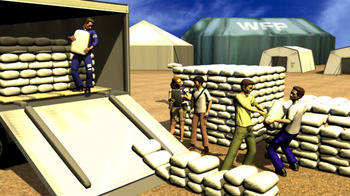
images courtesy of Food Force, © United Nations World Food Programme - all rights reserved
Two weeks ago I sat dumbfounded watching a French TV report in which journalism students practiced reporting a fictional national emergency. I couldn't help but think that what's cool about practice is that it makes perfect. If you practice having enough crises, you might actually get really good at having one! This hackle-raising report about teaching young adults to respond positively to crisis, just didn't seem to me like a simple exercise on getting prepared. The TV experience was absolutely colouring my thinking when I came across the UN's World Food Programme (WFP) website and discovered a new computer game for school kids called 'Food Force'.
'A major crisis has developed in the Indian Ocean, on the island of Sheylan. We're sending in a new team to step up the World Food Programme's presence there and help feed millions of hungry people.'
That's pronounced 'shay-lawn' by the way. The Food Force computer game is essentially a communications campaign of the UN's WFP, cleverly disguised as an educational tool. Although the game really does teach kids about mid-crisis food distribution, its purported goal, teaching students about the causes of hunger, is framed exclusively in the short term and completely ignores all of the long term causes.
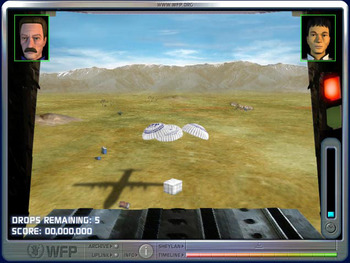
images courtesy of Food Force, © United Nations World Food Programme - all rights reserved
Food Force has six game tiers reflecting the basic elements of emergency food distribution: air surveillance (helicopter reconnaissance, counting clumps of roving refugees), energy packs (achieving nutritional and economic balance from rice, beans, vegetable oil, sugar and iodized salt), food drop (aim and drop those rations), locate and dispatch (Tetris-like global food collection), the food run (choosing the right route through hostile territory), and future farming (dealing with a combination of long term hunger solving factors).
Predictably my favourite game tier was 'future farming', where I was taught that paying people in food to attend job training programmes and so investing in the community, was the straightest path to community self-sufficiency and societal well-being. Together with the food pack nutritional assembly tier, this was the game tier with the highest educational value, going beyond point and drop and mouse dragging I mean racing.
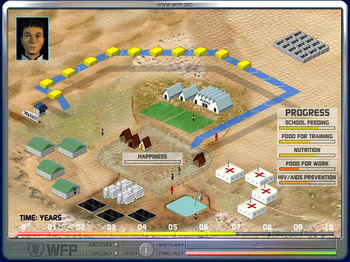
images courtesy of Food Force, © United Nations World Food Programme - all rights reserved
Food Force has a website chock-full with extra video, images and an educational package enabling teachers to work this computer game seamlessly into the curriculum. I pored over the WFP site in search of information addressing what I believe to be the long term causes of hunger and the long-term perspectives on solving the problems. Alas, I could find none. According to Food Force, hunger is caused by drought and civil war.
Of course I find no fault with the WFP's symptomatic relief efforts per se, nor do I see intentional evil with a communication strategy that illustrates this practice to children in the form of a computer game. But I do have a problem with placing this game in a curriculum that teaches children that the cause of hunger is simply drought and war. What are the some of the causes of drought? What are the some of the causes of war? What causes such a lack of food security that climactic fluctuations can take out several million people? Food Force offers no macro vision, and I do find fault with weaning children of the notion that food security is rested in global food politics. The macro vision of many commonly accepted causes of hunger, such as the small farm community-destroying effects of large-scale agricultural practice and the methods of monoculture, are left completely unaddressed by the WFP's computer game.
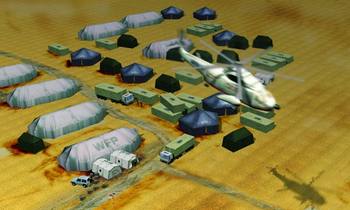
images courtesy of Food Force, © United Nations World Food Programme - all rights reserved
I often wonder if teaching children about hunger couldn't happen in a more nuanced way. Wouldn't it be more productive than training them to throw a little money at the problem? Well, maybe not with the 'throwing a little money at it' method of famine-control being so lucrative.
Tomorrow, I'll give an example of a solution.
I promise.
technorati tags: World Food Programme, Food Force, computer game, emergency food distribution
Posted by debra at 06:26 PM | Comments (2) | post to del.icio.us
Note to self: alfalfa, mustard, buckwheat, red night kidney, adzuki, soy, soy, soy
March 02, 2006
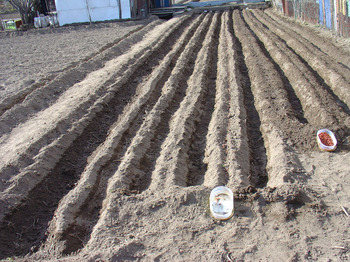
This is the planting order when facing the lower allotment. The acronym is AMBRASSS, which could stand for the the English embarass, if the cover crops once again fail to thrive. If the cover crops survive my handling and the weather, I can pronounce the acronym in French as in je t'embrace, which translates into a summer garden cocktail party with homegrown edamame as the cameo snack.
Note to self: I Innoculated the mustard seeds with dirt to form broadcastable seed pills. Narrowcasting is a more accurate description of what actually took place. Hopefully the mixing action didn't disturb the sprouted seed too much.
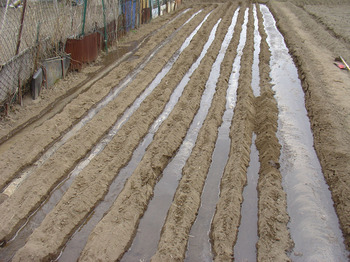
First irrigation run goes awry. Lowered irrigation pipe, made a huge mess of the footpath.
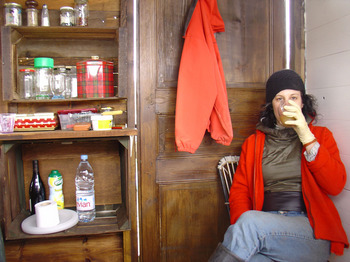
Digital photo of author drinking soup in KvR's new shed
It appears that I'm the first guest in Ktje's new cabane. JT remarked that we've started to dress like the 'Turnip Ladies' in a fairy tale and excepting the fact that neither one of us has actually grown a turnip, it's hard to disagree. For fun, we're going to wash and wear urban clothing for dinner from now on. Starting tomorrow.
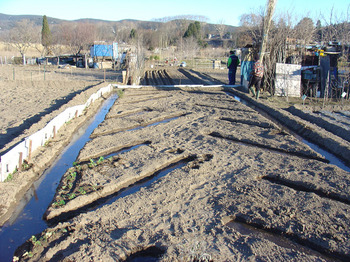
Each day the gents come to marvel at what seems to them to be a unique form of gardening. Today's crowd got a buckwheat sowing performance and a taste of buckwheat sprouts. I tried explaining that I was growing buckwheat (and alfalfa, mustard...) to improve soil condition by fixing nitrates and increasing the organic matter in my soil, but this didn't translate very well. In fact it didn't translate at all. Trick is to leave the explaining to Sidi AlGouche, the allotment's alpha male.
technorati tags: allotment, kitchen garden, irrigation
Posted by debra at 10:22 PM | Comments (6) | post to del.icio.us
Irrigate, ice skate
February 28, 2006
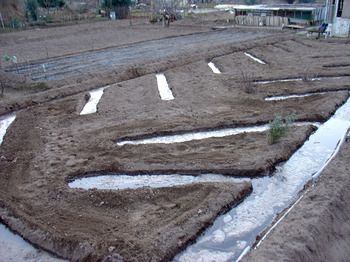
Took the new irrigation system out for a spin and it looks like I have a hunquering for the Netherlands. The idea is that all manner of plant life will grow along the borders, if it would just stop freezing for one day.
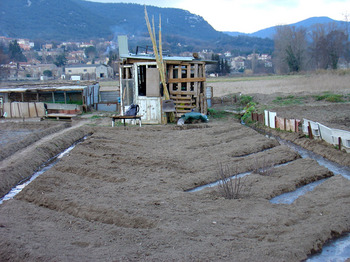
Vernacular architecture. Surely I have the ugliest shed in the gardens and hope that a good flood will wash it away.
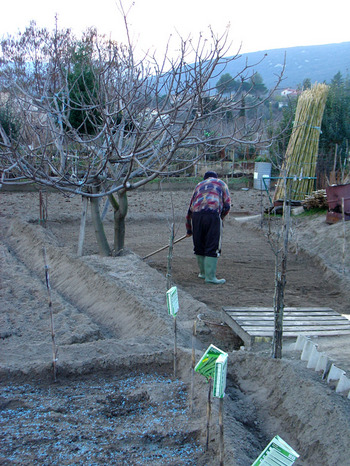
My sweet neighbour Sidi AlGouche, who saw me pissing about with the main canal structure, took the hoe from my hands, (Gimme that hoe, Ho!) and laid out the canal perimeter. He's so bored right now that he's raking his lands for the fourth time. Note, the blue pills that he gives his garden.
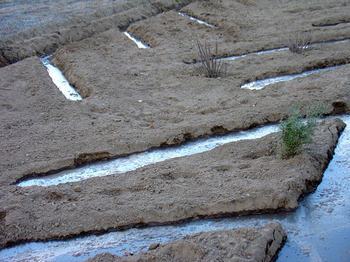
Irrigorgeous!
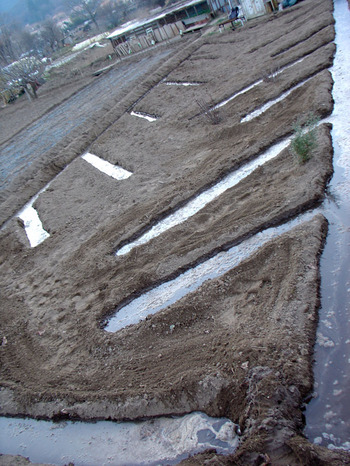
technorati tags: allotment, kitchen garden, irrigation
Posted by debra at 11:56 PM | Comments (3) | post to del.icio.us
Yesterday's news: anti-advertgames
February 03, 2006
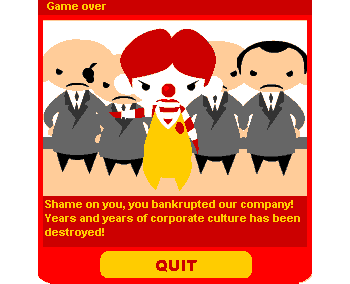
"Making money in a corporation like McDonald's is not simple at all. Behind every sandwich there is a complex process you must learn to manage: from the creation of pastures to the slaughter, from the restaurant management to the branding. You'll discover all the dirty secrets that made us one of the biggest companies of the world."
So state the Italian artist-activist makers of the McDonalds anti-advertgame, Molleindustria. I don't know if the fact that the rainforest is being destroyed to grow soy beans for hamburger meat or that cows are fattened with industrial garbage in feed lots is a secret anymore, but playing the online game illustrates that it definitely is a challenge balancing the economic factors of selling a burger without turning into a blood sucking evil-ass. After playing McDonalds for an hour, I had not once succeeded in making a profit and in fact I caused the company to go bankrupt every few minutes.
And if you're thinking, 'couldn't happen to a nicer bunch of guys', have a go.
The tip off is from Regine at we-make-money-not-art, a trend and technology blog. Thank you!
- Eric Schlosser's must-read investigation on the fast food industry is titled Fast Food Nation
- NYTimes review of Fast Food Nation
- If you're fluent in Dutch, you'll love de Keuringsdienst van Waarde's humourous yet disturbing consumer investigations streaming from the KVW website
- The only English subtitled de Keuringsdienst van Waarde broadcasts are about the development, design and production of a slave-free chocolate bar. Turns out, producing chocolate in which slave (yes, slave) labour is not part and parcel to the production practice is hard as can be.
Posted by debra at 09:21 AM | Comments (1) | post to del.icio.us
Grow your own dang food
January 30, 2006
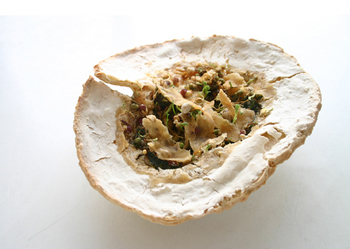
Back in the eighties, as a student at the University California at Santa Cruz, I lived in a vegetarian commune with a bunch of hippies. As hippies, we produced our own sprouts, yoghurt and salsa fresca for the entire commune, approximately thirty people. I had all but forgotten this part of my life until recently, when my Food Atelier students at the Design Academy Eindhoven started working on ways to grow their own food. The work of two enthusiastic students got my wings flapping enough for me to dare revisit my past. These are the images from the first trials, theirs and mine.
After initial attempts at growing mung sprouts in bread (see above), Cygalle Shapiro is successfully growing a ready-made 'salad on salad'.
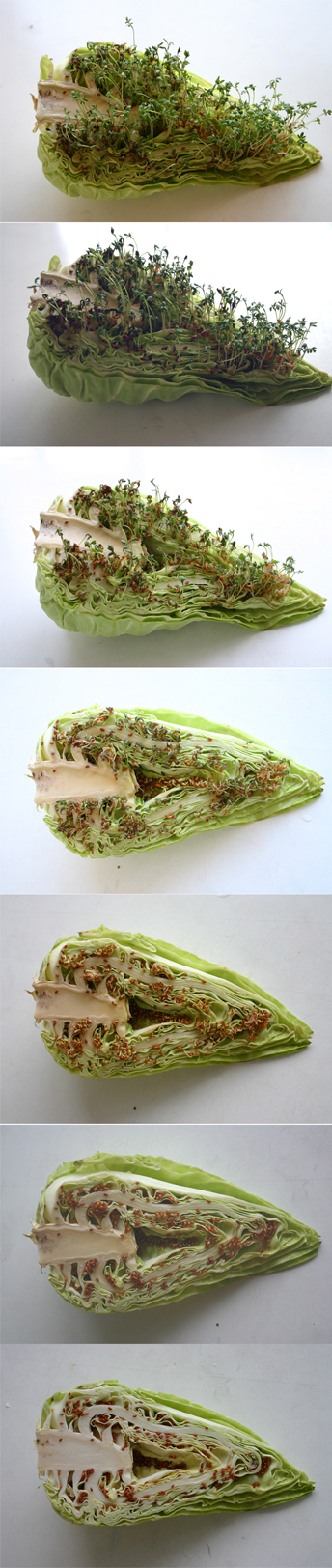
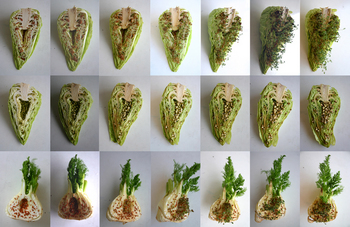
images top to bottom: sprouts in bread, salad on salad, sprouting experiments courtesy of Cygalle Shapiro, copyright Cygalle Shapiro 2005 - 2006. Contact culiblog for further information.
Liora Rosin is growing sprouts in labneh, a fresh yoghurt cheese, commonly made at home. For Rosin it is important that the seeds are grown within the labneh in order to transmit the flavour of the sprouted seed into the delicately tangy cheese.
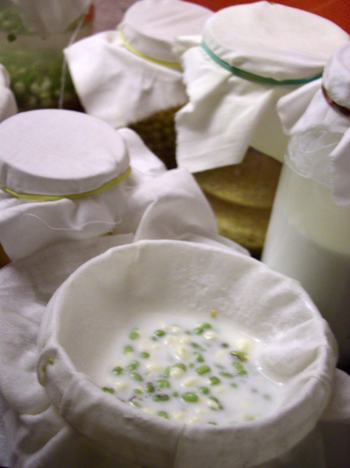
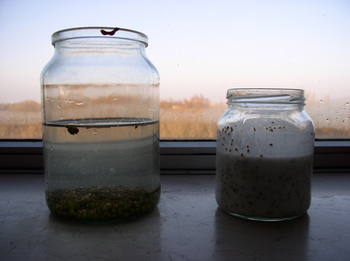
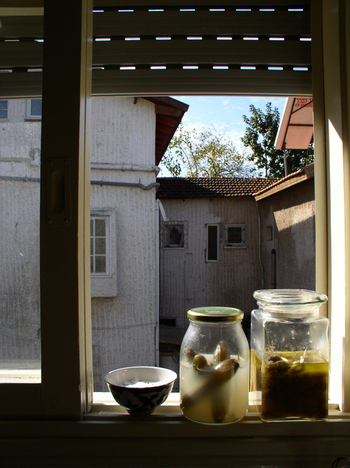
images top to bottom: home sprouting installation, soaking, lactic fermentation sill; courtesy of Liora Rosin, copyright Liora Rosin 2005 - 2006
Wouldn't the world be a better place if we all had a designated windowsill for lactic fermentation?
Having resolved to practice what I preach in 2006, I am also working on growing sprouts on labneh and find that the experiments coördinate nicely with my developing a good recipe for yoghurt ravioli.
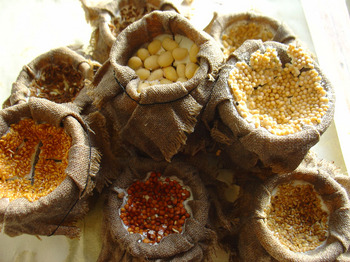
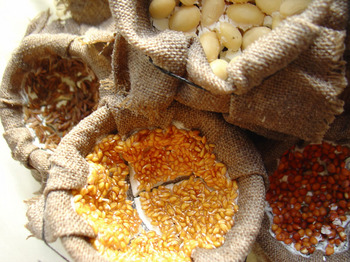
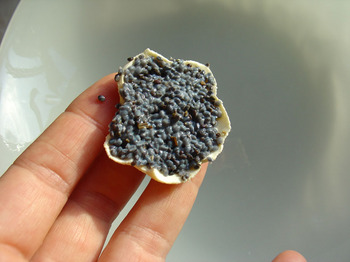
This is a cute disaster of basil seeds rotting into overly dry labneh. Seeds that become gelatinous when they are moistened (e.g., basil, buckwheat, watercress) are poor candidates for immediate immersion on or in the yoghurt medium.
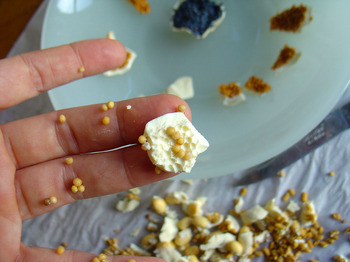
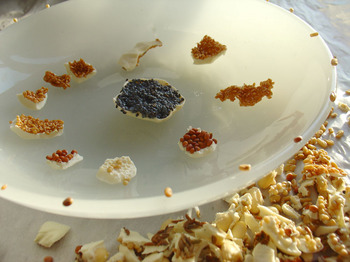
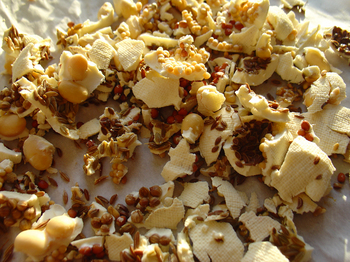
images top to bottom: sprout collection 2x, basil on labneh, playing with mistakes, pretending sampler, curd seed brittle; Debra Solomon
The results of an unsuccessful attempt at growing woody spice seeds (dill, coriander, cumin, kummel) in yoghurt medium with the intention of flavouring the labneh were not especially delicious, although visually exciting. The linen and the seeds texture the labneh beautifully and I look forward to spin a few successful recipes from these experiments soon.
Lori Alden's cheese definition site
N55: Manual for city farming plant modules
N55: Manual for home hydroponic unit
Sproutman's sprout bag. Any idiot can make one, but Sproutman is somehow selling them! My experience is that growing sprouts on wet linen works much better than growing them in jars. I have never tried sprouting in a linen bag.
Here are other urban gardening solutions, mostly rooftop gardening related:
- Rooftop Gardening link hub. Yes, it's a trend!
- Plant vegetables on your rooftops, like they do in Egyptian cities
- Toronto rooftop gardening project
- Greening Gothan Project, NYC also on the roof
- BLDG blog on rooftop farming in London
- Treehugger reports on Toronto rooftop gardening facts and figures
technorati tags: rooftop gardening, urban gardening, food security, sustainability, farming, food-related design, agricultural diversification
Posted by debra at 11:52 AM | Comments (8) | post to del.icio.us
Rural design conference scheduled for September 2006
January 21, 2006
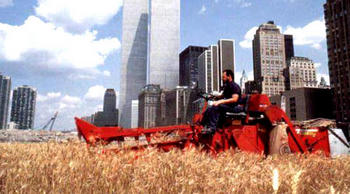
(above: Wheatfield, a large public work by Agnes Denes, image copyright Agnes Denes)
Chapeau to John Thackara at the Doors of Perception blog who reports today about a rural design conference scheduled to take place September 4-7 2006 (somewhere) in the UK. Just have a look at what's being developed for the programme! I am pleased to see that it is all about establishing and strengthening real connections between (urban) cultural producers and rural agriculture producers to the benefit of both.
In a conference forerunner in July of 2005, this is what they were talking about: farmers as curators - an international Rural Biennale for 2007, sustainable farm diversification, rural tourism, food marketing initiatives and staging the Rural Biennale as an integral part of a European Region of Rural Cultures and Farmer Creativity celebration.
To the list of interesting subjects already discussed and in the planning for September 2006, I would like to add: 'rural farmer to urban farmer advisory partnerships for urban gardening/farming initiatives'. I can't help but wonder if the experience and knowledge of the rural farmer can help urban farming inititives such as this wonderful urban farming project in East L.A from being under threat of closure due to urban land-use issues. Injecting (cultural) life into family farms suffering brunt of (European) Agricultural Policy might be just the ticket for rejuvenating a way of life under threat of extinction. Might not the urban farmer benefit from being part of this discussion and network?
- European Rural Culture events page
- Littoral - new zones for critical art practice. An excellent organisation website, with informative links on everything from an extremely mixed bag of individual artists and designers that use nature / agriculture / landscape as a creative platform, to cultural documents on foot and mouth disease!
- Cultural Documents of the Foot and Mouth Crisis in the UK
- Urban food gleaning project by Fallen Fruit
- The South Central Farms website is good reading if you want to get fired up!
- Pruned, weblog on landscape architecture and related fields.
- Pruned blog entry about South Central Farms in L.A.
- Pruned on artist Agnes Denes
- Brilliant films by Raymond Depardon about the demise of French farming communities in the Lozere were shown at the 2005 Int'l Documentary Film Festival in Amsterdam (IDFA) as part of a special tribute programme.
- Farming as a a landscaping trend in suburbia! (Landscaping is responsible for more than 80% of water use in the suburbs.)
- Doors of Perception review of urban farming proposal by Dutch architect Winy Maas
- Non-sanctioned urban gardening in Istanbul, entry in culiblog
- Innovation Network Rural Areas and Agricultural Systems
technorati tags: rural design, food security, sustainability, farming, food-related art, food-related design, food-related film, Raymond Depardon, agricultural diversification, agricultural policy, urban gardening
Posted by debra at 11:47 AM | Comments (1) | post to del.icio.us
Weedy plot, commuting, cover crops and humble pie
January 11, 2006
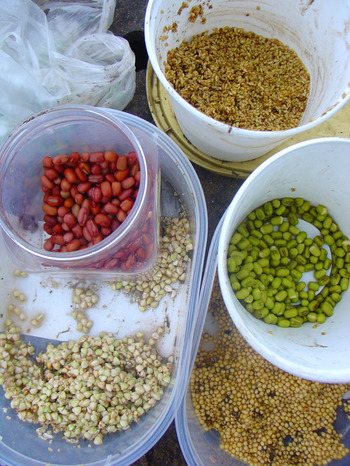
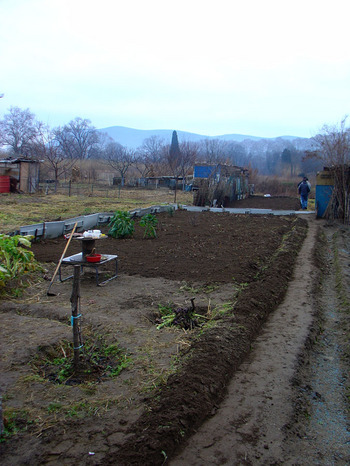
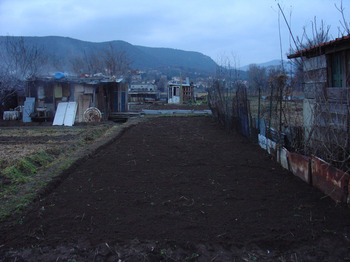
People who know me well would never say that I'm a practical woman. Now, all the more so. I've left my winter quarters in Occitania to return to the Polar Circle, where paid work is calling. Screaming, really. In gardening there's a time and a place for everything, and ever since I've had this garden, my commuting life-style has forced me to ignore this simple rule of nature and do things at the wrong times. Sunday, I finished turning the earth by hand on both allotments. One hundred and sixty square metres. That's seven in dog years, carry the three, and if you're not impressed, I don't care. I'm totally impressed with myself.
It's a funny thing in our allotments, all the women are organic gardners, and all the men are not. I don't know if that corresponds with some kind of hippy statistic, but that's the way it is. And there's a great deal of social control, you can't just let your garden go to pot, just because it's yours. I decided for this reason to experiment with growing cover crops, a crop just meant to keep out the bad weeds and condition the soil in the process. It's absolutely unconventional around here, and for this reason, I'd been preparing my neighbour, spending time talking to him about my experiment, to let him get used to the idea.
I'm talking about my very sweet neighbour AlGouche. The one who built the retaining wall/serre without my even asking for it, the one who waters my garden when I'm up north, the one who makes me sit down and eat a lunch of barbequed chicken and wine that he's prepared on his little fire when he thinks I'm working too hard (il faut manger), the one that feeds his garden little red and blue pills. I've been telling him for a week now, that before I leave Occitania, I'm going to plant a crop full of weeds, on purpose. Buckwheat, alfalfa, mustard, soybeans and adzuki beans, not for eating, but to improve the soil composition, keep down the real weeds, and give me an excuse to use that turquoise blue rototiller that we just bought. (I read that each time you use a rototiller you have to add 6% organic material to the soil so as not ruin it's texture.)
Plants not for eating? Al Gouche shakes his head, and tells me in a Moroccan-Occitanian dialect that I'm meshuggah.
The last days, I turned one hundred and sixty square metres of earth with a spitfork. The men of the allotments, bored out of their skulls with winter-lack-of-work, gather daily at AlGouche's shed for gossip and beer. That's 'man' for tea and sympathy, I guess. But on Monday, my last day in the garden, before departing for Amsterdam, I was completely shocked to overhear AlGouche defending me to the other men. 'She's not planting real weeds, just some plants that will improve the soil.' My heart lept.
And now I'm praying, and looking at the Occitanian weather report from Amsterdam, that the seeds that I have ever-so-crazily planted in January, and that really is meshuggah, will somehow sprout and thrive, beat the weed-race on my little plot of land, between now and March.
Subsistance farming really is a nerve wracking affair, part-time susbsistance farming, even more so. I keep telling myself that if this experiment doesn't work, nothing will be wasted but a few handfulls of seeds, one day of planting and a huge amount of pride. Which is expensive. Upon leaving the garden Monday evening, I say a little prayer for all the microbes and the earthworms, hoping they enjoy the oysters shells I crushed into the soil, hoping they enjoy the leaves and rotted corn husks, hoping the little legume seeds will grow, and win the growing race for the most light, water and nutrients. Please little legumes, winter cover crops, fix the nitrates in my soil, and produce as much biomass as you possibly can. I'm counting on you.
Posted by debra at 12:34 AM | Comments (2) | post to del.icio.us
Brussels pearls neither bitter nor farty
January 06, 2006
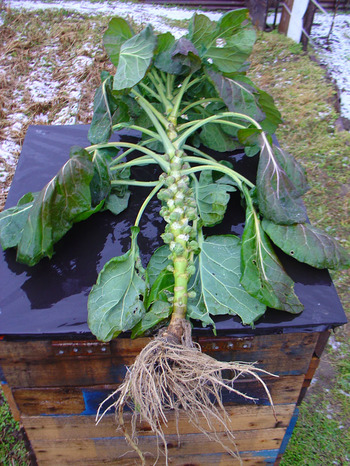
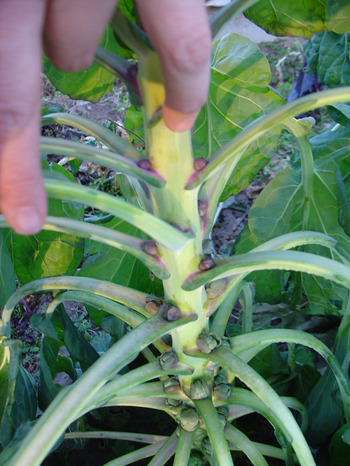
Look what Maman brought home for dinner tonight! While everyone else in the valley is shooting at wild boar, I managed to wrestle to the ground and uproot this domestic brussels sprouts tree. Admittedly, that sounds like I'm getting the short end of the stick, but the pearly buttons and sweet leaves of this homegrown resemble nothing of the bitter fartiness that I know to be storebought brussels sprouts. I've been scheming on how to bring back a whole tree to the sorrel-eating Dishy Lad on Tuesday, when I return to Amsterdam.
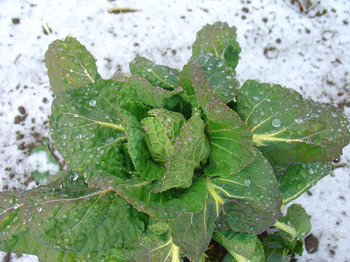
As a kid, not liking the food dished up at the dinner table was not an option. It was more or less expected that one would come to the table with a good appetite, sit down, join in the bubbly conversation and not only eat your food, but enjoy it. There was only one thing that brother Aar and I didn't really like, and that was brussels sprouts. Not liking something in our house meant that it was prepared once a year in the name of good health, and that we ate it anyway, smothered in tabasco sauce.
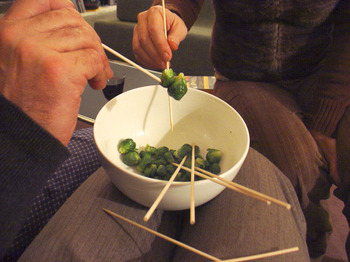
Tonight we're having brussels 'pearls' as a snack, that's how freaky we are! Two handfuls thrown into salted boiling water for just a few seconds, tossed with lightly salted butter and a squeeze of lemon and served on cocktail skewers. The friends were eating right out of my lap.
technorati tags: brussel sprouts, raw food, recipes, Languedoc, happiness, organic gardening, cooking
Please read more... "Brussels pearls neither bitter nor farty"
Posted by debra at 06:38 PM | Comments (0) | post to del.icio.us
Green manure cover crops and another garden parcel
January 05, 2006
Yesterday I aquired another parcel of land when I went to pay my yearly subscription at Monsieur L. Thirty-five euros per parcel (roughly 100m2) and all the river water you can use. Still, with the chateau of the Comtesse de R. in plain view, we the serfs of the C'-ac allotments know that all of this could be taken away at any time. But for the time being, I have enough ground to grow and experiment to my heart's content. It's extremely relaxing when my largest concern is how to increase the biomass of my soil. I'll be experimenting by sowing 'green manure' cover crops (buckwheat, yellow mustard, soy beans and alfalfa) on my two parcels until spring planting begins in March.
Posted by debra at 10:17 AM | Comments (0) | post to del.icio.us
Another gushy garden story
January 04, 2006
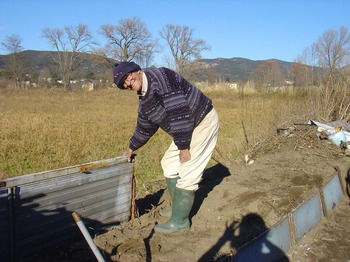
Why is this eighty-seven year old man smiling? One possible reason is that he has a garden... and neighbours. If I am any sort of judge of things that make one happy, I can report that the addition of a garden and all the things it brings with it, fresh veg and fruit, new friends, a sense of community, has increased my happiness considerably. Yesterday for example, I returned to the allotments to find that my generous neighbour, AlGouche, had pressed the eighty-seven year old Louis into service, installing a petit serre (little green house) for me in back of my cabane! AlGouche (see below) is concerned that, once back in Amsterdam, I'll worry endlessly about spring planting, but with the serre up, in March I can just get down to business. My heart melted when I saw the two gentlemen happily digging and pounding away, just so that I wouldn't worry! They even turned the soil, Louis taking very special care to remove all of the topinambour and bits of glass, and they all joked that I shouldn't gush too much and keep them from their work.
By the way, the first I'd ever heard of Louis was not in the context of the garden, but in a dancing story. Having just returned from a village party last spring, Ktje rang me up in Amsterdam to report the party gossip and to tell of an amazing old man who was passionately dancing salsa all by himself for more than two hours straight. This old man was Louis, the kind of eighty-seven year old that I aspire to be, although it may take me awhile to develop an affinity for salsa.
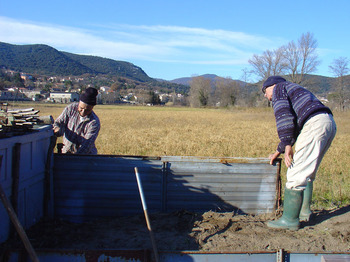
image: AlGouche initiates the works for the retaining wall/serre with garden neighbour Louis
technorati tags: aging, farming community, happiness, gardening, Languedoc,
Please read more... "Another gushy garden story"
Posted by debra at 09:05 AM | Comments (1) | post to del.icio.us
Second to last walk of the year
December 29, 2005
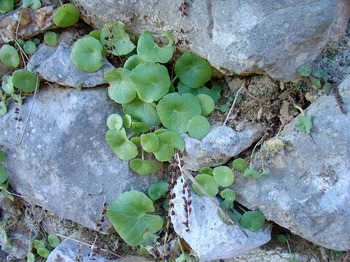
*Without a prayer of an internet connection in sight, I have been enjoying my friends, the garden and the splendid but freezing environs. Today's hike up the mountain led us past miner's lettuce growing in the maze of thick stone walls. And while talking of lettuces and of mines, there was gunshot all around us. It's hunting season, and I had left my orange cap at home.
The walk turned into a real adventure when, by chance, we met a bear of a mountain man, in his other life, an oceanographer. Our new acquaintance generously asked us in for some mountain style coffee on his homemade terrace which had irises **somehow hardy enough to bloom. Our new aquaintence has a two hundred degree view of both valleys, and is set up to maximise every minute of sunshine. He told us, that usually when the weather gets like this, (three weeks a year) he simply goes into hibernation, eating dinner at 15h and going to bed by 17h! An interesting man though, and we are pleased to have finally met an inhabitant of this mountain.
* - Merci, Wanadoo et France Neuf, both of whom treat their Mac customers very poorly.
** - My hopes of turning the soil before returning to the Pays Bas have been dashed by the cold.
Posted by debra at 01:28 PM | Comments (1) | post to del.icio.us
Birthday picnic au plein air
December 24, 2005
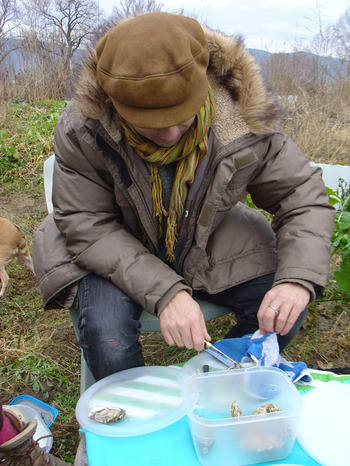
With a small group of friends we celebrated my birthday with a fresh and freezing garden picnic in the painfully crisp air. Champagne, oysters and a sorrel quiche, in the case of the sorrel, eaten one meter away from the very plant that grew it. New neighbours, new but wonderful friends, all kicking the frozen ground and sipping champagne. We unanimously are longing for summer, or at least the spring planting.
Still, the leaves of the bruxelles sprouts are very sweet and the kale is abundant. In the case of the kale, the plants came from seeds that spilled unto the ground whilst moving the cabane, all so very sweet.
Posted by debra at 01:13 PM | Comments (0) | post to del.icio.us
Winter BBQ practice down at the kitchen gardens
December 23, 2005
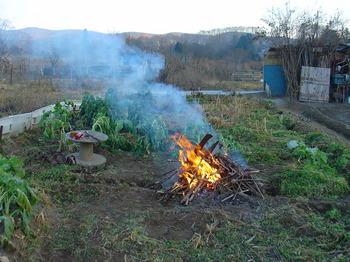
Can kitchen garden soil ever really have enough potash? A quick look around the environs and the answer is a resounding 'no'. It's fire lighting time, again!
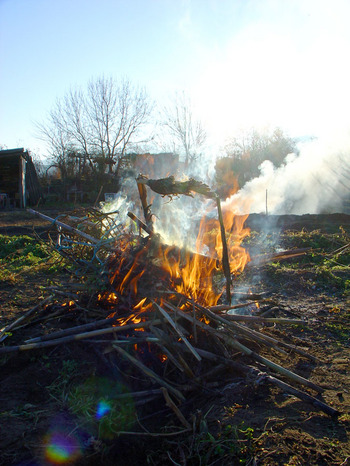
All the guys are doing it. Really. Every single last one of them.
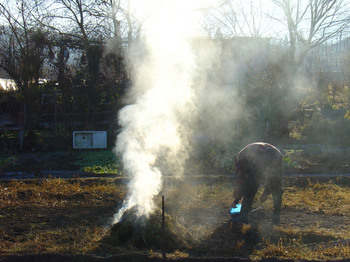
Because lighting fires is like youth serum.
technorati tags: garden, winter, kitchen garden, sustainablility, Lanquedoc, Occitanie, potager, fire
Please read more... "Winter BBQ practice down at the kitchen gardens"
Posted by debra at 03:25 PM | Comments (0) | post to del.icio.us
My kitchen garden at midwinter
December 21, 2005
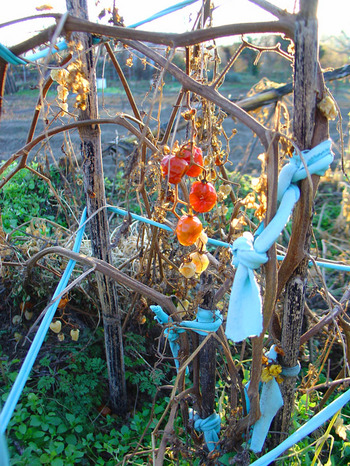
Granted, mine is the ugliest of all the kitchen gardens here, which is why it's unbelieveable that upon my return to Occitania, I was able to pluck leafy greens at midwinter! I fully expected to find nothing, bugs and more nothing, but to my great surprise there are sun dried tomatoes, sorrel, sweet raddichio, leaf cabbage, red cabbage, beets, beet greens, sage, rosemary, mint, broccoli, and soon... bruxelles sprouts. Gleaning is yielding enough food for a birthday party luncheon on the 24th!
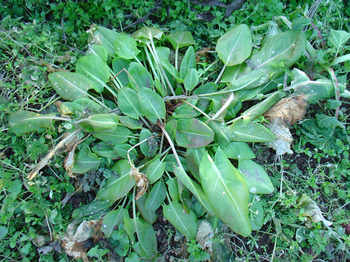
Please read more... "My kitchen garden at midwinter"
Posted by debra at 12:54 PM | Comments (5) | post to del.icio.us
Sort of public gardens
October 21, 2005
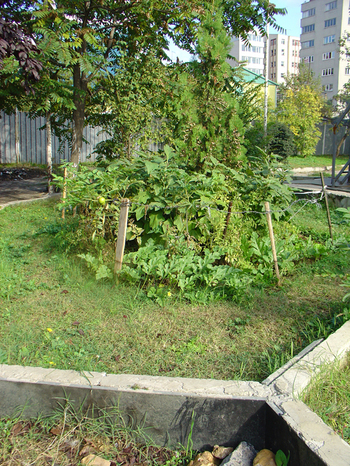
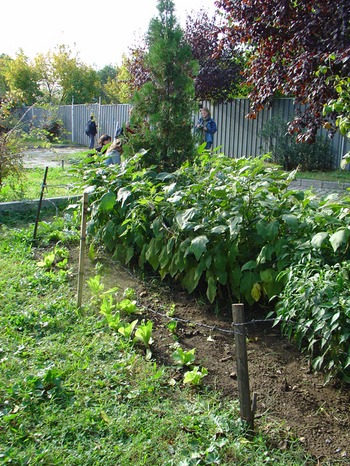
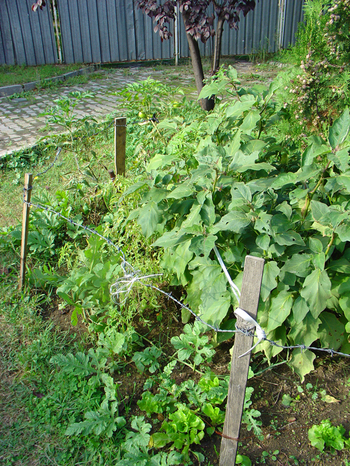
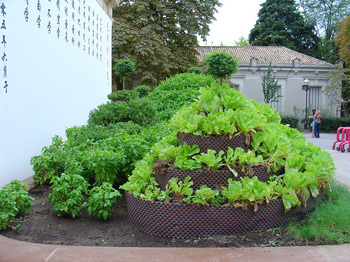
The urban garden is thriving in Istanbul. Walking around the Biennale's parallel programme locations in Karaköy, I spied some ad hoc agriculture in 'public' planters. These images show vegetables being grown amidst 'ornamental' city landscaping. Chapeau to the hacker-farmers growing squash, bell peppers, tomatoes and aubergines in their urban gardens. Look, they have even contructed a BBQ on which to do the grilling!
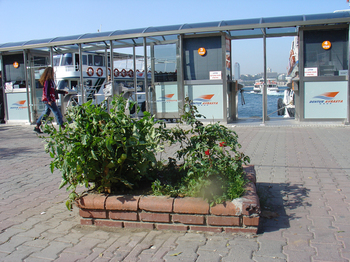
Smack dab in the middle of the Üskudar ferry terminal, ad hoc growers have cultivated tomatoes in all of the planters.
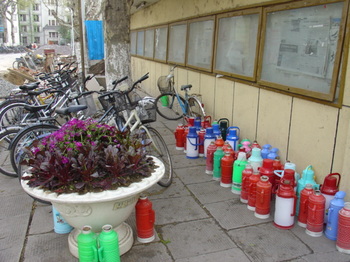
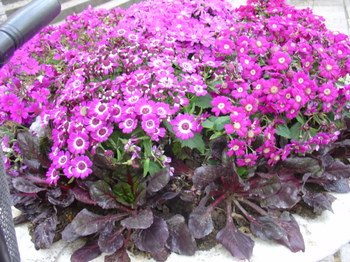
Images documenting beets being grown within public landscaping at a student housing complex in Nanjing in PRChina (April 2004).
And in Montpellier this summer, PRChinese artist Song Dong's salad installation.
technorati tags: public domain, urban gardening, food security, farming, food-related art, hacking, public space agricultural diversification, agricultural policy
Please read more... "Sort of public gardens"
Posted by debra at 04:04 PM | Comments (0) | post to del.icio.us
So except for the vodka...
August 06, 2005
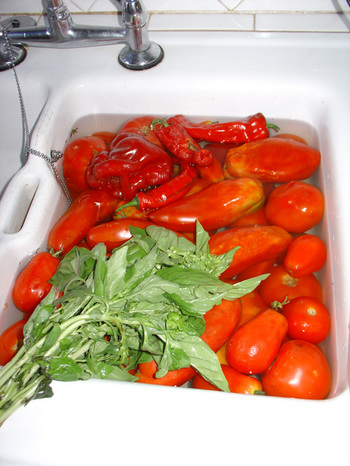
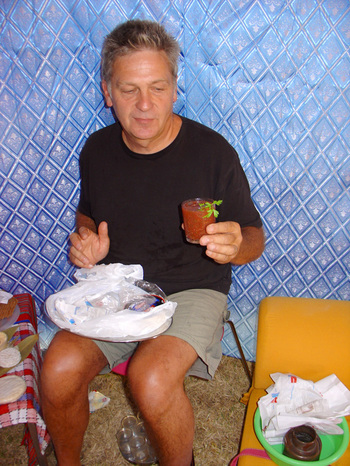
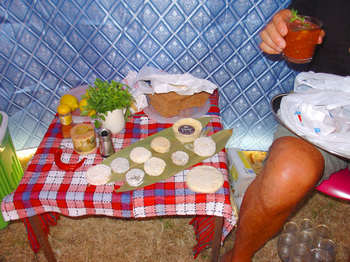
We thought that homegrown bloody marys would be an appropriate drink to celebrate his 44th birthday and to give the yurt a proper yurt-warming. All of the ingredients except the ever-important electrolytic enhancors were homegrown or grown within 2 kilometres of the yurt. Thankfully more homegrown (from only 4,5km away) was gifted later. Gawd bless us.
technorati tags: sustainable, organic gardening, vodka, yurt
Please read more... "So except for the vodka..."
Posted by debra at 12:48 PM | Comments (1) | post to del.icio.us
So except for the coffee...
July 26, 2005
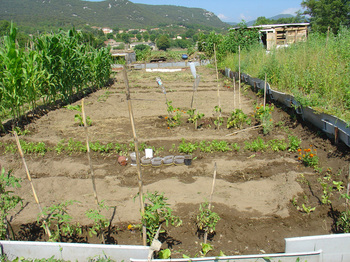
You may have noticed that culiblog has entered holiday mode. Hopefully this will all end soon. Profound apologia for the die-hards, but it's summer and all I want is homegrown. Please just go outside.
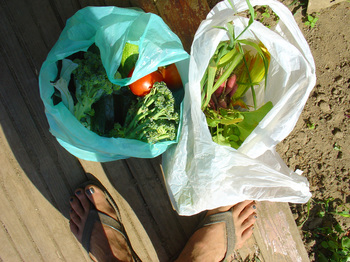
Here in Occitania, most of our food doesn't even make it the fridge before we've brushed the dirt off the roots and gobbled it up. Breakfast happens during the morning's water & weed and consists of cherry tomatoes, blackberries and baby courgettinissimi. Raw sheep's cheeses from the market, either very young or very old are our favourites and the saltiest dried ham compliment our salad at lunch. We have decided that we like all of our lettuces pure, not mixed. They're so sweet and full of flavour when you grow them yourself.
Except for the coffee, tea and peanut butter (you can take the girl out of California, but you can't take the California out of the girl), we're easily eating food grown within 5 kilometres of where we live. Yes, including the wine.
Now if we could just say that about our cosmetics. Please send black nail varnish.
images from l to r: today's harvest to be eaten at lunch, my garden (which changes every single day)
Please read more... "So except for the coffee..."
Posted by debra at 04:34 PM | Comments (0) | post to del.icio.us
Love those short supply chains
April 26, 2005
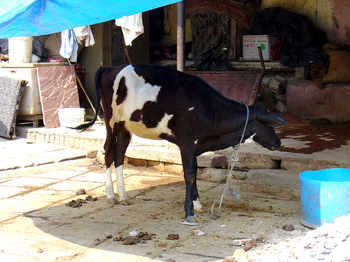
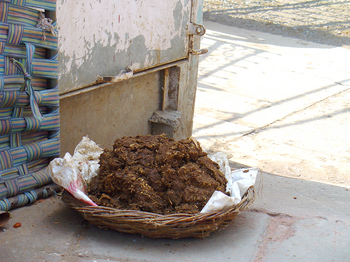
Here in Europe we can't stop talking about 'food miles', that is to say, how many kilometres our food travels before we actually get to touch it. There's that quite famous study of the strawberry yoghurt, It's the same for all products, including cow dung fuel. The images shown were all taken within 20 metres (!) of eachother in the Hanuman Mandir temple complex near CP, Delhi.
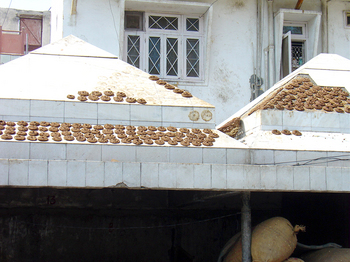
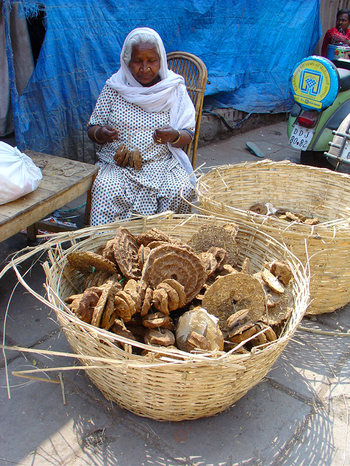
From top to bottom: Cow - dung collection - patty cake, patty cake, dry dry dry - fuel saleswoman
Please read more... "Love those short supply chains"
Posted by debra at 08:24 AM | Comments (0) | post to del.icio.us
Brain Food
January 20, 2005
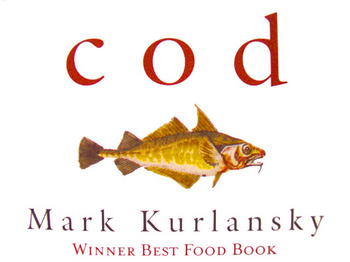
This terribly sad but well written book by Mark Kurlansky is a gripping history from the perspective of the cod. Kurlansky tells how fishing for this gadiform has deeply affected the wealth and development of many nations and technologies. I'm thinking the Flounder by Gunther Grass that I read back in the day but even more I'm thinking Fish Story, the mega-artwork by Allan Sekula, about the 'sweatshop called the Pacific'. (Sekula's visual history Fish Story was part of the the last Documenta XI in Kassel. One photograph in particular gave me goosebumps. You see a ship painter giving the Exxon Valdez a new name...fishy stuff.)
It turns out that cod in the form of stokvis (wind dried cod) turned out to be some good thinking-man's protein for the Norsemen. That extra portable brain-power enabled them to encounter New Foundland in 1000, where they also encountered the Beothuk People who had already discovered it and were not enamoured with the idea of sharing their space with the pink and hairy people from across the puddle.
Basques added salt to the stokvis recipe to make salt cod increasing the quality of the preservation and enabling Basque fishermen to to travel even farther - to the mouth of the St. Lawrence river. When explorer Jacques Cartier got there raring to claim his 'discovery' he encountered almost a thousand Basque fishing vessels. And a bunch of angry native Beothuk people getting pissy about the incessant attention.
Cod is inextricably tied to land (to dry it) and salt (to preserve it) and Salt is in fact the title of another one of Kurlansky's wonderful books.
Posted by debra at 08:54 PM | Comments (3) | post to del.icio.us
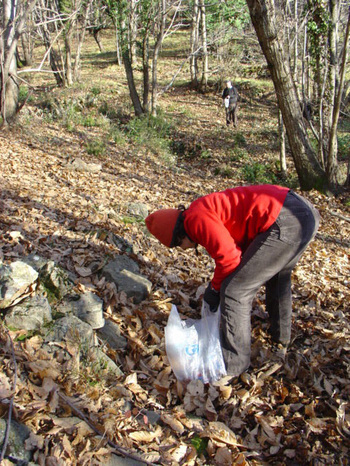
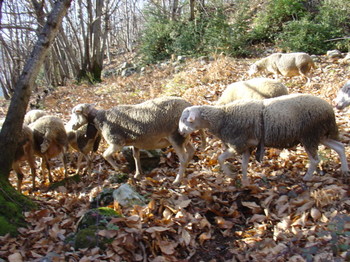
Chestnut Hunting on a Freeway of Sheep
December 18, 2004
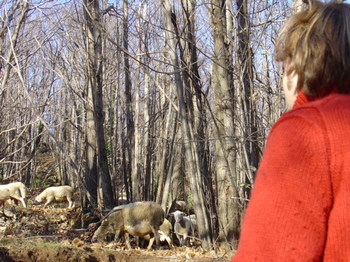
Just start imagining what that might be like.
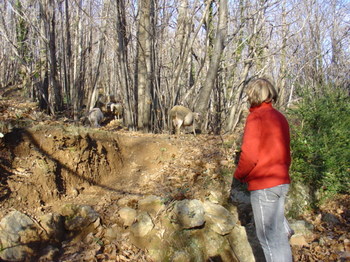
We didn't get in eachother's way.
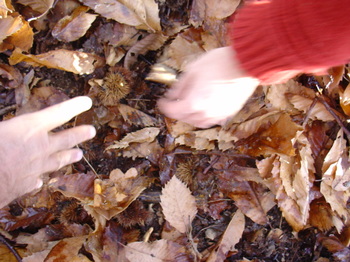
We wore red to alert the hunters. Saturday is hunting day.
technorati tags: Languedoc, hunting, chestnuts, food gathering, culiblog, sheep
Posted by debra at 11:49 PM | Comments (0) | post to del.icio.us


