
A nut cheese nut case
June 25, 2006
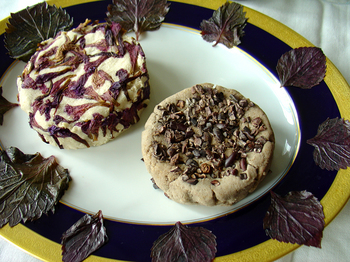
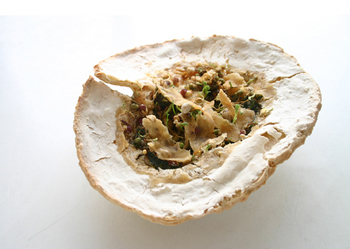
On the left, homemade pine nut paté with borage flowers. One the right, walnut paté with raw cocoa nibs. Normally this sort of food preparation is reserved for vegans, hippies and raw foodists. I am none of the above, a red-blooded porkatarian, I am. One of my readers disclosed that she thought that I was a man until a friend told her differently!
Anywho, this year I became an enthousiast of slightly fermented nuts, and I know, that’s just plain faggy. Not that there’s anything wrong with that! The nut flavours are delicate and would certainly go well with dairy cheeses. Note how I didn’t say, ‘real’ cheese?
(The leaves at plate’s edge are rose and mirin pickled shiso or perilla.)
To make these cheeses, follow the recipe for cashew cheese here, and substitute pine nuts or walnuts for cashews. Do not omit the sea salt, but do leave out the kimchi juice. Kimchi juice will make the cheese really cheesy - and these cheeses deserve to be a little sweeter than that. Instead, add a few glugs of maple syrup or a slab of honeycomb whilst blending.
Posted by debra at 12:06 PM | post to del.icio.us
Catchy, but not contagious
June 23, 2006
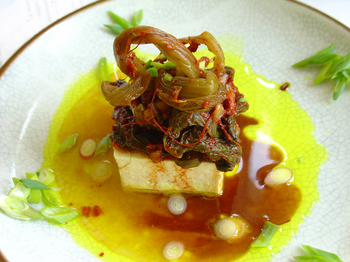
It was recently revealed in an offical report out of the Kimchi Nation that there are exactlly one zillion sorts of kimchi. Kimchi is a falsely generic term for the Korean national pickle and katchi is the mustard green variety pictured here.
Catchy Tofu
recipe described vertically, from bottom to top:
a puddle of saffron oil
stray scallions, strewn about
a block of fresh tofu
a stack of katchi
a drizzle of nama shoyu
Stack the ingredients voluptuously. Leak a few drizzles of nama shoyu over the lot until it starts to pool at the base of the tofu.
Serve.
- culiblog reports on the kimchi air conditioner
- culiblog recipe for kimchi comfort food
- culiblog recipe for kimchi monkfish en papillot
Posted by debra at 03:12 AM | post to del.icio.us
Master cleanser, for juice fasters and thirsty people
June 14, 2006
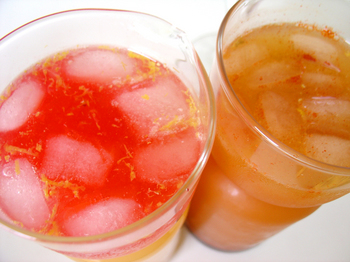
If you just think of this as lemonade, you might actually drink it. Master cleanser is the unfortunate name for a cayenne-spiked ginger lemonade, sweetened with maple syrup and sprinkled with sea salt. When you fast or do sports or simply exist in warm weather, it's wise to drink liquids that don't make you pee immediately. Most softdrinks, alcoholic drinks and all caffeinated liquids do this, removing the benefit of drinking for the purpose of hydration in the first place.
In this lemonade, the maple syrup and the fleur de sel allow the liquid to hydrate the body more thoroughy than if they weren't part of the mix. As a master cleanser, the cayenne and ginger are vasodialators and gently invigorate the gut.
If you're fasting, Master Cleanser is the sort of drink that you take with you and sip throughout the day. But if you just want a refreshing summer drink, call this Super Spicy Lemonade or rosé and do the exact same thing. You can even pretend you're fasting and be holier-than-thou, always a refreshing feeling and one of the least mentioned benefits of juice fasting.
Picture recipe after the jump.
Please read more... "Master cleanser, for juice fasters and thirsty people"
Posted by debra at 04:49 PM | post to del.icio.us
Juice fasting recipes, start with forgotten vegetables and then forget them again
June 13, 2006
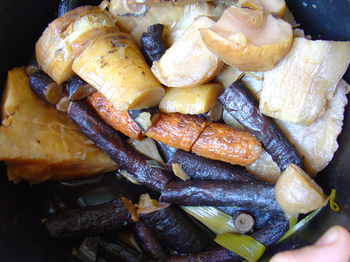
I'm the kind of gal that likes to pad her New Year's resolutions with seemingly achievable ambitions like, 'Improve handwriting' and 'Find ways to enjoy ancient root vegetables', but 5 months into the year, I haven't exactly achieved success in integrating parsnips and burdock into my winter diet in any significant way. When I returned home from Saturday's farmers' market loaded with fresh ingredients for a 5-day juice fast, I was confronted with a fridge half-full with ancient burdock, celeriac, carrots, parsnips, and a window sill of dried apples. The produce was definitely local, but in the course of some hecticity the past few months, had inadvertently become non-seasonal. I had created forgotten vegetables.
In the spirit of 'once a year whether you need it or not', I set to thoroughly cleaning out the fridge to make room for the new arrivals. Oddly, the pile of veg that didn't make the cut consisted predominantly of root veg, species hardy enough to survive extreme neglect. Not wanting to waste not, I gave the ancient grub a scrub and placed it in a large pot of water a'simmering over a low flame. Re-visiting the theme of forgotten vegetables, I simply forgot these vegetables anew. When every now and again I happened to remember them in the course of the next day, I just added some water or annointed them with a pinch of sea salt. I didn't even stir.
Yesterday I poured off the liquid, which left to its own devices had transformed itself into an aromatic vegetable bouillon, so delicious that VN and I felt positively blessed drinking it chilled from gold-rimmed shot glasses. Although I am not certain as to the nutritional value of this drink, I am certain that the initial slow-aging of the vegetables and the slow-drying of the apples is the reason that it ended up so flavourful. If you aren't forgetful, you could probably achieve this self-same result with fresh vegetables and a dehydrator, reducing the simmering time to boot. But I prefer to forget and let the soup just make itself.
Forgotten vegetable bouillon
2 kilos of mixed root vegetables; celeriac, parsnips, burdock, carrot)
4 wrinkly old apples, not rotten, just wrinkly and old
1 leek, very old but not rotten
big 'ol pinch of the sea salt
water straight out of the tap
Give the veg and fruit a good scrubbing. If it has been in the fridge for a few months, it really needs it. By the by, leaving the dirt on root veg (and even storing it in sand) keeps it fresher longer. That said, it's the optimism of washing off the dirt that caused these vegetables to dry so perfectly in the fridge over several months time that they retained all of their sugars.
Cut the root veg and apples with skin an all in a large pot filled to the brim with cold water and a big pinch of sea salt. Put the flame on low and if you must, cover the pot no more than half-way. Every four hours check to see what's going on, you may need to add water if you've evaporated too much. After at least two times of adding water and letting simmer, turn off the flame and let the liquid cool, lid off. Pour off the bouillon and use it as vegetable stock or as an ingredient in a root vegetable stock cocktail.
Posted by debra at 11:08 AM | post to del.icio.us
CPULs
when bad acronyms
happen to good people
June 09, 2006
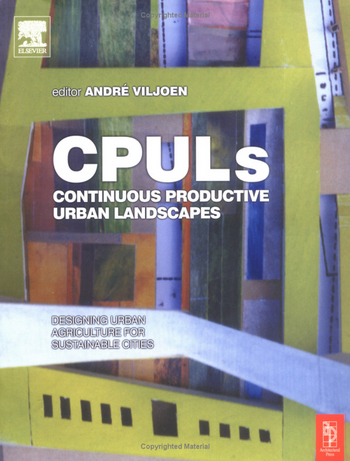
It's pronounced 'SEE, PULSE' and stands for Continous Productive Urban Landscapes. Architects Viljoen, Bohn and Howe's postively radical notion of combining productive urban landscapes with continuous landscapes, proposes a new urban design strategy that would change the appearance of contemporary cities towards an unprecedented naturalism. Think urban agriculture, allotment gardens, increased biodiversity, decreased carbon emissions and strategically connected green space - and you will start to get an idea of what the authors are suggesting. Although this is in no way within the scope of the book, never have I encountered a more holistic approach to urban planning that so thoroughly takes into account our imminent plunge into energy descent and the extreme effect that this will have on our food supply.
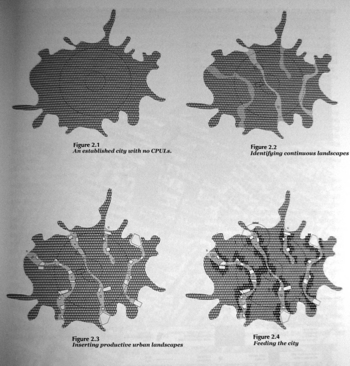
Diagrams showing a projected development of CPULs © Bohn & Viljoen Architects, reformatted for culiblog and used entirely without permission
Despite sporting a singularly unsexy title and a graphic design utterly devoid of charm, CPULs is a compelling vision for urban planners and (landscape) architects. The book is loaded with truly useful facts and case studies yet somehow remains a rivetting read for layfolk, comme moi. The authors were wise enough to begin the book with a succinct glossary defining all of the concepts so that within five pages you're already an adept at juggling terminology like vertical and horizontal intensification and you know the difference between an organiponico and a heurto intensivo.
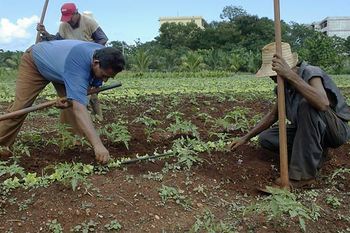
According to people who are in a position to compare, CPULs offers a rich documentation of UK allotment history and vivid reports of successful urban agriculture in contemporary Cuba, one of the few countries to have yet experienced peak oil. In 1990 when Cuba stopped receiving cheap juice from the Mothership and subsequently lost its largest client for agricultural produce, Havana citizens suddenly found themselves without access to sufficient food as expressed in 30% fewer calories in their diet! Instead of engaging in some futile rioting, they took up gardening en masse, and by gardening, I mean organic gardening. Later the government jumped on the bandwagon and started facilitating the urban agricultural effort in the form of responsible planning and infrastructure development. Presently Cuba is considered to be a living laboratory of how small urban farms and gardening collectives can successfully provide a significant portion of the urban food supply in spite of energy descent. Listen up, everybody! The CPULs authors were enlightened enough to note that a population accustomed to collectivism is more likely to be successful at community projects and that Northern European urban agricultural initiatives of the future will need to develop a native form to ensure their success.
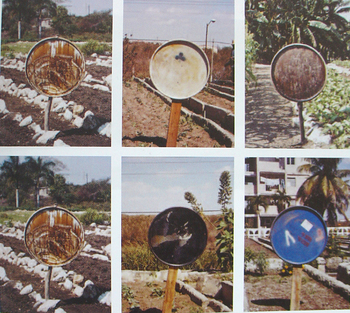
Oil drum lids used as markers in Havana organiponicos. Photos by Tom Phillips from CPULs used entirely without permission
CPULs' authors articulate the benefits and obstacles to their proposal and offer cogent strategies for creating city land use policy in which urban green and brown are treated as productive space, considering the unbuilt as an event of equal intensity as the built. A vision of a thriving CPULs in London 2045 provides a powerful scenario that I can imagine myself being a part of at any stage in my life. This is something I would not characterise as a common feature in most urban planning. In CPULs city planning the well-being of people is a central and distinguishing factor. In fact, its completely seductive.
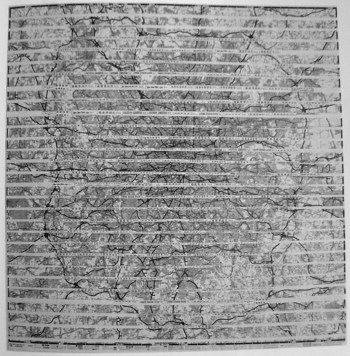
A map of London expanded to accomodate mini- and SUPER-market gardens, from a 1998 study © Viljoen and Bohn Architects, photographed from the book and used entirely without permission
Robert Hopkins from Transition Culture weblog notes, 'It is only in the last 30 or so years that we have perfected the art of creating totally useless landscapes. New industrial estates and business parks typify this, planted with 'low maintenance' shrubs, specifically bred to be entirely unproductive.' Bohn and Viljoen point out that though European cities have planned for a variety of approaches to open space including urban parks, urban river fronts, urban squares, urban stages, urban forests and urban beaches, there are as yet no urban fields. 'Living and growing food in the contemporary urban space, CPULs could formally be similar to urban parks.' I am inspired by the notion that landscape architecture could be pivotal in designing for a future in which peak oil will have tremendous impact on the urban food supply.
As someone who writes about food and culture and as an an art and design educator, I cannot recommend this book highly enough. I hope that its concepts are embraced by those who are in a position to implement urban planning of this nature. The notion of CPULS deserves to feature prominently in design and architecture curricula, informing a new generation of people designing our cities and potentially our well-being through our access to healthy food.
CPULs do not yet exist.
In type, they will be new,
in type they will be productive.
See, pulse, with a silent meow at the end.
- Continuous Productive Urban Landscapes. Designing Urban Agriculture for Sustainable Cities. Andre Viljoen (ed) 2005. Architectural Press
- Biography of Andre Viljoen at the Royal Institute of British Architects website
- Robert Hopkins' brilliant Transition Culture review of CPULs. The review also questions why Viljoen doesn't use the term permaculture when the ideas in this book are so clearly informed by it. Hopkins points out that THIS book is exactly where permaculture needs to be. Although CPULs author Graeme Sherriff addresses permaculture rather thoroughly in Chapter 22 (Permaculture and Prodcutive Urban Landscapes) I can imagine that editor Viljoen felt a need for a new definition (and therefore produced that unfortunate acronym) because the notion of permaculture does not specifically address urban planning and land use policy.
- Permaculture according to Wikipedia
- Permaculture according to CPULs authors - quoting Robert Hopkins!: 'Permaculture has evolved into a system for the conscious design of sustainable productive systems which integrate housing, people, plants, energy and water with sustainable financial and political structures.' (Robert Hopkins, 2000, p.203)
- CPULs according to wikipedia. Oh how odd, there is as of yet no entry.
- Energy descent
- James Howard Kunstler, author of the Long Emergency
- Eat the suburbs - an Energy Descent Primer
- Some of the more positive aspects of peak oil:
Healthier food
More active lifestyles
Greater self-reliance
A sense of connection to place and products
The re-emergence of local identity
An emphasis on quality over quantity
A means of overcoming addictive behaviours such as over-consumption - Permaculture Activist, the magazine - excellent read!
- Energy Descent Primer
- An MP3 of permaculture 'proponent' David Holmgren lecturing on permaculture and peak oil
- Robert Newman's History of Oil (stand-up comedy) on Google Video. Hilarious and not-so-hilarious at the same time.
Posted by debra at 01:51 PM | post to del.icio.us
An improbable history: meal assembly centers
March 26, 2006

image of friendly community hugging © Super Suppers, used entirely without permission
Kim Severson and Julia Moskin's New York Times article about meal assembly centers has me all excited and flapping my wings. For other people. They report on Texan Judie Byrd's service called Super Suppers, based upon the concept of the communal kitchen.
Here's how it works: a suburban working person with family goes sans entourage to a central food preparation center where the food is prepped and waiting in a professionally stocked and staffed kitchen. Meandering from station to station (s)he assembles the week's family meals, takes them home in zip-lock baggies made from compostable potato starch, freezes the meal-sized portions and heats them up when it's time to get the grits on the table.
What is not to like about this practically utopian idea, for other people? As a predominately self-employed happily not married person with zero children, and as someone who finds almost all elements of food preparation thrilling, I realise this business model was not made with people like me in mind. But because I am insane and live in a bubble, here's what I'm imagining:
1. The meal assembly center would stock its food exclusively from local farmers and artisanal producers, procuring the highest quality seasonal and local produce at a fair price. The meal assembly center would develop enduring relationships with these folks and the community using the meal assembly center would feel secure knowing that all of the food products they are using are made or grown with their well-being in mind.
2. In a professional kitchen with sharp knives and a seemingly limitless amount of freshly ironed tea towels (made from locally grown hemp), the meal assembly center's assisting chefs have prepared cooking stations for an interesting range of recipes. This week there are cuts of meat from the local deer cull and some strange root vegetables, next week it's traditional holiday fare from one of the region's thirty-seven ethnic groups, the week after that, it's all about vegan haute cuisine.
Whale washed up on the beach? No problem. The meal assembly center is hip to the community and the kelp is already rinsed. Finally you're cooking as if you live where you live!
3. It used to be common to take homemade bread dough to a communal bakery for baking. Heq, it used to be common for a lot of people to be involved in the family's cooking, sharing the workload, but also sharing the how-to and the chit-chat. At the meal assembly center, labour intensive dishes involving lots of stuffing, rolling, stretching and braiding could be prepared by the organisation or by other folks sharing the kitchen with an interest in these dishes. It would be a community that cooks, just like it was way back when, in the Wabac Machine.

image of Peabody and Sherman using the WABAC Machine (that's pronounced 'way-back') © Jay Ward, used entirely without permission
4. The meal assembly center would be stocked with amazing community-tested equipment. Here's your chance to try cooking on a wood burning stove. Want to smoke up some trout, stuff some sausage, make cheese, brew a stout beer? It's all possible because the community would do it together.
If you have prepared food (for your family) in a food preparation center, I would really love to hear about your experience. But please do not burst my bubble and tell me it's about Thai Mac 'n Cheese and Turkamales.
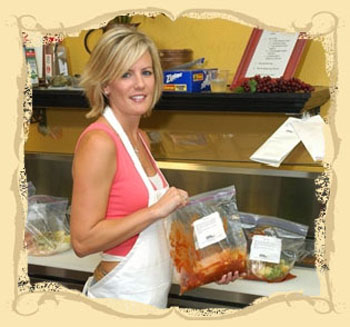
image of zip-lock wielding working yoga mom © Super Suppers, used entirely without permission
- Kim Severson and Julia Moskin's New York Times article on Super Suppers,food preparation centers
- Super Suppers
- Judie Byrd's website
- Sara Wilson at Entrepreneur dot com talks about the business concept of Super Suppers
- Peabody's Improbable History
- A blogger (let's call him Greg from Life's a Picnic) writes about his Super Suppers experience.
- Dream Dinners, just another meal assembly center
- Dr. Gurgles doesn't feel at ease with the concept
- Even more Gurgles from a time long past. Respect to the Gurgling Cod has followed this story in all its New York Times Magazine ugliness from the start.
technorati tags: food preparation centers, meal assembly centers, working moms, locative food, food trend, coommunity
Please read more... "An improbable history: meal assembly centers"
Posted by debra at 10:40 PM | Comments (15) | post to del.icio.us
Not cooking with flowers and leaves, a raw food recipe for marinated shitake mushrooms
March 21, 2006
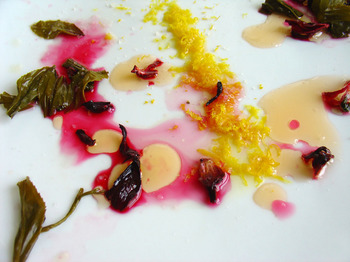
If I want to eat with my friends, I can't just serve up vegetables with the dirt still clinging to the rootball, the way I like it. I have to engage in some refining.
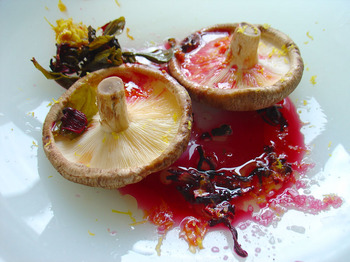
Hibiscus flower and green tea leaf marinated shitake mushrooms
(work: 7 minutes, wait: 1-4 hours)
- dried hibiscus flowers
- whole green tea leaves
- water
- fleur de sel
- lemon zest
- crayfish oil (vegetarians, relax)
- two shitake mushrooms
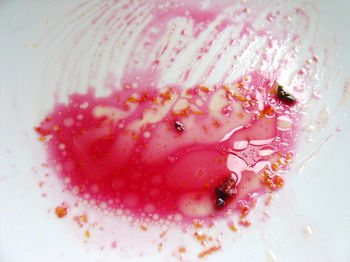
In the bottom of a cup, pour enough hot water to cover a layer of hibiscus flower and green tea leaves. You're going to make a highly aromatic and concentrated tea, something too strong to sip. Aim at producing four tablespoons.
(This year, hibisicus flowers seem to be my souring agent of choice. I find it hypnotising to watch the magenta colour leach out of the petals, and I just live for the 'powdery' aftertaste.)
Add to the 'tea' a big fluffy pinch of finely zested lemon peel, a goodly amount of fleur de sel, and a teaspoon or two of *crayfish oil.
Adjust the marinade and toss around with two large shitake mushrooms. Marinate for one to four hours before serving. Everytime you walk by, just toss the mushrooms lightly for fun.
You can keep the mushrooms for about a day without ruining the texture in or outside of the fridge. The marinade and juices leached out of the mushroom can be 'recycled', it's like bouillion for raw foodies. You know how I love the food recycling!
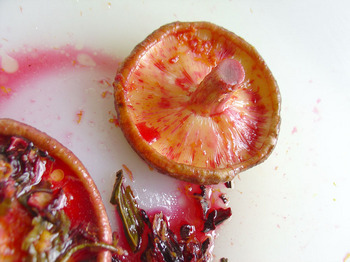
*A note on crayfish oil: you can't buy it. Mine was a cadeau made by my friend Marlein, to whom this recipe is dedicated. Possible (vegetarian) substitute: grape seed oil, barely warmed and barely covering half a fennel, star anise and a dried hibiscus petal. Leave to cool and sit for two days. Remove the 'stuff' and decant to a very clean jar. Store in a cool, dark and dry place.
*A note about using non-vegetarian, non-raw ingredients in this recipe: relax and enjoy delicious foods that have been made for you with love. Aromatic oils are like parfum, you need only a few drops. In this recipe you will need enough drops to fill a teaspoon or two.
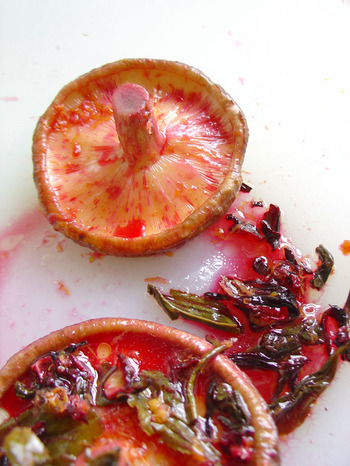
Both the green tea leaves and the crayfish oil have a powdery 'note' that compliments the woodiness of the shitake. This marinade smells like peonies. Shitake pivoine! My hands are parfumed from the shitake tossing.
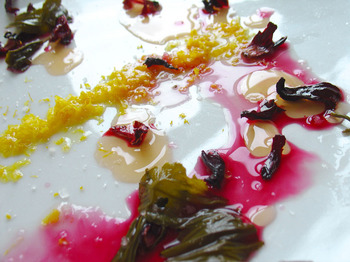
The recipe is dedicated to my dear friend Marlein Overakker, a chef who has turned me on to my favourite parfums and who is always a huge source of inspiration.
technorati tags: raw food recipes, vegetarian, shitake, mushrooms, cooking with flowers, cooking with tea, green tea
Posted by debra at 02:14 PM | Comments (9) | post to del.icio.us
Food Force computer game: force-feeding inaccurate notions of the causes of hunger
March 17, 2006
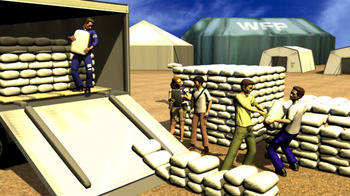
images courtesy of Food Force, © United Nations World Food Programme - all rights reserved
Two weeks ago I sat dumbfounded watching a French TV report in which journalism students practiced reporting a fictional national emergency. I couldn't help but think that what's cool about practice is that it makes perfect. If you practice having enough crises, you might actually get really good at having one! This hackle-raising report about teaching young adults to respond positively to crisis, just didn't seem to me like a simple exercise on getting prepared. The TV experience was absolutely colouring my thinking when I came across the UN's World Food Programme (WFP) website and discovered a new computer game for school kids called 'Food Force'.
'A major crisis has developed in the Indian Ocean, on the island of Sheylan. We're sending in a new team to step up the World Food Programme's presence there and help feed millions of hungry people.'
That's pronounced 'shay-lawn' by the way. The Food Force computer game is essentially a communications campaign of the UN's WFP, cleverly disguised as an educational tool. Although the game really does teach kids about mid-crisis food distribution, its purported goal, teaching students about the causes of hunger, is framed exclusively in the short term and completely ignores all of the long term causes.
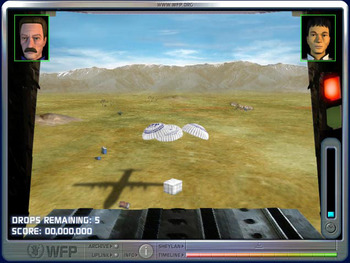
images courtesy of Food Force, © United Nations World Food Programme - all rights reserved
Food Force has six game tiers reflecting the basic elements of emergency food distribution: air surveillance (helicopter reconnaissance, counting clumps of roving refugees), energy packs (achieving nutritional and economic balance from rice, beans, vegetable oil, sugar and iodized salt), food drop (aim and drop those rations), locate and dispatch (Tetris-like global food collection), the food run (choosing the right route through hostile territory), and future farming (dealing with a combination of long term hunger solving factors).
Predictably my favourite game tier was 'future farming', where I was taught that paying people in food to attend job training programmes and so investing in the community, was the straightest path to community self-sufficiency and societal well-being. Together with the food pack nutritional assembly tier, this was the game tier with the highest educational value, going beyond point and drop and mouse dragging I mean racing.
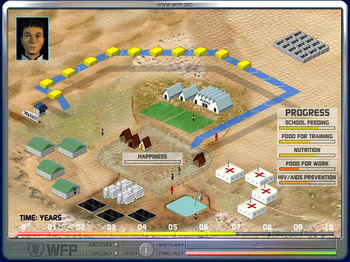
images courtesy of Food Force, © United Nations World Food Programme - all rights reserved
Food Force has a website chock-full with extra video, images and an educational package enabling teachers to work this computer game seamlessly into the curriculum. I pored over the WFP site in search of information addressing what I believe to be the long term causes of hunger and the long-term perspectives on solving the problems. Alas, I could find none. According to Food Force, hunger is caused by drought and civil war.
Of course I find no fault with the WFP's symptomatic relief efforts per se, nor do I see intentional evil with a communication strategy that illustrates this practice to children in the form of a computer game. But I do have a problem with placing this game in a curriculum that teaches children that the cause of hunger is simply drought and war. What are the some of the causes of drought? What are the some of the causes of war? What causes such a lack of food security that climactic fluctuations can take out several million people? Food Force offers no macro vision, and I do find fault with weaning children of the notion that food security is rested in global food politics. The macro vision of many commonly accepted causes of hunger, such as the small farm community-destroying effects of large-scale agricultural practice and the methods of monoculture, are left completely unaddressed by the WFP's computer game.
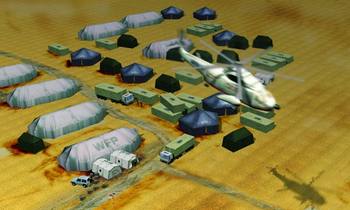
images courtesy of Food Force, © United Nations World Food Programme - all rights reserved
I often wonder if teaching children about hunger couldn't happen in a more nuanced way. Wouldn't it be more productive than training them to throw a little money at the problem? Well, maybe not with the 'throwing a little money at it' method of famine-control being so lucrative.
Tomorrow, I'll give an example of a solution.
I promise.
technorati tags: World Food Programme, Food Force, computer game, emergency food distribution
Posted by debra at 06:26 PM | Comments (2) | post to del.icio.us
Note to self: alfalfa, mustard, buckwheat, red night kidney, adzuki, soy, soy, soy
March 02, 2006
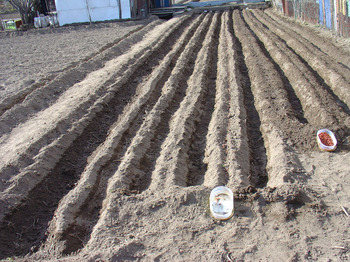
This is the planting order when facing the lower allotment. The acronym is AMBRASSS, which could stand for the the English embarass, if the cover crops once again fail to thrive. If the cover crops survive my handling and the weather, I can pronounce the acronym in French as in je t'embrace, which translates into a summer garden cocktail party with homegrown edamame as the cameo snack.
Note to self: I Innoculated the mustard seeds with dirt to form broadcastable seed pills. Narrowcasting is a more accurate description of what actually took place. Hopefully the mixing action didn't disturb the sprouted seed too much.
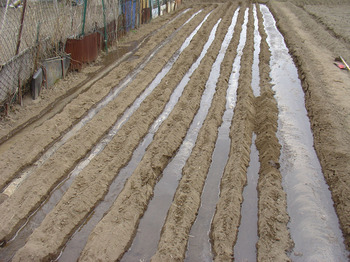
First irrigation run goes awry. Lowered irrigation pipe, made a huge mess of the footpath.
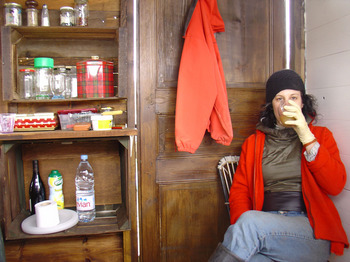
Digital photo of author drinking soup in KvR's new shed
It appears that I'm the first guest in Ktje's new cabane. JT remarked that we've started to dress like the 'Turnip Ladies' in a fairy tale and excepting the fact that neither one of us has actually grown a turnip, it's hard to disagree. For fun, we're going to wash and wear urban clothing for dinner from now on. Starting tomorrow.
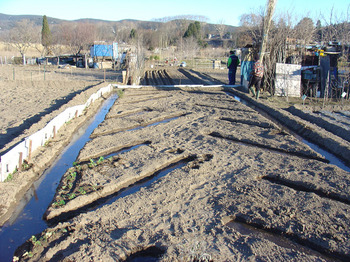
Each day the gents come to marvel at what seems to them to be a unique form of gardening. Today's crowd got a buckwheat sowing performance and a taste of buckwheat sprouts. I tried explaining that I was growing buckwheat (and alfalfa, mustard...) to improve soil condition by fixing nitrates and increasing the organic matter in my soil, but this didn't translate very well. In fact it didn't translate at all. Trick is to leave the explaining to Sidi AlGouche, the allotment's alpha male.
technorati tags: allotment, kitchen garden, irrigation
Posted by debra at 10:22 PM | Comments (6) | post to del.icio.us
Git yer frites on! What we'll probably all be wearing this Fall
February 24, 2006

Daddy's favourite outfit from the Jeremy Scott Fall 2006 collection, image used entirely without permission
This is no time to bitch I mean kvetch about healthier alternatives. Just plunk down a honqin' load o' dosh and git yer dang frites on, bi-haa-whoa. It's New York designer Jeremy Scott's Fall 2006 collection, and I'm sort of all over it.

From the Jeremy Scott Fall 2006 collection, image used entirely without permission
Really dig the pizza robe, but unless I keep the yurt up all winter, I just don't see it fitting into my lifestyle. It is mind-boggling though how well haute couture goes with a yurt. I keep telling everyone it was a practical choice, but you just have to keep the bigger picture in mind for that to become clear. Jeremy Scott is part of that bigger picture.

My new lounge-about-the-yurt robe from the Jeremy Scott Fall 2006 collection, used entirely without permission, although, soon I'll take my own dang pictures
Who wears Jeremy Scott besides me? Björk, Cammy Diaz, Chrissie Aguilera, Kylie Minogue, the artist formerly known as Esthertje and the geologist formerly known as my Dad.
- Check out Jeremy Scott's 2006 Fall collection in NY Mag
- Elle mag on Jeremy Scott Fall 2006
- FlyPaper on Jeremy Scott's high glycaemic fashion

From the Jeremy Scott Fall 2006 collection used entirely without permission
Posted by debra at 12:24 AM | Comments (0) | post to del.icio.us
Yesterday's news: anti-advertgames
February 03, 2006

"Making money in a corporation like McDonald's is not simple at all. Behind every sandwich there is a complex process you must learn to manage: from the creation of pastures to the slaughter, from the restaurant management to the branding. You'll discover all the dirty secrets that made us one of the biggest companies of the world."
So state the Italian artist-activist makers of the McDonalds anti-advertgame, Molleindustria. I don't know if the fact that the rainforest is being destroyed to grow soy beans for hamburger meat or that cows are fattened with industrial garbage in feed lots is a secret anymore, but playing the online game illustrates that it definitely is a challenge balancing the economic factors of selling a burger without turning into a blood sucking evil-ass. After playing McDonalds for an hour, I had not once succeeded in making a profit and in fact I caused the company to go bankrupt every few minutes.
And if you're thinking, 'couldn't happen to a nicer bunch of guys', have a go.
The tip off is from Regine at we-make-money-not-art, a trend and technology blog. Thank you!
- Eric Schlosser's must-read investigation on the fast food industry is titled Fast Food Nation
- NYTimes review of Fast Food Nation
- If you're fluent in Dutch, you'll love de Keuringsdienst van Waarde's humourous yet disturbing consumer investigations streaming from the KVW website
- The only English subtitled de Keuringsdienst van Waarde broadcasts are about the development, design and production of a slave-free chocolate bar. Turns out, producing chocolate in which slave (yes, slave) labour is not part and parcel to the production practice is hard as can be.
Posted by debra at 09:21 AM | Comments (1) | post to del.icio.us
Grow your own dang food
January 30, 2006
Back in the eighties, as a student at the University California at Santa Cruz, I lived in a vegetarian commune with a bunch of hippies. As hippies, we produced our own sprouts, yoghurt and salsa fresca for the entire commune, approximately thirty people. I had all but forgotten this part of my life until recently, when my Food Atelier students at the Design Academy Eindhoven started working on ways to grow their own food. The work of two enthusiastic students got my wings flapping enough for me to dare revisit my past. These are the images from the first trials, theirs and mine.
After initial attempts at growing mung sprouts in bread (see above), Cygalle Shapiro is successfully growing a ready-made 'salad on salad'.
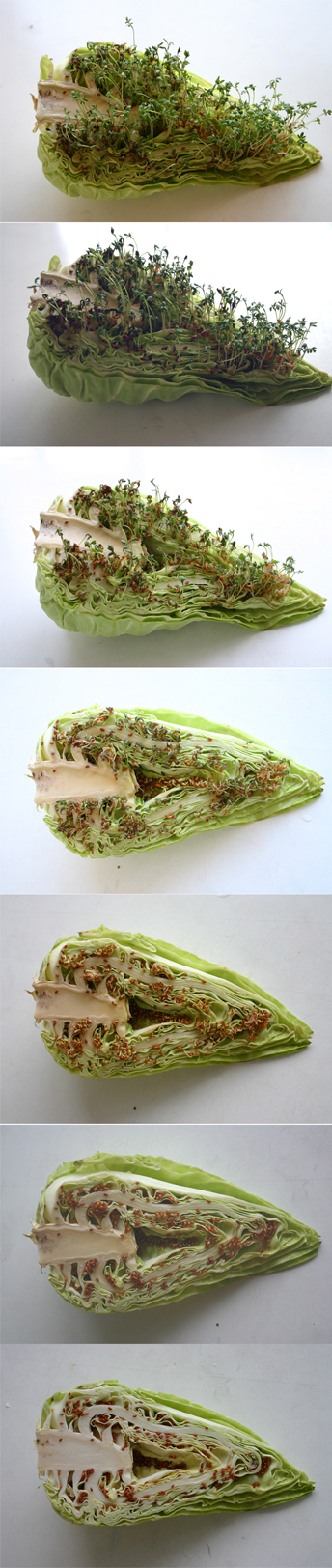
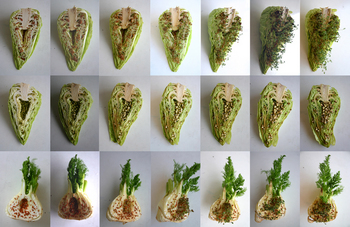
images top to bottom: sprouts in bread, salad on salad, sprouting experiments courtesy of Cygalle Shapiro, copyright Cygalle Shapiro 2005 - 2006. Contact culiblog for further information.
Liora Rosin is growing sprouts in labneh, a fresh yoghurt cheese, commonly made at home. For Rosin it is important that the seeds are grown within the labneh in order to transmit the flavour of the sprouted seed into the delicately tangy cheese.
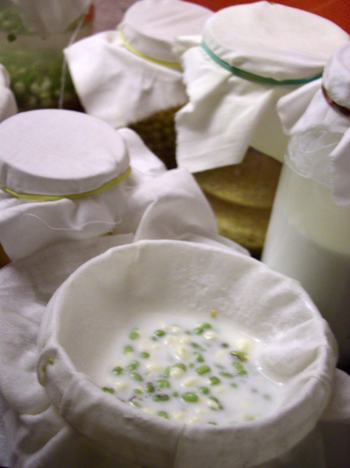
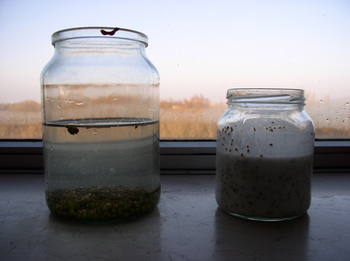
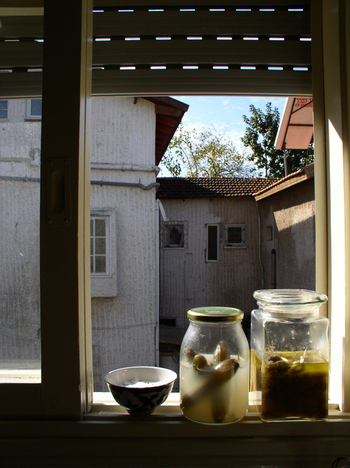
images top to bottom: home sprouting installation, soaking, lactic fermentation sill; courtesy of Liora Rosin, copyright Liora Rosin 2005 - 2006
Wouldn't the world be a better place if we all had a designated windowsill for lactic fermentation?
Having resolved to practice what I preach in 2006, I am also working on growing sprouts on labneh and find that the experiments coördinate nicely with my developing a good recipe for yoghurt ravioli.
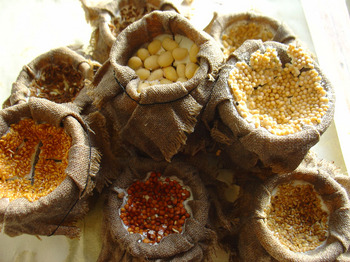
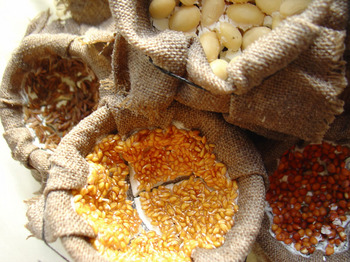
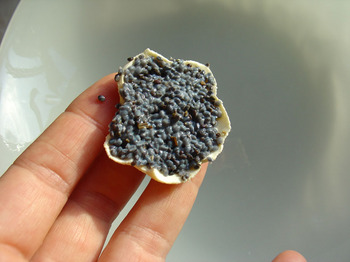
This is a cute disaster of basil seeds rotting into overly dry labneh. Seeds that become gelatinous when they are moistened (e.g., basil, buckwheat, watercress) are poor candidates for immediate immersion on or in the yoghurt medium.
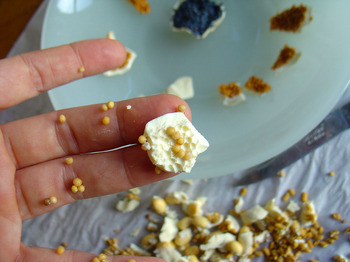
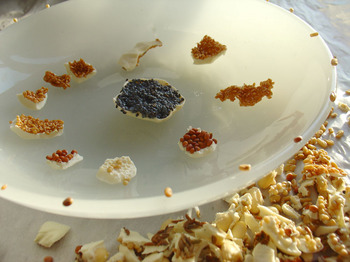
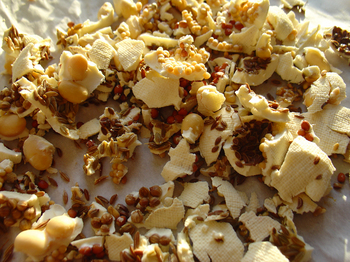
images top to bottom: sprout collection 2x, basil on labneh, playing with mistakes, pretending sampler, curd seed brittle; Debra Solomon
The results of an unsuccessful attempt at growing woody spice seeds (dill, coriander, cumin, kummel) in yoghurt medium with the intention of flavouring the labneh were not especially delicious, although visually exciting. The linen and the seeds texture the labneh beautifully and I look forward to spin a few successful recipes from these experiments soon.
Lori Alden's cheese definition site
N55: Manual for city farming plant modules
N55: Manual for home hydroponic unit
Sproutman's sprout bag. Any idiot can make one, but Sproutman is somehow selling them! My experience is that growing sprouts on wet linen works much better than growing them in jars. I have never tried sprouting in a linen bag.
Here are other urban gardening solutions, mostly rooftop gardening related:
- Rooftop Gardening link hub. Yes, it's a trend!
- Plant vegetables on your rooftops, like they do in Egyptian cities
- Toronto rooftop gardening project
- Greening Gothan Project, NYC also on the roof
- BLDG blog on rooftop farming in London
- Treehugger reports on Toronto rooftop gardening facts and figures
technorati tags: rooftop gardening, urban gardening, food security, sustainability, farming, food-related design, agricultural diversification
Posted by debra at 11:52 AM | Comments (8) | post to del.icio.us
2006 Bloggies, that blog awardish time of year again...
January 07, 2006

Wing-flapping all around! Thanks to the kind folks for nominating culiblog in the 2006 Bloggies. If you want to show your appreciation to the author of your daily dose, you can still nominate culiblog for the categories: best food blog, best under-represented blog (!) or... dare I say it, blog of the year?
But only until the 10th of January, so carpe diem your tochas on over to the 2006 Bloggies. I've nominated about thirty of my favourite blogs in the various categories: Doors of Perception weblog, BLDGBLOG, Pruned and FutureFeeder, to name just a few. In the food blog category, I'm keeping my nominations shtum for the time being. Well, as shtum as one can be with the linkage in the flanks of my blog...
Posted by debra at 01:55 PM | Comments (0) | post to del.icio.us
Another gushy garden story
January 04, 2006
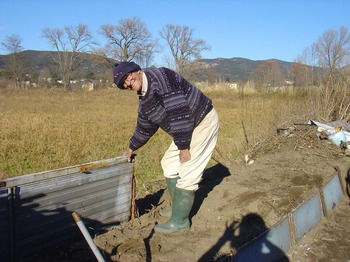
Why is this eighty-seven year old man smiling? One possible reason is that he has a garden... and neighbours. If I am any sort of judge of things that make one happy, I can report that the addition of a garden and all the things it brings with it, fresh veg and fruit, new friends, a sense of community, has increased my happiness considerably. Yesterday for example, I returned to the allotments to find that my generous neighbour, AlGouche, had pressed the eighty-seven year old Louis into service, installing a petit serre (little green house) for me in back of my cabane! AlGouche (see below) is concerned that, once back in Amsterdam, I'll worry endlessly about spring planting, but with the serre up, in March I can just get down to business. My heart melted when I saw the two gentlemen happily digging and pounding away, just so that I wouldn't worry! They even turned the soil, Louis taking very special care to remove all of the topinambour and bits of glass, and they all joked that I shouldn't gush too much and keep them from their work.
By the way, the first I'd ever heard of Louis was not in the context of the garden, but in a dancing story. Having just returned from a village party last spring, Ktje rang me up in Amsterdam to report the party gossip and to tell of an amazing old man who was passionately dancing salsa all by himself for more than two hours straight. This old man was Louis, the kind of eighty-seven year old that I aspire to be, although it may take me awhile to develop an affinity for salsa.
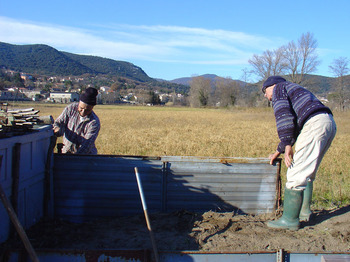
image: AlGouche initiates the works for the retaining wall/serre with garden neighbour Louis
technorati tags: aging, farming community, happiness, gardening, Languedoc,
Please read more... "Another gushy garden story"
Posted by debra at 09:05 AM | Comments (1) | post to del.icio.us
My kitchen garden at midwinter
December 21, 2005
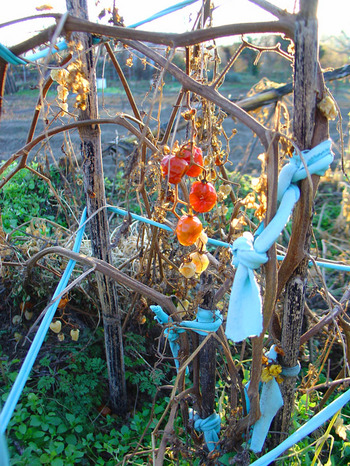
Granted, mine is the ugliest of all the kitchen gardens here, which is why it's unbelieveable that upon my return to Occitania, I was able to pluck leafy greens at midwinter! I fully expected to find nothing, bugs and more nothing, but to my great surprise there are sun dried tomatoes, sorrel, sweet raddichio, leaf cabbage, red cabbage, beets, beet greens, sage, rosemary, mint, broccoli, and soon... bruxelles sprouts. Gleaning is yielding enough food for a birthday party luncheon on the 24th!
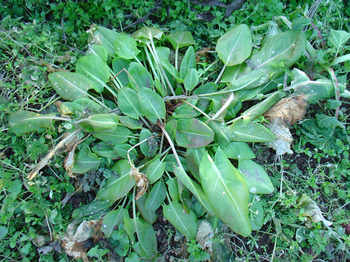
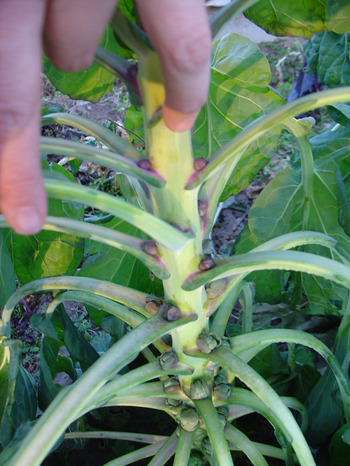
Please read more... "My kitchen garden at midwinter"
Posted by debra at 12:54 PM | Comments (5) | post to del.icio.us
Healing Foods Pyramid is sickmaking
December 17, 2005
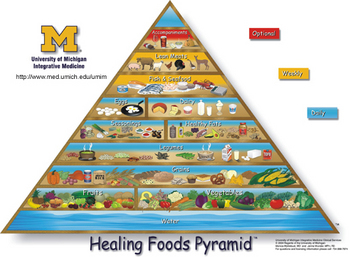
Never say never, but I never get sick. And according to the University of Michigan's Healing Foods Pyramid, the reason I never get sick is that it seems I primarily eat 'healing foods'. That, in and of itself is sickmaking.
The smart folks at the Uni emphasize:
* Healing Foods
- Only foods known to have healing benefits or essential nutrients are included
* Plant-based choices
- Plant foods create the base and may be accented by animal foods
* Variety & balance
- Balance and variety of color, nutrients, and portion size celebrate abundance
* Support of a healthful environment
- Our food, and we in turn, reflect the health of our earth
* Mindful eating
- Truly savor, enjoy and focus on what you are eating
(spotted on: Slashfood)
technorati tags: health, nutrition, food, food pyramids,
Posted by debra at 03:34 PM | Comments (2) | post to del.icio.us
And the answer is... community supported agriculture
November 30, 2005
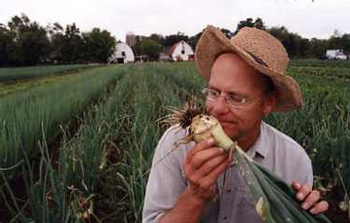
image courtesy of the Real Dirt on Farmer John website
Well, at least that is one of the most positive answers to the questions that came to my mind after watching Erwin Wagenhofer’s We Feed the World (Austria 2005) Saturday night at the IDFA. Although reviews and film descriptions already abound, here's culiblog's quick take on the films The Real Dirt on Farmer John, We Feed the World and Bullshit.
Context is everything, although this hadn't occurred to me weeks ago when I reserved my tickets for the IDFA and Shadow Festivals. It was pure coincidence that I chose Taggert Siegel’s The Real Dirt on Farmer John (US 2005) instead of We Feed the World as my first IDFA film. But the documentary about John Peterson (I heart him) is such a poignant portrayal of his pursuit of agricultural viability on a very personal level, that the film armed me with an outlook positive enough to take on the eloquent doom and gloom of the other documentaries. I wish my fellow audience members had been so lucky, because their anger and disillusionment about the realities sketched in Wagenhofer's, We Feed the World and even Holmquist's Bullshit was palpable.
Please read more... "And the answer is... community supported agriculture"
Posted by debra at 11:17 AM | Comments (1) | post to del.icio.us
The Hunger Artist
November 24, 2005
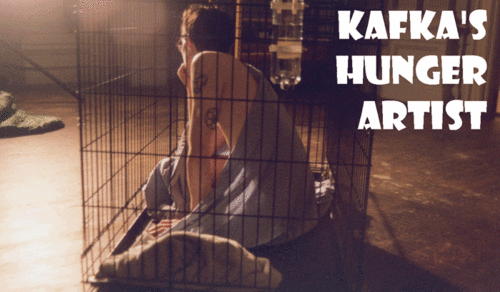
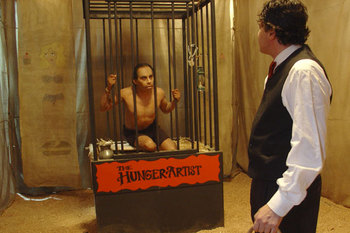
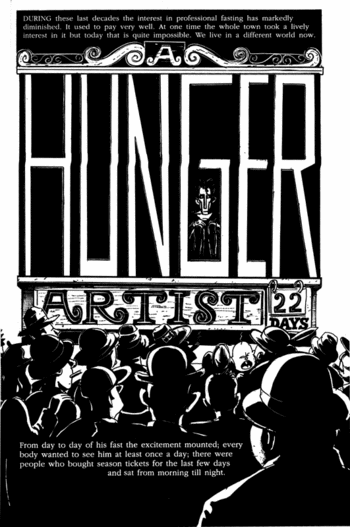
Here's one for the archives: Google (images) 'Hunger Artist'
Happy Thanksgiving, by the way.

Please read more... "The Hunger Artist"
Posted by debra at 08:04 AM | Comments (4) | post to del.icio.us
Just experimenting with raw cruciferous vegetables
November 16, 2005
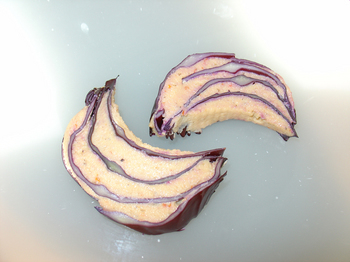
It would be absolutely no problem for me to go on and on about the conceptual and nutritional inconsistencies of the raw food (culture) diet, but I have to admit that this raw food culinary experiment has seriously increased my intake of *cruciferous vegetables. And that's good a thing because all cooked cruciferous vegetables taste to me like fart. And that's a bad thing.
* cabbages, kale, broccoli, bruxelles sprouts, cauliflower, get it?
Please read more... "Just experimenting with raw cruciferous vegetables"
Posted by debra at 02:20 PM | Comments (4) | post to del.icio.us
Everything but the squeal
November 15, 2005
Sometimes in a recipe, you want to instruct the cook to go outside her normal boundaries of food preparation. I used the term 'everything but the squeal' to describe the use of every single living part of a beet and a radish in an entry titled Yurt and Garden and in an entry on Indian Leafenware earlier this year.
"Everything but the squeal" is a quote attributed to the meat-packing industry and it was first signalled in Upton Sinclair's 1906 novel, the Jungle which described the vile and unhygenic working conditions under which meat was reaching American consumers 100 years ago. If we can believe PETA (People for the Ethical Treatment of Animals), and Eric Schlosser's Fast Food Nation (and I do), not a whole heq of a lot has changed. I do not recommend visiting this site if you plan on eating any part of any animal, wearing fur, leather and even wool, or even drinking the fruits of an animal's existence, any time soon. The PETA organisation is all about the squeal, and I have to say, the practices that they document are abhorrent.
But one needn't result to scare tactics to make me reduce my intake of animal protein and feel guilty for wearing a fur hat during winters up here in the polar circle. Mark Kurlansky's Cod doesn't mention once the issue of animal suffering. In Cod, it's all about extinction dot dot dot.
Please read more... "Everything but the squeal"
Posted by debra at 10:41 AM | Comments (2) | post to del.icio.us
Everything but the squeal
Sometimes in a recipe, you want to instruct the cook to go outside her normal boundaries of food preparation. I used the term 'everything but the squeal' to describe the use of every single living part of a beet and a radish in an entry titled Yurt and Garden and in an entry on Indian Leafenware earlier this year.
"Everything but the squeal" is a quote attributed to the meat-packing industry and it was first signalled in Upton Sinclair's 1906 novel, the Jungle which described the vile and unhygenic working conditions under which meat was reaching American consumers 100 years ago. If we can believe PETA (People for the Ethical Treatment of Animals), and Eric Schlosser's Fast Food Nation (and I do), not a whole heq of a lot has changed. I do not recommend visiting this site if you plan on eating any part of any animal, wearing fur, leather and even wool, or even drinking the fruits of an animal's existence, any time soon. The PETA organisation is all about the squeal, and I have to say, the practices that they document are abhorrent.
But one needn't result to scare tactics to make me reduce my intake of animal protein and feel guilty for wearing a fur hat during winters up here in the polar circle. Mark Kurlansky's Cod doesn't mention once the issue of animal suffering. In Cod, it's all about extinction dot dot dot.
Please read more... "Everything but the squeal"
Posted by debra at 10:41 AM | Comments (2) | post to del.icio.us
And now for something completely simple, honeycomb cocoa nib bonbon
November 14, 2005
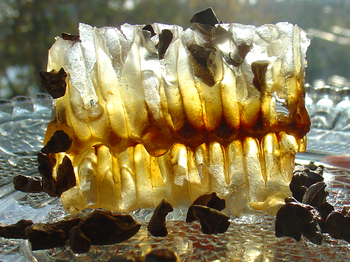
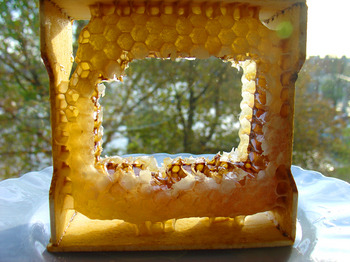
Images r to l: bonbon prototyping, the box it came in
Recipe for Honeycomb Cocoa Nib bonbon
Cut a piece of honeycomb into desired shape.
Place the dripping honeycomb on some raw cocoa nibs.
Alternately, place some raw cocoa nibs on the dripping honeycomb.
Serve.
Posted by debra at 02:02 PM | Comments (10) | post to del.icio.us
Food Subculture Club visits a raw food (un)cooking workshop
November 13, 2005
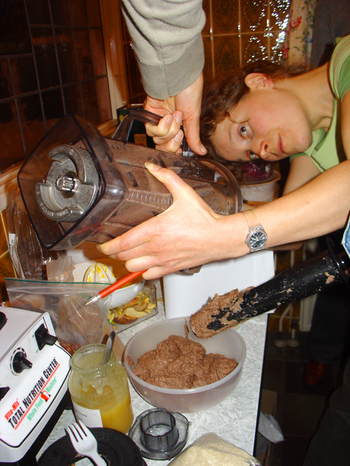
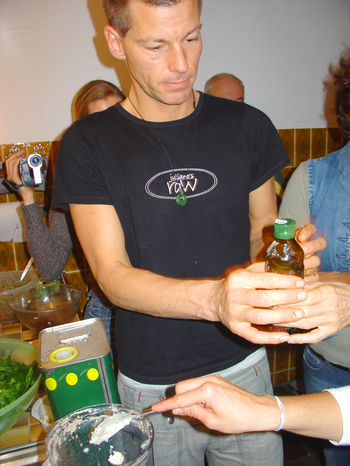
When cooking with meat or dairy, it's always easy to create foods that are delicious, rich and complex in flavour. By combining processed grain flours with an oven, or brown rice and a rice maker, it's simple enough to make comfort food. But I have always been curious as to whether a diet of raw food could fulfill the very normal culinary hunkerings for diversity and satisfaction. By this I mean, the potential nutritional benefits of eating a raw food diet aside, is it possible to make an interesting raw food repetoire that is well-suited to the Northern European winter?
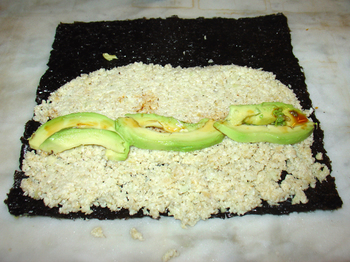
On my cookbook shelves there are two cookbooks about raw food cuisine; Roxanne Klein & Charlie Trotter's R A W, and Juliano Brotman's Raw, the UNcookbook. I had tried several recipes from
Just from a culinary prespective...
The workshop, held in an anti-squat in exceedingly picturesque Broek in Waterland just north of Amsterdam, ended up having a lot in common with one of Louis Theroux's Weird Weekends, except that I'm nowhere near as charming as Louis is/was and the workshop was in the middle of the week. During the introductions I inadvertently started things off on the wrong foot by not giving the correct answer to the question, 'how raw are you?' My answer, 'Pretty dang raw, but I'm not a vegetarian' caused more than a few of the other participants to gasp audibly. I could have known that by trying to explain my omnivorous culinary bend that I would become the pisspole of raw food guru-ji Juliano.
Personal affinities aside, it is only fair to mention that I found all of the food that we prepared in the workshop to be 'rock my world' delicious and most of my prejudices with regard to this subculture's cuisine were quickly dispelled. The food wasn't all wet and cold, it didn't taste like 'health food', it didn't taste like vegan food, it was neither bland nor monotonous. In fact, at the end of the workshop, I really started getting cravings for something SIMPLE, like a piece of undressed lettuce. Juliano prepares foods like a parfumier makes a scent. He composes flavours and textures out of his ingredients. His knowledge of the flavour characteristics and textures of the ingredients he uses is impressive. Were it not for this fact, I would have been so out of there, having very little tolerance for statements like 'cooked food is pure poison', and 'I know someone that has been raw for six hundred years'. There was an unspeakable culture clash, but boy can this guy (un)cook.
One of the things I appreciated most about the workshop is that due to Juliano's conviction that everyone in the entire world should become 'raw' immediately, he was eager to explain a feasible methodology for running a raw food kitchen and/or household. I had reported earlier that raw cuisine is labour intensive, and compared to throwing ingredients into a rice maker or grilling up some flesh, it is, but Juliano explained how to make some basic ingredients that could be worked into meals over a period of a week that made the idea of raw food meal preparation less daunting.
Please click 'please read more' to see an interview that I conducted with Juliano and Ariel that will probably answer some of your burning (sorry) raw food questions.
Please read more... "Food Subculture Club visits a raw food (un)cooking workshop"
Posted by debra at 08:31 PM | Comments (1) | post to del.icio.us
Chef Thor, Croqueta d'Amor, Medaille d'Or, Cultural Sectór!
November 04, 2005
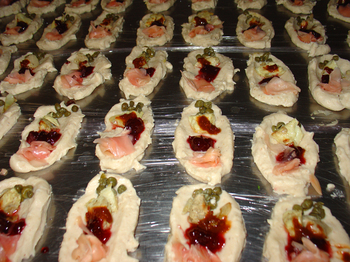
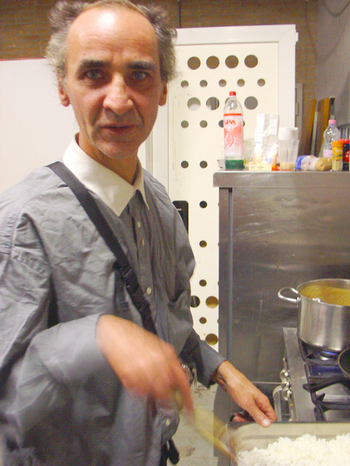
images top to bottom: Croqueta d'Amor in process, the chef formerly known as Thor, Chef Croquette works on a Croquette Japonais
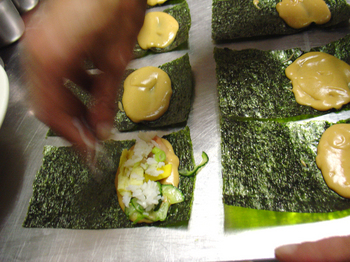
At a top secret location in Amsterdam's PostCS cultural hub, Chef Croquette and the Croquette Family get to work on the hundreds of croquettes ordered for a weekend filled with cultural events. It's as if the PostCS (home to the Stedelijk Museum, Mediamatic, Club 11, numerous artists' initiatives and one of the thirty-eight locations for the 6th annual Museum Night) suddenly needs it's very own croquette chef. Of course croquette commissioners from the cultural sector are the most demanding of all. To posh up their menus this weekend they unanimously chose two of the newest creations from the chef formerly known as Chef Thor; the Croqueta d'Amor ('No More War!' '7 Sabors!') and the Croquette Japonais.
Just like Willy Wonka's Magic Chewing Gum, each bite of the Croqueta d'Amor and the Croquette Japonais yields a different taste explosion, seven flavours in all. In the film as well as the book by Roald Dahl, the magic chewing gum is still in beta when bitchy Violet Beauregard (chewing gum expert and glutton) snatches a piece of the gum to give it a chew and to sell the recipe to a rival candymaker. Due to the side-effects caused by the experimental nature of the gum, Violet blows up into a giant blueberry and has to be juiced forthwith!
Let that be a lesson to us all.
Chef Croquette joked to me, 'er zijn kapers op de kust' , which is a charming Dutch way of saying, 'many is the chef that would pirate this recipe.' Indeed, as we prepared the croquettes in a location deep under the earth's crust, at least five chefs happened to 'pop in for a little chat'. I think they could sense that Chef C. had perfected the technique of creating an entire meal in ten cubic centimetres of croquette with no ill side-effects. That or the fact that the location was also a central storage place for beer. Either way, the concept of Open Source is not alive and well in the culinary world.
Please read more... "Chef Thor, Croqueta d'Amor, Medaille d'Or, Cultural Sectór!"
Posted by debra at 11:31 PM | Comments (2) | post to del.icio.us
A belly full of raw food facility, reviewing a conceptual restaurant
November 02, 2005
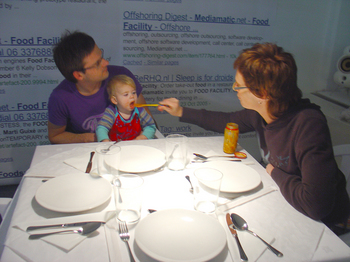
Smart babies bring their own food to a restaurant opening
It's probably fair to assert that last Saturday was an all-time first in Amsterdam: two interesting culinary events in one day. I made sure to attend both Juliano Brotman's Raw Food UnCooking workshop as well as the restaurant launch of Marti Guixé & Mediamatic's Food Facility at the Post CS. Yoga and raw food in the afternoon, black clothing, pearl-swinging, wine drinking, cigarette smoking, take-away food in the evening. Time in between to change costumes I mean outfits, and I had the fixings for a well-balanced day.
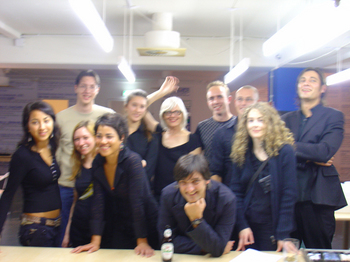
The Food Facility staff (aka Mediamatic and Marti Guixé) giddy and a'blur
Just like normal people, raw food chefs can run a little late, and we were still busy with the results of the uncooking workshop two hours after it's scheduled end. I thought it wouldn't be a problem, assuming that raw food could in no way be complex or filling, but I was mistaken. At 19.00h when I arrived at the Food Facility, I had no desire to eat. Luck would have it that my belly full of raw would turn out to be a blessing.
Luck wouldn't have it that my erstwhile best-friend-with-a-deadline would call to say that she couldn't show up for dinner that evening. GASP, alone at a restaurant opening with a big fat reservation for two! The ever-on-the-ball Mediamatic nouvelles maîtres Arne en Jans, arranged a dinner date for me on the spot (and a delightful one). That, dear reader, is what I call excellent service!

Graphic designers guesting Food Facility catch the early bird special, Guixé designed chairs
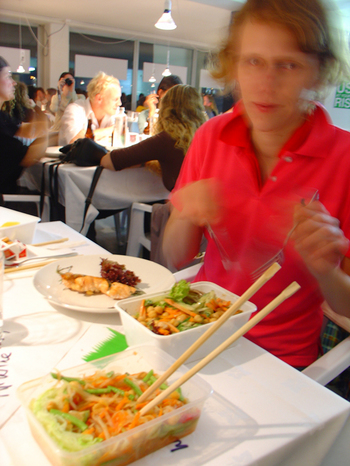
Katarina eats spada on rosemary sticks well within three hours of ordering it
The restaurant was glowing with all manner of mixed spot and flourescent lighting, bright white, with HTML blue, black and green columns in the centre. Draped on the walls were large print-outs of the results of a Google search; 'food', 'food facility', 'Marti Guixé' and 'Mediamatic'. Of course this search yields lots of culiblog entries, and I have to say, there's nothing like seeing the name of your blog plastered all over an interior to warm your heart and coax out a favourable review. Designers, do like Marti does.
In the centre of the room Guixé placed a food island, where the delivery boys on scooters brought in the orders and from where the restaurant staff would bring the dish to it's rightful owner. The tables were laid with damaste (not real damaste), with large tumbler glasses, generous cutlery, and large cloth napkins (not real cloth). All of the guests were pregnant with expectation, and some were actually pregnant. Marti G. described the evening thusly, 'It was like attending my own wedding...'
My dining buddy Katarina and I ordered from a well-designed menu based upon the takeout menus from twelve different restaurants in Amsterdam. By 'based upon' I mean photo copied and by twelve I mean nine. We were having an excellent time, drinking and talking, waiting and drinking and talking, smoking and drinking and drinking and smoking and talking and waiting and drinking. Talking all the while, the friends were dropping by for a chit chat, we were being visited by extremely attentive maîtres and wait staff. Waiters are for waiting.
And then we did some more of that waiting. Which was fine. I still wasn't the least bit hungry with my belly full of raw, but some guests were starting to get peckish, and by peckish, I mean uppity. Certain tables began to organise exuberant betting pools as to who would get their food first.
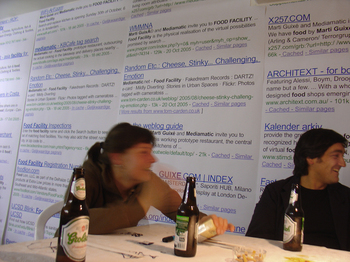
The bride and bridegroom Guixé giggling at all the betting going on
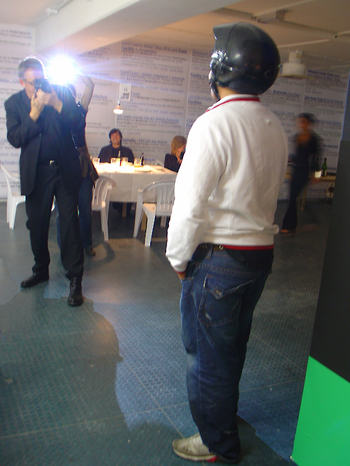
The arrival of the first delivery boy with one baggie of takeout food
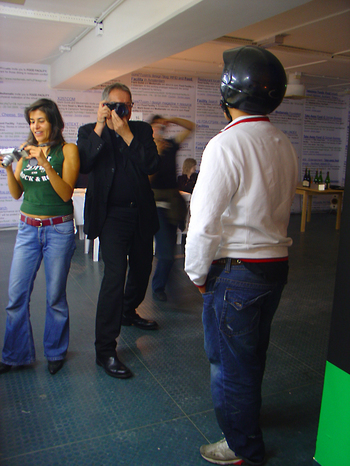
The paparazzi can't contain themselves
And then the first delivery boy entered the restaurant. Helmet on, a little white baggy filled with Chinese takeaway in his hand, and the entire facility went berserk. Cameras were flashing, guests were laughing and many stood up to applaud and 'whoop whoop'. All this for one little white bag of grits. This scenario repeated itself as each delivery boy entered the Food Facility until the very end of the evening. That, dear reader, is good restaurant interface design.
My sashimi arrived, well within one and a half hours. An hour, two glasses of wine and one and a half cigarettes later my green papaya salad arrived. You can see by my menu choices that I was doing my dangdest to keep the raw thing going. Ordinarily this amount of wait would be unacceptable, a good reason to do some non-positive wing-flapping. But this particular evening, I would have to categorise this as perfect timing. Perfect amount of drama and excitement, entertaining guests entertaining themselves just fine, excellent conversation (one of my waitresses turned out to be a sufi), food for thought and merriment abounding. Guaranteeing an excellent experience is also a part of restaurant design, and it's silly to go to a restaurant opening with the actual intention of getting fed.
Guixé and Mediamatic's Food Facility is open Fridays and Saturdays until December 11, 2005 and I highly recommend at least one visit. I have chosen Food Facility as the location to celebrate the one year birthday party of culiblog.org during Saturday's Museum Night. It was one year ago (Museum Night 2004 at Mediamtic) that culiblog launched it's domain. We're going to fill up on nibbles beforehand at my house.
Food Facility open Friday and Saturday from 18.00h - 22.00h
November 4 - December 11, 2005 at Post CS, Amsterdam.
Read Mediamatic's announcement here or call +31 (0)6 3376 8810 for reservations.
Please read more... "A belly full of raw food facility, reviewing a conceptual restaurant"
Posted by debra at 10:31 AM | Comments (0) | post to del.icio.us
Juliano's Raw
October 28, 2005

Image of Juliano and friends courtesy of Juliano Brotman's Planet Raw website
Loyal culiblog readers know that I like my bacon fried crispy and that I never pass up an opportunity to eat most forms of smoked pork. But I also like to expand my culinary and nutritional repetoire with raw food kweezeen. Everything in moderation, including and especially moderation. This weekend Juliano Brotman, chef proprietor of the Hollywood restaurant Raw is in Amsterdam giving a workhop together with ashtanga yoga instructor Caroline Klebl.
Saturday October 29, de Loods/Prinseneiland 20G Amsterdam
13.30-15.30 Ashtanga Yoga workshop with Caroline Klebl
16.00-19.00h Raw Vegan Cuisine: drinks, desserts, hors d'oeuvres
Sunday October 30, de Loods/Prinseneiland 20G Amsterdam
11.00-13.00 Ashtanga Yoga workshop with Caroline Klebl
14.00-16.30 Raw Vegan Cuisine: salads, soups and entrées
For reservations: +31 (0)6 3377 1014
Of course I'll be attending the entrées preparation 'block' because I think I can just figure out how to make a raw salad but never seem to get around to making Juliano's Raw Chili. One sad discovery is that, in terms of mise en place, it's difficult to combine preparation for raw and cooked foods into one meal. Raw food, however delicious and wholesome, is labour and ingredient intensive. My hope is that Juliano's workshop will increase my facility enough to eradicate the technical glitch that is influencing the success of my dinner parties.
There is a glut of food-related events this Sunday but a nice thing about Raw Food (and other low glycaemic diets) is that within hours of eating one is RAVENOUS. (Who was the hippy that said you should always leave one third of your belly free for Shiva?) Right after Juliano's pizza emerges from the dehydrator, I'll be tucking into something else delicious at the Guixégasbord at Mediamatic that selfsame evening.
Posted by debra at 11:59 AM | Comments (0) | post to del.icio.us
Honey, rockin' my world
October 27, 2005
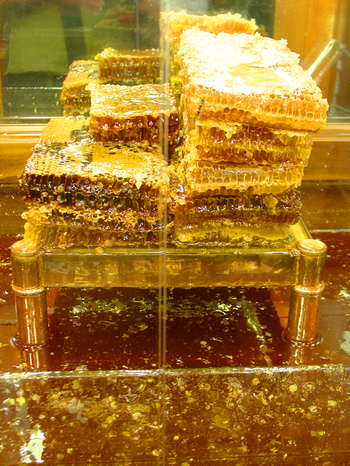
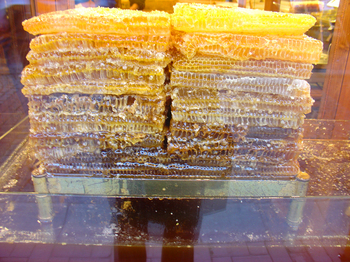
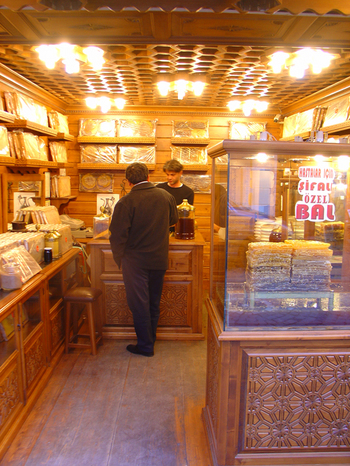
A honey shop in the Kadiköy market in Istanbul is visited by wasps.
Posted by debra at 03:47 PM | Comments (1) | post to del.icio.us
I love smoking everything in moderation
October 22, 2005
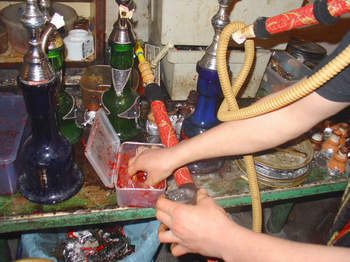
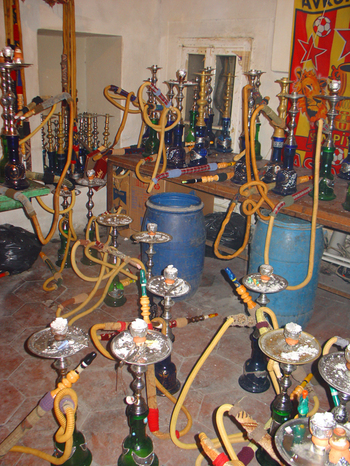
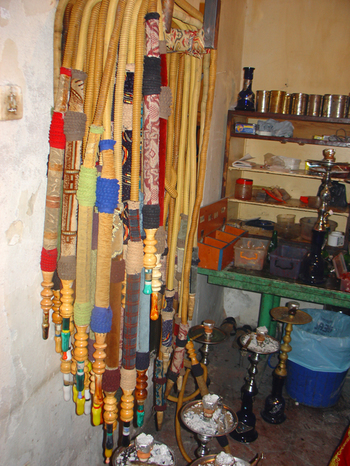
Last year in Delhi I reported on why it's a good idea to keep a positive attitude while experimenting with stimulants. This year I simply throw myself into the task. By the volume of the blueish haze, one wouldn't suspect that we were entering an outdoor tea house, but the tea house, (and by tea, I mean smoke) of the Balkan Student Union is a vaulted-ceilinged wonder of kilim pillowed couches and abundant eastern aesthetic occupying a maze of very confusing little stone courtyards. There are only four things on the menu here: tobaccos, teas (apple, mint, black) or coffee, and a game resembling backgammon. After a long day's walk through the Istanbul Biennale locations, it was wonderful to get into a heady relax with a bowl full of nargileh. That's Turkish for waterpipe tobacco drenched in apple, mint or rose syrup. Smoking a waterpipe is like inhaling jewelry, so delicious. Dip your finger in the tobacco straight out of the tin and you'll taste that it's sweet as candy.
Everything in moderation, including moderation.
images top to bottom: an employee of the Istanbul University Balkan Student Union Smokehouse fills a waterpipe bowl with apple flavoured tobacco, a tangle of waterpipes in the storage room await new customers, the pipes unplugged
technorati tags: Turkey, Istanbul, waterpipe
Please read more... "I love smoking everything in moderation"
Posted by debra at 02:36 PM | Comments (3) | post to del.icio.us
Papabubble is pure sugar finger lickin'
October 18, 2005
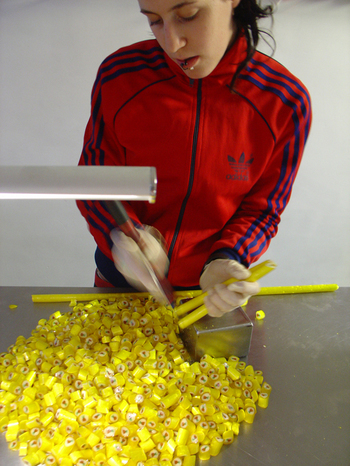
Loyal culiblog readers know that I'm not a big fan of sweets, but sometimes sugar is coaxed by masterful hands into shapes and colours so beautiful, and with flavours so delicious, that it's all I can do to keep from hauling off and giving it a good lickin'. At the moment of writing, I'm popping acid drops, one after another into my mouth and sucking them so violently, that I shall surely be giving myself a blister.
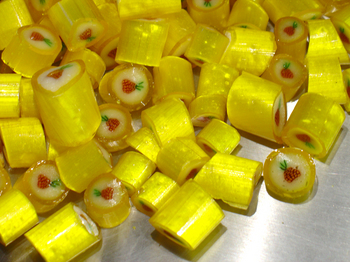
Which brings me to papabubble, the source of these acid drops that are doing all the damage to the roof of my mouth. When I returned to Amsterdam this Autumn, a new shop had occupied Harlemmerdijk 70, and I became a fan of their candy straight away. Inside the contemporary interior, a noble candy is being produced right before your very eyes. You feel like a child oggling the sculpturally shaped sugar. The concept belongs to Australian papabubble originators, Tommy Tang and Christopher King, who opened the first shop in Barcelona in June 2003, but it was Marieken van den Brink, who studied artisanal candy-making with them, that brought the concept to the Netherlands in 2004. For this she won a Marie Claire Starters Award in 2004, turning her dream and her lolly import business (Lulu Loves Lollies) into papbubble Amsterdam. Nice one. Here's some money, now go and make some candy.
But it's not just candy. It's a very pure, playful and artisanal product that she and her partner, Dominik Otto, and his sister Marie Otto, are making in the Amsterdam shop. It's all very old-fashioned and sweet. They live upstairs above the shop, and just like in a fairy tale, afternoons the place is a'swarm with children and single women, straight from school and yoga class, that have come in to watch the candy making process and get offered tastes of free candy by the smiling sugar pullers.
What I most love about what is going on at papabubble (aside from the high level of craftsmanship and amazing flavours of sour) was that the molten sugar is truly played with by the candy makers, Dominik and Marie (brother and sister). They don't throw away the candy ends but turn them into blobbous sculptures and sell them in that form. These blobs of sugar will make a beautiful centrepiece (did I just use the word centrepiece?) at my next dinner party as a communal after-dinner sugar-lick.
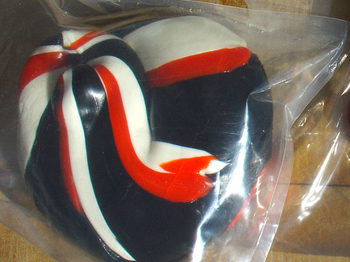
More conventionally (but not really) are the hard candy rings, which of course make a right mess if you wear them, but if you're a child, or if you're in love and in the mood, they'll be just the ticket.
'Hon, lick my finger?'
papabubble
Haarlemmerdijk 70
1013 JE Amsterdam
tel +31 (0)20 6262662
fax +31 (0)20 6267654
www.papabubble.nl
images l to r: Candymaker Marie Otto cuts rolls of hardened sugar into pineapple hard candy, closeup of pineapple candy, a blob of sugar that will feature at my next dinner
Please read more... "Papabubble is pure sugar finger lickin'"
Posted by debra at 02:13 PM | Comments (2) | post to del.icio.us
All I really really want is locative food
October 01, 2005

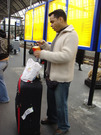

That is, food that tells me where I am and where it's from by it's very name and nature (without the use of an RFID tag). And all I really really want is to have one major train station and one major airport in one country that sells food that is not created by food product designers but by local people from local ingredients and reflecting the diverse local food culture already present.
Imagine Amsterdam's Schiphol Airport... Could the experience of Schiphol be enriched if you knew that this was the only airport in the world where you could exclusively buy locally grown and produced Dutch food and regional specialities? Was it already one and a half years ago that Doors of Perception and Urban Unlimited organised a cultural experts meeting for the city of Breda, a new node on the line of the High Speed Train. If I recall correctly, we recommended just this very thing.
The images above were taken within a period of 4 minutes. Friday afternoon, chip eaters abound at Amsterdam Centraal Station. Just imagine the possible effect on the environment and the state of agriculture and upon the local economy if these chips were made from a diverse range of local potatoes, fried in oil grown and produced locally. Imagine if you could order chips from a menu sporting 8 different kinds of potato! Imagine if the product of the finger fried potato embraced diversity.
And then there's the mayo...
And the knowledge economy that could sprout up from bringing the local boutique producer's products to the transportation hubs of the world...
Frites eaters: images of people eating chips taken on Friday September 30, 2005 from 16:23-27 at Amsterdam CS and on the train to Rotterdam.
Posted by debra at 09:53 AM | Comments (2) | post to del.icio.us
Oh to utter the words, food design...
September 28, 2005

Well it's about bloody time! Coinciding with all manner of design events going on right now in Amsterdam, the Stedelijk Museum hosted a symposium titled Food Design at the ubiquitous Club 11, featuring three speakers and three completely different interpretations.
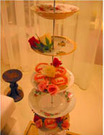
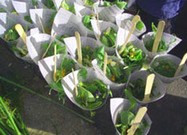
Marije Vogelzang (Proef) is doing some very interesting work from her studio slash catering laboratory and counts the stars of Dutch design (such as the Ladies Hella Jongerius, Marlies Dekkers and Li Edelkoort) amongst her clients. After a stunning portfolio presentation, I can't wait to visit Vogelzang's restaurant in Rotterdam Proef and get down to the business of tasting and nibbling. (Proef means 'taste' or 'taste it', in Dutch.) Vogelzang's work is all about engaging the eater in the underlying concept of the food and its presentation. I loved her daring in a recent catering project in which she used WWII ration ingredients to invoke memories about this bleak period. She elegantly walks the fine line between being thought provoking and utterly disarming when she stated, 'It's design that someone puts in their mouth, and absorbs into their body. It's all very intimate'. That's what I call a laudable attitude!
Although it wasn't the most pleasant message to hear, I can't stop thinking about the corporate presentation by Hans van Trijp from Unilever. Food design according to the multinational means designing the market context in which a food product exists, and has very little to do with actual food. Van Trijp described Honig's SpongeBob pasta as the perfect marriage of food design and marketing. Predictably, I found van Trijp's take and food and food design extremely disturbing, but I am so very eager to get in touch with him to hear more of what he has to say about how multinationals, even when we wouldn't dream of buying their products, influence our every day life right down to the iggly niggly bit of designing a country's infrastructure. This means that while Marije Vogelzang is designing a lunch using 'forgotten vegetables', Unilever, by the very virtue of it's market share, is determining which races of grains farmers will be growing and how food will be manufactured and distributed in decades to come. I just can't help but think it's a wise idea to keep in close contact with the suits. I'm just as much a stakeholder as the next Lady, right?
Ex-designer and unwitting stand-up comedian Marti Guixé as per usual wowwed the audience with a portfolio presentation of more than a decade's worth of food-related projects. He is the well-known Catalunian ex-designer that has worked extensively with shoe brand Camper, and ultimately designed their flagship restaurant, Foodball, in Barcelona. Balls are something of a leitmotif in Marti G's gastro-design as you can see from this author's review. It might have been just the unfortunate lighting, but while presenting images of his 'corporate sponsored food', (in this case an omelette with a sauce-stamped Calvin Klein logo), Guixé claims to have noticed van Trijp's lip twitch.
Although I'm not willing to spill the beans just yet, I am looking forward to Guixé's collaboration with Mediamatic in just a few week's time. Guixé and Mediamatic will be opening up a temporary restaurant in the basement of the former TPG builiding where you'll... read about it in culiblog.
images from l to r: Vogelzang's salad course of city leafy greens (served with grilled pigeon breast), hanging etagères made of 2nd hand plates designed by Vogelzang for Dutch fabric producer de Ploeg, Gin and Tonic Fog Party by Marti Guixé (artificial indoor fog made of gin and tonic at Casco, Utrecht). The above images are from the (ex-)designers' websites, © and hopefully also courtesy of Vogelzang and Guixé.
Posted by debra at 09:03 AM | Comments (6) | post to del.icio.us
How to feel a food mile
September 19, 2005
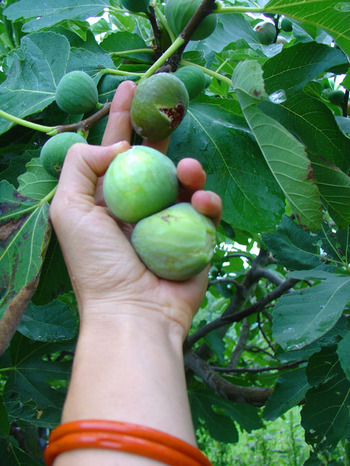
If it takes me eleven days to really feel at home, just imagine how a piece of fruit must feel after travelling under much worse conditions and for a far greater distance! No wonder one must go to great lengths in the urban environment to find tasty fresh food. My head finally adjusted to being here this morning, which makes me think that I would have adjusted faster if I didn't have one.
The photos above are of the things that I am missing the most since I've returned to the North. Although the sun does occasionally shine, I've been forced to hide my pedicure de campagne under woolen socks and fabulous boots. Life is one big give and take.
Please read more... "How to feel a food mile"
Posted by debra at 10:00 AM | Comments (1) | post to del.icio.us
Today's fig-related transactions
September 01, 2005
Went to bum a cigarette from my kitchen garden neighbour AlGouche,
and was invited to sit around eating figs and play with Abel's toes for awhile (Abel is 3 months old, so it's OK).
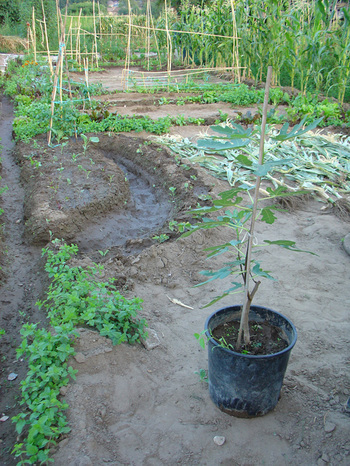
Received a fig tree as a present from Abel's parents, Amad & Lila,
and gave them some leafy greens.
Gave some tomatoes to neighbour Patrick across the stone wall,
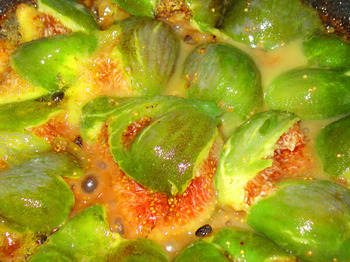
and was given a huge jar of fig preserves that utterly rocked my world.
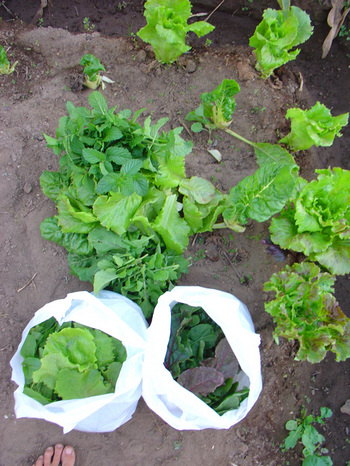
Inquired whether Patrick would like an assortment of leafy greens from my kitchen garden,
and received an apple on top of the wall, which I think was an 'exchange-a-thon' joke.
It's not really apple season yet.
Gave Patrick an assortment of leafy greens.
Gave Mme Afkir an assortment of leafy greens.
Have decided that tomorrow while watering the Family Afkir's kitchen garden, I will eat some of their figs when no one is watching.
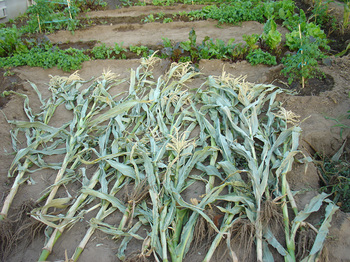
images t to b: the gifted fig tree (black figs of yet unkonwn variety), corn stalks drying and all my leafy greens thriving, divvying up the leafy greens for those that want them:
Posted by debra at 12:23 AM | Comments (1) | post to del.icio.us
Subsistance farming can be so romantic
August 30, 2005

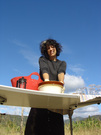
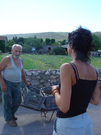
... if you only have to do it for a week. The long and short of it is that whilst living in the yurt, Lad and I didn't end up doing a whole heq of a lot of cooking, preferring instead to eat what fell into our mouths, right out of the hands that fed us. In the Occitanian summer that means raspberries, and yes, lots of leafy greens.
After the buzz of the new and the raw wore off, we did eventually develop a hunquering for heated food. Turns out that like most lads, mine knows how to BBQ, and is thankfully not averse to grilling a radish (or an ear of corn). We BBQ'd inside the yurt because the mercury did actually drop below 22°c at one point and we feared we might get the wrong kind of shivers.
Our favourite dish was a sorrel omelette prepared with Brillat-Savarin creamy cheese. Now I, in all my decades have never actually heard of a guy liking sorrel, or at least one willing to take it full on and fake it for an entire week. So for the time being, this spells blessing-counting time.
And oh how we turned eating my garden's first tomato into a wondrous ritual. Amen.
images from l to r: Lad eating from the hand that feeds him, domestic work-related gender issues au plein air, leafy green grower talks to leafy green eater about soil tillability (although clearly, Monsieur C. is tucking into more than just leafy greens!)
Please read more... "Subsistance farming can be so romantic"
Posted by debra at 11:44 AM | Comments (0) | post to del.icio.us
Happy spoon
August 29, 2005
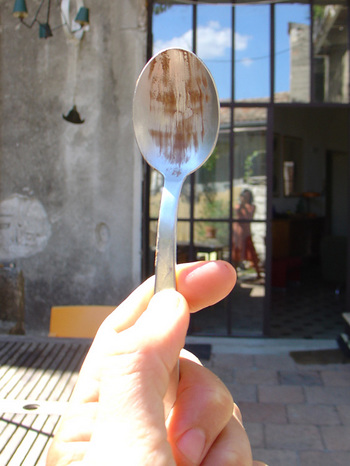
Yurt down, lad gone, summer's end. You can hardly blame a gal for eating choco-hazelnut paste straight out of the jar. The spoon came out of my mouth making a mockery of my attempt at food-medicating.
Please read more... "Happy spoon"
Posted by debra at 02:37 PM | Comments (1) | post to del.icio.us
Yurt and garden
August 13, 2005
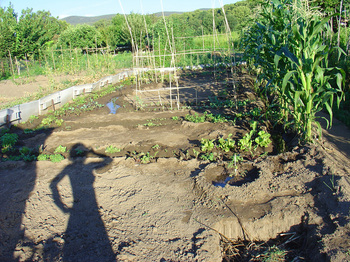
My garden at three and a half weeks old, is thriving! My yurt, set up at the edge of a vineyard, with views into two river valleys and mountains on all sides, is now little more than a glorified bedroom, shouting distance from the 'real house' in town.
But in one week's time a very special guest will arrive and we will among other things, live, and cook (!!!) at the yurt without the support of a proper kitchen. And because I am not a practical woman by nature, I have my heart set upon the notion that the yurt-cooking menu should consist primarily of food originating from my pre-pubescent garden. So I'm digging my toe in the dirt and wondering what kind of grits can a gal dish up using corn, tomatoes, several kinds of lettuce, rocket, chard, red chicory, mint, basil, sorrel, coreander, and everything but the squeal of a radish and a beet using nothing but a BBQ-for-one and an Occitanian 2-ring burner.
Fortunately, he's a vegetarian.
images from t to b: author slash subsistence farmer surveys her harvest possibilities, yurt lighting, flashed-view from the foot of bed.


Posted by debra at 11:24 AM | Comments (7) | post to del.icio.us
That's French for BBQ practice
August 02, 2005
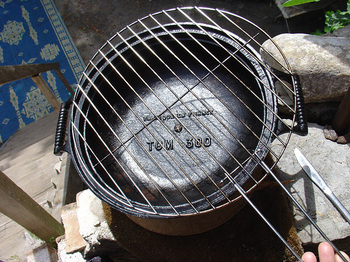
Last year I bought my first BBQ, a very cute bbq-for-one sort of thing. The level of my naïvete concerning all things BBQ became apparent when it turned out that there really is no such thing as BBQ'ing for one. After giving her a good shining, I announced to the hungry hoard that it was I who would be preparing that night's dinner on the barbie. There were a few grunts and not a little bit of silver-back posing, but in the end the gents were somewhat content to let me have a go at the girly BBQ as long as I didn't fiddle with their well-composed fires or ask too many questions.
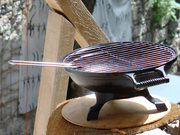
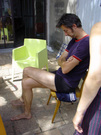
Up until this moment, I thought BBQ'ing was little more than guys hanging around playing with fire, but to my disappointment it turned out that there was actual skill and engagement involved in producing and maintaining a fire suitable to transform a hunk of meat into something amazing. And while I was busy making a dog's breakfast of some dainty sardines on my Barbie-doll-barbie, I also realised that the average eleven year old boy has a great deal more BBQ'ing experience than I do due to his vast experience in playing with fire.
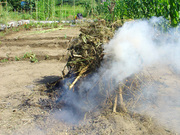
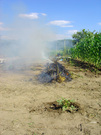
No worries, this year is a year for solving all of life's little problems and now that I am generating loads of burning material in the garden I have the perfect excuse to work on my own fire-making skills instead of facilitating others by making meat marinades. And since we're in Occitania, it seems that it's OK to go around lighting fires on hot August afternoons in your garden if you want to. Tonight we're having dainty little sardines, on the big barbie.
And check out my fire! The ash heap was still hot the next day and when I distributed the ashes thoughout the garden I accidentally cinged a little tomato plant in two. It's like youth serum, fire-making.
Posted by debra at 02:57 PM | Comments (1) | post to del.icio.us
So except for the coffee...
July 26, 2005
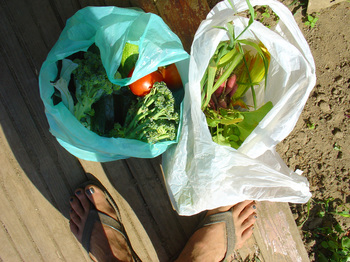
You may have noticed that culiblog has entered holiday mode. Hopefully this will all end soon. Profound apologia for the die-hards, but it's summer and all I want is homegrown. Please just go outside.
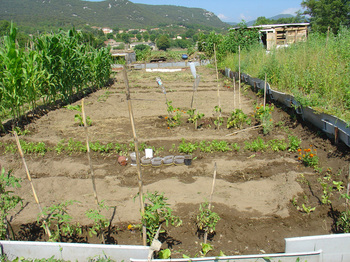
Here in Occitania, most of our food doesn't even make it the fridge before we've brushed the dirt off the roots and gobbled it up. Breakfast happens during the morning's water & weed and consists of cherry tomatoes, blackberries and baby courgettinissimi. Raw sheep's cheeses from the market, either very young or very old are our favourites and the saltiest dried ham compliment our salad at lunch. We have decided that we like all of our lettuces pure, not mixed. They're so sweet and full of flavour when you grow them yourself.
Except for the coffee, tea and peanut butter (you can take the girl out of California, but you can't take the California out of the girl), we're easily eating food grown within 5 kilometres of where we live. Yes, including the wine.
Now if we could just say that about our cosmetics. Please send black nail varnish.
images from l to r: today's harvest to be eaten at lunch, my garden (which changes every single day)
Please read more... "So except for the coffee..."
Posted by debra at 04:34 PM | Comments (0) | post to del.icio.us
Dear Dad, please get crackin'
July 02, 2005
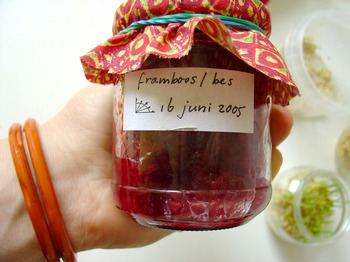
Look what Auntie Kristi made me from the first harvest of her very own garden back in the Old Country. This raspberry/berry jam brought tears to my eyes, so delicious. None too sweet either, just the way I like it. Now there are two people in the world that make me jam that makes my heart leap with joy.
Posted by debra at 01:14 PM | Comments (0) | post to del.icio.us
It was an accident
June 29, 2005
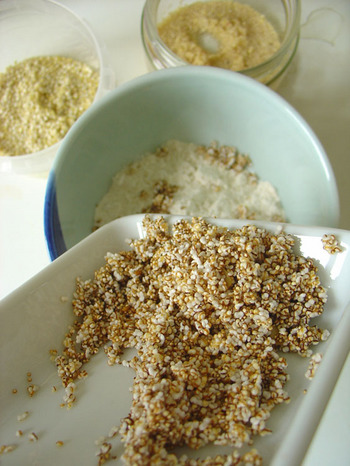
Puffed quinoa is delicious and has a surprising texture. I heated it in an a lightly oild pan but a paint stripper will do a better job in the future. The plan was a chapati with a puffed quinoa 'layer'. That plan still needs a bit of work and I'm hoping that Harold McGee's On Food and Cooking will help me sort out the differences between quinoa, sorghum and millet, water absorbtion, and the gelatinization of starch.
Posted by debra at 11:41 PM | Comments (3) | post to del.icio.us
Sometimes I'm irreverent and I take the easy way out. Here's how...
June 15, 2005
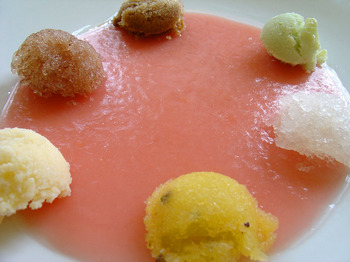
Granitas shown clockwise from 10 'o clock; duoi uoi nuoc hot e (let's just call this, banana and acceptably gelatinous seed drink), ice coffee, green tea tofu, lychee soda, passion fruit&juniper berry&ume boshi, mango tofu. Center; guava disk.
The motivation behind this granita sampler was the desire to make some recipes that involved little more than ripping open a can of Chinese soft-drink, freezing the contents for two and a half hours and then giving it a good scratchin'.
Please read more... "Sometimes I'm irreverent and I take the easy way out. Here's how..."
Posted by debra at 02:30 PM | Comments (2) | post to del.icio.us
Space food
June 14, 2005
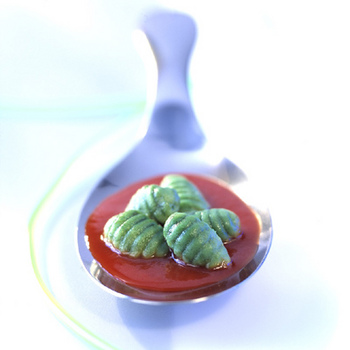
(image courtesy of ESA Directorate of Human Spaceflight and Alain Ducasse)
A former colleague of mine, aerospace engineer Alexander van Dijk, sent me this link about chef Ducasse and his staff developing food for manned missions into space. Check out the space food experiments from the directorate of human spaceflight right here. The article talks about aiming to produce 40% of the food locally for astronauts on long term missions. The nine basic ingredients that ESA plans to grow on other planets are: rice, onions, tomatoes, soya, potatoes, lettuce, spinach, wheat and spirulina, a blue-green algae, very rich in protein (65% by weight), calcium, carbohydrates, lipids and various vitamins.
Although I love to develop recipes based upon a highly restricted diet as much as the next guy, I really miss seeing bean and seed sprouts in the descriptions Ducasse experiments. it's so easy to do and you have within 4 days food healthier than when you just had a hill of beans.
Posted by debra at 12:56 PM | Comments (0) | post to del.icio.us
Hibiscus flowers
June 12, 2005
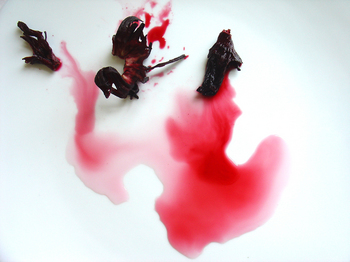
One million years ago, when I was a little girl, I had a piano teacher called Miss Pierce. She was an elegant and graceful woman, and ancient, as far as I was concerned. She was the secret girlfriend of Mr. Greenjeans, from the chilluns' TV show, Captain Kangaroo! We lived in a university town full of orange and date orchards on the edge of the desert, and Miss Pierce was probably one of the few people there that fulfilled for me, in her own wierd and spinster way, the notion of what it is to be 'fabulous'.
I used to arrive at her strangely decorated house for lessons with my neighbour Michelle, who was even more of a tomboy than I was. The two of us played so rambunctiously that Miss Pierce decided to give us 'lady-lessons' at no extra charge. We agreed to the lady-lessons because we just loved listening to Miss Pierce blather on and on about table manners and gentlemen as we sipped hibiscus tea and nibbled girlscout cookies, all the while kicking eachother surreptitiously under the table.
Miss Pierce liked her hibiscus tea incredibly sour but I never added sugar because sugar was 'white death', and I was trying to get my head around enjoying sour things. Hibiscus flowers in their wet form, alive and still on the tree, are forever connected in my mind with my father and his battle against vast herds of aphids. But hibiscus flower in its dry form and as a tea still reminds me of my piano teacher, Miss Pierce, patiently battling to turn me and Michelle into ladies.
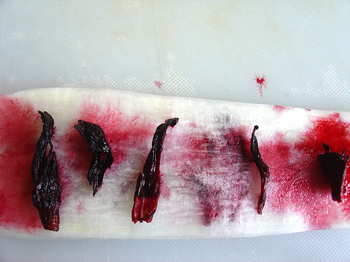
Today I'm experimenting with using hibiscus flower as a souring agent in a batch of quick pickles and a vegetable broth intended for a summer borscht although 12°c doesn't really qualify as summer.
Please read more... "Hibiscus flowers"
Posted by debra at 02:25 PM | Comments (9) | post to del.icio.us
Fortunately the food was slow and dry
June 10, 2005
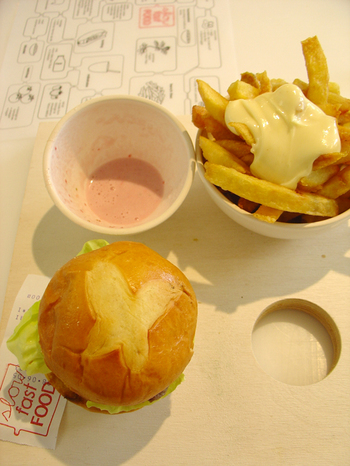
When the 'slow' is the Slow Food Movement and the 'dry' is Dutch design agents Droog Design, the combination of slow and dry is a good thing. In Dutch, droog means 'dry', and it refers to the dry humor of many of their designed objects. Droog is celebrating their Amsterdam Staalstraat location by hosting a temporary 'fastfood' restaurant to showcase their food-related design items (open until Sunday 12.06). The menu is quintessential fast food; burgers, chips, shakes, but all the ingredients are sourced from local ingredients, made by artisanal suppliers and prepared with the love and attention of Slow Food Movement volunteers. I decided to be a lady who lunches and give their grub a try.
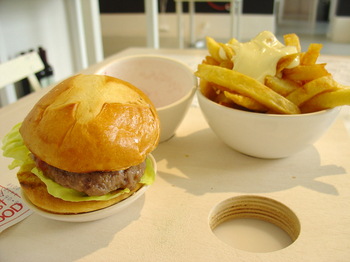
The foodstuffs arrive in round-bottomed ceramic bowls - all of which you may take home with you after eating! The strawberry shake contained a goodly portion of fresh, local strawberries. The burger bun was made from brioche dough, the burger, real chopped all-organic beef, dripping real meat juices! And so the story goes, good ingredients prepared with love from barnyard to burp. The restaurant is primarily about letting folks try out design objects in a real food context so not surprisingly the portions are mini-petit. This sweet and small design choice reminded me of the way Pee Wee Herman used to eat baby corn on TV; kernel for kernel typewriter style! After finishing my slow fastfood lunch, I wasn't hungry but I did have a little hunquering to take home some more of those cute little round-bottomed bowls.
Please read more... "Fortunately the food was slow and dry"
Posted by debra at 12:17 AM | Comments (0) | post to del.icio.us
Strawberry stories
June 09, 2005
I took home some of those organic strawberries from Brabant last Sunday and by Monday morning I had turned eating strawberries into a yoga breathing practice. Inhale; pop a strumberry in your mouth and squish it against the roof of your mouth with your tongue, wait. Exhale; get high off the strawberry flavour. I got so good at doing this that I could eat one strawberry per breath!
The berries were sitting in a bowl on the counter and I was wandering around the house when all of a sudden I heard a huge BANG coming from the kitchen. (You can see the mark on the window in the image above.) Apparently a bird spied the strawberries and thought, 'mmmmmmmmmmmm breakfast', and smashed headlong into the window! Ouchy!
Normally I don't even like strawberries. They're like tomatoes in that they usually don't taste good unless you grow them yourself, but these strawberries were amazingly aromatic and tastey. Peter, from Artis said that when he went to pick up the two crates at the farmers' market last Sunday, the farmer insisted upon carrying the crates home for him. And so they went, side by side, the farmer proudly displaying the crates of jewel-like strawberries all the way home.
Posted by debra at 09:52 AM | Comments (2) | post to del.icio.us
Recycled tetraware and even more leafenware
June 03, 2005
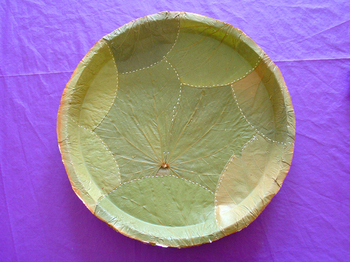
The image on the left shows (clockwise from 10 o'clock) a repurposeed surplus tetra-pak plate, a banana bark pressed bowl, a paper plate made out of 'surplus' film poster and the underside of the tetra-pak plate showing its origins as a tomato paste container for an arab-speaking country. In the centre is the underside of a banana bark bowl.
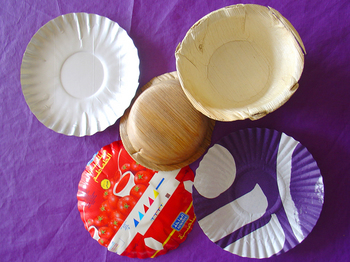
The image on the right shows a beautiful sewn leaf platter (~50cm diam) backed with surplus printed plastic originally produced for juice packaging. Alternating layers of leaf and plastic make the platter just sturdy enough to carry a few things as long as those things don't happen to weigh anything.
Please read more... "Recycled tetraware and even more leafenware"
Posted by debra at 11:53 AM | Comments (0) | post to del.icio.us
Leafenware is everything but the squeal
June 02, 2005
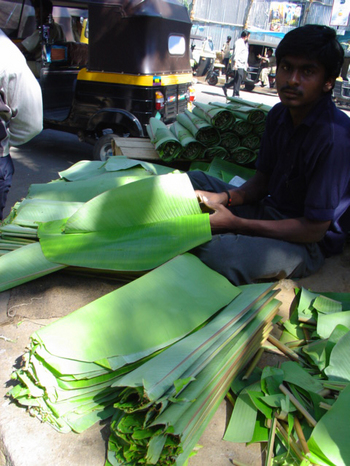
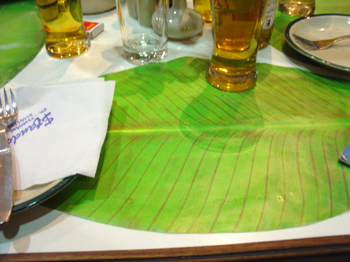
A banana leaf is a plate in Bangalore. The uppermost image shows a Ghandi bazaar (Bangalore) plate maker producing and selling leafenware on the street. The waste products of his production are eaten by noshing cows. This is 'everything but the squeal' vegetarian-style.
But Delhi is far far away from the banana climes of the South and an artificial banana leaf plate seems to be a logical substitute. This fabric photoshop job was doing duty as a placemat at drinking club, the Standard at CP before we procured it from the owners for the culiblog packaging archive.
Faithful culiblog readers are familiar with the entry just a few weeks ago of the pepesan sans pep dish, wrapped in bamboo leaves. I am curious about whether bamboo leaves bought at a Chinese supermarket in Amsterdam, imported from somewhere deep in the guts of PRChina qualify as ecologically sound plate choices, but I would like to hear from someone with a strong opinion - or better yet - some actual knowledge on this subject.
Q1: Is a one-use banana leaf plate a more sustainable choice than a ceramic plate in a place where banana trees are harvested?
Q2: Is a pack of dried bamboo leaves a more ecologically sound dinner party option than ceramic plates when the bamboo leaves are imported from PRChina and the dinner party is in the Netherlands? or Occitania?
Q3: Is a re-usable (maybe 100 times) fabric plate more ecological than a ceramic plate if the fabric plate is produced locally? (The plate can be rinsed in soapy water and rinsed clean.)
Q4: Are recycled paper plates like the ones shown in this culiblog entry or the tetra-pak plates more ecological than the different sorts of leaf plates if all of the materials come from local sources?
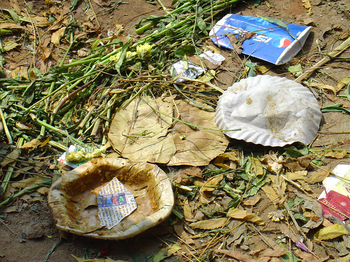
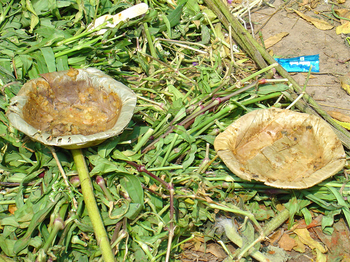
Pictured above are images of leaf plate and other vegetable (and non-veg) trash on the streets of Delhi.
How does one calculate the sustainability of a given object? Ceramic or stainless steel plates are produced under industrial conditions, raw materials possibly imported, packaging distribution all factor in. Imported dried bamboo leaves do quite a lot of travelling. Banana leaves seem ecological (if locally grown) but what are the conditions of the banana plantation and how are the leaves harvested? And what if you already own some plates? And what if you live in the city and don't have a compost pile or animals with four stomaches roaming the streets?
technorati tags: leafenware, Delhi, sustainability
Please read more... "Leafenware is everything but the squeal"
Posted by debra at 09:47 AM | Comments (8) | post to del.icio.us
Pasta that is not pasta
May 27, 2005
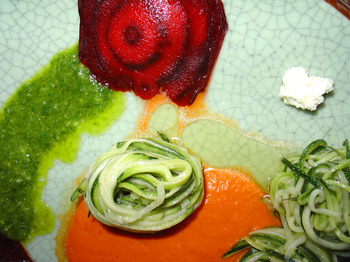
Finalement, Pasta that is not pasta. In this recipe I use thinly sliced raw courgette/zucchini as spaghettini, and courgette/zucchini and beet slices as ravioli. The main ingredient of the sauce is Turkish pickled and roasted peppers, a product I love because of the bits of charred skin still sticking to the pepper flesh. There is nothing like fire to add flavour to food, as our ancestors, if only they could respond to this blog entry, would readily agree.
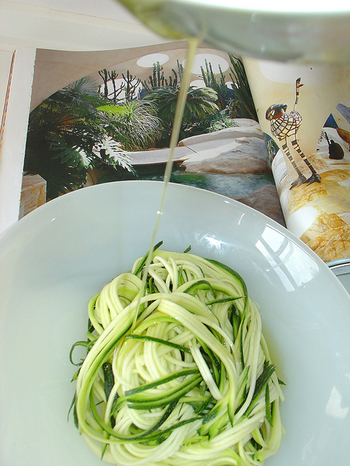
Pasta that is not pasta
- courgette spaghettini
- courgette ravioli
- beet ravioli
- roasted and pickled paprika coulis
- rocket emulsion
The beet ravioli recipe you can find here. For the courgette spaghettini, please click Please read more to read more.
Please read more... "Pasta that is not pasta"
Posted by debra at 09:01 AM | Comments (2) | post to del.icio.us
Chicken jail
May 12, 2005
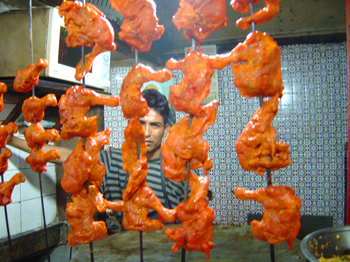
A man languishing behind bars of a chicken jail. This image was taken near Connaught Place in Delhi and is part of an archive compiled by participants of the Nomadic Banquet workshop, Delhi March 14-26, 2005. For more blog entries and image archives, please check out the official Nomadic Banquet website as well as that of the Doors of Perception. Doors 8 Delhi: Platforms for Social Innovation.
Posted by debra at 03:49 PM | Comments (0) | post to del.icio.us
Which one is the fish skin wedding anniversary?
May 09, 2005
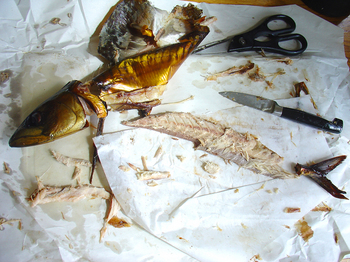
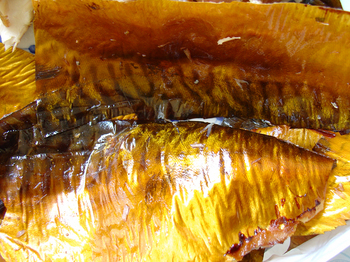
5th Wedding Anniversary Menu for John and Kristi
Pasta that is not pasta
- courgette spaghettini
- courgette ravioli
- roasted and pickled pepper coulis
- rocket emulsion
- even creamier cheese in a can
Pepesan sans pep
- grated coconut tamale with
- smoked mackerel marinated in tamarind and lime leaves
- sweet potato
- not very much sambal djeroek taking into account the delicate Northern palates
- coconut cream
Charlie Trotter's Banana and Chocolate Lava Cake
- w/ roasted mini bananae
Please read more... "Which one is the fish skin wedding anniversary?"
Posted by debra at 10:19 AM | Comments (1) | post to del.icio.us
Ladies who drink bubbles on a Friday afternoon
May 07, 2005

Good friends and exemplary ladies Quirine and Helena celebrate the opening of their new offices in the Amsterdam Post CS with some bubbles. Their film Celebration, a documentary about the Florida town of the self-same name and the desires of its quirky inhabitants premiered in January at the Rotterdam Int'l Film Festival. Ladies Jans P., Quirine & Helena and I celebrate until the happy hour develops into a pale liquid dinner. We speak about all manner of things unspeakable, (food) taboos, anorexia in terms of objects, and we're glad we got that off our chests! We devise plans to optimise an upcoming Belgian shopping trip but there's really no reason to name names unless they want to start sponsoring us. Life is fine when one's own life is grist for the mill.
Monday evening 09.05.05 at 09.05 at Club 11, Mediamatic will host the Mobtagging Salon which will feature past works by our Ladies, including excerpts from one of my favourite of their films, The Tower, a spooky documentary about a castle inhabiting aristorcratic hippy family. That's my kind of people.
Please read more... "Ladies who drink bubbles on a Friday afternoon"
Posted by debra at 10:26 AM | Comments (0) | post to del.icio.us
Scared of a little granola perfume
May 06, 2005
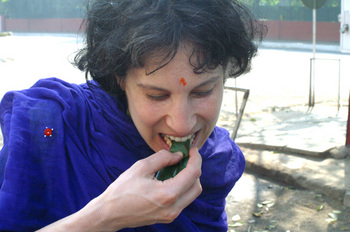
In Dutch we have a term, 'doorheenbijten' that means literally 'to bite through something'. We use this term to describe the painful process of exploring unchartered territory. Think for just a moment about what could have motivated someone to invent such an idiom. Now, think about the circumstances that would have caused an entire culture to embrace this idiom enough to use it regularly!
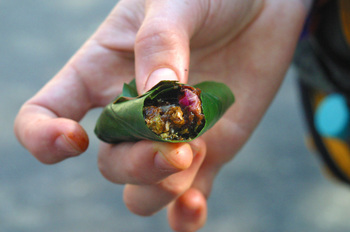
The images above show the author about to take her first bite of paan without any idea what paan could possibly smell, taste or feel like. It is quite strange to try something with very little previous reference, and having never tried chewing tobacco, paan was unchartered territory for me.
In a neat little kiosk by the side of the road the paan wallah prepared the leaf for me with all manner of goos, crystals, flakes, shavings and sprinkles - none of which seemed familiar. Although I would like to say that I bravely put the roll into my mouth and enthusiastically started chomping away, the photograph above reveals the utter lack of trust and relax I had in approaching this new foodstuff. You can also see how such an utter lack of trust and relax results in a particularly unaesthetic portrait. That fact alone should be motivation enough to drop some food taboos.
Good news is that as I reported earlier, paan is delicious, something like eating granola perfume. And like the photograph that I keep of myself in the freezer to remind me of what I looked like in a bikini in 1998 (to avoid an over-consumption of ice-cream), I have decided to keep this picture at hand to remind myself to be more trusting of new foods.
Please read more... "Scared of a little granola perfume"
Posted by debra at 12:36 PM | Comments (1) | post to del.icio.us
Restaurant for anorexics
May 05, 2005
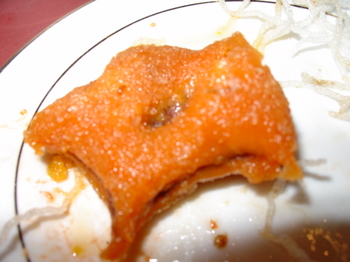
Sehnsucht, (means longing in German) is the name of a Berlin restaurant for anorexics. Owner Katja Eichbaum, formely anorexic, started this project with private funding (only her father would lend her money) as a therapy for her own condition. The chef is anorexic as are several members of staff. Sehnsucht's menu items have names that don't include words for food to avoid confronting anorexics with the fact that they are about to eat. 'Hallo' (lobster bisque), 'Pirate's Eye' (2 fishfingers and a fried egg), and 'Heissehunger' (ravenous hunger = rack of lamb) are all dishes that non-anorexics might order in 'normal' restaurants. But one item on the menu consists simply of a fork, knife, and an empty plate. It is titled 'Thieves Platter' and facilitates the anorexic diner to steal (or share) from those dining with her.
As expected the restaurant has received a huge amount of international publicity. And although I have not yet eaten at there, relying solely on restaurant reviews to inform myself, if Sehnsucht is an attempt to create a location for anorexia patients in the guise of a regular restaurant for the people that love them, it is also a wasted opportunity.
Why not revel in anorexia? Why not serve food items so refined and 'stretched' like anorexics themselves create on the spot each night at the family dinner table? Anorexics are master chefs and food stylists when placed in the harsh context of the family; hardboiled eggs with the yolks surgically removed, crackers deconstructed so that their total surface area has been increased twenty-fold, slices of bread with each visible grain extracted and displayed on the edge of the plate, utterly dissected broccoli. I say this without having seen Sehnsucht's menu but hope sincerely that it is not just another do-gooder resto in which the real food on the menu functions only to lure the paying and eating guests.
Please read more... "Restaurant for anorexics"
Posted by debra at 08:38 AM | Comments (4) | post to del.icio.us
Far away is the new *onrein
May 03, 2005
Maybe it comes from the fact that I'm reading up on dietary law combined with reading John Thackara's book, In the Bubble about sustainability and design, but I'm starting to wonder if distance is the new unkosher. In Patrick Faas' Volkskrant article titled, The prophet Mohammed's favourite dish, (18.02.1997) about Islam's flexible standpoint on whether one may eat ostrich and camel, I couldn't help but wrinkle up my nose at the thought of ostrich farms far far away and poor slabs of beef having to travel first by air and then by freight truck to get to the supermarket and then our tables. According to In the Bubble we spend more time transporting ourselves to our grocery shopping than actually doing our grocery shopping. And I don't want to bring down any wrath upon myself, but it seems that a lot of religious dietary law is based upon cultural food preferences and taboos rather than hygiene. Proof? Both Jewish and Islamic law are quite arbitrary about which foods are considered clean and unclean. I can't help but wonder why in this day and age hygiene should have preference over sustainability when it comes to dietary law.
*Onrein means unclean in Dutch, unclean in the religious sense of the word.
Posted by debra at 05:59 AM | Comments (1) | post to del.icio.us
Hors d'oeuvre of affliction
April 27, 2005
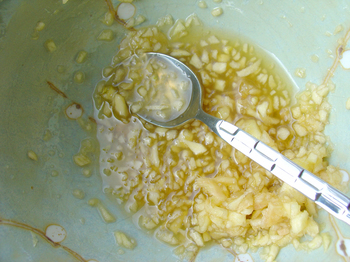
Some years ago a friend of mine waxing rabbinic told me that during Pesach week, whilst eating charoset one must never say, 'Mmmmm, I love charoset!", because charoset, a delicious mixture of apples, honey, and/or nuts, dates figs, symbolises the mortar used by slaves to build the buildings of the fill in the blank here, and don't take things too literally, you!
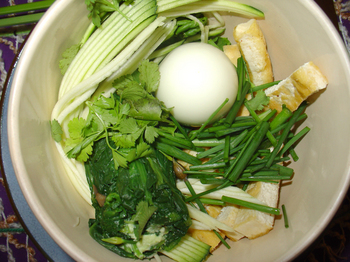
That sounded like a quirky but plausible Jewiish behaviourism to me and I decided to incorporate it into my narrative.
Yesterday evening, two friends of mine from Kampala were back in the Heimatt and fortune placed them at my dinner table. Oddly I didn't feel much like cooking when I wrenched myself away from my work at 19h and I don't know how I did, but I did somehow manage to slap something together for us to eat. It just wasn't me not to want to cook for dear friends and somehow I convinced myself that it was OK to serve a ritual combination of matzah, charoset and bitter herbs (horseradish) as an hors d'oeuvre!
I show Alice and Lee how to do like the Jews do, make a little sandwich by piling the charoset and bitter herbs onto the matzah, how you take enough horseradish so that it causes you to shed at least one tear for the slaves that once were, for the slaves that still are, and finally, that even if you like the taste of the mixture, you're not supposed to say so. Charoset stands for the mortar of the enslaved and we're supposed to act like we hate it.
After the lengthy explanation I space out and Alice and Lee get to work making their own hors d'oeuvres with the materials provided, all the while telling me funny stories about the Amakula International Film Festival that they set up in Kampala last year. Alice takes a bite of her d'oeuvre, and with a pleading look on her face grasps her throat, pounds on her chest, shudders, starts looking frantically for her napkin as if she wants to spit in it, is barely able to swallow the mouthfull, slams her hand down hard on the table with a resounding BAM and pronounces, 'YHhUCK!'
I am completely shocked. The combination of witnessing a cherished friend intensely dislike something that I've dished up, plus all the guilty feelings for not giving it my all earlier that evening, plus a little bit of wonderment thrown in because I'd never actually heard of someone not liking the ritual combination. It's all just a bit too much. 'What, you don't like my cooking?'
Alice and Lee look at me with these puzzled looks on their faces and finally Alice musters, 'But, didn't you just say that...'
Please read more... "Hors d'oeuvre of affliction"
Posted by debra at 09:42 AM | Comments (10) | post to del.icio.us
Another short supply chain
April 26, 2005
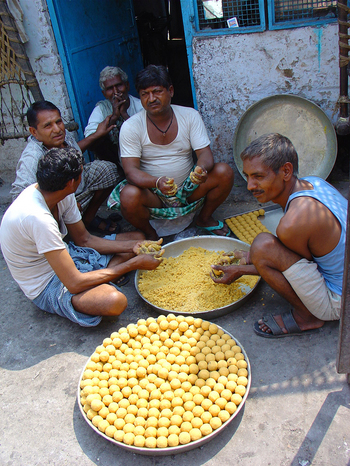
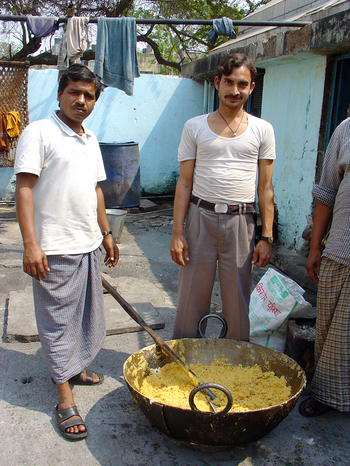
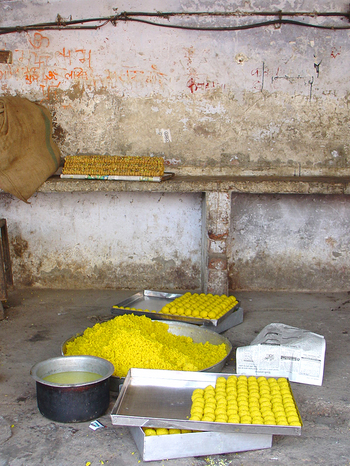
This time it's dessert! Ladoos, to be exact. These gentlemen are working in the temple compound (Hanuman Mandir, CP, Delhi) 30 metres from the dung fuel sales and manufacturing woman. Their whole production setup takes place within 10 metres, their point of sale is 30 metres away.
A ladoo is a graham flour sweet, sometimes made with puffed rice. If someone would explain to me why one always finds ladoo near temples I would be most appreciative. I think it has to do with religiously sanctioning things that people like to do anyway, and I mean that in the most generous possible way.
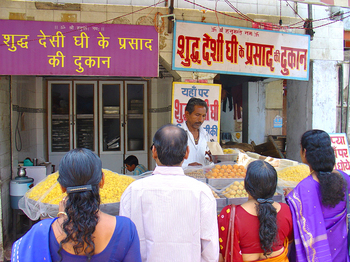
Please read more... "Another short supply chain"
Posted by debra at 09:07 AM | Comments (3) | post to del.icio.us
Love those short supply chains
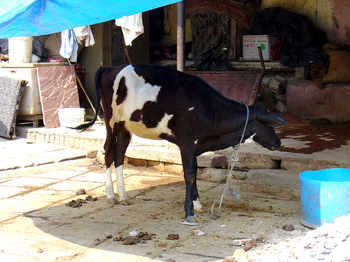
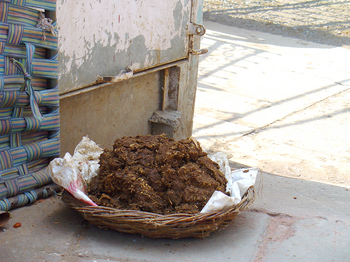
Here in Europe we can't stop talking about 'food miles', that is to say, how many kilometres our food travels before we actually get to touch it. There's that quite famous study of the strawberry yoghurt, It's the same for all products, including cow dung fuel. The images shown were all taken within 20 metres (!) of eachother in the Hanuman Mandir temple complex near CP, Delhi.
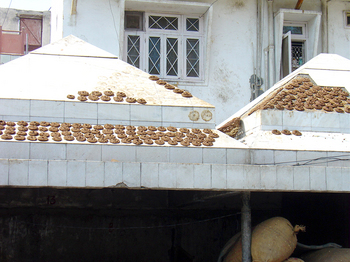
From top to bottom: Cow - dung collection - patty cake, patty cake, dry dry dry - fuel saleswoman
Please read more... "Love those short supply chains"
Posted by debra at 08:24 AM | Comments (0) | post to del.icio.us
Passover cleaning
April 22, 2005
In December 2004, a Spanish Talmudic scholar named Sinterklaas was cited translating the Torah,
'Passover is the holiday when it behooves
us to clean the barnacles out of our grooves'.
If you don't have anything in the fridge, it's easier to clean it. Smetvrees, the fear of contamination, is an ancient Jewish tradition and therefore a once yearly scrub-down (and burning!) is on the menu today, the day before Pesach. Before the week of Passover commences, it's necessary to rid the house of all items containing leaven, creating an elaborate excuse for rarely performed activities such as dusting and refridgerator cleaning.
Since March 11 I've been in my home exactly 3 days. The contents of my fridge (l to r, top to bottom) are: 2 eggs, jars of mustard and homemade sambal from January 2004 (a gift from a then-not-yet-ex, indicating the period of time that has passed over since... YIPES = LEAVEN!!!), 1,5 train station supermarket courgettes, leftover film from a photoshoot in 2003. 2nd row; 2 1000 yr. duck eggs, 1 open packet of gari (pickled ginger), pickled daikon radish, 1 jar of anchovis. 3rd row; 1 tin of sheep cheese in brine containing 1/8th of a cheese, 2 tins containing only brine which I will also categorise as clutter I mean leaven, 4 St. Marcellin lait cru cheeses brought from Occitania on Wednesday.
In the vegetable 'crisper', which I realistically refer to as 'the rotter'; 1 piece of burdock from a 2004 automnal dinner, 1 carrot from same dinner, a lot of paper bags that act as an absorbent layer when I'm gone for any length of time ( = LEAVEN), 500ml of half fat milk, bought at the train station, 1 bottle of ketchup from last century. Ketchup is oddly exempt from all dietary law.
Please read more... "Passover cleaning"
Posted by debra at 10:20 AM | Comments (4) | post to del.icio.us
Avocado update
April 21, 2005
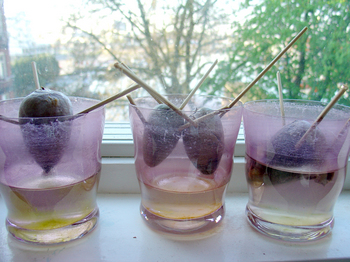
Safe and sound back in the Heimatt. Pity la geste Californienne. Compare the image above to the entry of hope before heading off to India and France. Looks like my sense of home in Amsterdam needs a bit of nurturing. My inner mother tells me to return the failed avocado sprouters to their original use as vessles of buffalo grass vodka.
Posted by debra at 08:01 AM | Comments (0) | post to del.icio.us
Delhi recycling, in all fairness
March 15, 2005

When is recycling not really recycling? When the recycled or re-purposed item never really had a purpose in the first place. These papers, have been left on the ground (location across the street from Jantar Mantar, Delhi), as far as I can tell, for no other purpose than to be repurposed. The image on the left is a stack of paper left on the street as an offering to the gods of the recycled chaat-bag-makers.
Packaging for chaat is often nothing more than a bag made from old newsprint or repurposed paper, or for the wetter stuff, a leaf plate. The bag pictured on the right was made from some terribly interesting literature about bonds. One can see the imprint of the deep-fried sweet peas contained within being absorbed into the paper making a pretty pattern.
Posted by debra at 01:07 PM | Comments (0) | post to del.icio.us
A street snack called chaat
March 14, 2005
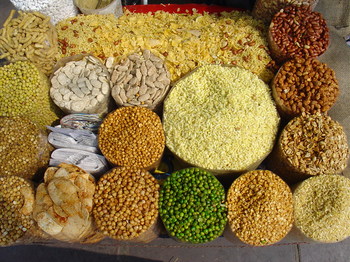
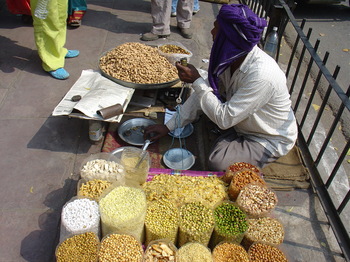
In Delhi street vendors sell chaat, that is to say snacks consisting of all manner of puffed, roasted and deepfried legumes, grains, pasta products and broken crackers. Nibbles to go, nibbles to take home, nibbles that remind one of the street. A chaat vendor will sell his beans and bobs dry to take home, or if you've got the right guy he'll mix up a little chaat-snack for you right then and there with some very much needed chaat-moisturizer i.e. sweet chilli sauce.
Look at (click on) the image on the left closely and you'll see the bags in which the chaat is sold folded neatly between the goods. The bags are made of recycled newspaper and other redundant paper glued into bags for packaging.
Please read more... "A street snack called chaat"
Posted by debra at 07:27 PM | Comments (2) | post to del.icio.us
Delhi street food vendors benchmark good health practices and urban planning
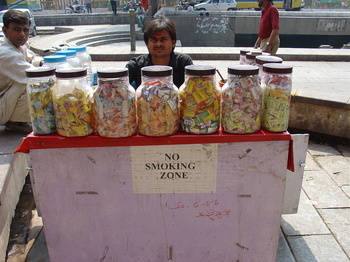
This Delhi street vendor has set up a much needed no smoking zone right in front of his stand (located in front of the state emporia across the street from the Hanuman Mandir near CP). I believe he is selling little packets of flavoured chewing tobacco.
Posted by debra at 06:30 PM | Comments (0) | post to del.icio.us
Bad eating habits
February 16, 2005
Mille pardons. Culiblog is temporarily suffering from bad eating habits.
Love,
Debra
Posted by debra at 12:58 PM | Comments (4) | post to del.icio.us
Lacking and craving
February 08, 2005
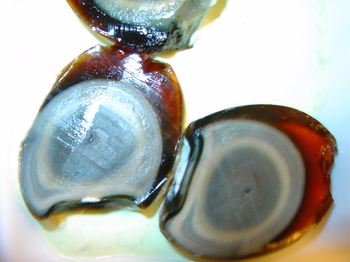
Supposedly craving a certain food is your body telling you that your diet lacks a certain something. But what is it that my diet lacks if I get cravings for 1000 year eggs with Cheese in a Can Soup? Could the lack of light and earthy outdoor fun up here in the Polar Circle have made me wood ash and lime deficient? Do I need to get my tochas down to Occitania where I never crave these elegant looking duck eggs?
1000 year eggs are raw duck eggs that have been coated with a paste of salt, wood ash and lime and then rolled in rice chaff to keep them from cementing together. They are placed in a ceramic pot and rotated every few days for two weeks. After this time the insides of the eggs have become 'softboiled' and turned dark transluscent amber (the white) and greenish greyish black (the yolk).
The design of my old Mac G3 laptop (a Pismo) always reminded me of a 1000 year egg. I find this colour combination extremely elegant - the 'white' of the 1000 year egg is like a golden amber aspic, sometimes with fractal designs forming in it!
Doesn't it just make you wonder how a preservation technique like this develops?
Please read more... "Lacking and craving"
Posted by debra at 10:23 AM | Comments (8) | post to del.icio.us
Cooking Challenge, Pôts de Crumble
February 07, 2005
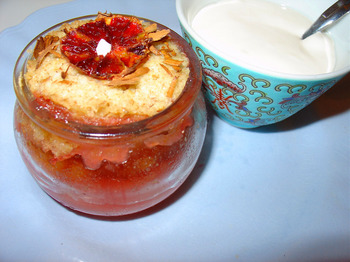
In French that's pronounced poh and the term can mean everything from a pot to piss in to a pot to plant some blood orange apple crumble in. Recycling fool that I am, these pôts originally contained storebought creme caramel but serve as excellent ramekin substitutes.
This past weekend was the Paper Chef Challenge, a little game some food bloggers like to play not dissimilar from the BBC television show Ready, Steady, Cook. The group agrees to use a group of ingredients in a recipe over a finite course of time. Wheat flour, cinnamon, blood oranges and creme fraiche, with extra points for using broccoli, chorizo, stale bread and something else. After a botched batch of stale cornbread French Toast (which in Dutch amusingly translates into a dessert called Turning Bitches), I decided to do something very un-Debra and stick to the menu.
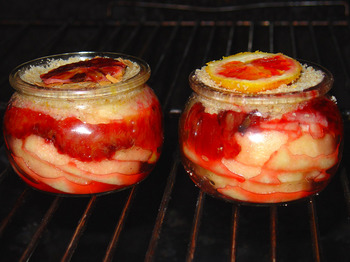
Desserts based on the apple crumble principle have always been my back-up dessert. I actually never eat dessert but perform it exclusively when I have guests and consequently dot dot dot. The blood oranges in this dessert give it extra tang, for those of us that truly don't have a sweet tooth.
One thing - the only kind of orange I like is a blood orange, and I use every single part separately.
Another thing - there are many sorts of cinnamon but for baking only Sri Lankan stick cinnamon will do. Ignore the dried pre-powdered kind and buy a proper stick of very thin bark. The thick stuff is for making meat stews anyway. You pulverise the cinnamon into splinters between your fingers - and there are few things finer than biting into a cinnamon bit, an explosion of flavour reminiscent of the RedHots candy of my childhood.
Oh and another thing - Whole meal chappati flour 'is not just for hippies anymore'. This finely ground wholemeal is definitely light enough to use for baking.The trick is to work with a light hand and to not over-mix the thing that should not be over-mixed, in fact, to become light yourself.
Ohm and one last thing - Creme fraiche (d'Isigny) is best taken straight up, with a spoon.
Please read more... "Cooking Challenge, Pôts de Crumble"
Posted by debra at 10:05 AM | Comments (3) | post to del.icio.us
I hate bread
February 04, 2005
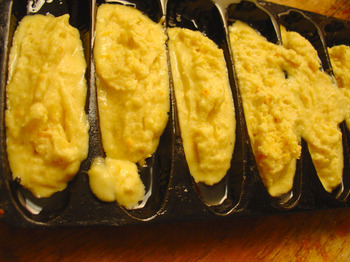
Except sometimes and some breads.
I love cornbread and I love my little cornbread iron. Maybe because it's bound up in a possibly made-up memory or maybe it was something that really happened. But I believe that I became covetous of my Auntie S's when she dished up some cornbread 'ears' for Thanksgiving at least 2 decades ago.
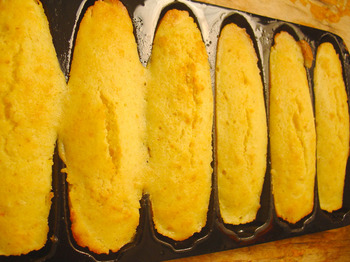
A cornbread iron is a perfect iron age tool. You heat it up, grease it up, heat it up some more and then pour in the cornbread batter. Shove the lot in the oven and the cornbread takes half the time and finishes with an excellent texture and crumb.
Please read more... "I hate bread"
Posted by debra at 10:37 PM | Comments (5) | post to del.icio.us
Gullet Girl
January 24, 2005
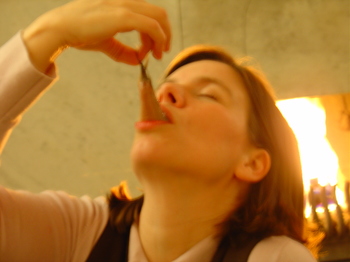
This is the correct Dutch way to eat a herring.
By firelight.
Please read more... "Gullet Girl"
Posted by debra at 09:31 AM | Comments (5) | post to del.icio.us
Brain Food
January 20, 2005
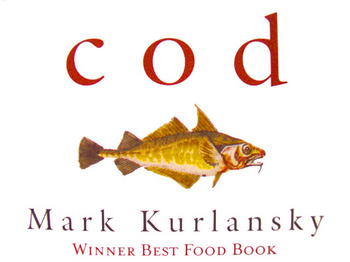
This terribly sad but well written book by Mark Kurlansky is a gripping history from the perspective of the cod. Kurlansky tells how fishing for this gadiform has deeply affected the wealth and development of many nations and technologies. I'm thinking the Flounder by Gunther Grass that I read back in the day but even more I'm thinking Fish Story, the mega-artwork by Allan Sekula, about the 'sweatshop called the Pacific'. (Sekula's visual history Fish Story was part of the the last Documenta XI in Kassel. One photograph in particular gave me goosebumps. You see a ship painter giving the Exxon Valdez a new name...fishy stuff.)
It turns out that cod in the form of stokvis (wind dried cod) turned out to be some good thinking-man's protein for the Norsemen. That extra portable brain-power enabled them to encounter New Foundland in 1000, where they also encountered the Beothuk People who had already discovered it and were not enamoured with the idea of sharing their space with the pink and hairy people from across the puddle.
Basques added salt to the stokvis recipe to make salt cod increasing the quality of the preservation and enabling Basque fishermen to to travel even farther - to the mouth of the St. Lawrence river. When explorer Jacques Cartier got there raring to claim his 'discovery' he encountered almost a thousand Basque fishing vessels. And a bunch of angry native Beothuk people getting pissy about the incessant attention.
Cod is inextricably tied to land (to dry it) and salt (to preserve it) and Salt is in fact the title of another one of Kurlansky's wonderful books.
Posted by debra at 08:54 PM | Comments (3) | post to del.icio.us
Keeping one's vows
January 19, 2005

Remember in October when I had just bought Roxanne Klein's R A W and I reported how it made me homesick for Laurel's Kitchen? And then upon rereading Laurel's Kitchen I made a vow to 'take cashew cheese seriously' from now on?
Well, I have been taking cashew cheese making very seriously indeed, and I believe I have improved upon the Good Ladies' recipes. Pictured above are some of the steps in this easy process (from l to r: placing the blended cashew butter in a cheese cloth, cheese cloth hanging in the window, cheese cloth dripping with cashew milk and dark winter sky).
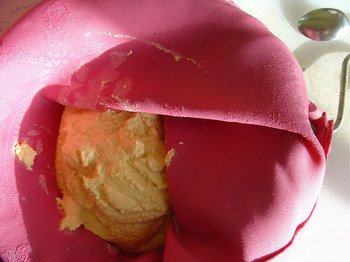

Please read more... "Keeping one's vows"
Posted by debra at 05:09 PM | Comments (3) | post to del.icio.us
Like raw beans in a hippy's beard
January 18, 2005
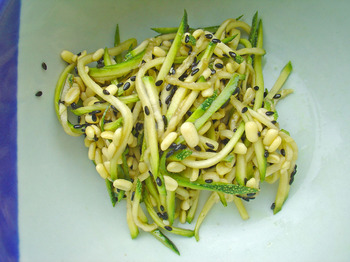
In less than 2 months I will be heading off to India again and as I prepare the Indian version of the Nomadic Banquet Workshop I find myself hunquering for Indian food. I'll be writing about the Nomadic Banquet in future culiblog entries.
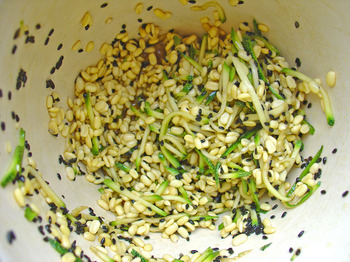
Hippy Beard is the nickname I gave to the Southern Indian (Karnatakan) mung dal salad that I adored in Bangalore and adapted to my own liking once back in the Heimatt. If you thought that nothing good could ever come from eating raw beans, you really need to try this simple recipe. The salad is very light and the good kind of crunchy with no negative... uh, aspects.
The cukes I replaced with zukes and unfortunately I had to omit the 'curry leaf' because I can't find it anywhere in Europe. It doesn't take a whole lot of imagination to figure out why I call this salad Hippy Beard and just like in a real hippy beard this salad keeps for a few days. I'll ask my buddy Zeenat Hassan (who is neither a hippy nor does she sport a beard) for the real name of this refreshing snack with the cheerful 'mouth-feel'. It was her menu choice for that fine afternoon in Bangalore... (recipe follows).
Please read more... "Like raw beans in a hippy's beard"
Posted by debra at 07:01 PM | Comments (3) | post to del.icio.us
Juicing, but not frothing, and you?
January 06, 2005
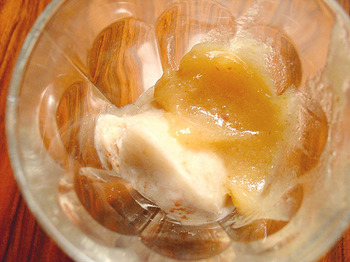
So far this juice fast has yielded quite a number of discoveries, the usefullness of oat milk being one of them. In my opinion grain and nut milks qualify for a juice fast because they are simply the wrung out water in which grain or nut meal has been soaking. These 'milks' don't give the gut flora anything more to do than a glass of apple juice does but they are useful in making things taste 'creamy'.
Other discoveries concern how to make 'comfort food' for the fast yet maintain its nutritional value. Roxanne Klein (and all raw foodies) feel that valuable enzymes in vegetables and fruits are destroyed when heated above 50°c. For this fast I've kept to this parameter while still being able to serve up some warm soup on these cold Occitanian days.
Here are a list of some of the liquids that my ruthless jury has deemed delicious enough to sip even when not on a juice fast: (This is not a menu.)
Cucumber Kiwi Juice
Kiwi Zucchini Juice
Pineapple Juice (fresh squeezed is entirely different from the storebought stuff)
Carrot Grapefruit Juice
Celery Juice
Avocado Zucchini Soup
Celeriac Oat Milk Soup
Green Curry and Carrot Soup
Broccoli Stalk, Zucchini Soup with Guacamole Dumplings
Red Pepper Tomoato Miso Flower Broth
Date and Pear Sorbet (pictured above)
Banana Chai Ice Cream (pictured above)
Pear Sorbet
The juicer that I am borrowing from Fred and Kristine for the duration of the fast is a real Cadillac (Magimix Le Duo). Only crit about this machine is that it doesn't produce foamy froth - like my Braun back in the Heimatt. I think that some of the recipes could be improved with new texture additions. At home I use the foam from the juicer.
Posted by debra at 10:46 PM | Comments (2) | post to del.icio.us
Milk tasting, and you?
January 05, 2005
As I said, not eating solid foods affords you a chance to try new things. Tonight we did a little experimental milk tasting. Because we're on a juice fast and generally behaving as self-righteously as we can we decided to bypass the locally produced cow, sheep and goat varieties and test the locally imported almond, rice and oat milks.
Oat milk was the clear winner in the category; Tastes Like Something I Might Drink Even When Debra Isn't Forcing Me.
Please read more... "Milk tasting, and you?"
Posted by debra at 10:19 PM | Comments (0) | post to del.icio.us
Juice fasting, and you?
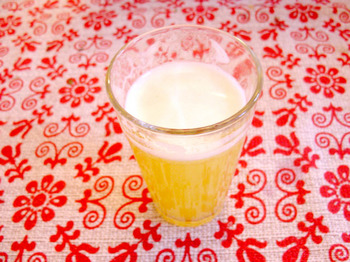
It may look like a *beer but it's just fresh-squeezed pineapple juice. We're fasting, remember?
After the holiday gorging, after the guests have gone, we decided that it was high time to do a little juice fast, just a short 3-day holiday gift to our gut flora for putting up with the over-indulgent behaviour of the past weeks.
I like to fast a few times a year and JT was curious about my assertion that fasting can be relatively painless. I will address some of the issues of juice fasting in the coming entries.
What I most enjoy about fasting is the opportunity it gives me to approach food in an entirely different manner. I use the juice fast to create new recipes and techniques for all things liquid.
And how is JT doing? Just fine. We just returned from a long walk along the river, through 17 farmers onion fields and vineyards, strutting over too low fences and broken stone walls up to and around LaRoque and back. JT will be glad to tell you that lunch was satisfying even if it was entirely brown (home-pressed juice from local apples and a bowl of miso soup).
* A Belgian Wit Bier
Posted by debra at 11:51 AM | Comments (0) | post to del.icio.us
Enough with the raw food already
January 03, 2005
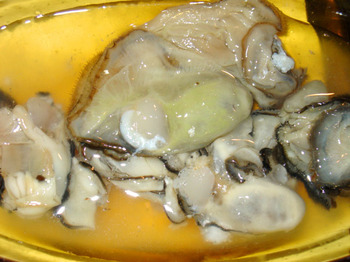
We just couldn't eat them all so they've been in the fridge in a wet tea towel since the 31st. I wouldn't have guessed that after so much time you could still eat them raw, although upon opening more than 2/3rds of them were perfectly delicious looking, smelling and tasting. Those deemed not perfect were only a bit dehydrated, not unlike ourselves after overdoing the champies.
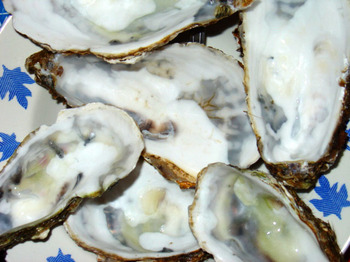
I decided to warm them in some melted butter, chopped garlic, rosemary sprig and bay laurel from le chateau.Gawd damn do I love oysters! It was J's first time on New Year's and we told him that eating an oyster is like biting into fresh and solid seawater. Now he sees oyster eating as a superior option to actually going swimming.
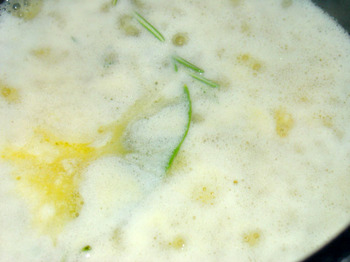
Oh and here's what else was going on... JT, Kristi, Fred, Kristine, un grand tour de leur chateau, aussi la Palmiére, la cascade, et toutes pour lui.
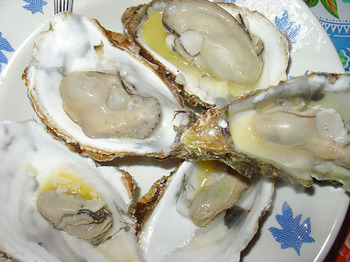
Please read more... "Enough with the raw food already"
Posted by debra at 05:10 PM | Comments (0) | post to del.icio.us
I want you raw (part 2)
January 01, 2005
In la douce France they eat oysters on New Year's Eve. Although in the past year we may occasionally have been known to bitch and moan about cultural convention, assimilation has never been so painless as it was tonight.
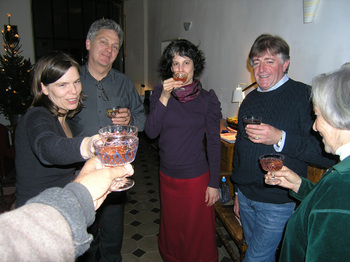
JT sniffs out some unsavoury goings on.
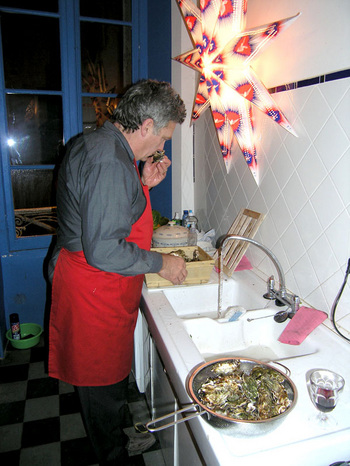
(Photos by Jogi Panghaal)
Posted by debra at 01:45 AM | Comments (0) | post to del.icio.us
Making Roti with Jogendra (play with your food)
December 31, 2004
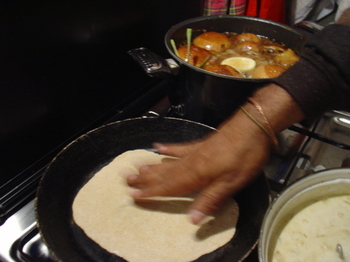
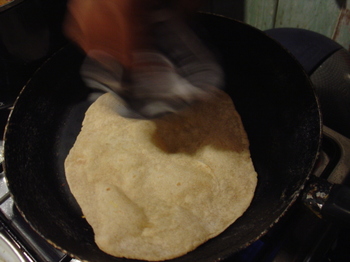
I have my way.
Jogi has his way.
But you can tell by his name that its his birthright to know how to make a better roti.
If you make the roti MY way they puff up like pillows. My way involves a lot of not doing anything and getting the heat right. (Plus you get to use up some of the chicken fat from your ever expanding chicken fat collection.)
If you make rotis Jogi's way, they also puff up like pillows, but you get to play with them constantly and tamp them down with a tea towel, in my opinion the last thing to do to make something puff up. I stand corrected.
Pictured below is another way to make roti in which you start out in the pan and then dump them right onto the flame. It was a regular Occitanian roti circus tonight.
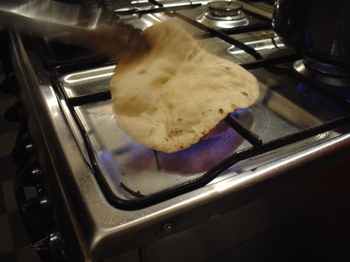
Posted by debra at 12:51 AM | Comments (2) | post to del.icio.us
The cost of taking it with a grain of salt and the 'L' word
December 23, 2004
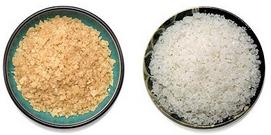
On a more serious note, let's talk about the cost of exporting salt - or any other gourmet food item...
My friend JT shuddered when I asked if I should extend the (relatively local) French salt collection I plan on giving his family with a package of rose coloured Himalayan salt. As with most export products the cost of transporting the goods is not fully reflected in the cost of the product itself. (See his blog here.)
Just like my Mom used to say, 'It's all about location. Location, location, location!' It ALMOST goes without saying that one can best buy locally and hope for nice xmas gifts from the Jewish houseguests.
Pictured above on the left is not a bowl of cornflakes but a bowl of very pretty New Zealand Flake Salt. Pictured on the right is the correct gift buy, the *local, the less well-travelled Fleur de sel de Guerande.
Mr. Bloch's Salt Archive the Motherload of salt information
US Saltworks gourmet salt guide - great salt images here.
* local for I me moi.
Posted by debra at 08:10 AM | post to del.icio.us
Next unto sallat she shall deliver forth all her fricassees...
December 09, 2004
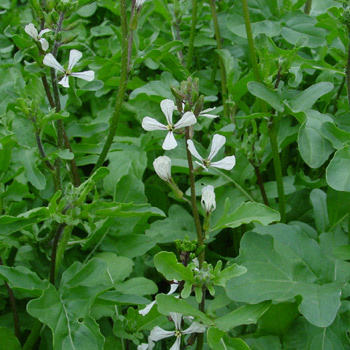
This leafy green quote comes from Gervase Markham's The English Housewife written in 1615 in a treatise about salads. These words are instructions describing the placement of dishes and the order of courses, starting with light leafy green salads and moving through salads with boiled and pickled vegetables. I have gleaned this tidbit from Cathy K. Kaufman's article on 17th century salads on the Culinary Historians of New York website.
Take the buds of al kind of good Hearbes and a hanfull of French capers, seven or eight Dates cut in long slices, a hanfull of Raisins of the Sun,...
Please read more... "Next unto sallat she shall deliver forth all her fricassees..."
Posted by debra at 07:11 PM | Comments (0) | post to del.icio.us
Adam is the genuine article...
November 23, 2004

The very attentive Adam Kuban raced over on his, his, (whatever sort of motorcycle he's riding) to assure me that his weblog Slice is purely about offering the best possible pizza fieldguide and not about I-Pod applications, 'not that there's anything wrong with that...'
One lengthy browsie-browse later and I can't argue with him. Kuban has done his homework, meticulously logging it all onto his I-Pod (and generously sharing it with the world). I'd trust him to find me a slice. Take a peak at Slice or read an interview from the Gothamist about Adam. I have other questions that I prefer to ask in private first. ; )
Posted by debra at 12:10 AM | Comments (3) | post to del.icio.us
Aunti-Cakes, Anti-Cakes
November 15, 2004
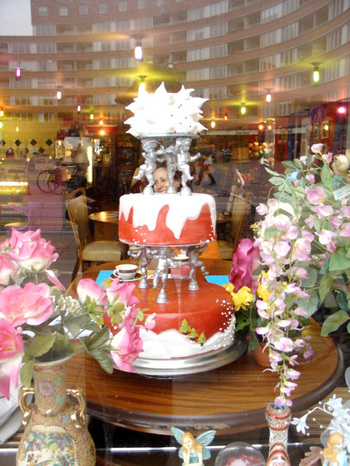
Gawd they're pretty, these (fake) cakes from de Taart van mijn Tante (My Auntie's Cake/Recipe) displayed in the tea room of the patisserie on the Ferdinand Bolstraat in Amsterdam. My aunties, fabulous cooks and bakers though they are, wouldn't dream of baking such cakes, too much White Death (sugar). My aunties' cakes are more likely to be made with persimmons (kaki fruit). Homegrown persimmons.
Posted by debra at 11:01 AM | Comments (0) | post to del.icio.us
Halalchisch
November 06, 2004

What's wrong with this image?
Posted by debra at 07:52 PM | Comments (2) | post to del.icio.us
Hash Shakes are sooooooooo passée
November 05, 2004

Well, what were You eating one and a half years ago?
Bhang Shake (serves 3)
Aditya and Arjun (not their real names) dosed me with the vivid high of this sublime hash milkshake one and a half year's ago.
What were we THINKING!!!
Please read more... "Hash Shakes are sooooooooo passée"
Posted by debra at 08:58 PM | Comments (7) | post to del.icio.us
Poppyseed Mustard
October 26, 2004
It tastes just like it looks, dark and musty. Even though I mixed this batch with a roasted garlic clove I still think it would taste great with chocolate! Poppyseed 'mustard' makes me long for strudel and as soon as I am done with this juice fast I'll develop a savoury strudel with poppy seeds and mushrooms.
Posted by debra at 10:46 PM | Comments (4) | post to del.icio.us
Learning through your Ass: The Return of Laurel's Kitchen
October 08, 2004

When I became a vegetarian at the tender age of 13, my parents, fearing that I would stunt my own growth gave me what was considered at the time to be a good introduction to vegetarian nutrition, amino acid chains and global food politics. It was my first cookbook ever and its pictureless recipes for soy-milk, cashew cheese and other 'technically advanced' foodstuffs threw me completely for a loop.
It was California in the 70's but my Mom wasn't about to go foodshopping in a store filled with goat-knitting long-hairs smelling like garbanzo farts, and I didn't know that you could simply go to an Asian supermarket and BUY a ready-made block of tempeh. So when one of Laurel's recipes called for say, soy milk and said, (see recipe page 138) I would actually make the soy milk - often with unsavoury results.
Due to a series of 'intrusive kitchen disasters' my mother decided that I could only do the big preparations for the week's food on Sunday. (Not the fresh things, just the... legume-rich things.) Considering that I had turned the family kitchen into a soybean laboratory it wasn't entirely the cruel thing to do. I would prepare my vegetarian food for the week ahead and microwave it warm each day. For an experienced cook, preparing food in advance wouldn't have posed much of a problem but I had very little PRACTICAL cooking experience. I couldn't tell beforehand if a recipe was difficult and mistakes I made on Sunday were the grits on the table the livelong week. This educational technique is known in some cultures as 'learning through your ass'.
I was cooking outside the repetoire of my family and Laurel wasn't helping. Laurel's Kitchen, although an amazing source of 1970's California anthropology was absolutely a crap book for an inexperienced cook.
But yesterday when I brought home Roxanne Klein and Charlie Trotter's R A W, the first thing I did was pull Laurel from my shelf for one more read.
Please read more... "Learning through your Ass: The Return of Laurel's Kitchen"
Posted by debra at 01:09 AM | Comments (7) | post to del.icio.us
Ik lust je R A W
October 07, 2004
Wing flapping all around! Today I indulged myself and bought a cookbook that I have wanted to own for quite some time. R A W by Roxanne Klein (a culinary approach to vegan and raw food cooking) with Charlie Trotter, one of the US's most innovative chefs. Regular readers know that porkatarians like me can't also be vegans but I am still so very excited by this pairing of the minds.
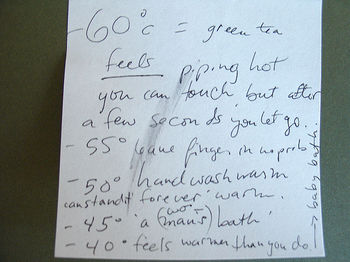
A browsiebrowse through and so far there are lots of recipes that look like watermelon spit-up (maybe she took Trotter's 'froth thing' a little bit too literally) and I think that bit about preserving the enzymes is a load of halookie. If you put a blended something in a dehydrator for 5 hrs I doubt very seriously that there will be any 'living' quality left in the foodstuff. TEST: Put yourself in a sauna for 5 hrs and see how you feel. Now imagine yourself to be a carrot!
B U T
The book is brimming with beauty, love of a rich variety of ingredients and new techniques (new since *Laurel's Kitchen) and I swear I'm going to take cashew cheese seriously this time.
* You're going to have to wait until tomorrow's entry about Laurel's Kitchen, written in 1976 it was THE quintessential bible of Californian hardcore vegetarianism.
Posted by debra at 05:52 PM | Comments (2) | post to del.icio.us
Possible Epiphany
October 05, 2004
She's going to try one of my recipes. And I'm scared.
What if she doesn't understand and makes a dog's breakfast of the thing. She might stop trying my recipes forever.
Although I have cooked since I was a child, I am new at writing recipes for other people. I am new at explaining cooking to people that have a different experience level or culinary background than I. What if I use too few words? Too many words are confusing. I don't know if someone will understand, 'the shoulders of the cabbage', or not. I want to convey my enthusiasm for cooking but I know that folks that don't make a sport of expanding their cooking repetoire also don't have the sticktoitiveness of someone who does. (stick-to-it-ive-ness - it's a real word).
I was thinking about this this morning, when she told me she had bought some ingredients to try the chalupsies when I realised, most cooking is taught by example. Most often you have seen and tasted the dish before you try to make it. You have watched it being prepared, seen the in-between stages. You build upon the techniques you learned at home when you try to copy something you have eaten in a restaurant or when you follow a recipe.
I learned how to cook because my father, who loves cooking, fried omelets every Saturday morning using daring combinations of food. My Aunties and Grams used to 'practically' compete with one another to see who could make the most delicious, most beautiful dinners. My Mom, a self-admitted non-cook, learned how to make her excellent tomato sauce based dishes from my Dad's friend Campinella.
Reading a recipe, even with explicit imagery will not bring ease into the kitchen. Ease comes from practice, ease comes from enjoying every moment of touching, smelling and looking at the marvels of the food. Ease comes when folks hang out in the kitchen and start 'yakkin' (that has nothing to do with yaks or the 'Y' word). Like with anything, ease comes when you make 'it' your own.
Posted by debra at 10:11 AM | Comments (3) | post to del.icio.us
Changes
October 04, 2004
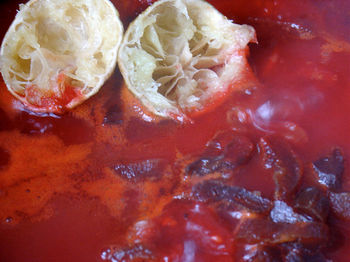
This recipe for Chalupsie has been hybridised to the hilt. Pronounce it however you like, it's just Stuffed Cabbage or Chou Farci and up here in the Polar Circle we need hearty winter fare like this.
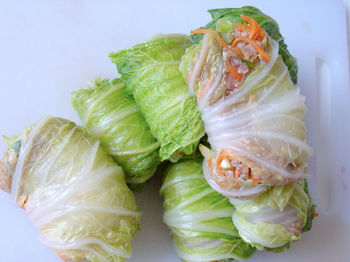
C H A N G E S :
It was my Gramma's recipe from the 'old country', from HER mother, but Grams used minutemaid frozen lemon juice concentrate ? something the 'old country' never had. I dropped 'that ingredient' like a load of so much cement over Tchernobyl and replaced it with a spoonful of thai green curry paste plus every single part of a fresh lime.
Some other changes that I have made include fractalising the prep time from 2hrs to 20 minutes. Now instead of reminiscing about chalupsies we can actually eat them. I also replaced the old country hamburger helper and changed the kind of cabbage to one that can be denuded of its leaves in one fell swoop.
Posted by debra at 11:15 AM | Comments (6) | post to del.icio.us
Let me bore you with: Culture Shock
September 25, 2004
Where was it that I read that 'inordinant attention to bodily functions and diet is one of the symptoms of culture shock'? Certainly this is not the only symptom, and certainly this inordinant attention isn't always a symptom of anything in particular BUT, since I started working on the Ladies Gourmet Cycling piece in 2003 I am obsessed with the glycemic index and glycemic load of foods. Here is the list that hangs from my refridgerator right under my kilometer buildup schedule. (I've stopped cycling and started running until Spring of 2005 in order to develop a different relationship to the Dutch weather. Funny how running in the rain is a pleasure and riding in the rain is a hell.)
This list has been hacked from somewhere on the web and suffices for now but it unfortunately does not contain entries for nuts and seeds or leafy greens. This could mean that either these items have both indexes and loads so low that they are deemed unsuitable for this list or because they aren't really considered 'common' foods. Hm...
Posted by debra at 11:32 AM | Comments (0) | post to del.icio.us
Let me bore you with: Culture Shock
Where was it that I read that 'inordinant attention to bodily functions and diet is one of the symptoms of culture shock'? Certainly this is not the only symptom, and certainly this inordinant attention isn't always a symptom of anything in particular BUT, since I started working on the Ladies Gourmet Cycling piece in 2003 I am obsessed with the glycemic index and glycemic load of foods. Here is the list that hangs from my refridgerator right under my kilometer buildup schedule. (I've stopped cycling and started running until Spring of 2005 in order to develop a different relationship to the Dutch weather. Funny how running in the rain is a pleasure and riding in the rain is a hell.)
This list has been hacked from somewhere on the web and suffices for now but it unfortunately does not contain entries for nuts and seeds or leafy greens. This could mean that either these items have both indexes and loads so low that they are deemed unsuitable for this list or because they aren't really considered 'common' foods. Hm...
Posted by debra at 11:32 AM | Comments (0) | post to del.icio.us
Glycemic Index, Glycemic Load
September 23, 2004
Okay Freaks, here is a great article about the definition of Glycemic Index and Glycemic load. Don't mind the fact that you have to go to a diabetes website to read about it. Diabetics, folks with hypoglycemia and athletes need to be experts on glycemic indexes and loads.
http://diabetes.about.com/library/mendosagi/ngilists.htm.
See also:
http://www.glycemicfoodlist.com/#G_Load
Posted by debra at 02:00 PM | Comments (0) | post to del.icio.us
Glycemic Index, Glycemic Load
Okay Freaks, here is a great article about the definition of Glycemic Index and Glycemic load. Don't mind the fact that you have to go to a diabetes website to read about it. Diabetics, folks with hypoglycemia and athletes need to be experts on glycemic indexes and loads.
http://diabetes.about.com/library/mendosagi/ngilists.htm.
See also:
http://www.glycemicfoodlist.com/#G_Load
Posted by debra at 02:00 PM | Comments (0) | post to del.icio.us
Eat off the floor? Get the facts...
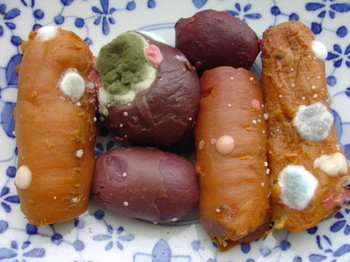
In Amsterdam if I drop food when I'm cooking I always just pick it up and pop it into my mouth. I eat off my floor - sometimes days after the 'fall'. And what you may ask are my criteria for scrapping or scarfing? With me it depends on whether the food was initially wet or dry. (See semi-unrelated picture above of some mould I grew in 3 weeks time on some wet food.) Foods that become wetter as they get older I tend to scrap. Yesterday I found some old almonds lying quite dryly on the floor of my bedroom. I picked 'em up and scarfed 'em right down in one clean hand motion.
Readymade Mag's Eat off the floor
In this old ReadyMade Mag issue there is a funny article about eating off the floor and whether it is unclean. If you have kids you probably have heard of the 5 second rule, 'don't anything that has been on the floor for more than 5 seconds.'
I always thought of this as the 15 second rule. Oops.
There was a Dutch telev�e ad in which one sees a woman bringing her clothes to the cleaners. With some difficulty she peels a piece of salt licorice (type muntje) out of a dirty jeans pocket and tosses it into her mouth. This much to the disgust of the guy behind the counter. It was a licorice ad. What would I have done? Oh, definitely scarf.
Posted by debra at 12:08 PM | Comments (0) | post to del.icio.us
Harvest begins and Summer leaves off
August 31, 2004
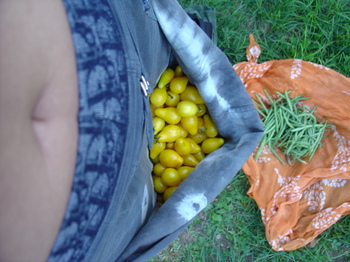
At Fred and Kristine's the tomato harvest is in full-swing. This is my adhoc collection of pear tomatoes, the beans are at my feet. They planted 19 other sorts of heirloom varieties but old-fashioned girl that I am, I just prefer the cherry tomatoes. This is evidenced by that fact that I don't appear to have any in my skirt. I have eaten every last one of them.
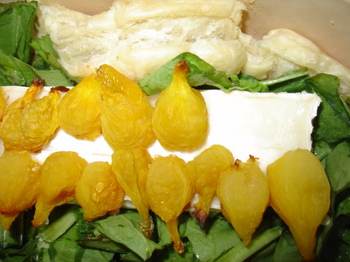
Earlier that day I had packed my yurt up for the winter and my upperbody ached from lifting yak felt. I was too tired to do any innovative cooking that night.
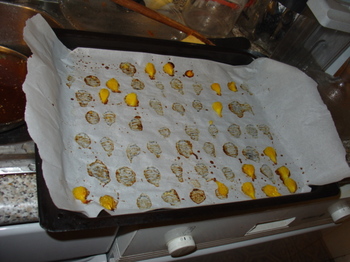
Posted by debra at 12:16 AM | post to del.icio.us
Leafy Greens
August 16, 2004
Up here at the Chateau there is no shortage of appreciation for leafy greens. Tonight we eat our salad with rapt attention as Kristine sings the praises of yesterday's salad, plucked by a visiting chef. Claire and Valerie recount that their Grandmere not only goes mushroom hunting but salad green hunting in the mountains. They tell us that they have eaten salads of wild greens plucked from the environs with more than 20 species of leaf.
We sprinkle a very subtle vinaigrette onto Fred and Kristine's homegrown leaves, some bitter, some succulent, some meaty. I eat each besprinkled leaf with my fingers. It is ten o'clock at night and the skies have just opened up their guts. We eat the salad together in contented silence, the 5 us, as a precious dessert under an umbrella'd table in the rain.
Posted by debra at 11:56 AM | post to del.icio.us
Aligot
July 22, 2004
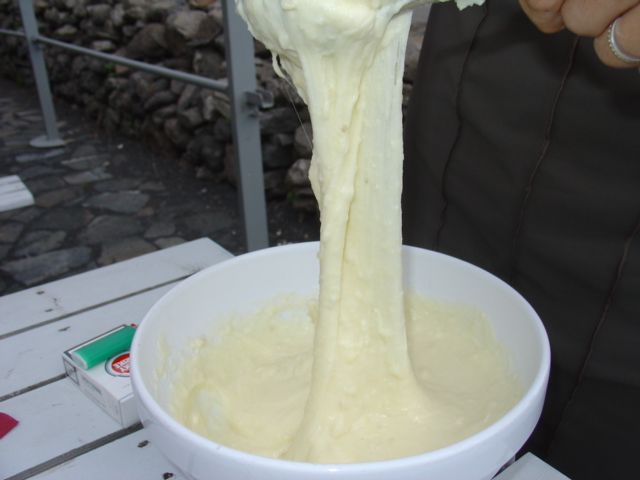
Aligot is melted Aubrac cheese, chunky mashed potatoes, and coarsely chopped garlic stirred and stirred and stirred in a special p�t d'Aligot until it gets nice and stringy.
Posted by debra at 09:24 AM | Comments (1) | post to del.icio.us
No Rest for the Rugged
July 13, 2004
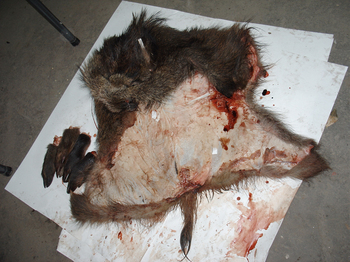
There you are, a pre Iron Age chef and you want to whip up a fine bouillon for tonight's f�ete. It's easy as pie... read on.
Please read more... "No Rest for the Rugged"
Posted by debra at 10:42 AM | Comments (0) | post to del.icio.us
If it Bleeds, it Leads
July 12, 2004
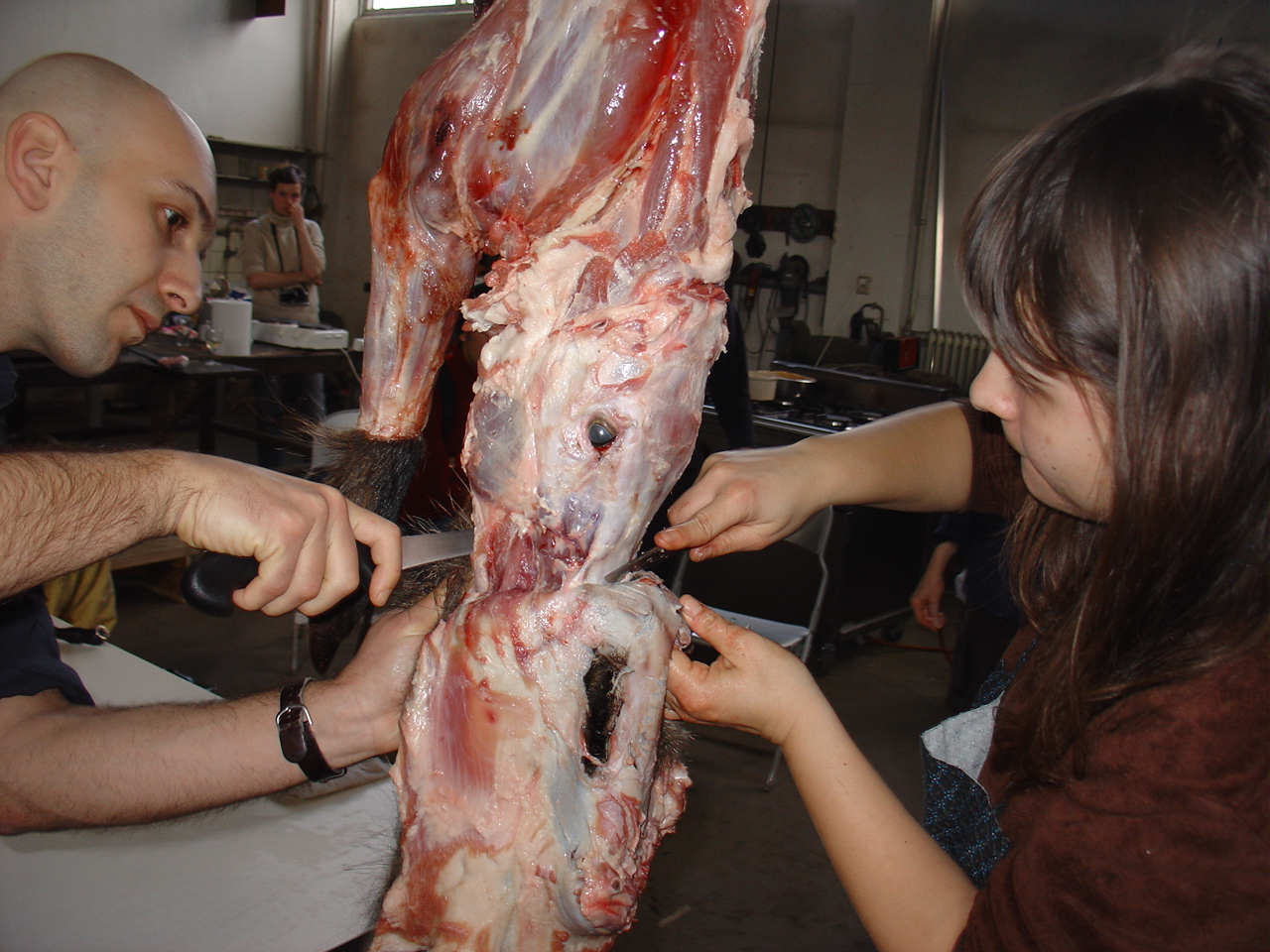
That's was one of the more memorable lines in Michael Moore's, 'Bowling for Columbine'. Moore is speaking to a TV producer, asking him to explain why there are so many fear evoking images on the US nightly news. The TV producer replies self-evidently, 'If it bleeds, it leads'.
I thought the line was a fitting title to the next few entries of Culiblog in which I will document a workshop that I followed at the Jan van Eyck Academie in Maastricht this last February. Onno Faller led a workshop titled, 'Cooking as Genre' the last two days of which were devoted to a little dead wild boar. Above you see Natasha and a handsome bald bloke, BOTH VEGETARIANS, skinning the poor dead beast.
Although I have killed hundreds of animals for food and skinned them and prepared them, I never find this an easy task. I find myself gritting my teeth as I remove their jackets. I am not repulsed, but I feel sad for the animal, I feel the extreme tension of the killing and of a death that I initiated by wanting to eat the animal. Every animal, even a lobster, fights for its life as we would do. And it never ceases to amaze me that once the animal is skinned, it becomes just a piece of meat to me and my mind switches to the matter of the marinade.
Please read more... "If it Bleeds, it Leads"
Posted by debra at 01:28 PM | Comments (4) | post to del.icio.us
Hangover Helper
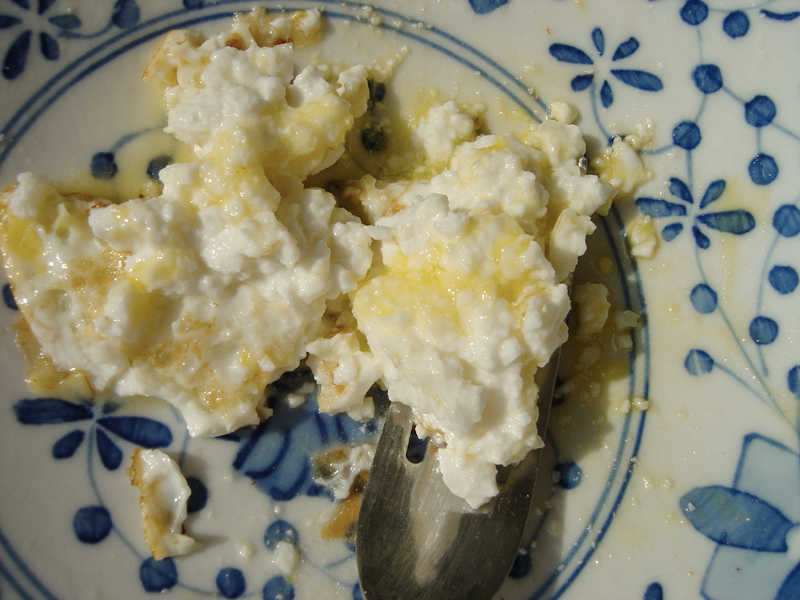
We only wanted to go dancing.
And of course pollute ourselves and then sweat it out on a dancefloor in a very slutty way. We wanted to smoke and breathe deeply, to sweat. The goddess of Shake Yer Bootie unfortunately had other designs for the evening and our simple plan fell through. You can't dance just anywhere. Sometimes that special sleazy ambience is essential to the formula. In the 'consolation bar' we sat to drink one more 'last one'. Above my head hung fake old-fashioned enamel advertisements for Guiness stout that asserted, 'Guiness gives strength'. Vitamine B complex, iron, excellent. I guess the moral of the story is that a person just doesn't always need a whole hell of a lot of strength. This morning I was waxing existential when I remembered, 'BREAKFAST!' And I remembered it twice. This is my second breakfast.
Fried eggs with 'cheese in a can', the Turkish sheep cheese rounds in brine sold in cans here. Salty, crumbly, meltable, beautiful to the beholder, delicious. Thank Gawd for breakfast.
Posted by debra at 12:57 PM | Comments (2) | post to del.icio.us
Tonijn voor het Publieke Domein
June 25, 2004
That's Dutch for Tunafish Salad for the Public Domain, the title of the bad weather picnic that I designed (and produced with the generous help of Tracey Prehay and Anne Schiffer) for the opening of my student's exhibition at the Balengebouw in Roombeek (Enschede). (Website is forthcoming!)
tunafish sandwich (broodje tonijn voor het publieke domein)
baggie of pickles (zakje zuur - pickles, zilver uitjes)
baggie of sweeties (zakje zoet - bitter koekjes, nep ouderwetse drop)
peach (perzik)
water
Please read more... "Tonijn voor het Publieke Domein"
Posted by debra at 11:48 PM | Comments (2) | post to del.icio.us
Moralist hangups
June 20, 2004
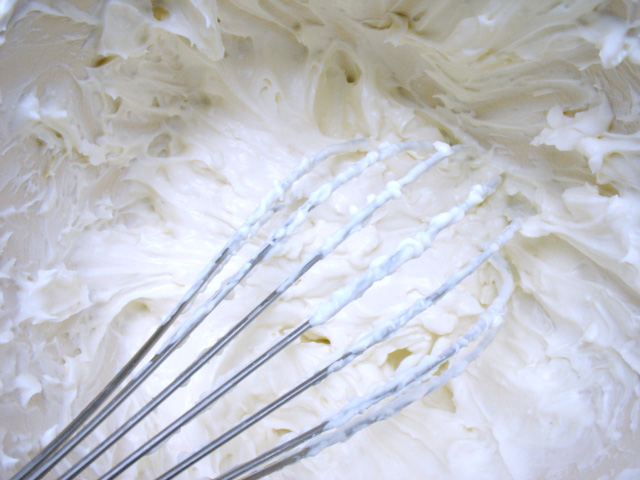
It's a day for raucous rejoicing when an immigrant to the Netherlands can help the natives remember their culinary traditions. Hangop is a Dutch summer dessert. It is simply yoghurt hung up in a wet tea towel until all of the whey has drained out of it, thickening the yoghurt in the process.
'Why drain yoghurt yourself?' you may ask. Indeed, why hang up yoghurt when we can now buy perfectly delicious, hyper-thick and fatty yoghurt at Turkish shops. The Turkish version even comes in a handy tub that when recycled works brilliantly as vernacular tupperware.
The reason you should drain your own yoghurt is that this process is beautiful to behold and it yields a urine coloured water called 'whey'. Drink whey as a thirst quencher. Served ice-cold, there is no subsititute for piercing through the thick wall of mucous produced by an 80 kilometer cycling adventure than a good glass of whey.
Please read more... "Moralist hangups"
Posted by debra at 04:35 PM | Comments (3) | post to del.icio.us
Comfort Food
June 12, 2004
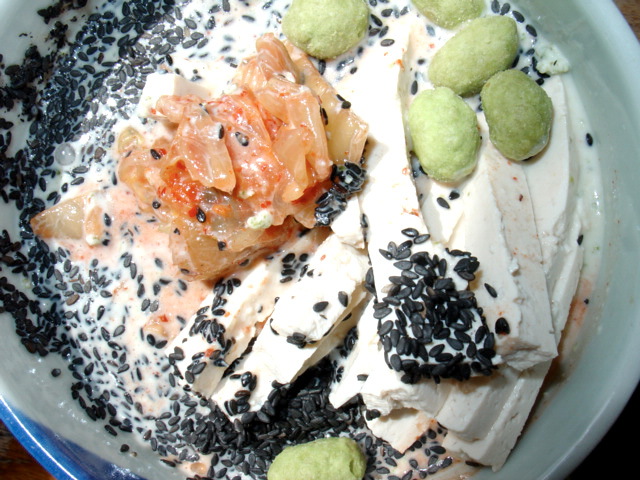
Since I was 14 I've been a huge fan of kimchi (korean pickled cabbage). And lately not a day goes by when I don't eat it. And lately I eat it with noodle-cut tofu, 'white cheese soup', black sesame seeds and wasabi peanuts.
I love the way the different textures of cabbage and daikon radish feel on my tongue, the prickling of the ferment, the mild, soothing tofu, the crunchy sesame seeds and the pungency of the wasabi peanuts. A pool of 'white cheese soup' (recipe follows) with spring onion provides contrast to the kimchi, balancing the flavours.
- fresh bubbling kimchi
- fresh raw tofu cut into 'noodles'
- a white cheese soup (recipe follows)
- sprinkling of black sesame seeds and wasabi peanuts
Please read more... "Comfort Food"
Posted by debra at 04:11 PM | post to del.icio.us
Comfort Food
Since I was 14 I've been a huge fan of kimchi (korean pickled cabbage). And lately not a day goes by when I don't eat it. And lately I eat it with noodle-cut tofu, 'white cheese soup', black sesame seeds and wasabi peanuts.
I love the way the different textures of cabbage and daikon radish feel on my tongue, the prickling of the ferment, the mild, soothing tofu, the crunchy sesame seeds and the pungency of the wasabi peanuts. A pool of 'white cheese soup' (recipe follows) with spring onion provides contrast to the kimchi, balancing the flavours.
- fresh bubbling kimchi
- fresh raw tofu cut into 'noodles'
- a white cheese soup (recipe follows)
- sprinkling of black sesame seeds and wasabi peanuts
Please read more... "Comfort Food"
Posted by debra at 04:11 PM | post to del.icio.us
Eat Yer Snakes
May 08, 2004
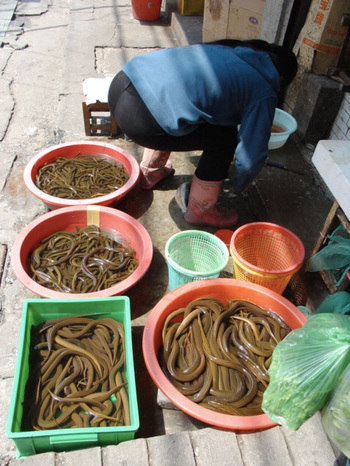
"Well because my Auntie was a Mormon missionary and she was actually E A T E N A L I V E by snakes. Ever since then I haven't had much appetite for snakes. "
"Nope, not even if they're skewered."
technorati tags: China, Nanjing, snakes, outdoor market
Posted by debra at 04:48 PM | post to del.icio.us
Don't Spit Everywhere
May 01, 2004

No one seemed to be paying a whole lot of attention to these wonderful posters.
Please read more... "Don't Spit Everywhere"
Posted by debra at 01:32 PM | post to del.icio.us
A Single Grain of Rice
April 25, 2004

Yi Li Mi = A Single Grain of Rice in mandarin neon. A Single Grain of Rice is a project for a culinarily oriented fasting restaurant that I am initiating. Future entries in 2006 will explain this project in greater depth, but at least I've got the neon sign.
technorati tags: fasting, China, neon
Posted by debra at 12:49 PM | Comments (1) | post to del.icio.us
Water distribution by bike
April 24, 2004
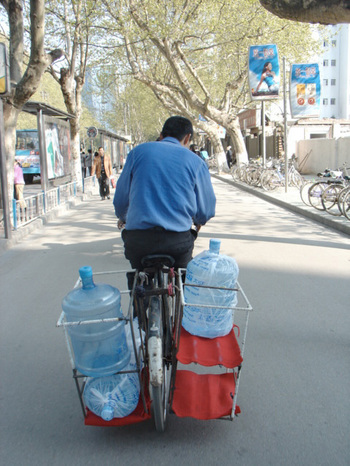
2L PP PD = Two litres per person per day.
No gettin' around that.
Now get it out there.
Posted by debra at 06:09 PM | post to del.icio.us
Attempt # 2 at Acquiring a Taste for Stinky Tofu
April 08, 2004
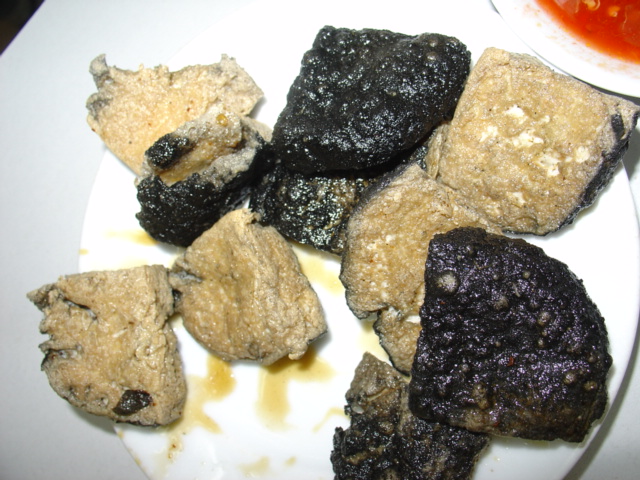
I like the i d e a of stinky tofu but I haven't yet acquired a taste for it. The version depicted above is fried. I thought this would diminish the aroma reminiscent of human excrement that this foodstuff can't help but exude. Sadly the frying seems to have had no affect upon the smell of stinky tofu. It's a pity that I can't yet upload an ODOR.
Posted by debra at 11:05 AM | post to del.icio.us
Eaten Alive
April 04, 2004
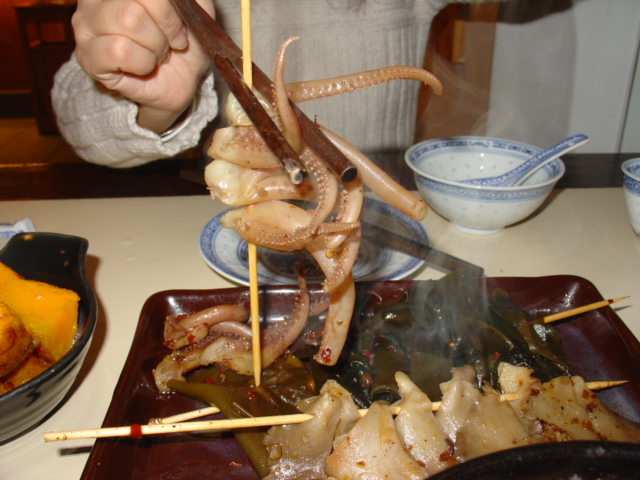
"Well you see, my maternal grandfather was a merchant marine and he was actually EATEN ALIVE one day by an octopus and ever since that day I just can't eat octopus anymore..."
"No, not even if its dead and skewered."
Posted by debra at 10:37 AM | post to del.icio.us
Feeding the Animals
April 02, 2004
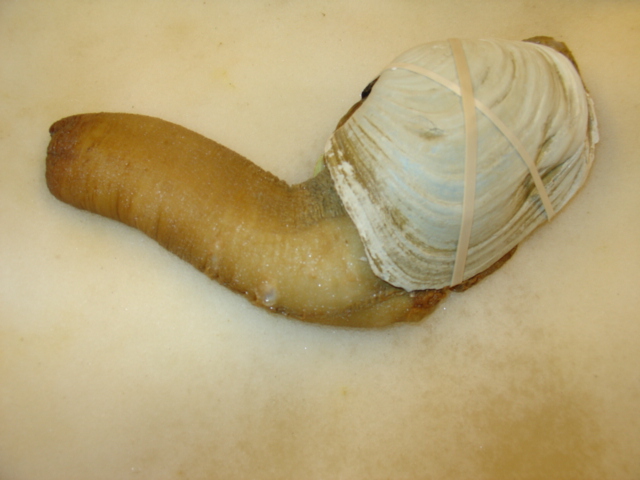
A shellfish as large as your arm. That's good eatin'.
Posted by debra at 10:17 AM | post to del.icio.us
Attempt #1: Learning to Love Stinky Tofu
March 27, 2004
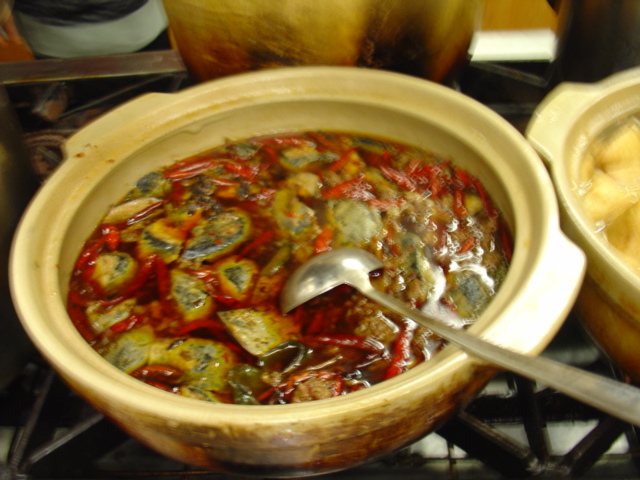
The Chinese call it 'Stinky Tofu'. And they're not lying. It's aged tofu that many a left coast university student has inadvertently made by just leaving the tofu to its own devices.
Eating Stinky Tofu requires acquiring an acquired taste. Every image of this food in my Chinese Food point-it will represent an attempt to acquire a love for this dish.
Please read more... "Attempt #1: Learning to Love Stinky Tofu"
Posted by debra at 08:27 AM | post to del.icio.us
Duck Entier en plastique
March 25, 2004
Duck under plastic wrap at a food-court style restaurant in Nanjing, PRC
Posted by debra at 08:12 AM | post to del.icio.us
Juice fasting, Soup fasting
March 20, 2004
In preparation of my trip to PRChina I am fasting this week. Liquids only� primarily fruit and vegetable juices, but also broths and froths. It is exciting to present myself with the opportunity of creating new juice and soup recipes as well doing a survey on rice, soy, and barley 'milks'. I had never fasted during the winter and this gives me the opportunity to focus on developing satisfying and warming liquid foods of culinary interest.
Enoki mushroom and roasted garlic broth:
Please read more... "Juice fasting, Soup fasting"
Posted by debra at 10:32 PM | post to del.icio.us


