CPULs
when bad acronyms
happen to good people
June 09, 2006
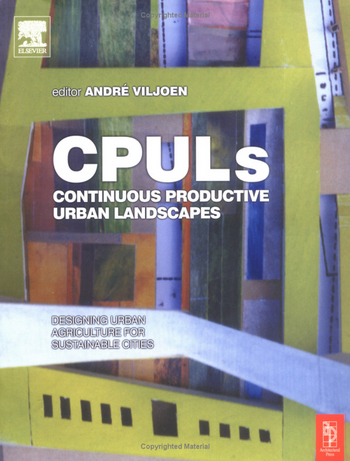
It's pronounced 'SEE, PULSE' and stands for Continous Productive Urban Landscapes. Architects Viljoen, Bohn and Howe's postively radical notion of combining productive urban landscapes with continuous landscapes, proposes a new urban design strategy that would change the appearance of contemporary cities towards an unprecedented naturalism. Think urban agriculture, allotment gardens, increased biodiversity, decreased carbon emissions and strategically connected green space - and you will start to get an idea of what the authors are suggesting. Although this is in no way within the scope of the book, never have I encountered a more holistic approach to urban planning that so thoroughly takes into account our imminent plunge into energy descent and the extreme effect that this will have on our food supply.
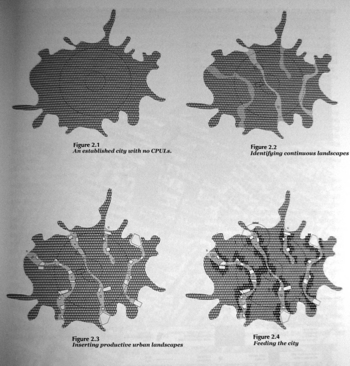
Diagrams showing a projected development of CPULs © Bohn & Viljoen Architects, reformatted for culiblog and used entirely without permission
Despite sporting a singularly unsexy title and a graphic design utterly devoid of charm, CPULs is a compelling vision for urban planners and (landscape) architects. The book is loaded with truly useful facts and case studies yet somehow remains a rivetting read for layfolk, comme moi. The authors were wise enough to begin the book with a succinct glossary defining all of the concepts so that within five pages you're already an adept at juggling terminology like vertical and horizontal intensification and you know the difference between an organiponico and a heurto intensivo.
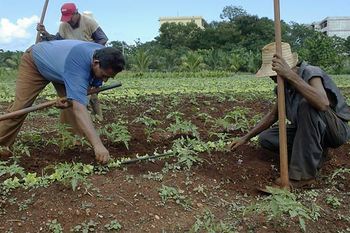
According to people who are in a position to compare, CPULs offers a rich documentation of UK allotment history and vivid reports of successful urban agriculture in contemporary Cuba, one of the few countries to have yet experienced peak oil. In 1990 when Cuba stopped receiving cheap juice from the Mothership and subsequently lost its largest client for agricultural produce, Havana citizens suddenly found themselves without access to sufficient food as expressed in 30% fewer calories in their diet! Instead of engaging in some futile rioting, they took up gardening en masse, and by gardening, I mean organic gardening. Later the government jumped on the bandwagon and started facilitating the urban agricultural effort in the form of responsible planning and infrastructure development. Presently Cuba is considered to be a living laboratory of how small urban farms and gardening collectives can successfully provide a significant portion of the urban food supply in spite of energy descent. Listen up, everybody! The CPULs authors were enlightened enough to note that a population accustomed to collectivism is more likely to be successful at community projects and that Northern European urban agricultural initiatives of the future will need to develop a native form to ensure their success.
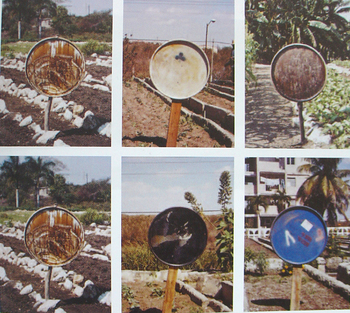
Oil drum lids used as markers in Havana organiponicos. Photos by Tom Phillips from CPULs used entirely without permission
CPULs' authors articulate the benefits and obstacles to their proposal and offer cogent strategies for creating city land use policy in which urban green and brown are treated as productive space, considering the unbuilt as an event of equal intensity as the built. A vision of a thriving CPULs in London 2045 provides a powerful scenario that I can imagine myself being a part of at any stage in my life. This is something I would not characterise as a common feature in most urban planning. In CPULs city planning the well-being of people is a central and distinguishing factor. In fact, its completely seductive.
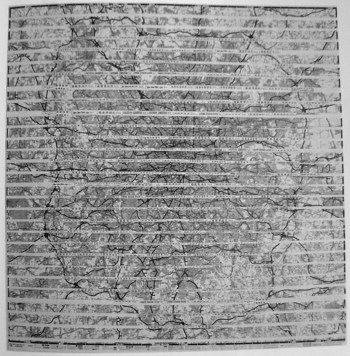
A map of London expanded to accomodate mini- and SUPER-market gardens, from a 1998 study © Viljoen and Bohn Architects, photographed from the book and used entirely without permission
Robert Hopkins from Transition Culture weblog notes, 'It is only in the last 30 or so years that we have perfected the art of creating totally useless landscapes. New industrial estates and business parks typify this, planted with 'low maintenance' shrubs, specifically bred to be entirely unproductive.' Bohn and Viljoen point out that though European cities have planned for a variety of approaches to open space including urban parks, urban river fronts, urban squares, urban stages, urban forests and urban beaches, there are as yet no urban fields. 'Living and growing food in the contemporary urban space, CPULs could formally be similar to urban parks.' I am inspired by the notion that landscape architecture could be pivotal in designing for a future in which peak oil will have tremendous impact on the urban food supply.
As someone who writes about food and culture and as an an art and design educator, I cannot recommend this book highly enough. I hope that its concepts are embraced by those who are in a position to implement urban planning of this nature. The notion of CPULS deserves to feature prominently in design and architecture curricula, informing a new generation of people designing our cities and potentially our well-being through our access to healthy food.
CPULs do not yet exist.
In type, they will be new,
in type they will be productive.
See, pulse, with a silent meow at the end.
- Continuous Productive Urban Landscapes. Designing Urban Agriculture for Sustainable Cities. Andre Viljoen (ed) 2005. Architectural Press
- Biography of Andre Viljoen at the Royal Institute of British Architects website
- Robert Hopkins' brilliant Transition Culture review of CPULs. The review also questions why Viljoen doesn't use the term permaculture when the ideas in this book are so clearly informed by it. Hopkins points out that THIS book is exactly where permaculture needs to be. Although CPULs author Graeme Sherriff addresses permaculture rather thoroughly in Chapter 22 (Permaculture and Prodcutive Urban Landscapes) I can imagine that editor Viljoen felt a need for a new definition (and therefore produced that unfortunate acronym) because the notion of permaculture does not specifically address urban planning and land use policy.
- Permaculture according to Wikipedia
- Permaculture according to CPULs authors - quoting Robert Hopkins!: 'Permaculture has evolved into a system for the conscious design of sustainable productive systems which integrate housing, people, plants, energy and water with sustainable financial and political structures.' (Robert Hopkins, 2000, p.203)
- CPULs according to wikipedia. Oh how odd, there is as of yet no entry.
- Energy descent
- James Howard Kunstler, author of the Long Emergency
- Eat the suburbs - an Energy Descent Primer
- Some of the more positive aspects of peak oil:
Healthier food
More active lifestyles
Greater self-reliance
A sense of connection to place and products
The re-emergence of local identity
An emphasis on quality over quantity
A means of overcoming addictive behaviours such as over-consumption - Permaculture Activist, the magazine - excellent read!
- Energy Descent Primer
- An MP3 of permaculture 'proponent' David Holmgren lecturing on permaculture and peak oil
- Robert Newman's History of Oil (stand-up comedy) on Google Video. Hilarious and not-so-hilarious at the same time.
Posted by debra at 01:51 PM | post to del.icio.us
Anorexia, art,
war, rant
April 17, 2006
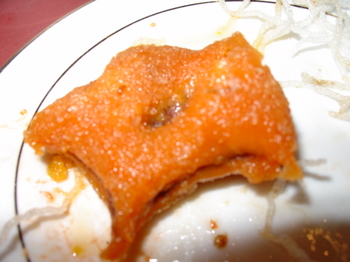
The pumpkin dumpling that I just couldn't finish.
A little less than a year ago I wrote an entry about SehnSucht, a restaurant for anorexics in Berlin that had opened up sometime in January 2005. Because I didn't have a picture of the restaurant, and because I hadn't visited it (and to this day can only get a robot on the phone), I did the logical thing and accompanied my entry with a blurry image of a greasy half-eaten pumpkin dumpling.
The dumpling image was a huge hit if i can believe my site meter referrals. And until last month, dumplin' was smack in the middle of a Google Images page for the search-string anorexics. Folks were clicking on the dumpling, and so doing finding culiblog, proving that it's not only horny old fat men that scour the anorexia sites for skeletal supermodels and thinspiration. Actual 'Anas' and 'Mias' were haulin' their boney tuchas over to culiblog to get a gander at the food porn.
Well this one's for you, Ladies!

LA Raeven at the Mediamatic War Salon, photo by Bea Correa, courtesy of Mediamatic
LA Raeven is the artist name for twins Liesbeth and Angelique Raeven, whose very subject matter is themselves. Their video installation work and performances are about the female body image and the behaviour dynamics of twins, especially when this dynamic expresses itself in psychologically nuanced eating habits.
LA Raeven were launched into fame in February 2002 when they created a huge kafuffle with Wild Zone 1 & 2, a video installation exhibited at the ICA London. It was the first time that the twins showed themselves in their work, lolling about and being overly skinny amidst half-drunk glasses of white wine and a floor littered with the occasional mini-nibble. The gallery was infused with the artists' own feral scent, reportedly concocted from their very own pee. Of course the bourgeois art press found it so scandalous that female artists with anorexia should be able to express themselves about body image, that they censured the artists' call for participation before the exhibition, and a goodly deal of the exhibition's press. Just like in China!
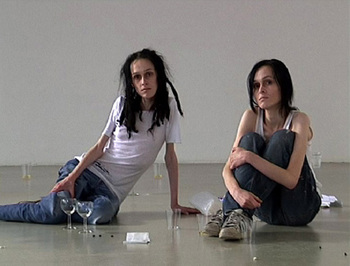
LA Raeven, video still from Wild Zone 1 (2001), courtesy of the artists
In a painful to watch BBC NewsNight interview, the Raeven sisters weren't contextualised primarily as artists, not even as kooky artists, but as eating-disorder victims. The 'feminist' psychotherapist Susie Orbach, author of Hunger Strike and ironically, Fat is a Feminist Issue (no potshots, please) was called in to moderate the discussion. Watching the interview, I was apalled at the insufferably intolerant BBC commentator. I believe that self-empowerment has many forms of expression, and that it is in fact medicalisation and consistently pathologising what is primarily women's behaviour, that is inherently anti-feminist. But that's just me, I'm a 3rd-wave feminist orthochondriac, not into rehearsing unhealthy scenarios, or encouraging others to practice theirs from haughty podia. And I'm talking about NewsNight, here.
The sisters told me recently, 'It was unbelieveable how we were treated at that time. Censured! When a Chinese artist eats a fetus, you don't see journalists calling psychoanalysts in to help. Instead, Western art journalists stumble over themselves trying to explain away (AiWeiWei!) this behaviour as an expression against an unhealthy regime."
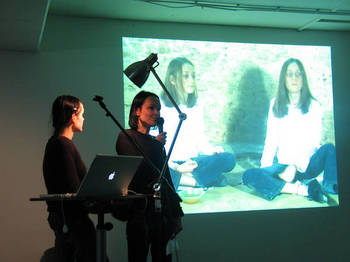
As part of Mediamatic's anti-war protest exhibition titled, le Mépris, (non-food-related, but go see it anyway), Mediamatic held a War Salon, (April 5th) at which the Sisters Raeven were invited to show some of their new work. The idea to put LA Raeven in a war and violence themed programme was an inspired one. Aside from new work by the ladies, highlights from the lineup included an analysis of the US Army recruitment game America's Army, and ended with a macabre audience participation karaoke with the songs of that very political body, Brigitte Bardot.
A goodly portion of the audience was represented by young male gamers from the nearby universities, there to listen to their friends, scientists David B. Nieborg and Jonas Hielscher speak about and demonstrate America's Army and Battlefield2, respectively. Gamers. That's a nice, socially acceptable term that we all use in contemporary cultural discourse. Gamers play games, in this case, war games on computers with lots of other gamers. Gamers at university study games and other gamers, and even write theses about these things. Well LA Raeven also play games.
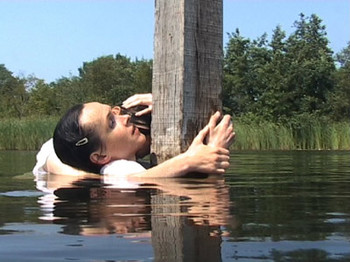
LA Raeven, video still from "Love knows many faces" (2005), courtesy of the artists
I disagree with those that would suggest that LA Raeven's presence and presentation at the Mediamatic War Salon represents a war on the body, or war against the body. Their oeuvre, and especially the new works, Prison in Me (2005) and Thin Line (2006) show an assault on individuality and a strategy to escape this assault. The image above is a still from the video, Love knows many faces (2005), in which the twins go for a swim and play a sisterly game of trying to drown eachother. Recovering from a symmetrical but futile attempt at individuation, they exhaust themselves into one big clump of Liebestod. Game on, Girls!
Thin Line (2006) shows one of LA Raeven's own food games, now in the hands of pre-pubescent twins. In a Bruxelles basement conjuring up horrific notions of Dutroux, the identically dressed twins flip a coin. The 'winner' is required to eat both sisters' dinner portions, and the loser gets nothing at all. The game is repeated through all the courses of a (continental European) meal, such that inevitably, one of the sisters ends up stuffing herself whilst the other is left to go hungry. Before you brush it off as childish, may I suggest that you play this game with your partner for an entire day, exploring the complex feelings that it generates. In fact it is not at all about waging war on one's own body. Pity that the body just gets in the way.
The hunger strike is male behaviour, a purposeful and politically engaged expression. The hunger artist is male, and is an artist above all. I left the war salon with even greater respect for LA Raeven's authenticity and artistic engagement. But I coudln't help wonder about the reasons why (female) anorexia should be considered to be more pathological and unspeakable than the (male) fear of terrorism whose effects are unleashed upon us every day. Why should an expression of the fear of fat, and/or the extreme expression of self-control that is anorexia be considered to be more offensive than the extreme societal control that is expressed by waging and playing at waging war?
- culiblog on SehnSucht, a restaurant for anorexics in Berlin
- Mediamatic War Salon wrap-up with photos by Bea Correa
- LA Raeven at Gallery Ellen de Bruijne Projects in Amsterdam
- le Mépris / Location: Mediamatic
POST CS Gebouw, ground floor
Oosterdokskade 5, Amsterdam
18.03.2006 - 30.04.2006
Thursday through Sunday 12.00 - 18.00. - Ellen de Bruijne Projects
- Fat is a Feminist Issue, by Susie Orbach
- Hunger Strike by Susie Orbach
- the Guardian article by Sean O'Hagan
- LA Raeven, Aesthetic Terrorists, by Sander Pleij, de Groene Amsterdammer. Unfortch in Dutch.
- Performance art in PRChina according to Wikipedia
- The Chinese Fuck Off art exhibition as opposition to the Shanghai Biennial in 2000. The title, 'Fuck Off' is considered by some to be a questionable translation for 'Uncooperative Attitude' in the Mandarin language.
- America's Army, a recruitment campaign and live, online computer game funded by private, Hollywood and ultimately US tax dollars, teaches children how to be ethnocentric and extremely violent. Apparently it's a fun game, and US Army soldiers actually train with it. You can play individually or as a team. The 3rd largest 'national' team, is Dutch.
- Stedelijk Museum, Post CS
Next Level - Art, Games & Reality
10.03.06 - 18.06.06
"Work by artists and designers who make the vocabulary of games their own, and provide us with their personal reflection on it." [so that the curatorial staff of the Stedelijk doesn't have to.-editor] - Thinspiration according to the very sane Wikipedia
- For the readers of German, a January 2005 review of the restaurant for anorexics, SehnSucht. Here's the telephone number, please give it a go. (Stadtteil: Tiergarten / Adresse: Dortmunder Straße 12, 10555 Berlin / Telefon: +49 (0)30 3995 266)

LA Raeven, video still from "Prison in Me" (2005), courtesy of the artists
technorati tags: anorexia, art, war, chinese performance art, restaurant for anorexics, twins, feminism, war, computer games, American Army, LA Raeven, Mediamatic, ICA London, SehnSucht, Susie Orbach, twin love,
Posted by debra at 07:10 PM | Comments (9) | post to del.icio.us
Episode 1, emergency food distribution and the role of the cameras
March 19, 2006
- This entry refers to food distribution as discussed in yesterday's entry about the World Food Programme's computer game, Food Force.
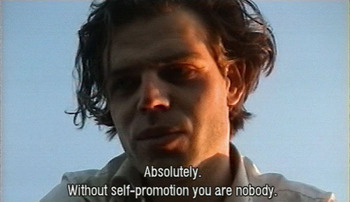
video still from Episode 1, © Renzo Martens
In January 2004, Dutch artist Renzo Martens produced his forty-four minute art film, Episode 1, a documentation of an extensive art performance. Martens travelled to the hottest hot spot war that he could find at the time of making the film (Chechnya, 2002), and in this 'setting' he pointed the camera, not at the war's victims and/or perpetrators like most (news) cameras do, but back upon himself. In Episode 1, Martens asks his Chechen and Russian Federation subjects, 'What do you think about me?'
Enough about you, let's talk about what you think about me.
Martens subjects are the normal cast of characters in every war; heavily armed soldiers on border patrol, civilians lining up for food, civilians trying to get on with it, civilians suffering before their destroyed homes and lives, refugees, but also all manner of NGO employees with their food programmes and journalists with their stories. Within minutes we understand that this is not simply a film about war, but a film about the role of the camera in war, about ethics, the dehumanising effect of pointing the camera and about what is so humanising about turning the camera back around at one's self.
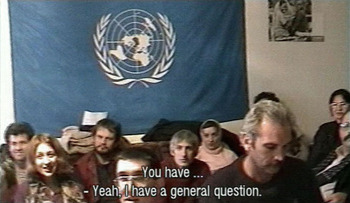
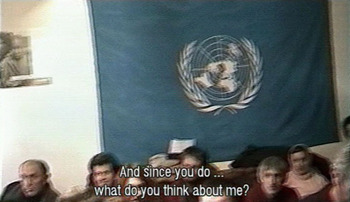
video stills from Episode 1, © Renzo Martens
In the tense environment of a Chechen UN press conference, in territories under fire, the conference moderator asks a group of journalists, NGO employees and UN workers, 'Does anyone have any questions?' Martens pipes up, 'Yes, I have a question!' 'What do you think about me?' Peals of laughter, no one can believe their ears. Ultimatey Martens' question is ignored and the journalists and NGO employees disband to their SUV convoys, rushing off to yet another 'opening' of a milk powder storage facility. Martens interviews the director of the operation, and together they quickly establish the fact that where there are cameras, there can be food relief. No cameras, no aid. In light of this, how could the World Food Programme build its computer game Food Force without even one single PR tier?
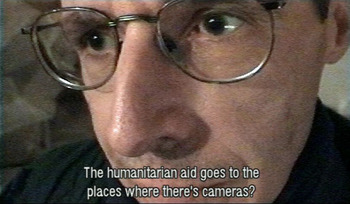
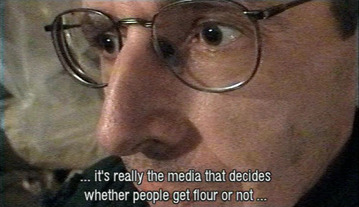
video still from Episode 1, © Renzo Martens
Episode 1 takes us through many such media-laden scenarios. In an open market destroyed no more than thirty minutes ago by Russian Federation soldiers with tanks and heavy artillery, a woman recounts how she and the other market women formed a human shield to halt the execution of a group of Chechen boys. Speaking to the camera, in an oddly well-rehearsed role of who stands where and who says what to the camera, the woman is still shaking from the experience. The scene ends with Martens staring shamefaced at the ground, unable to gather enough gumption to ask her what she thinks of him.
At a food distribution centre, Martens addresses a group of women lined up to receive rations of oil and flour. 'I just want to ask you what you think of me!' and this time there is an answer. The grim situation of lining up to receive basic foodstuffs, fades in the face of humanising laughter and warm sparkling eyes, women just being women. For a moment the food queue has all but disappeared. 'Boy, I think you're handsome, with your blue eyes!' 'What's your theme?' 'Are you a journalist?' 'No, he's an artist.' 'I think he's a journalist.'
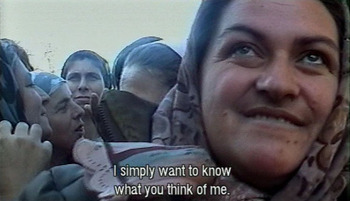
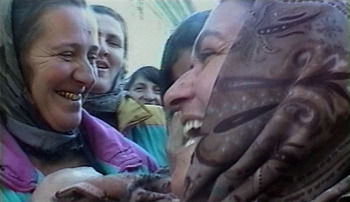
video stills from Episode 1, © Renzo Martens
Ultimately Martens 'act' of showing up with his camera and popping the question brings humanity to every situation that he creates. When he meets a young woman in a refugee camp (who bears an uncanny resemblance to his true love back in Belgium), his question changes, 'How should a man let a woman know that he loves her?' the woman's answer, delivered with beaming smile and sparkling eyes, dissolves the miserable tent landscape and suddenly it's just two people (and their translators) talking about love and life.
Of course Martens created this film for an art context, and the film articulately addresses contemporary art issues. Quite possibly Martens would be appalled that I consider his film to be 'useful', not just for artists and an art public, but as a tool to talk about the causes of war, hunger and the politics of emergency food distribution. And the question that Martens dares to ask amidst flying bullets, UN press conferences, annoyed Russian soldiers, women in food queues and refugees living in tent camps, the initial struggle that it initiates in the interviewee and in me, the audience, as I am simultaneously embarrassed by this question, but know that it is a question that can air-lift all of us actors out of the immediate and into a larger, more important discussion. Complexity is not complicated. Episode 1 brings us to the next tier, where a complex situation can be discussed with the nuance it deserves.
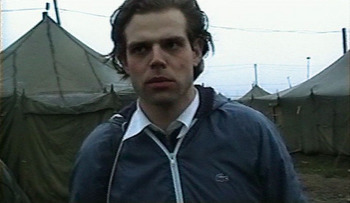
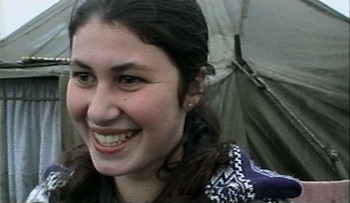
video still from Episode 1, © Renzo Martens
technorati tags: food-related film, Episode 1, Renzo Martens, Chechnya, cinema, emergency food distribution, Food Force
Posted by debra at 11:17 AM | Comments (3) | post to del.icio.us
Food Force computer game: force-feeding inaccurate notions of the causes of hunger
March 17, 2006
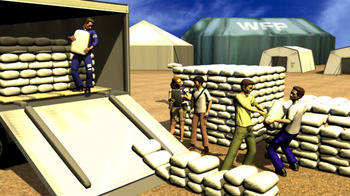
images courtesy of Food Force, © United Nations World Food Programme - all rights reserved
Two weeks ago I sat dumbfounded watching a French TV report in which journalism students practiced reporting a fictional national emergency. I couldn't help but think that what's cool about practice is that it makes perfect. If you practice having enough crises, you might actually get really good at having one! This hackle-raising report about teaching young adults to respond positively to crisis, just didn't seem to me like a simple exercise on getting prepared. The TV experience was absolutely colouring my thinking when I came across the UN's World Food Programme (WFP) website and discovered a new computer game for school kids called 'Food Force'.
'A major crisis has developed in the Indian Ocean, on the island of Sheylan. We're sending in a new team to step up the World Food Programme's presence there and help feed millions of hungry people.'
That's pronounced 'shay-lawn' by the way. The Food Force computer game is essentially a communications campaign of the UN's WFP, cleverly disguised as an educational tool. Although the game really does teach kids about mid-crisis food distribution, its purported goal, teaching students about the causes of hunger, is framed exclusively in the short term and completely ignores all of the long term causes.
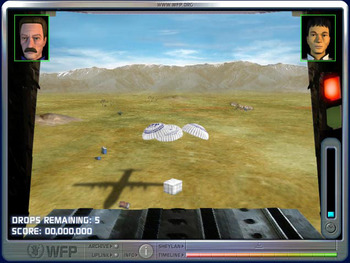
images courtesy of Food Force, © United Nations World Food Programme - all rights reserved
Food Force has six game tiers reflecting the basic elements of emergency food distribution: air surveillance (helicopter reconnaissance, counting clumps of roving refugees), energy packs (achieving nutritional and economic balance from rice, beans, vegetable oil, sugar and iodized salt), food drop (aim and drop those rations), locate and dispatch (Tetris-like global food collection), the food run (choosing the right route through hostile territory), and future farming (dealing with a combination of long term hunger solving factors).
Predictably my favourite game tier was 'future farming', where I was taught that paying people in food to attend job training programmes and so investing in the community, was the straightest path to community self-sufficiency and societal well-being. Together with the food pack nutritional assembly tier, this was the game tier with the highest educational value, going beyond point and drop and mouse dragging I mean racing.
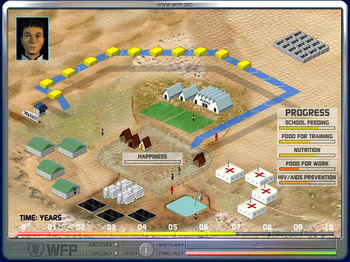
images courtesy of Food Force, © United Nations World Food Programme - all rights reserved
Food Force has a website chock-full with extra video, images and an educational package enabling teachers to work this computer game seamlessly into the curriculum. I pored over the WFP site in search of information addressing what I believe to be the long term causes of hunger and the long-term perspectives on solving the problems. Alas, I could find none. According to Food Force, hunger is caused by drought and civil war.
Of course I find no fault with the WFP's symptomatic relief efforts per se, nor do I see intentional evil with a communication strategy that illustrates this practice to children in the form of a computer game. But I do have a problem with placing this game in a curriculum that teaches children that the cause of hunger is simply drought and war. What are the some of the causes of drought? What are the some of the causes of war? What causes such a lack of food security that climactic fluctuations can take out several million people? Food Force offers no macro vision, and I do find fault with weaning children of the notion that food security is rested in global food politics. The macro vision of many commonly accepted causes of hunger, such as the small farm community-destroying effects of large-scale agricultural practice and the methods of monoculture, are left completely unaddressed by the WFP's computer game.
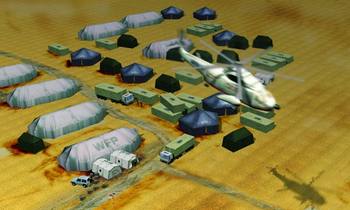
images courtesy of Food Force, © United Nations World Food Programme - all rights reserved
I often wonder if teaching children about hunger couldn't happen in a more nuanced way. Wouldn't it be more productive than training them to throw a little money at the problem? Well, maybe not with the 'throwing a little money at it' method of famine-control being so lucrative.
Tomorrow, I'll give an example of a solution.
I promise.
technorati tags: World Food Programme, Food Force, computer game, emergency food distribution
Posted by debra at 06:26 PM | Comments (2) | post to del.icio.us
Food-related film at the 4th Berlinale Talent Campus
February 23, 2006
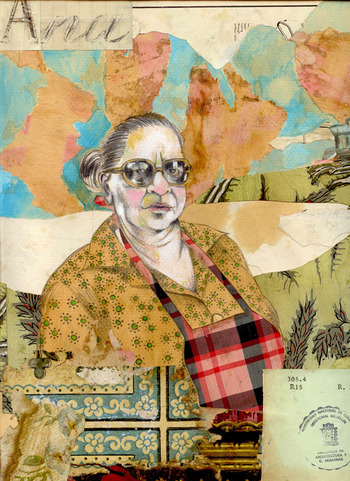
'Doña Ana', watercolour and collage that inspired Marlon Vasquez Silva's animation film Strawberry Eating Woman. 'Doña Ana' © Marlon Vasquez Silva, digital image courtesy of the artist
Apparently the director of the Berlinale International Film Festival, Dieter Kosslick, is obsessed with food and cooking. This explains why one of the six programmes had as its theme Food, Hunger and Taste. The 4th edition of the Berlinale Talent Campus (BTC), a section for young-ish filmmakers (when young means under 40), was dedicated to a heavily-worked relationship between food and film. Aside from my interest in the subjects, this was the most coherent and well-organised programme within the Berlinale. The Talent Campus offered young filmmakers a chance to meet, show their films, attend presentations, workshops and in general become indoctrinated I mean introduced to the film industry.
Although the evenings' big-screens at the BTC lamentably included worn out choices of food-related film like Babette's Feast, Eat Drink Man Woman, (how to ruin great films with unimaginative programming) and the dreaded 'Food + Romantic Comedy' genre piece, 'Bella Martha' by Sandra Nettelbeck, the programmers were wise enough to screen historical gems like Marcel Pagnol's 'Harvest (Regain)', informative documentaries like Hal Erickson's 'Alice Waters and her Delicious Revolution' (2003) and the most sensual cinematic food chain and materials exploration ever made, 'Drawing Restraint 9' by Matthew Barney.
This year, thirty-two young filmmakers were spotlighted in the Berlinale Talent Campus and divided into a five part programme titled unoriginally, 'Food for Thought'. From the selection, the films on the subject of hunger tended to suffer most from ill-research and moralist pedantics.
But when the films were good, they were very very good. Here is the culiblog selection of the eight best films on Food, Hunger and Taste from this year's Berlinale Talent Campus (in alphabetical order):
- A LOVE SUPREME. Nilesh Patel, UK: A hyper-rhythmic black and white short supposedly inspired by Raging Bull, but I see it as a sexy visualisation of a samosa recipe. I love the film's changing sense of time, concentrated detail shots and the stolen moments of materials pleasure. Bravo.
- CAKE IN THE FACE. Katarina Hellberg, Sweden: At a Talent Campus laden with moralistic expressions, one of the most refreshingly humorous films was Hellberg's CAKE IN THE FACE. Hellberg interviews the head of the international 'pie-ing' movement, who says, 'Every time I pie someone it is a total orgasm.' The international movement throws soft cream pies in the faces of the offensively powerful as a political expression. This film is indicative of the acitivist undercurrent in the world of food at the moment, and would programme well alongside feature length documentaries. It offers the audience a light-hearted answer to combat the gloom that is the contemporary food and agriculture documentary.
- It is noteworthy that of all the BTC short films, only those dealing with pies and cakes were funny. Short pause for thought.
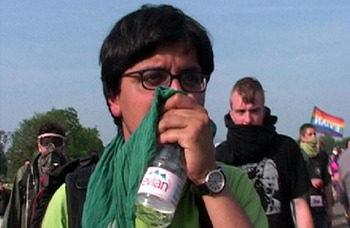
EviannaÏve image still © Verena Vargas, used courtesy of e|x|il Film
- EVIANNAÏVE. Verena Vargas, Germany: Lengthy but good, but lengthy. Eviannaïve documents a group of activists as they travel by train from Berlin to a small town near Geneva to disrupt the 2004 meeting of the G8. Civil disobediance and youthful enthusiasm are their only weapons. The title's palindrome hints at how difficult it is for the anarchists to mobilise politically, but somehow they do. (Maintaining the values of civil disobedience in the face of violent police action is not for the faint of heart.) It's the hippy in me that can't help but identify with activists that pick up their trash upon returning from the demo. This is a worthy historical document, lengthy, but good. But lengthy.The Eviannaïve website
- HUNGER. Maia Burduli, Georgia: Shrieking babies, tightly bundled up in blankets. One is worried that a fumbling nurse, insisting on carrying three newborns at a time, will drop one on its noggin. Ms. Burduli exlained after the screening that in Georgia, a baby's screams for its first mouthful of breast milk is a positive thing, a sign of thriving. In the film, once the nipples show up, we see what babies and mamas see, right up close and personal. Intense sucking is followed by a blissed-out milk coma.
- LA VIDA DULCE. Rouven Rech, Germany: An almost slapstick documetary short about Cuban subsidised cake distribution. If you're a Cuban mother on Mother's Day, you will get yer dang cake. After watching the short several times, it still confounds me that even though cake boxes are used in the transport of these generously frosted creations, no one puts the cake in the box, preferring instead to keep it on display, exposing the cake to all manner of dangers. Hilarious and sweet.
- STRAWBERRY EATING WOMAN. Marlon Vasquez Silva, Colombia: This was by far the most unique film of the BTC, an animation comprised of beautifully created watercolours and collages addressing the plight of displaced farmers in Colombia. Without being overtly political, Strawberry Eating Woman lays bare the loss of cultural capital that occurs when small agricultural communities are destroyed. Surprising and refreshing, like an excellent little strawberry.
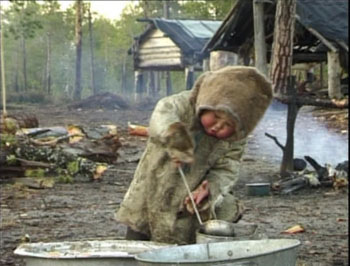
Tiny Katerina serves food to the dogs, image still © Ivan Golovnev, used courtesy of Golvnev Film
- TINY KATERINA. Ivan Golovnev, Russian Federation: Golonev admits readily that Tiny Katerina is a film about changing lifestyle more than about food. It documents the youngest member of a Northwest Siberian family that lives in a felt tent in near isolation. Katerina can't be more than two years old, but it is confusing whether she is playing at being an adult or is actually participating in the rigourous family chores! We see her lugging blocks of firewood around and cooking for the family's dogs. Two years old! Golovnev's camera is completely unobserved, offering an intimate view of a life that will soon vanish in the petrol politics currently plaguing this region. The documentary short has a distrubing ending that places the film within a larger political context.
- WASTE NOT, WANT NOT (CHICKEN A LA CARTE) Ferdinand DeMadura, Philippines: Just because I included this film on my list does not mean that I liked it. But Chicken a la Carte's subject has deeply interested me ever since I encountered it in PRChina: food-recycling. DeMadura follows a supply chain in which food travels from an urban food court in Anywhereville, South East Asia, to the kitchen where waste food is sorted, placed in a bag, in a bucket on a bike. I do not like green eggs and ham. Later the recyclist distributes the food amongst village children and the choicest of gleanings land ultimately on the family table of the food-recyclist himself. The practice is widespread all over... everywhere. Better film next time, DeMadura, but chapeau, your subject matter is rivetting.
technorati tags: Berlinale Talent Campus, Berlinale International Film Festival, film, food-related film, cinema, Berlin
Posted by debra at 03:25 PM | Comments (0) | post to del.icio.us
When fish fall in love
February 13, 2006
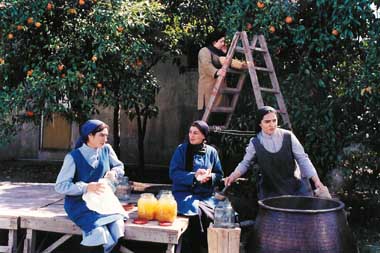
film still from When Fish Fall in Love, shows main character Atieh, her daughter and sisters preparing orange syrup in the garden. Image used without permission
When it comes to food-related film, I couldn't have made a better start at the Rotterdam International Film Festival. Drawing Restraint 9 had me reeling for days. Good for Drawing Restraint, bad for all the others that I saw directly afterwards. I had all but given up hope for finding a new approach to the genre, when I went to see the last film on my list.
When Fish Fall in Love saved me from being mired in bourgeois feel-good movies, films that are little more than romantic comedies with chefs and kitchens, gratuitous food porn, films that make audiences twitter at the thought of eating bull's testicles. Fish Fall in Love is Iranian theatre director Ali Raffi'i's first feature about two lovers being reunited after a twenty-year separation, and a new generation of about-to-be lovers, about to be separated.
Ex-political prisoner and Iranian émigré Aziz returns to his home at a Caspian Sea coastal village, where he finds that his former beloved Atieh, her daughter and two sisters have appropriated his family home and turned it into a restaurant. The film is shot like an old postcard from your grandparents' seaside holiday, complete with long images of regional specialities. In this film, no dish leaves the kitchen without making a cameo. Can you imagine jewelled rice doing the red-carpet walk at Cannes?
Ali Raffi'i spoke to the audience before the screening, explaining that this film was about the difference between the way his and the generation now in their twenties, express love for one another. His intricately developed characters convey the complicated situation of a generation (Aziz and Atieh) whose political passion (may have necessarily) precedes their passion for each other. This contrasts sharply with the generation of Atieh's daughter Touka and her Teheran beloved Reza, who are even driven to criminal acts in the hope of supporting their love.
Admirably, Raffi'i endeavoured to show a different view of woman than what he described as 'ordinarily portrayed in Iranian cinema'; a woman whose destiny is not dependent on the presence or hope for presence of a man in her life. Not being sufficiently familiar with Iranian cinema to judge, I had to think, 'Heq, come on over here, that's a hole in the market!' Until now, the art installation videos of Shirin Neshat and the British documentary filmmaker Kim Longinotto's Divorce Iranian Style were until now, my sole influences.
While Atieh is a strong character, supporting her daughter, two of her sisters and herself by running a small restaurant, she is also always really nervous about this role. Preparing lunch and dinner for only twenty, though she's been doing it for years, seems to be a monumental feat for her. Among the many kitchen shots of brilliantly presented 'home-style' cooking, the viewer is treated to beads of sweat on noses and upper lips, the wiping off of sweat from brows and the drenched backs of clothing. I'm thinking, 'Sister, what you need is a smaller menu.' But Atieh's unwieldy menu seems to represent traditional culture and her uncomfortable relationship with it.
The film's ending is deliciously open, giving few clues as to how Aziz and Atieh will give shape to their deep love and respect for one another in the future.This combined with Raffi'i's rich characters have given me room to identify completely with love's consequences for Atieh and Aziz. All that I am willing to give away, is that there is a cottage involved. I know that the next time I make orange syrup, this film will be the first thing on my mind.
- Film review of When Fish Fall in Love on Teheran Avenue
- Iranian Food Photos on Flickr
- Film Festival Rotterdam entry about When Fish Fall in Love
- Forget Martha's Vineyard, I'm going to Iran
- Women Make Movies on Kim Longinotto
- About Ali Rafi'i as a theatre director
technorati tags: International Film Festival Rotterdam, film, food-related film, cinema, Rotterdam, When Fish Fall in Love, Ali Rafi'i
Posted by debra at 02:01 PM | Comments (0) | post to del.icio.us
Food-related film at the Berlin International Film Festival
February 09, 2006

Pack up your yurt, we're moving to the steppes of Berlin for a week, where it's much colder than it was in Rotterdam, and where a yurt will come in handy. The craziness begins today at the Berlinale, the Berlin International Film Festival. Culiblog will be attending the madness for an entire week, from Saturday the 11th until the 19th, reporting on all food-related films and presentations.
This year there is a glut of food-related film because aside from the regular programme, food, hunger and taste are the subject of the Berlinale Talent Campus, a platform within the Berlinale festival. The Berlinale Talent Campus creates opportunities for young filmmakers to meet with les eminences grises from the film industry and the folks from the more active side of food and food culture as well. Alice Waters, Vandana Shiva, Carlo Petrini will all be there.
Once again, I've created a culiblog food-related film selection culled form the entire Berlinale programme for those willing to move beyond Babette's Feast. Oh dear, it's 2006 and they're actually showing Babette's Feast!
The culiblog selection at the the 56th International Berlinale Film Festival:
Saturday, 11.02.2006:
23:00: - Harvest (Regain), a Marcel Pagnol classic! (Manon de la Source)Sunday, 12.02.2006
18:00: - Berlin Talent Campus Screening - Food For Thought: Origins: Tom Luddy will present all 32 Talent short films on "Hunger, Food and Taste" in three sessions, beginning at 18:00. Today's programme "Origins" will include eleven short films from seven different countries. In between the screenings, Tom Luddy will introduce the Talent directors and discuss their reflections on "Hunger, Food and Taste".
10:30: - Eat and Shoot the Indie Way, presentation with a.o. Alice Waters, Angie Lam, Vandana Shiva and Slow Food's Carlo Petrini
12:15: - Who Owns Life? Talk with Vandana Shiva and Renate Künast
16:30: - Talk with Peter Kubelka: Cooking as the Origin of Culture...
17:30: - One Way Boogie Woogie / 27 Years Later, James Benning
Monday, 13.02.2006
14:00: - The Case for Taste, lecture and screening of Nossiter's Mondovino with Carlo Petrini a.o.
18:00: - Berlin Talent Campus Screening -
Food For Thought: Delicious Revolution: Today's Food for Thought session is hosted by US-director Doug Hamilton. His film ALICE WATERS AND THE DELICIOUS REVOLUTION is a documentary about the ideas and ideals of natural food specialist Alice Waters, who has been practicing and sharing with the world her healthy and environmentally conscious principles for nearly thirty years. After the screening, director Doug Hamilton will answer questions.
20:30: - Mondovino, Jonathan NossiterTuesday, 14.02.2006
18:00: - Berlin Talent Campus Screening -
12:30: - Matthew Barney: No Restraint, Alison Chernick
18:00: - Berlin Talent Campus Screening - Food For Thought: "Kill or Die" is today's screening of a new round of shorts from the Campus competition "Films on Hunger, Food and Taste". Tom Luddy will present ten filmmakers from eight countries and talk about their cinematic stories about the relationship between food and death, about the often hidden fact that for some, eating means killing, and about food, fear and devotion.
18:45: - Drawing Restraint 9, Matthew Barney Wednesday, 15.02.2006
18:00: - Food For Thought: Lost Supper: A screening of the Berlinale Talent Campus films on "Hunger, Food and Taste" is dedicated to films that deal with hunger, starvation and poverty in the world. Eleven short film productions from eleven countries explore the unjust manner of food distribution in the world and the local effects of this problem. Tom Luddy will introduce all of this year's Talent filmmakers and talk about their productions.Friday, 17.02.2006
18:15: - 37 Uses for a Dead Sheep, Ben HopkinsSaturday, 18.02.2006
14:30: - Happy as One, Vanessa Jopp
You'll be needing these links as well:
- 56th Berlinale International Film Festival (programme search in English)
- Berlinale Talent Campus lineup of film on food, hunger and taste
- Berlinale Talent Campus (in English)
- Berlinale Talent Campus evening programme
- Berlinale Talent Campus lecture and presentation programme
- Slow Food and the Berlinale Talent Campus have teamed up. Here's the blurb.
- Jonathan Nossiter's Mondovino
- NYTimes film review of Marcel Pagnol's classic from 1937, Harvest (Regain)
- Marcel Pagnol filmography on the IMdb
- James Benning interview by Danni Zuvela on the Senses of Cinema website
- James Benning's filmography on Wikipedia
- Synopsis of Alison Chernick's Matthew Barney: No Restraint
- Ben Hopkins, 37 Uses of a Dead Sheep
- A list of food-related films, compiled by Rebecca Epstein for Gastronomica. Her dissertation titled, "Crime and Nourishment", focused on the food and foodways of Hollywood gangster films. Epstein's list needs a good tweaking and I don't agree with her about a lot of the titles, but it will serve us just fine for February.
- culiblog reviews Matthew Barney's Drawing Restraint 9
technorati tags: Berlinale International Film Festival, film, food-related film, cinema, Berlin, Drawing Restraint, Matthew Barney
Posted by debra at 02:12 PM | Comments (6) | post to del.icio.us
Drawing Restraint, dragging ambergris
February 05, 2006

Occidental Guest (bride), production still from Matthew Barney's Drawing Restraint 9, copyright Matthew Barney, used without permission
Filled with expectation unsuitable for the company of friends, clutching a fat wad of tickets between fingers reeking of quickly eaten, mediocre sushi, it is unwise to view the best film of the festival first. It just ruins everything, and this is exactly what happened to me on January 30th when, in the exquisite 'old' Luxor cinema in Rotterdam, I saw Drawing Restraint 9.

Shimenawa, production still from Matthew Barney's Drawing Restraint 9, copyright Matthew Barney, used without permission
Drawing Restraint is artist Matthew Barney's 2006 film entry in the International Film Festival Rotterdam and as well the Berlinale Film Festival, where he is a member of the jury. Avant-pop artist, composer and girlfriend Björk composed the soundtrack. Their collaboration is astounding on all levels; the film will make you cry, it is that beautiful. Aside from being culiblog's favourite at this year's festival, the film is exemplary of food-related film in the culiblog sense of the word; food, food culture, food as culture and the culture that grows our food.
Matthew Barney is the Lance Armstrong of contemporary art. In my opinion, no chef can yet lay claim to this position. Drawing Restraint 9 is also the best food-related film ever made, a lavish display of sensuality and ritual.
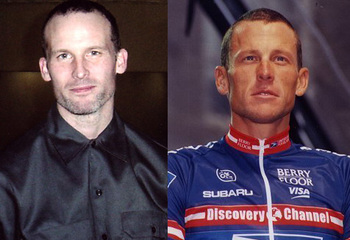
Barney on the left, Armstrong on the right
Drew Daniel of Matmos wrote this stellar description of Barney's art practice on Björk's DR9 website:
Barney is a visual artist whose ambitious, rigorous multimedia work encodes esoteric meanings while providing lushly immediate aesthetic rewards. Best known for The Cremaster Cycle, the sprawling sequence of five films made over ten years which was the subject of a recent Guggenheim retrospective, Matthew Barney's work is multimedia in execution but singularly focused in conception: tightly unified fusions of sculpture, performance, architecture, set design, music, computer generated effects and prosthetics, Barney's films deploy the full range of cinematic resources in the service of a hermetic vision rich with densely layered networks of meaning drawn from mythology, history, sports, music, and biology.
This is a sexy way of saying that Barney's work is based upon his own elaborate and logical cosmology. In Drawing Restraint he playfully turns materials, forms, geometries and processes (e.g. petroleum jelly, silicone, whale blubber, ambergris, other marine excretions and accretions), cultural-historical narratives and geographic trajectories (e.g. the architecture, interior and machinery of a whaling ship, the culture of whaling, the history of a specific ship) and the experience of time (e.g. pearl oyster divers holding their breath under water, the migration of whales, a Japanese tea ceremony), into a luscious weave of deeply connected meaning and narrative.
This is where chefs tend to slack off.
But this is Barney's demarrage, an escape or breakaway that gives him an advantage over the rest of the 'field'. Whereas it is common for a chef to create a 'richly organized set of aesthetics' (as Drew Daniel describes Barney's approach to making art), I know of no example within the culture of contemporary haute cuisine in which a chef recontextualises elements on this level to form a total experience beyond the formal boundaries of restaurant culture. Perhaps I'm not going to the right sort of parties. I long for an haute cuisine that is less 'applied' and more autonomous.
Please read more... "Drawing Restraint, dragging ambergris"
Posted by debra at 08:51 PM | Comments (4) | post to del.icio.us
And the answer is... community supported agriculture
November 30, 2005
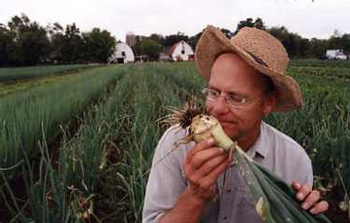
image courtesy of the Real Dirt on Farmer John website
Well, at least that is one of the most positive answers to the questions that came to my mind after watching Erwin Wagenhofer’s We Feed the World (Austria 2005) Saturday night at the IDFA. Although reviews and film descriptions already abound, here's culiblog's quick take on the films The Real Dirt on Farmer John, We Feed the World and Bullshit.
Context is everything, although this hadn't occurred to me weeks ago when I reserved my tickets for the IDFA and Shadow Festivals. It was pure coincidence that I chose Taggert Siegel’s The Real Dirt on Farmer John (US 2005) instead of We Feed the World as my first IDFA film. But the documentary about John Peterson (I heart him) is such a poignant portrayal of his pursuit of agricultural viability on a very personal level, that the film armed me with an outlook positive enough to take on the eloquent doom and gloom of the other documentaries. I wish my fellow audience members had been so lucky, because their anger and disillusionment about the realities sketched in Wagenhofer's, We Feed the World and even Holmquist's Bullshit was palpable.
Please read more... "And the answer is... community supported agriculture"
Posted by debra at 11:17 AM | Comments (1) | post to del.icio.us
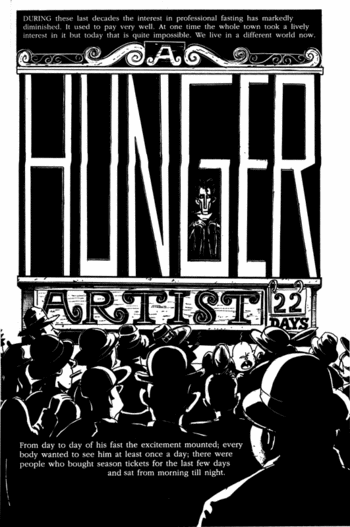
The Hunger Artist
November 24, 2005
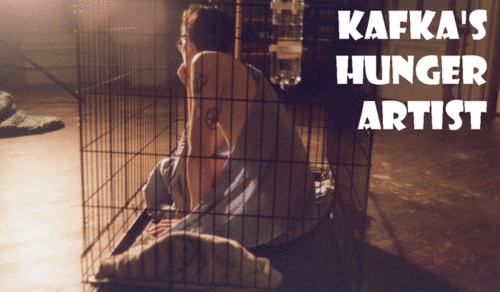
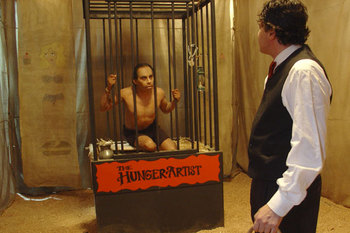
Here's one for the archives: Google (images) 'Hunger Artist'
Happy Thanksgiving, by the way.

Please read more... "The Hunger Artist"
Posted by debra at 08:04 AM | Comments (4) | post to del.icio.us
Food-related film, art, design and culture in Amsterdam
November 17, 2005
Starting next week culiblog is feeding itself with food-related films from the Shadow and IDFA documentary film festivals. Themes such as the family farm, food distribution, foodstore owners, olive trees, Japanese home cooking and of course globalisation, feature prominently in my selection.
The Netherlands has two film seasons each year. In November and December it's documentary season with the Shadow Film Festival and the International Documentary Festival Amsterdam (IDFA). In January it's the International Film Festival Rotterdam. I have known couples that, when they broke up, had to decide who would get to go to which film festival. Seriously. Big stars like artist Allan Sekula, who presented his documentary Fish Story at the Shadow Festival in 2002, show up for these events in our dark but cosy Polar Circle villages.
The culiblog programme of food-related documentary film (Nov 25-Dec 03, 2005, Amsterdam NL)
Friday 25.11
12.30h Film Museum: Meat Vegetables and Dessert
14.45h City 7: My Dear Olive Tree
18.30h Calypso: The Real Dirt on Farmer John
20.20h Cinerama 1: Profils Paysans (Profiles of Farmers: Daily Life)
Saturday 26.11
12.00h City 1: Bullshit
21.00h City 1: We Feed the World
22:00h Uitkijk: Autumn
Sunday 27.11
16.00h Melkweg: Taimagura Grandma
Monday 28.11
11.00h Cinerama 1: The Real Dirt on Farmer John
14.30h City 7: Het is een Schone Dag Geweest (It's been a lovely day)
21.45h Cinerama 1: Our Daily Bread
22.00h Uitkijk: Alimentation Generale
Tuesday 29.11
20.00h City 5: Bullshit
21.30 City 1: We Feed the World
Wednesday 30.11
19.00h City 1: Our Daily Bread
Thursday 01.12
10.45 City 7: My Dear Olive Tree
Friday 02.12
20.15 City 3: Meat Vegetables and Dessert
Saturday 03.12
12.45h Calypso 1: We Feed the World
14.15h Film Museum: Profils Paysans
17.30h City 2: Our Daily Bread
19.00h City 3: Bullshit
19.15h City 7: Het is een schone dag geweest
For IDFA reservations:
IDFA +31 (0)20 4277452 (open from 12-17h)
http://www.idfa.nl/
For Shadow Festival reservations, contact the locations:
de Melkweg +31 (0)20 53 18181
Lijnbaansgracht 234/A
de Uitkijk +31 (0)20 6237 460
Prinsengracht 452
Please read more... "Food-related film, art, design and culture in Amsterdam"
Posted by debra at 11:46 AM | Comments (0) | post to del.icio.us
Food Subculture Club visits a raw food (un)cooking workshop
November 13, 2005
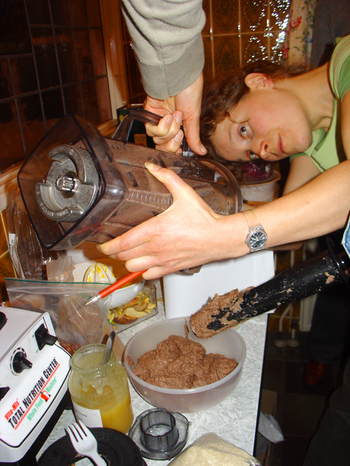
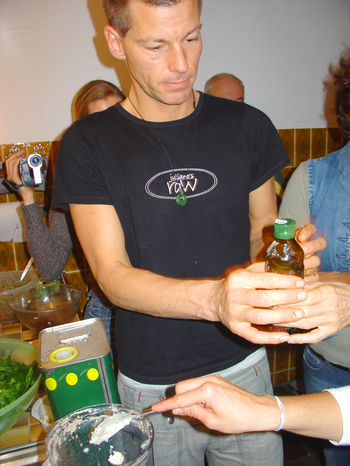
When cooking with meat or dairy, it's always easy to create foods that are delicious, rich and complex in flavour. By combining processed grain flours with an oven, or brown rice and a rice maker, it's simple enough to make comfort food. But I have always been curious as to whether a diet of raw food could fulfill the very normal culinary hunkerings for diversity and satisfaction. By this I mean, the potential nutritional benefits of eating a raw food diet aside, is it possible to make an interesting raw food repetoire that is well-suited to the Northern European winter?
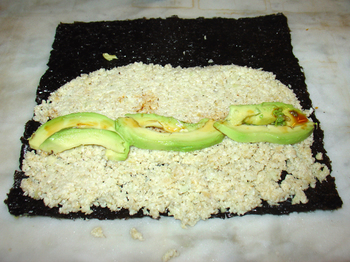
On my cookbook shelves there are two cookbooks about raw food cuisine; Roxanne Klein & Charlie Trotter's R A W, and Juliano Brotman's Raw, the UNcookbook. I had tried several recipes from
Just from a culinary prespective...
The workshop, held in an anti-squat in exceedingly picturesque Broek in Waterland just north of Amsterdam, ended up having a lot in common with one of Louis Theroux's Weird Weekends, except that I'm nowhere near as charming as Louis is/was and the workshop was in the middle of the week. During the introductions I inadvertently started things off on the wrong foot by not giving the correct answer to the question, 'how raw are you?' My answer, 'Pretty dang raw, but I'm not a vegetarian' caused more than a few of the other participants to gasp audibly. I could have known that by trying to explain my omnivorous culinary bend that I would become the pisspole of raw food guru-ji Juliano.
Personal affinities aside, it is only fair to mention that I found all of the food that we prepared in the workshop to be 'rock my world' delicious and most of my prejudices with regard to this subculture's cuisine were quickly dispelled. The food wasn't all wet and cold, it didn't taste like 'health food', it didn't taste like vegan food, it was neither bland nor monotonous. In fact, at the end of the workshop, I really started getting cravings for something SIMPLE, like a piece of undressed lettuce. Juliano prepares foods like a parfumier makes a scent. He composes flavours and textures out of his ingredients. His knowledge of the flavour characteristics and textures of the ingredients he uses is impressive. Were it not for this fact, I would have been so out of there, having very little tolerance for statements like 'cooked food is pure poison', and 'I know someone that has been raw for six hundred years'. There was an unspeakable culture clash, but boy can this guy (un)cook.
One of the things I appreciated most about the workshop is that due to Juliano's conviction that everyone in the entire world should become 'raw' immediately, he was eager to explain a feasible methodology for running a raw food kitchen and/or household. I had reported earlier that raw cuisine is labour intensive, and compared to throwing ingredients into a rice maker or grilling up some flesh, it is, but Juliano explained how to make some basic ingredients that could be worked into meals over a period of a week that made the idea of raw food meal preparation less daunting.
Please click 'please read more' to see an interview that I conducted with Juliano and Ariel that will probably answer some of your burning (sorry) raw food questions.
Please read more... "Food Subculture Club visits a raw food (un)cooking workshop"
Posted by debra at 08:31 PM | Comments (1) | post to del.icio.us
Chef Thor, Croqueta d'Amor, Medaille d'Or, Cultural Sectór!
November 04, 2005
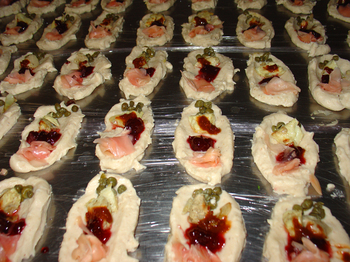
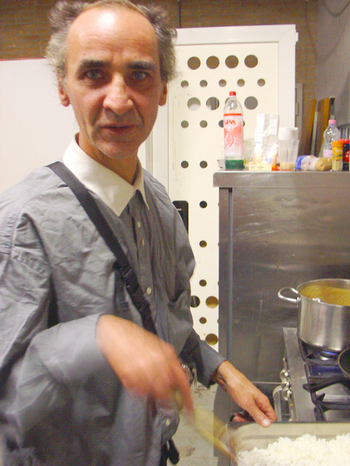
images top to bottom: Croqueta d'Amor in process, the chef formerly known as Thor, Chef Croquette works on a Croquette Japonais
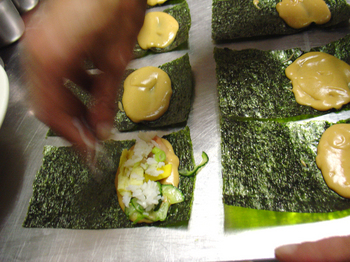
At a top secret location in Amsterdam's PostCS cultural hub, Chef Croquette and the Croquette Family get to work on the hundreds of croquettes ordered for a weekend filled with cultural events. It's as if the PostCS (home to the Stedelijk Museum, Mediamatic, Club 11, numerous artists' initiatives and one of the thirty-eight locations for the 6th annual Museum Night) suddenly needs it's very own croquette chef. Of course croquette commissioners from the cultural sector are the most demanding of all. To posh up their menus this weekend they unanimously chose two of the newest creations from the chef formerly known as Chef Thor; the Croqueta d'Amor ('No More War!' '7 Sabors!') and the Croquette Japonais.
Just like Willy Wonka's Magic Chewing Gum, each bite of the Croqueta d'Amor and the Croquette Japonais yields a different taste explosion, seven flavours in all. In the film as well as the book by Roald Dahl, the magic chewing gum is still in beta when bitchy Violet Beauregard (chewing gum expert and glutton) snatches a piece of the gum to give it a chew and to sell the recipe to a rival candymaker. Due to the side-effects caused by the experimental nature of the gum, Violet blows up into a giant blueberry and has to be juiced forthwith!
Let that be a lesson to us all.
Chef Croquette joked to me, 'er zijn kapers op de kust' , which is a charming Dutch way of saying, 'many is the chef that would pirate this recipe.' Indeed, as we prepared the croquettes in a location deep under the earth's crust, at least five chefs happened to 'pop in for a little chat'. I think they could sense that Chef C. had perfected the technique of creating an entire meal in ten cubic centimetres of croquette with no ill side-effects. That or the fact that the location was also a central storage place for beer. Either way, the concept of Open Source is not alive and well in the culinary world.
Please read more... "Chef Thor, Croqueta d'Amor, Medaille d'Or, Cultural Sectór!"
Posted by debra at 11:31 PM | Comments (2) | post to del.icio.us
A belly full of raw food facility, reviewing a conceptual restaurant
November 02, 2005
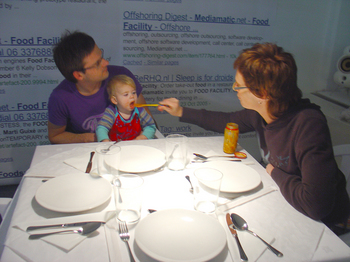
Smart babies bring their own food to a restaurant opening
It's probably fair to assert that last Saturday was an all-time first in Amsterdam: two interesting culinary events in one day. I made sure to attend both Juliano Brotman's Raw Food UnCooking workshop as well as the restaurant launch of Marti Guixé & Mediamatic's Food Facility at the Post CS. Yoga and raw food in the afternoon, black clothing, pearl-swinging, wine drinking, cigarette smoking, take-away food in the evening. Time in between to change costumes I mean outfits, and I had the fixings for a well-balanced day.
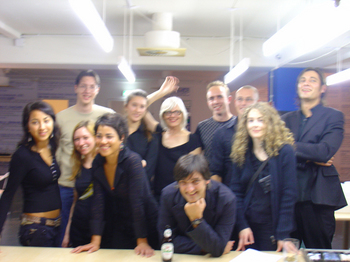
The Food Facility staff (aka Mediamatic and Marti Guixé) giddy and a'blur
Just like normal people, raw food chefs can run a little late, and we were still busy with the results of the uncooking workshop two hours after it's scheduled end. I thought it wouldn't be a problem, assuming that raw food could in no way be complex or filling, but I was mistaken. At 19.00h when I arrived at the Food Facility, I had no desire to eat. Luck would have it that my belly full of raw would turn out to be a blessing.
Luck wouldn't have it that my erstwhile best-friend-with-a-deadline would call to say that she couldn't show up for dinner that evening. GASP, alone at a restaurant opening with a big fat reservation for two! The ever-on-the-ball Mediamatic nouvelles maîtres Arne en Jans, arranged a dinner date for me on the spot (and a delightful one). That, dear reader, is what I call excellent service!
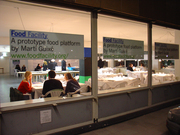

Graphic designers guesting Food Facility catch the early bird special, Guixé designed chairs
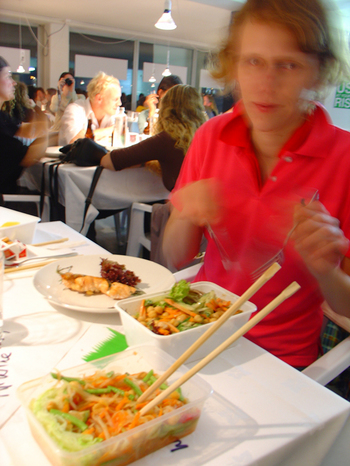
Katarina eats spada on rosemary sticks well within three hours of ordering it
The restaurant was glowing with all manner of mixed spot and flourescent lighting, bright white, with HTML blue, black and green columns in the centre. Draped on the walls were large print-outs of the results of a Google search; 'food', 'food facility', 'Marti Guixé' and 'Mediamatic'. Of course this search yields lots of culiblog entries, and I have to say, there's nothing like seeing the name of your blog plastered all over an interior to warm your heart and coax out a favourable review. Designers, do like Marti does.
In the centre of the room Guixé placed a food island, where the delivery boys on scooters brought in the orders and from where the restaurant staff would bring the dish to it's rightful owner. The tables were laid with damaste (not real damaste), with large tumbler glasses, generous cutlery, and large cloth napkins (not real cloth). All of the guests were pregnant with expectation, and some were actually pregnant. Marti G. described the evening thusly, 'It was like attending my own wedding...'
My dining buddy Katarina and I ordered from a well-designed menu based upon the takeout menus from twelve different restaurants in Amsterdam. By 'based upon' I mean photo copied and by twelve I mean nine. We were having an excellent time, drinking and talking, waiting and drinking and talking, smoking and drinking and drinking and smoking and talking and waiting and drinking. Talking all the while, the friends were dropping by for a chit chat, we were being visited by extremely attentive maîtres and wait staff. Waiters are for waiting.
And then we did some more of that waiting. Which was fine. I still wasn't the least bit hungry with my belly full of raw, but some guests were starting to get peckish, and by peckish, I mean uppity. Certain tables began to organise exuberant betting pools as to who would get their food first.
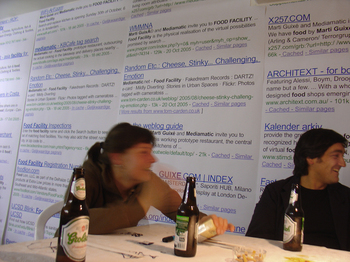
The bride and bridegroom Guixé giggling at all the betting going on
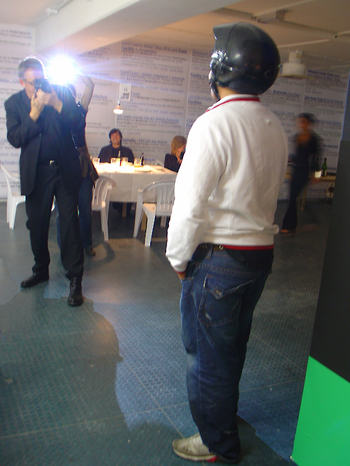
The arrival of the first delivery boy with one baggie of takeout food
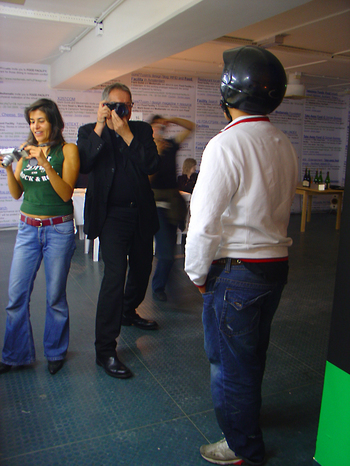
The paparazzi can't contain themselves
And then the first delivery boy entered the restaurant. Helmet on, a little white baggy filled with Chinese takeaway in his hand, and the entire facility went berserk. Cameras were flashing, guests were laughing and many stood up to applaud and 'whoop whoop'. All this for one little white bag of grits. This scenario repeated itself as each delivery boy entered the Food Facility until the very end of the evening. That, dear reader, is good restaurant interface design.
My sashimi arrived, well within one and a half hours. An hour, two glasses of wine and one and a half cigarettes later my green papaya salad arrived. You can see by my menu choices that I was doing my dangdest to keep the raw thing going. Ordinarily this amount of wait would be unacceptable, a good reason to do some non-positive wing-flapping. But this particular evening, I would have to categorise this as perfect timing. Perfect amount of drama and excitement, entertaining guests entertaining themselves just fine, excellent conversation (one of my waitresses turned out to be a sufi), food for thought and merriment abounding. Guaranteeing an excellent experience is also a part of restaurant design, and it's silly to go to a restaurant opening with the actual intention of getting fed.
Guixé and Mediamatic's Food Facility is open Fridays and Saturdays until December 11, 2005 and I highly recommend at least one visit. I have chosen Food Facility as the location to celebrate the one year birthday party of culiblog.org during Saturday's Museum Night. It was one year ago (Museum Night 2004 at Mediamtic) that culiblog launched it's domain. We're going to fill up on nibbles beforehand at my house.
Food Facility open Friday and Saturday from 18.00h - 22.00h
November 4 - December 11, 2005 at Post CS, Amsterdam.
Read Mediamatic's announcement here or call +31 (0)6 3376 8810 for reservations.
Please read more... "A belly full of raw food facility, reviewing a conceptual restaurant"
Posted by debra at 10:31 AM | Comments (0) | post to del.icio.us
Juliano's Raw
October 28, 2005
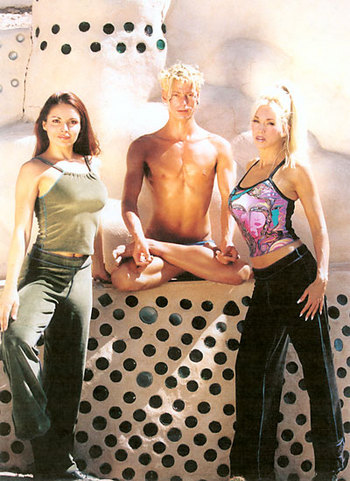
Image of Juliano and friends courtesy of Juliano Brotman's Planet Raw website
Loyal culiblog readers know that I like my bacon fried crispy and that I never pass up an opportunity to eat most forms of smoked pork. But I also like to expand my culinary and nutritional repetoire with raw food kweezeen. Everything in moderation, including and especially moderation. This weekend Juliano Brotman, chef proprietor of the Hollywood restaurant Raw is in Amsterdam giving a workhop together with ashtanga yoga instructor Caroline Klebl.
Saturday October 29, de Loods/Prinseneiland 20G Amsterdam
13.30-15.30 Ashtanga Yoga workshop with Caroline Klebl
16.00-19.00h Raw Vegan Cuisine: drinks, desserts, hors d'oeuvres
Sunday October 30, de Loods/Prinseneiland 20G Amsterdam
11.00-13.00 Ashtanga Yoga workshop with Caroline Klebl
14.00-16.30 Raw Vegan Cuisine: salads, soups and entrées
For reservations: +31 (0)6 3377 1014
Of course I'll be attending the entrées preparation 'block' because I think I can just figure out how to make a raw salad but never seem to get around to making Juliano's Raw Chili. One sad discovery is that, in terms of mise en place, it's difficult to combine preparation for raw and cooked foods into one meal. Raw food, however delicious and wholesome, is labour and ingredient intensive. My hope is that Juliano's workshop will increase my facility enough to eradicate the technical glitch that is influencing the success of my dinner parties.
There is a glut of food-related events this Sunday but a nice thing about Raw Food (and other low glycaemic diets) is that within hours of eating one is RAVENOUS. (Who was the hippy that said you should always leave one third of your belly free for Shiva?) Right after Juliano's pizza emerges from the dehydrator, I'll be tucking into something else delicious at the Guixégasbord at Mediamatic that selfsame evening.
Posted by debra at 11:59 AM | Comments (0) | post to del.icio.us
Papabubble is pure sugar finger lickin'
October 18, 2005
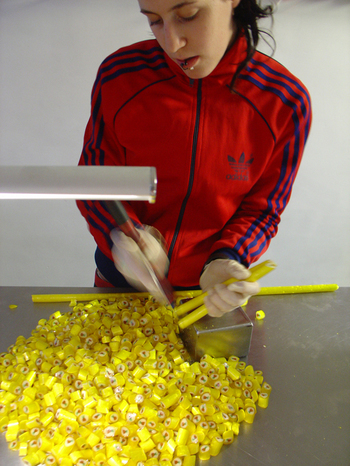
Loyal culiblog readers know that I'm not a big fan of sweets, but sometimes sugar is coaxed by masterful hands into shapes and colours so beautiful, and with flavours so delicious, that it's all I can do to keep from hauling off and giving it a good lickin'. At the moment of writing, I'm popping acid drops, one after another into my mouth and sucking them so violently, that I shall surely be giving myself a blister.
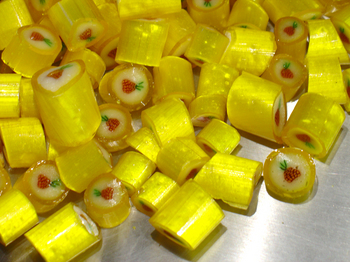
Which brings me to papabubble, the source of these acid drops that are doing all the damage to the roof of my mouth. When I returned to Amsterdam this Autumn, a new shop had occupied Harlemmerdijk 70, and I became a fan of their candy straight away. Inside the contemporary interior, a noble candy is being produced right before your very eyes. You feel like a child oggling the sculpturally shaped sugar. The concept belongs to Australian papabubble originators, Tommy Tang and Christopher King, who opened the first shop in Barcelona in June 2003, but it was Marieken van den Brink, who studied artisanal candy-making with them, that brought the concept to the Netherlands in 2004. For this she won a Marie Claire Starters Award in 2004, turning her dream and her lolly import business (Lulu Loves Lollies) into papbubble Amsterdam. Nice one. Here's some money, now go and make some candy.
But it's not just candy. It's a very pure, playful and artisanal product that she and her partner, Dominik Otto, and his sister Marie Otto, are making in the Amsterdam shop. It's all very old-fashioned and sweet. They live upstairs above the shop, and just like in a fairy tale, afternoons the place is a'swarm with children and single women, straight from school and yoga class, that have come in to watch the candy making process and get offered tastes of free candy by the smiling sugar pullers.
What I most love about what is going on at papabubble (aside from the high level of craftsmanship and amazing flavours of sour) was that the molten sugar is truly played with by the candy makers, Dominik and Marie (brother and sister). They don't throw away the candy ends but turn them into blobbous sculptures and sell them in that form. These blobs of sugar will make a beautiful centrepiece (did I just use the word centrepiece?) at my next dinner party as a communal after-dinner sugar-lick.
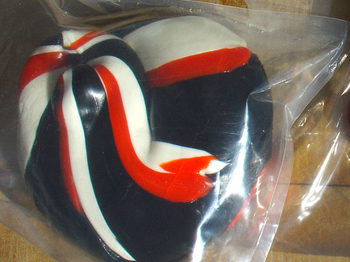
More conventionally (but not really) are the hard candy rings, which of course make a right mess if you wear them, but if you're a child, or if you're in love and in the mood, they'll be just the ticket.
'Hon, lick my finger?'
papabubble
Haarlemmerdijk 70
1013 JE Amsterdam
tel +31 (0)20 6262662
fax +31 (0)20 6267654
www.papabubble.nl
images l to r: Candymaker Marie Otto cuts rolls of hardened sugar into pineapple hard candy, closeup of pineapple candy, a blob of sugar that will feature at my next dinner
Please read more... "Papabubble is pure sugar finger lickin'"
Posted by debra at 02:13 PM | Comments (2) | post to del.icio.us
All I really really want is locative food
October 01, 2005

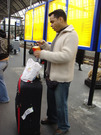

That is, food that tells me where I am and where it's from by it's very name and nature (without the use of an RFID tag). And all I really really want is to have one major train station and one major airport in one country that sells food that is not created by food product designers but by local people from local ingredients and reflecting the diverse local food culture already present.
Imagine Amsterdam's Schiphol Airport... Could the experience of Schiphol be enriched if you knew that this was the only airport in the world where you could exclusively buy locally grown and produced Dutch food and regional specialities? Was it already one and a half years ago that Doors of Perception and Urban Unlimited organised a cultural experts meeting for the city of Breda, a new node on the line of the High Speed Train. If I recall correctly, we recommended just this very thing.
The images above were taken within a period of 4 minutes. Friday afternoon, chip eaters abound at Amsterdam Centraal Station. Just imagine the possible effect on the environment and the state of agriculture and upon the local economy if these chips were made from a diverse range of local potatoes, fried in oil grown and produced locally. Imagine if you could order chips from a menu sporting 8 different kinds of potato! Imagine if the product of the finger fried potato embraced diversity.
And then there's the mayo...
And the knowledge economy that could sprout up from bringing the local boutique producer's products to the transportation hubs of the world...
Frites eaters: images of people eating chips taken on Friday September 30, 2005 from 16:23-27 at Amsterdam CS and on the train to Rotterdam.
Posted by debra at 09:53 AM | Comments (2) | post to del.icio.us
Oh to utter the words, food design...
September 28, 2005
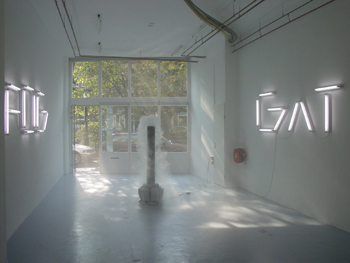
Well it's about bloody time! Coinciding with all manner of design events going on right now in Amsterdam, the Stedelijk Museum hosted a symposium titled Food Design at the ubiquitous Club 11, featuring three speakers and three completely different interpretations.
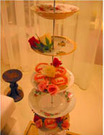
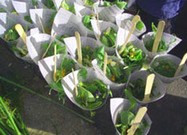
Marije Vogelzang (Proef) is doing some very interesting work from her studio slash catering laboratory and counts the stars of Dutch design (such as the Ladies Hella Jongerius, Marlies Dekkers and Li Edelkoort) amongst her clients. After a stunning portfolio presentation, I can't wait to visit Vogelzang's restaurant in Rotterdam Proef and get down to the business of tasting and nibbling. (Proef means 'taste' or 'taste it', in Dutch.) Vogelzang's work is all about engaging the eater in the underlying concept of the food and its presentation. I loved her daring in a recent catering project in which she used WWII ration ingredients to invoke memories about this bleak period. She elegantly walks the fine line between being thought provoking and utterly disarming when she stated, 'It's design that someone puts in their mouth, and absorbs into their body. It's all very intimate'. That's what I call a laudable attitude!
Although it wasn't the most pleasant message to hear, I can't stop thinking about the corporate presentation by Hans van Trijp from Unilever. Food design according to the multinational means designing the market context in which a food product exists, and has very little to do with actual food. Van Trijp described Honig's SpongeBob pasta as the perfect marriage of food design and marketing. Predictably, I found van Trijp's take and food and food design extremely disturbing, but I am so very eager to get in touch with him to hear more of what he has to say about how multinationals, even when we wouldn't dream of buying their products, influence our every day life right down to the iggly niggly bit of designing a country's infrastructure. This means that while Marije Vogelzang is designing a lunch using 'forgotten vegetables', Unilever, by the very virtue of it's market share, is determining which races of grains farmers will be growing and how food will be manufactured and distributed in decades to come. I just can't help but think it's a wise idea to keep in close contact with the suits. I'm just as much a stakeholder as the next Lady, right?
Ex-designer and unwitting stand-up comedian Marti Guixé as per usual wowwed the audience with a portfolio presentation of more than a decade's worth of food-related projects. He is the well-known Catalunian ex-designer that has worked extensively with shoe brand Camper, and ultimately designed their flagship restaurant, Foodball, in Barcelona. Balls are something of a leitmotif in Marti G's gastro-design as you can see from this author's review. It might have been just the unfortunate lighting, but while presenting images of his 'corporate sponsored food', (in this case an omelette with a sauce-stamped Calvin Klein logo), Guixé claims to have noticed van Trijp's lip twitch.
Although I'm not willing to spill the beans just yet, I am looking forward to Guixé's collaboration with Mediamatic in just a few week's time. Guixé and Mediamatic will be opening up a temporary restaurant in the basement of the former TPG builiding where you'll... read about it in culiblog.
images from l to r: Vogelzang's salad course of city leafy greens (served with grilled pigeon breast), hanging etagères made of 2nd hand plates designed by Vogelzang for Dutch fabric producer de Ploeg, Gin and Tonic Fog Party by Marti Guixé (artificial indoor fog made of gin and tonic at Casco, Utrecht). The above images are from the (ex-)designers' websites, © and hopefully also courtesy of Vogelzang and Guixé.
Posted by debra at 09:03 AM | Comments (6) | post to del.icio.us
Salad Song
August 26, 2005
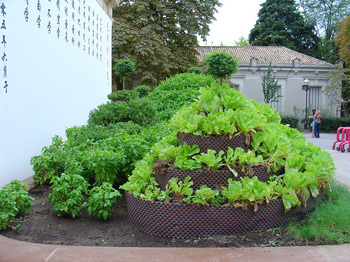 By now we are all well aware of the profound relationship between the citizens of Bejing and Montpellier. Therefore it should come as no surprise when the Occitanian cultural powers that be deem it high time for an 'international biennial' of Chinese contemporary art in their fair city. And why the heq not, if every other city can have one why shouldn't Montpellier?
Of particular interest to me was Song Dong's (Beijing, PRC) leafy greens installation at the entrance of the Pavillon du Musée Fabre. The work is titled, 'Art after Da Zhai' and I have done my best translating the programme description thusly:
By now we are all well aware of the profound relationship between the citizens of Bejing and Montpellier. Therefore it should come as no surprise when the Occitanian cultural powers that be deem it high time for an 'international biennial' of Chinese contemporary art in their fair city. And why the heq not, if every other city can have one why shouldn't Montpellier?
Of particular interest to me was Song Dong's (Beijing, PRC) leafy greens installation at the entrance of the Pavillon du Musée Fabre. The work is titled, 'Art after Da Zhai' and I have done my best translating the programme description thusly:
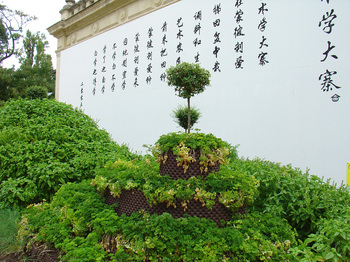 Song Dong uses one of Maoist China's most important political catchphrases, "Agriculture takes example from DaZhai." In the Sixties, the peasants of this village of Shanxi multiplied their grain production by seven and Mao Zedong presented Da Zhai with the 'red banner'. The mountains carved in terraces by the farmers became a political emblem.
Please read more... "Salad Song"
Posted by debra at 01:06 PM | Comments (0) | post to del.icio.us
Lolly Lab
June 28, 2005
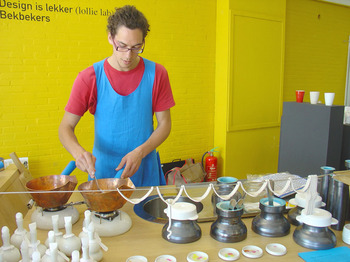
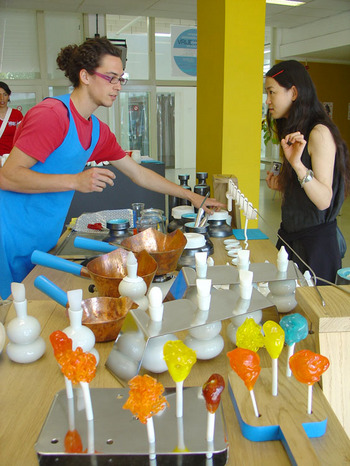
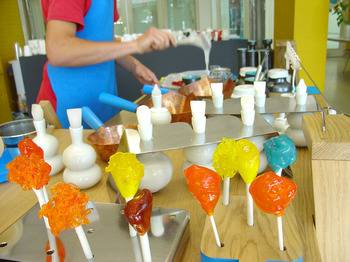
Imagine my delight last Sunday when the very first work I see at Arnhem's exam show is Bas Kools' Lolly Lab. Kools is a freshly graduated designer with fine prospects for the future. He'll attend the RCA in London next year.
What I loved most about Kools' setup was that he put the prototypes into a playful context. He seemed to have thought of everything; the playful array of lolly sticks, sugar melting copper pans, ceramic pots and recepticals, the vessels containing the flavours and colours, palet dishes, a working lab unit with gas burners (water?), air blowers, lolly holders in metal and rubber, bottle stops, display, etc... Kools has an interest in finding ways to make 'design' 'accessible'. But some of the sexier shapes of the lolly holders and the rubber slings reminded me immediately of the details hidden (and thus showcased) in a Matthew Barney work. Not bad.
And this leads me to my wee critique of the work. Kools designed a lolly laboratory, a perfect context for his range, so where are the experimental lollies? It is a pity that in this instance, Bas used standard flavours, colours and non-designed shapes for the lollies themselves. It would be worthwhile investigating working with a chef or someone with a developed and outspoken culinary aesthetic to create flavours, colours, textures and shapes as alluring and expressive as the other parts of this lab and installation. The well-designed utensils, if they are meant to be accessible, should serve and even contribute to the experimentation that is going on in the lab. There is still plenty of space for this to happen in the future. I certainly would be willing to give it a go; the Lolly Lab gave me itchy fingers.
Please read more... "Lolly Lab"
Posted by debra at 10:21 AM | Comments (4) | post to del.icio.us
I would have been satisfied with less
June 27, 2005
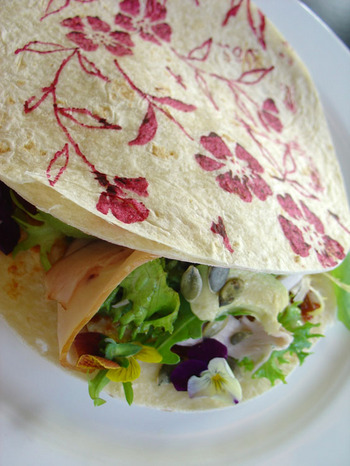
Café Dudok in Arnhem prepared a special menu in honour of the Arnhem Fashion Biennale. Dutch Art Institute student, MuXue and I were visiting Arnhem for other reasons entirely but we did manage to end the day with an hors d'oeuvre and dessert at said café. The starter, a smoked turkey avocado and edible flower 'wrap', was printed in a floral pattern with cherry red pigment. It was most unfortunate that the pigment had no additional flavour because it would've been great if the pattern was made out of salsa picante for example, with an overlay of patterned guacamole and maybe cutout smoked turkey in pretty tailored shapes. Bring on les ruches!
Also the California-Dutch in me always feels inclined to let folks know that 'wraps' (let's just call them white flour tortillas from now on) really should be served warmed up to arouse the subtle flavours of the nutritional void that is white flour.
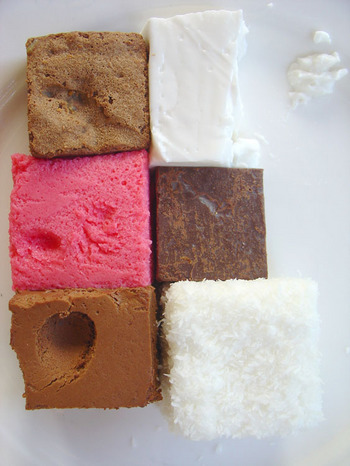
The dessert of this fashion menu was presented rather simply and therefore I reacted to the lack of pretension with less venom. Visually it reminded me of Allsorts licorice candy. It was a dessert of blocks and a worthwhile array of textures, had some of the flavours not come from directly out of standard bottled essences. MuXue and I felt we were served far too much food, but that's something that seems to be inescapable these days. The service was great by the way, and this is a rarity in a café in the Netherlands.
Squares from top left and top to bottom: walnut fudge brownie, bitter almond pannacotta, raspberry bavarois, dark chocolate-raisin fudge, cake au mousse au chocolat, coconut snowball. The finger pokes in the mousse and in the raspberry bavarois are the author's own.
Please read more... "I would have been satisfied with less"
Posted by debra at 06:46 AM | Comments (4) | post to del.icio.us
Art is, art was fluid last Sunday
June 08, 2005
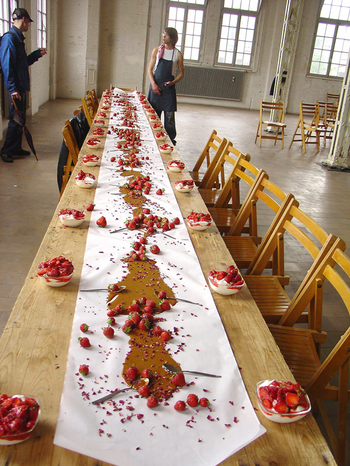
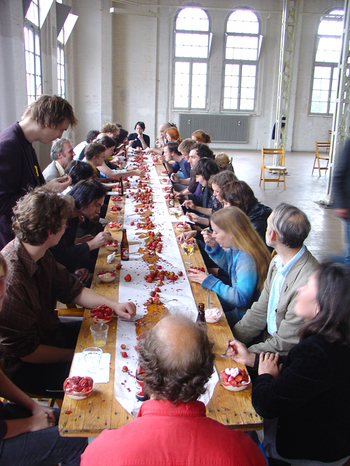
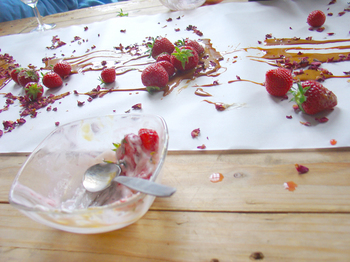
Due to the good company and delightfully engaged audience, artist initiative Artis in Den Bosch showed this Sunday (05.06.2005) that they really know how to throw a happening. Margriet Kemper opened the salon with a presentation of her book, Speak, Image! (unfortunately only in Dutch) in which she talks about how the image is actually a performer. Kemper cited Allan Kaprow, the Daddy of the Happening, explaining to us the choice of the title of the event, Art Fluid.
A.K.: 'I want the line between art and life to be as fluid as possible'.
A presentation of culiblog was next on the menu followed by a breathtaking poetry reading by Robert Gray (AU) and the Dutch translator of Gray's work, Maarten Elzinga. Wafts of rosey caramel in-the-make were the only distraction as both Gray and Elzinga read for the better part of 42 minutes to a rapt audience.
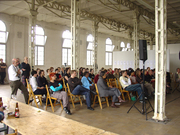
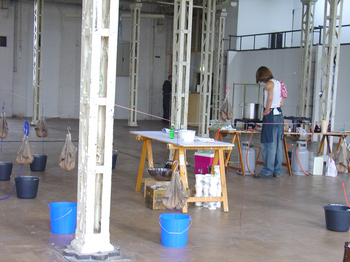
Now there's only so much reflection and interior thought that an audience can take, and just when we thought we would forever be living inside of our heads, the shy noise band, SPASM performed invisibly from the guts of the cavernous gallery. It was just the lightness that the moment needed and everyone started to beam with smiles so broad they barely fit on their faces. Everyone except the young children who ran around annoyed with fingers in their ears.
What could be a better follow-up to a poetry reading and a concert of noise than a cookery presentation! Together with my fabulous assistants, Stefano and Kaj, I rejoiced in showing other Dutch people how to make the traditional Dutch 'hang-op'. The hang-op had been dripping whey all the livelong day in linen bags hanging from pink string, defining the space of the kitchen. Stefano removed the linen bags from meathooks and helped Kaj scrape out the 'hung' yogurt from within. Kaj then proceeded to beat to a satiny smooth consistency, the yogurt with rose flavoured whipped cream. I know, it was very, very sexy.
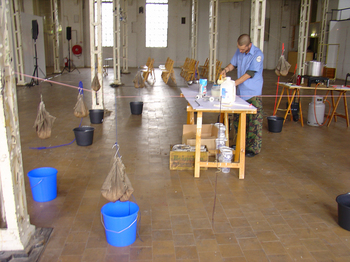
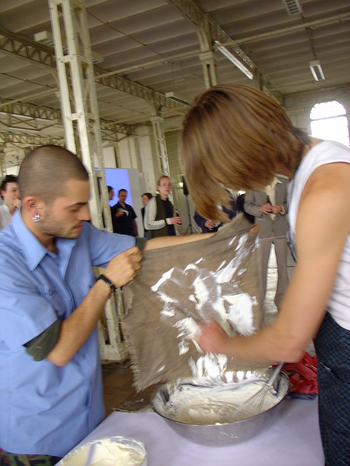
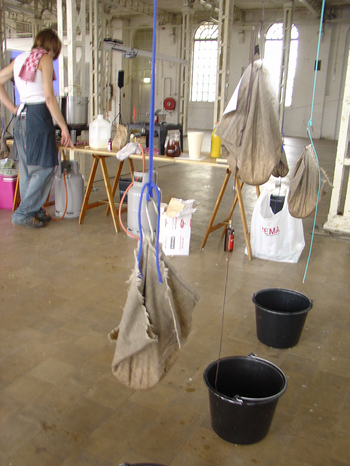
While the audience enjoyed a film by Annika Ström and a presentation of Jan van Toorn's (re)releases from the oldies but goodies of avant-garde sound-art, Kaj and Stefano prepared the banquet table with rose petals, rosey caramel, organic local strawberries and little bowls of hang-op.
Aan tafel, I sort of whispered into the microphone.
Please read more... "Art is, art was fluid last Sunday"
Posted by debra at 09:57 AM | Comments (4) | post to del.icio.us
Restaurant for anorexics
May 05, 2005
Sehnsucht, (means longing in German) is the name of a Berlin restaurant for anorexics. Owner Katja Eichbaum, formely anorexic, started this project with private funding (only her father would lend her money) as a therapy for her own condition. The chef is anorexic as are several members of staff. Sehnsucht's menu items have names that don't include words for food to avoid confronting anorexics with the fact that they are about to eat. 'Hallo' (lobster bisque), 'Pirate's Eye' (2 fishfingers and a fried egg), and 'Heissehunger' (ravenous hunger = rack of lamb) are all dishes that non-anorexics might order in 'normal' restaurants. But one item on the menu consists simply of a fork, knife, and an empty plate. It is titled 'Thieves Platter' and facilitates the anorexic diner to steal (or share) from those dining with her.
As expected the restaurant has received a huge amount of international publicity. And although I have not yet eaten at there, relying solely on restaurant reviews to inform myself, if Sehnsucht is an attempt to create a location for anorexia patients in the guise of a regular restaurant for the people that love them, it is also a wasted opportunity.
Why not revel in anorexia? Why not serve food items so refined and 'stretched' like anorexics themselves create on the spot each night at the family dinner table? Anorexics are master chefs and food stylists when placed in the harsh context of the family; hardboiled eggs with the yolks surgically removed, crackers deconstructed so that their total surface area has been increased twenty-fold, slices of bread with each visible grain extracted and displayed on the edge of the plate, utterly dissected broccoli. I say this without having seen Sehnsucht's menu but hope sincerely that it is not just another do-gooder resto in which the real food on the menu functions only to lure the paying and eating guests.
Please read more... "Restaurant for anorexics"
Posted by debra at 08:38 AM | Comments (4) | post to del.icio.us
Fish and Chips, Surinam Style
January 30, 2005
Telo is my favourite dish from Surinam. Delicious shredded salt cod piled upon deep fried casava with Madame Jeanette salsa fresca dumped in the corner of a plastic container. A completely inadequate coloured fork features prominently in the visual but serves no other purpose.
Typically I drink the only softdrink that I like, young coconut drink, flecks of coconut flesh floating around in the can and clogging up the straw. In my opinion the best telo in the Netherlands can be found at Cong's Corner in Rotterdam and every single time that I go to Rotterdam I look forward to eating at this completely unglamourous snackbar on the corner of one of the most museum-filled street on Earth. I'm here for the Rirkriit Tiravanija retrospective at the Boijmans van Beuningen where I also enjoyed the Anri Sala films. My friends Quirine Racké and Helena Muskens' film Celebration is in premier at the Lantaren Venster.
Posted by debra at 10:47 PM | Comments (2) | post to del.icio.us
Brain Food
January 20, 2005
This terribly sad but well written book by Mark Kurlansky is a gripping history from the perspective of the cod. Kurlansky tells how fishing for this gadiform has deeply affected the wealth and development of many nations and technologies. I'm thinking the Flounder by Gunther Grass that I read back in the day but even more I'm thinking Fish Story, the mega-artwork by Allan Sekula, about the 'sweatshop called the Pacific'. (Sekula's visual history Fish Story was part of the the last Documenta XI in Kassel. One photograph in particular gave me goosebumps. You see a ship painter giving the Exxon Valdez a new name...fishy stuff.)
It turns out that cod in the form of stokvis (wind dried cod) turned out to be some good thinking-man's protein for the Norsemen. That extra portable brain-power enabled them to encounter New Foundland in 1000, where they also encountered the Beothuk People who had already discovered it and were not enamoured with the idea of sharing their space with the pink and hairy people from across the puddle.
Basques added salt to the stokvis recipe to make salt cod increasing the quality of the preservation and enabling Basque fishermen to to travel even farther - to the mouth of the St. Lawrence river. When explorer Jacques Cartier got there raring to claim his 'discovery' he encountered almost a thousand Basque fishing vessels. And a bunch of angry native Beothuk people getting pissy about the incessant attention.
Cod is inextricably tied to land (to dry it) and salt (to preserve it) and Salt is in fact the title of another one of Kurlansky's wonderful books.
Posted by debra at 08:54 PM | Comments (3) | post to del.icio.us
Juicing, but not frothing, and you?
January 06, 2005
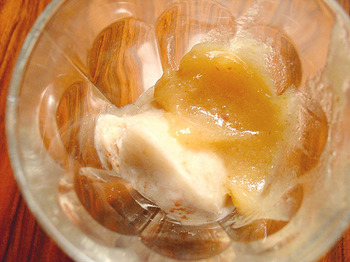
So far this juice fast has yielded quite a number of discoveries, the usefullness of oat milk being one of them. In my opinion grain and nut milks qualify for a juice fast because they are simply the wrung out water in which grain or nut meal has been soaking. These 'milks' don't give the gut flora anything more to do than a glass of apple juice does but they are useful in making things taste 'creamy'.
Other discoveries concern how to make 'comfort food' for the fast yet maintain its nutritional value. Roxanne Klein (and all raw foodies) feel that valuable enzymes in vegetables and fruits are destroyed when heated above 50°c. For this fast I've kept to this parameter while still being able to serve up some warm soup on these cold Occitanian days.
Here are a list of some of the liquids that my ruthless jury has deemed delicious enough to sip even when not on a juice fast: (This is not a menu.)
Cucumber Kiwi Juice
Kiwi Zucchini Juice
Pineapple Juice (fresh squeezed is entirely different from the storebought stuff)
Carrot Grapefruit Juice
Celery Juice
Avocado Zucchini Soup
Celeriac Oat Milk Soup
Green Curry and Carrot Soup
Broccoli Stalk, Zucchini Soup with Guacamole Dumplings
Red Pepper Tomoato Miso Flower Broth
Date and Pear Sorbet (pictured above)
Banana Chai Ice Cream (pictured above)
Pear Sorbet
The juicer that I am borrowing from Fred and Kristine for the duration of the fast is a real Cadillac (Magimix Le Duo). Only crit about this machine is that it doesn't produce foamy froth - like my Braun back in the Heimatt. I think that some of the recipes could be improved with new texture additions. At home I use the foam from the juicer.
Posted by debra at 10:46 PM | Comments (2) | post to del.icio.us
Milk tasting, and you?
January 05, 2005
As I said, not eating solid foods affords you a chance to try new things. Tonight we did a little experimental milk tasting. Because we're on a juice fast and generally behaving as self-righteously as we can we decided to bypass the locally produced cow, sheep and goat varieties and test the locally imported almond, rice and oat milks.
Oat milk was the clear winner in the category; Tastes Like Something I Might Drink Even When Debra Isn't Forcing Me.
Please read more... "Milk tasting, and you?"
Posted by debra at 10:19 PM | Comments (0) | post to del.icio.us
Re-enact creaming
December 13, 2004
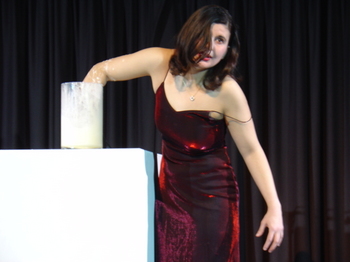
Mediamatic and CASCO's performance night titled Re-enact was rife with food related performance art. My absolute favourite performer was Nezaket Ekici who oh so diva-liciously turned cream into butter with her bare right hand. It took 24 minutes or thereabouts. Everyone was aswoon!
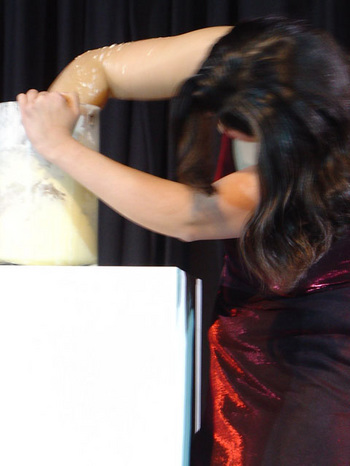
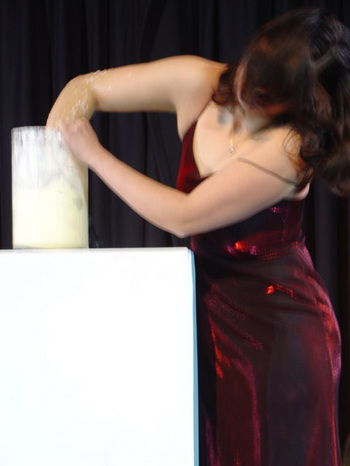
Please read more... "Re-enact creaming"
Posted by debra at 01:47 PM | Comments (0) | post to del.icio.us
Adam is the genuine article...
November 23, 2004
The very attentive Adam Kuban raced over on his, his, (whatever sort of motorcycle he's riding) to assure me that his weblog Slice is purely about offering the best possible pizza fieldguide and not about I-Pod applications, 'not that there's anything wrong with that...'
One lengthy browsie-browse later and I can't argue with him. Kuban has done his homework, meticulously logging it all onto his I-Pod (and generously sharing it with the world). I'd trust him to find me a slice. Take a peak at Slice or read an interview from the Gothamist about Adam. I have other questions that I prefer to ask in private first. ; )
Posted by debra at 12:10 AM | Comments (3) | post to del.icio.us
Sunday Tea, Fruit Boom
November 14, 2004
We can all use a bit more para so a visit to the Witte de With Paraeducation Department was the order of the day, this Sunday. The salon-format programme titled Facts of Chance (authored by artists Anne Schiffer, Marcel van den Berg, and Frank Koolen) was satisfying, like when the cookie tin stays open; an interesting collection of videos, slideshow, film and included a performance by Koolen. Pictured above is an inadvertent recipe featured in the slideshow titled Fruit Boom or in English, Fruit Tree. Now is that fruit + balance or fruit + skewer + time?
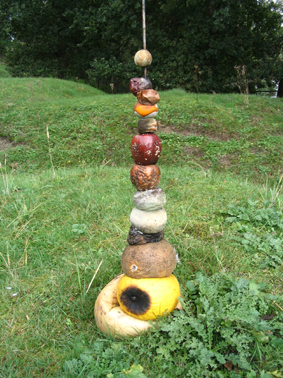
(images courtesy of Frank Koolen)
Please read more... "Sunday Tea, Fruit Boom"
Posted by debra at 07:44 PM | Comments (0) | post to del.icio.us
Fade to Beige
November 06, 2004

What, you don't like my spork? It is designed by Pandora Design in Italy and is called Moscardino.
Please read more... "Fade to Beige"
Posted by debra at 08:26 AM | post to del.icio.us
Taking Cashew Cheese Seriously This Time
November 04, 2004
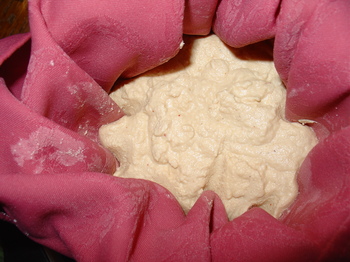
In my October 6th entry I report on buying R A W and how it made me nostalgic for the vegetarian classic, Laurel's Kitchen. I said I was going to take cashew cheese seriously these time and I am a woman of my word. Roxanne Klein's recipe calls for 'fermented bean water' but I just used kim chi (pickled cabbage) juice to sour the nut mash - worked great.
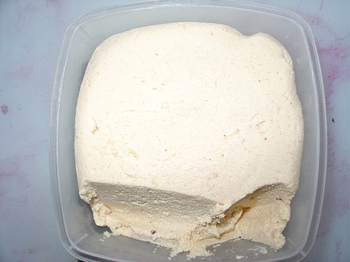
It's not called cheese because it tastes or feels anything like cheese - but it's really delicious, delicious enough to eat frequently. It will suffice for comfort food in these grim days.
Please read more... "Taking Cashew Cheese Seriously This Time"
Posted by debra at 09:28 AM | Comments (2) | post to del.icio.us
Learning through your Ass: The Return of Laurel's Kitchen
October 08, 2004
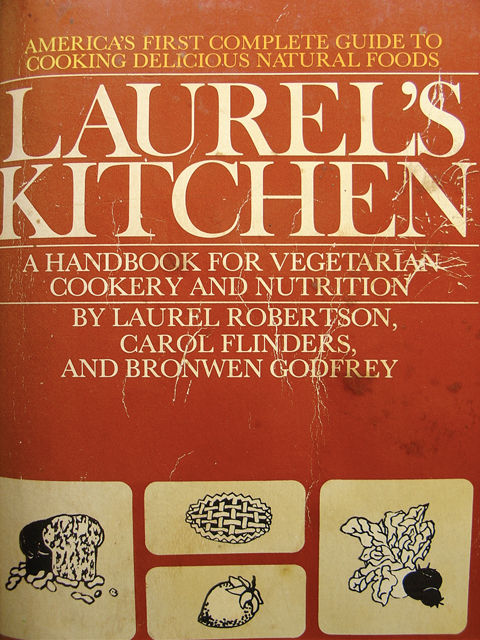
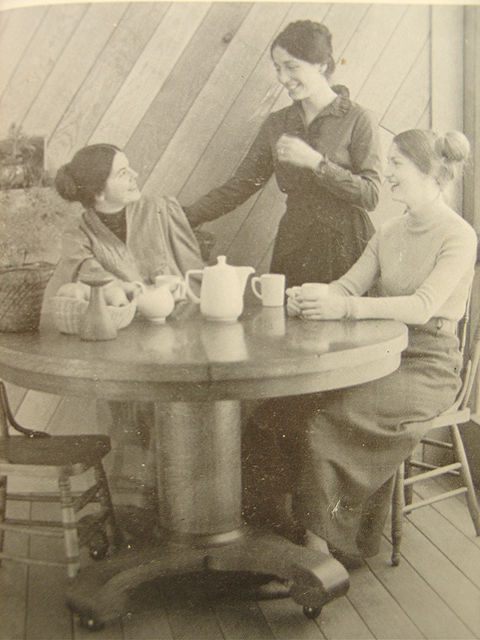
When I became a vegetarian at the tender age of 13, my parents, fearing that I would stunt my own growth gave me what was considered at the time to be a good introduction to vegetarian nutrition, amino acid chains and global food politics. It was my first cookbook ever and its pictureless recipes for soy-milk, cashew cheese and other 'technically advanced' foodstuffs threw me completely for a loop.
It was California in the 70's but my Mom wasn't about to go foodshopping in a store filled with goat-knitting long-hairs smelling like garbanzo farts, and I didn't know that you could simply go to an Asian supermarket and BUY a ready-made block of tempeh. So when one of Laurel's recipes called for say, soy milk and said, (see recipe page 138) I would actually make the soy milk - often with unsavoury results.
Due to a series of 'intrusive kitchen disasters' my mother decided that I could only do the big preparations for the week's food on Sunday. (Not the fresh things, just the... legume-rich things.) Considering that I had turned the family kitchen into a soybean laboratory it wasn't entirely the cruel thing to do. I would prepare my vegetarian food for the week ahead and microwave it warm each day. For an experienced cook, preparing food in advance wouldn't have posed much of a problem but I had very little PRACTICAL cooking experience. I couldn't tell beforehand if a recipe was difficult and mistakes I made on Sunday were the grits on the table the livelong week. This educational technique is known in some cultures as 'learning through your ass'.
I was cooking outside the repetoire of my family and Laurel wasn't helping. Laurel's Kitchen, although an amazing source of 1970's California anthropology was absolutely a crap book for an inexperienced cook.
But yesterday when I brought home Roxanne Klein and Charlie Trotter's R A W, the first thing I did was pull Laurel from my shelf for one more read.
Please read more... "Learning through your Ass: The Return of Laurel's Kitchen"
Posted by debra at 01:09 AM | Comments (7) | post to del.icio.us
Learning through your Ass: The Return of Laurel's Kitchen
When I became a vegetarian at the tender age of 13, my parents, fearing that I would stunt my own growth gave me what was considered at the time to be a good introduction to vegetarian nutrition, amino acid chains and global food politics. It was my first cookbook ever and its pictureless recipes for soy-milk, cashew cheese and other 'technically advanced' foodstuffs threw me completely for a loop.
It was California in the 70's but my Mom wasn't about to go foodshopping in a store filled with goat-knitting long-hairs smelling like garbanzo farts, and I didn't know that you could simply go to an Asian supermarket and BUY a ready-made block of tempeh. So when one of Laurel's recipes called for say, soy milk and said, (see recipe page 138) I would actually make the soy milk - often with unsavoury results.
Due to a series of 'intrusive kitchen disasters' my mother decided that I could only do the big preparations for the week's food on Sunday. (Not the fresh things, just the... legume-rich things.) Considering that I had turned the family kitchen into a soybean laboratory it wasn't entirely the cruel thing to do. I would prepare my vegetarian food for the week ahead and microwave it warm each day. For an experienced cook, preparing food in advance wouldn't have posed much of a problem but I had very little PRACTICAL cooking experience. I couldn't tell beforehand if a recipe was difficult and mistakes I made on Sunday were the grits on the table the livelong week. This educational technique is known in some cultures as 'learning through your ass'.
I was cooking outside the repetoire of my family and Laurel wasn't helping. Laurel's Kitchen, although an amazing source of 1970's California anthropology was absolutely a crap book for an inexperienced cook.
But yesterday when I brought home Roxanne Klein and Charlie Trotter's R A W, the first thing I did was pull Laurel from my shelf for one more read.
Please read more... "Learning through your Ass: The Return of Laurel's Kitchen"
Posted by debra at 01:09 AM | Comments (7) | post to del.icio.us
Ik lust je R A W
October 07, 2004
Wing flapping all around! Today I indulged myself and bought a cookbook that I have wanted to own for quite some time. R A W by Roxanne Klein (a culinary approach to vegan and raw food cooking) with Charlie Trotter, one of the US's most innovative chefs. Regular readers know that porkatarians like me can't also be vegans but I am still so very excited by this pairing of the minds.
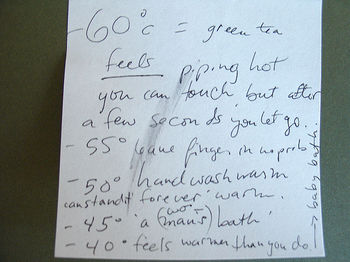
A browsiebrowse through and so far there are lots of recipes that look like watermelon spit-up (maybe she took Trotter's 'froth thing' a little bit too literally) and I think that bit about preserving the enzymes is a load of halookie. If you put a blended something in a dehydrator for 5 hrs I doubt very seriously that there will be any 'living' quality left in the foodstuff. TEST: Put yourself in a sauna for 5 hrs and see how you feel. Now imagine yourself to be a carrot!
B U T
The book is brimming with beauty, love of a rich variety of ingredients and new techniques (new since *Laurel's Kitchen) and I swear I'm going to take cashew cheese seriously this time.
* You're going to have to wait until tomorrow's entry about Laurel's Kitchen, written in 1976 it was THE quintessential bible of Californian hardcore vegetarianism.
Posted by debra at 05:52 PM | Comments (2) | post to del.icio.us
Google Recipe Finder
October 02, 2004
The fabulous R.vT. came up with this Google Recipe Search link.
http://theory.stanford.edu/~amitp/recipe.html
Forget typing in turkey, or wild boar. It's just a search engine, go crazy and try tofurkey + lemon curd or monkey + banana + camenbert! Suddenly nothing seems wierd anymore. (Does this mean that I miss China?) Anyway, it's Sukkah, a Jewish harvest holiday conveniently scheduled each Autumn when 'God wants you to try eating something new'. Yeah.
Which reminds me, my brother Aaron made up a game when we were little in which the sole aim was to make the other person barf. The rule was that you had to concoct a mixture of edible substances (no poison allowed) and dish it up to your sibling � and they had to eat or drink it. Yes. Try it sometime, it's much harder than it sounds.
In this game we discovered that toothpaste is surprisingly versatile as an ingredient. Aaron came up with a toothpaste-orange juice and tabasco sauce smoothie that was fairly effective in getting me to gag and I came up with a peanutbutter and toothpaste sandwich which was impossible to swallow. Toothpaste, who would've thunk it?
R.vT. offered to shop for me since my ankle was sprained Wednesday in a bike accident. It's difficult for me to accept graciously because I am able to stand and walk. Even so, he was a right sweetie today and helped me do my shopping at the hippy market. This is what it's going to be like being an old lady. Carrying a shopping bag with the aid of a friend.
(Respect also to the super lief MM, who cooked and shopped and was a rock of gezelligheid when I couldn't walk, as well as neighbours GS and BK who brought packs of frozen beans to discourage swelling.)
Please read more... "Google Recipe Finder"
Posted by debra at 10:35 PM | Comments (0) | post to del.icio.us
Taiwanese Bean Beverage
July 01, 2004
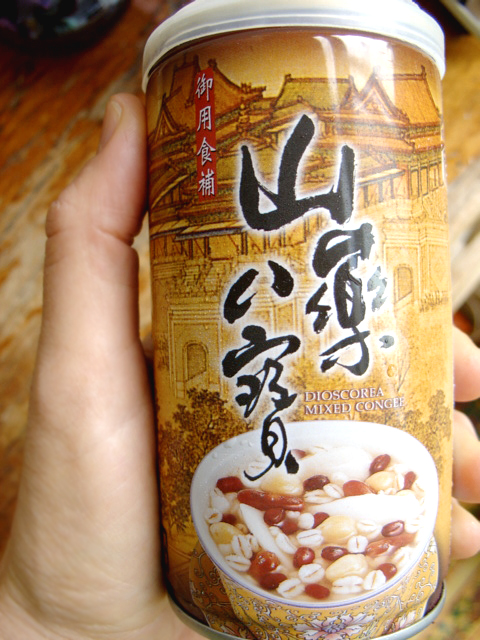
Yesterday Dan said that Latvians are lucky.
But today is another day and for breakfast I decided to serve up this Taiwanese Bean Beverage to my Latvian guest *Emils. Just a little good morning experiment. Emils remained cheerful throughout the tasting although shortly after fulfilling his task as guinea pig he dashed out of the house supposedly to buy a shirt - but I think he hauled off and got a bagel.
Discorea Mixed Congee ingredients: water, sugar, adlay(?), discorea rhizome (?), chickpeas, glutinous rice, red beans, kidney beans, millet, oatmeal, oats.
* Emils Rode is a Latvian artist currently participating in the show BREAKTHROUGH in Den Haag. This exhibition in the Grote Kerk spotlights artists from the new European member states. http://www.grotekerkdenhaag.nl
Posted by debra at 02:41 PM | Comments (3) | post to del.icio.us
Smart Taiwanese Packaging (because you never know when you're going to want to tuck into that Discorea Mixed Congee snack that you've been stowing away in your purse for special occasions)
The spoons that come with the Taiwanese bean beverages that I bought yesterday snapped neatly into the lid. Unfold and click and you're ready to suck up all the goodness.
Posted by debra at 02:04 PM | Comments (2) | post to del.icio.us
About 10,000 EURO worth of ham
June 10, 2004
An image of the ham fridge at one of Barcelona's bistros. This is clearly the ideal way to store the serrano hams until the neat shavings land on a plate near your bread.
Please read more... "About 10,000 EURO worth of ham"
Posted by debra at 05:51 AM | Comments (2) | post to del.icio.us
Camper's Flagship Restaurant
June 07, 2004
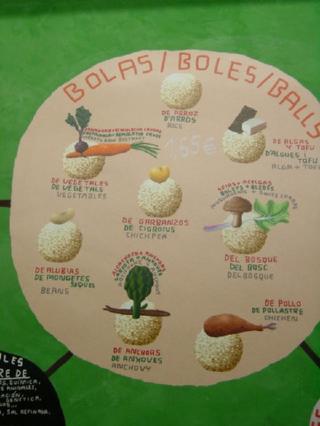
The wall mural menu at 'Foodball'. These last days in Barcelona I had the opportunity to meet up with designer Marti Guixé to talk about our food-related projects. He showed me the newly opened Camper flagship restaurant that he designed.
Please read more... "Camper's Flagship Restaurant"
Posted by debra at 11:34 PM | Comments (1) | post to del.icio.us
Camper's Flagship Restaurant
The wall mural menu at 'Foodball'. These last days in Barcelona I had the opportunity to meet up with designer Marti Guixé to talk about our food-related projects. He showed me the newly opened Camper flagship restaurant that he designed.
Please read more... "Camper's Flagship Restaurant"
Posted by debra at 11:34 PM | Comments (1) | post to del.icio.us


