
A nut cheese nut case
June 25, 2006
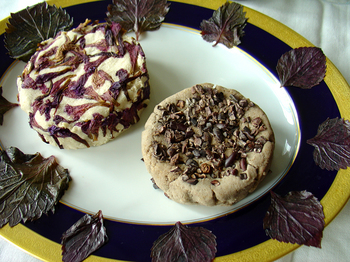
On the left, homemade pine nut paté with borage flowers. One the right, walnut paté with raw cocoa nibs. Normally this sort of food preparation is reserved for vegans, hippies and raw foodists. I am none of the above, a red-blooded porkatarian, I am. One of my readers disclosed that she thought that I was a man until a friend told her differently!
Anywho, this year I became an enthousiast of slightly fermented nuts, and I know, that’s just plain faggy. Not that there’s anything wrong with that! The nut flavours are delicate and would certainly go well with dairy cheeses. Note how I didn’t say, ‘real’ cheese?
(The leaves at plate’s edge are rose and mirin pickled shiso or perilla.)
To make these cheeses, follow the recipe for cashew cheese here, and substitute pine nuts or walnuts for cashews. Do not omit the sea salt, but do leave out the kimchi juice. Kimchi juice will make the cheese really cheesy - and these cheeses deserve to be a little sweeter than that. Instead, add a few glugs of maple syrup or a slab of honeycomb whilst blending.
Posted by debra at 12:06 PM | post to del.icio.us
Catchy, but not contagious
June 23, 2006
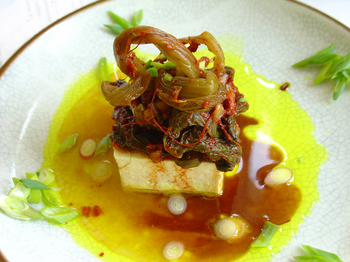
It was recently revealed in an offical report out of the Kimchi Nation that there are exactlly one zillion sorts of kimchi. Kimchi is a falsely generic term for the Korean national pickle and katchi is the mustard green variety pictured here.
Catchy Tofu
recipe described vertically, from bottom to top:
a puddle of saffron oil
stray scallions, strewn about
a block of fresh tofu
a stack of katchi
a drizzle of nama shoyu
Stack the ingredients voluptuously. Leak a few drizzles of nama shoyu over the lot until it starts to pool at the base of the tofu.
Serve.
- culiblog reports on the kimchi air conditioner
- culiblog recipe for kimchi comfort food
- culiblog recipe for kimchi monkfish en papillot
Posted by debra at 03:12 AM | post to del.icio.us
Master cleanser, for juice fasters and thirsty people
June 14, 2006
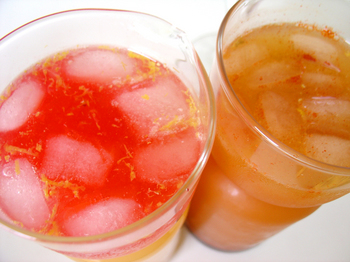
If you just think of this as lemonade, you might actually drink it. Master cleanser is the unfortunate name for a cayenne-spiked ginger lemonade, sweetened with maple syrup and sprinkled with sea salt. When you fast or do sports or simply exist in warm weather, it's wise to drink liquids that don't make you pee immediately. Most softdrinks, alcoholic drinks and all caffeinated liquids do this, removing the benefit of drinking for the purpose of hydration in the first place.
In this lemonade, the maple syrup and the fleur de sel allow the liquid to hydrate the body more thoroughy than if they weren't part of the mix. As a master cleanser, the cayenne and ginger are vasodialators and gently invigorate the gut.
If you're fasting, Master Cleanser is the sort of drink that you take with you and sip throughout the day. But if you just want a refreshing summer drink, call this Super Spicy Lemonade or rosé and do the exact same thing. You can even pretend you're fasting and be holier-than-thou, always a refreshing feeling and one of the least mentioned benefits of juice fasting.
Picture recipe after the jump.
Please read more... "Master cleanser, for juice fasters and thirsty people"
Posted by debra at 04:49 PM | post to del.icio.us
Juice fasting recipes, start with forgotten vegetables and then forget them again
June 13, 2006
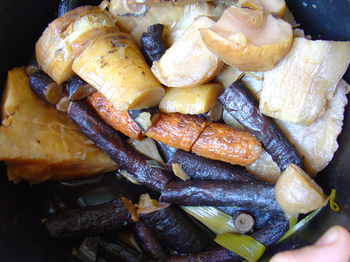
I'm the kind of gal that likes to pad her New Year's resolutions with seemingly achievable ambitions like, 'Improve handwriting' and 'Find ways to enjoy ancient root vegetables', but 5 months into the year, I haven't exactly achieved success in integrating parsnips and burdock into my winter diet in any significant way. When I returned home from Saturday's farmers' market loaded with fresh ingredients for a 5-day juice fast, I was confronted with a fridge half-full with ancient burdock, celeriac, carrots, parsnips, and a window sill of dried apples. The produce was definitely local, but in the course of some hecticity the past few months, had inadvertently become non-seasonal. I had created forgotten vegetables.
In the spirit of 'once a year whether you need it or not', I set to thoroughly cleaning out the fridge to make room for the new arrivals. Oddly, the pile of veg that didn't make the cut consisted predominantly of root veg, species hardy enough to survive extreme neglect. Not wanting to waste not, I gave the ancient grub a scrub and placed it in a large pot of water a'simmering over a low flame. Re-visiting the theme of forgotten vegetables, I simply forgot these vegetables anew. When every now and again I happened to remember them in the course of the next day, I just added some water or annointed them with a pinch of sea salt. I didn't even stir.
Yesterday I poured off the liquid, which left to its own devices had transformed itself into an aromatic vegetable bouillon, so delicious that VN and I felt positively blessed drinking it chilled from gold-rimmed shot glasses. Although I am not certain as to the nutritional value of this drink, I am certain that the initial slow-aging of the vegetables and the slow-drying of the apples is the reason that it ended up so flavourful. If you aren't forgetful, you could probably achieve this self-same result with fresh vegetables and a dehydrator, reducing the simmering time to boot. But I prefer to forget and let the soup just make itself.
Forgotten vegetable bouillon
2 kilos of mixed root vegetables; celeriac, parsnips, burdock, carrot)
4 wrinkly old apples, not rotten, just wrinkly and old
1 leek, very old but not rotten
big 'ol pinch of the sea salt
water straight out of the tap
Give the veg and fruit a good scrubbing. If it has been in the fridge for a few months, it really needs it. By the by, leaving the dirt on root veg (and even storing it in sand) keeps it fresher longer. That said, it's the optimism of washing off the dirt that caused these vegetables to dry so perfectly in the fridge over several months time that they retained all of their sugars.
Cut the root veg and apples with skin an all in a large pot filled to the brim with cold water and a big pinch of sea salt. Put the flame on low and if you must, cover the pot no more than half-way. Every four hours check to see what's going on, you may need to add water if you've evaporated too much. After at least two times of adding water and letting simmer, turn off the flame and let the liquid cool, lid off. Pour off the bouillon and use it as vegetable stock or as an ingredient in a root vegetable stock cocktail.
Posted by debra at 11:08 AM | post to del.icio.us
CPULs
when bad acronyms
happen to good people
June 09, 2006
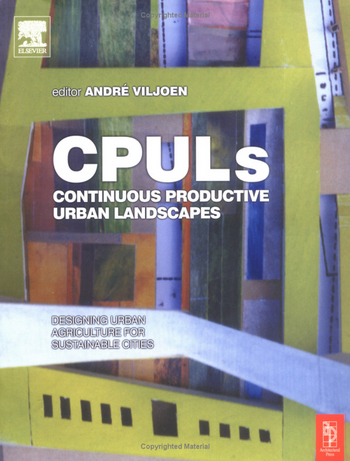
It's pronounced 'SEE, PULSE' and stands for Continous Productive Urban Landscapes. Architects Viljoen, Bohn and Howe's postively radical notion of combining productive urban landscapes with continuous landscapes, proposes a new urban design strategy that would change the appearance of contemporary cities towards an unprecedented naturalism. Think urban agriculture, allotment gardens, increased biodiversity, decreased carbon emissions and strategically connected green space - and you will start to get an idea of what the authors are suggesting. Although this is in no way within the scope of the book, never have I encountered a more holistic approach to urban planning that so thoroughly takes into account our imminent plunge into energy descent and the extreme effect that this will have on our food supply.
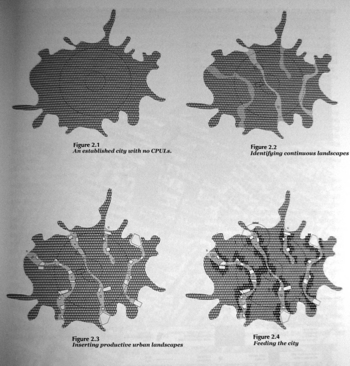
Diagrams showing a projected development of CPULs © Bohn & Viljoen Architects, reformatted for culiblog and used entirely without permission
Despite sporting a singularly unsexy title and a graphic design utterly devoid of charm, CPULs is a compelling vision for urban planners and (landscape) architects. The book is loaded with truly useful facts and case studies yet somehow remains a rivetting read for layfolk, comme moi. The authors were wise enough to begin the book with a succinct glossary defining all of the concepts so that within five pages you're already an adept at juggling terminology like vertical and horizontal intensification and you know the difference between an organiponico and a heurto intensivo.
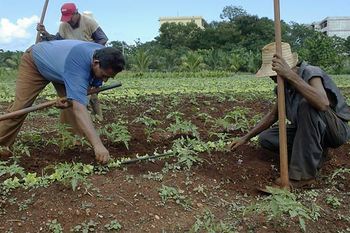
According to people who are in a position to compare, CPULs offers a rich documentation of UK allotment history and vivid reports of successful urban agriculture in contemporary Cuba, one of the few countries to have yet experienced peak oil. In 1990 when Cuba stopped receiving cheap juice from the Mothership and subsequently lost its largest client for agricultural produce, Havana citizens suddenly found themselves without access to sufficient food as expressed in 30% fewer calories in their diet! Instead of engaging in some futile rioting, they took up gardening en masse, and by gardening, I mean organic gardening. Later the government jumped on the bandwagon and started facilitating the urban agricultural effort in the form of responsible planning and infrastructure development. Presently Cuba is considered to be a living laboratory of how small urban farms and gardening collectives can successfully provide a significant portion of the urban food supply in spite of energy descent. Listen up, everybody! The CPULs authors were enlightened enough to note that a population accustomed to collectivism is more likely to be successful at community projects and that Northern European urban agricultural initiatives of the future will need to develop a native form to ensure their success.
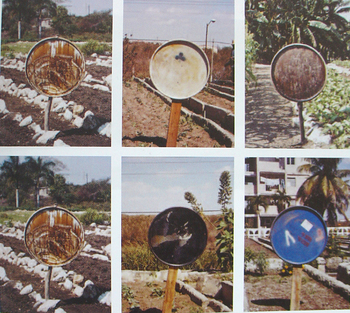
Oil drum lids used as markers in Havana organiponicos. Photos by Tom Phillips from CPULs used entirely without permission
CPULs' authors articulate the benefits and obstacles to their proposal and offer cogent strategies for creating city land use policy in which urban green and brown are treated as productive space, considering the unbuilt as an event of equal intensity as the built. A vision of a thriving CPULs in London 2045 provides a powerful scenario that I can imagine myself being a part of at any stage in my life. This is something I would not characterise as a common feature in most urban planning. In CPULs city planning the well-being of people is a central and distinguishing factor. In fact, its completely seductive.

A map of London expanded to accomodate mini- and SUPER-market gardens, from a 1998 study © Viljoen and Bohn Architects, photographed from the book and used entirely without permission
Robert Hopkins from Transition Culture weblog notes, 'It is only in the last 30 or so years that we have perfected the art of creating totally useless landscapes. New industrial estates and business parks typify this, planted with 'low maintenance' shrubs, specifically bred to be entirely unproductive.' Bohn and Viljoen point out that though European cities have planned for a variety of approaches to open space including urban parks, urban river fronts, urban squares, urban stages, urban forests and urban beaches, there are as yet no urban fields. 'Living and growing food in the contemporary urban space, CPULs could formally be similar to urban parks.' I am inspired by the notion that landscape architecture could be pivotal in designing for a future in which peak oil will have tremendous impact on the urban food supply.
As someone who writes about food and culture and as an an art and design educator, I cannot recommend this book highly enough. I hope that its concepts are embraced by those who are in a position to implement urban planning of this nature. The notion of CPULS deserves to feature prominently in design and architecture curricula, informing a new generation of people designing our cities and potentially our well-being through our access to healthy food.
CPULs do not yet exist.
In type, they will be new,
in type they will be productive.
See, pulse, with a silent meow at the end.
- Continuous Productive Urban Landscapes. Designing Urban Agriculture for Sustainable Cities. Andre Viljoen (ed) 2005. Architectural Press
- Biography of Andre Viljoen at the Royal Institute of British Architects website
- Robert Hopkins' brilliant Transition Culture review of CPULs. The review also questions why Viljoen doesn't use the term permaculture when the ideas in this book are so clearly informed by it. Hopkins points out that THIS book is exactly where permaculture needs to be. Although CPULs author Graeme Sherriff addresses permaculture rather thoroughly in Chapter 22 (Permaculture and Prodcutive Urban Landscapes) I can imagine that editor Viljoen felt a need for a new definition (and therefore produced that unfortunate acronym) because the notion of permaculture does not specifically address urban planning and land use policy.
- Permaculture according to Wikipedia
- Permaculture according to CPULs authors - quoting Robert Hopkins!: 'Permaculture has evolved into a system for the conscious design of sustainable productive systems which integrate housing, people, plants, energy and water with sustainable financial and political structures.' (Robert Hopkins, 2000, p.203)
- CPULs according to wikipedia. Oh how odd, there is as of yet no entry.
- Energy descent
- James Howard Kunstler, author of the Long Emergency
- Eat the suburbs - an Energy Descent Primer
- Some of the more positive aspects of peak oil:
Healthier food
More active lifestyles
Greater self-reliance
A sense of connection to place and products
The re-emergence of local identity
An emphasis on quality over quantity
A means of overcoming addictive behaviours such as over-consumption - Permaculture Activist, the magazine - excellent read!
- Energy Descent Primer
- An MP3 of permaculture 'proponent' David Holmgren lecturing on permaculture and peak oil
- Robert Newman's History of Oil (stand-up comedy) on Google Video. Hilarious and not-so-hilarious at the same time.
Posted by debra at 01:51 PM | post to del.icio.us
If you like fresh leafy greens and pork, you're going to love kruudmoes
May 14, 2006
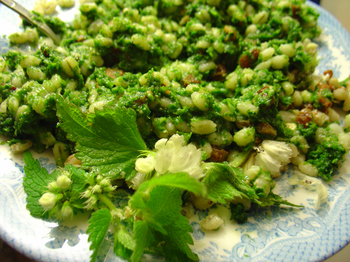
First impression: I may have taken an overly Californian approach to making kruudmoes this time, but although I should probably increase the gooeyness to make it just the way the natives do, kruudmoes is just crazy delicious.
If you're like me and:
- love to chomp away on all sorts of leafy greens, the weedier the better,
- adore all things pork,
- can't get enough of cultured milk products,
- are nostalgic about barley,
Dutch crude mousse is going to blow your mind.
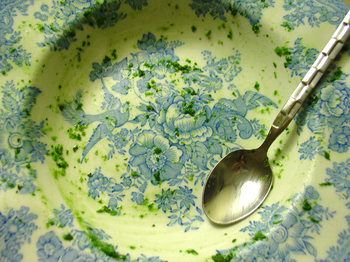
Normally I don't eat with a spoon, let alone a teaspoon. But I was tasting the oats and the greens mixture and became so enthusiastic that I couldn't even stop to set myself up with some sticks.
Posted by debra at 10:31 PM | Comments (0) | post to del.icio.us
Street food waste =
street food packaging
April 29, 2006
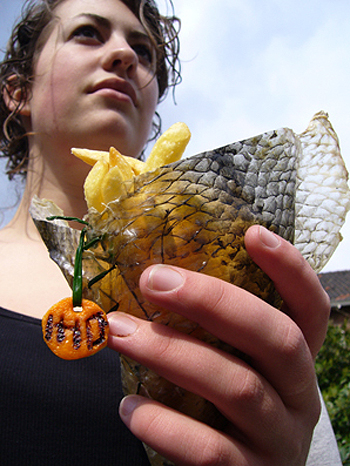
Fish and chips: image of street food packaging concept 'IHO', © Païvi Kovanen, Eva Arts and Caroline van Teeffelen 2006, used courtesy of the designers. Please respect student work, contact culiblog for updates.
(This is the second in a series of entries about the Street Food Workshop developed and conducted together with Katja Gruitjers for our students from the Design Academy Eindhoven and the HAS den Bosch.)
Just the simple fact of making street food creates tonnes of food waste. Students Païvi Kovanen, Eva Arts and Caroline van Teeffelen used food waste materials to develop packaging for street food. Katja and I were really impressed with their packaging concept IHO, which means skin in Finnish. Even mo' bettah, when you turn the letters around to spell OHI, you get the Finnish word for leftovers.
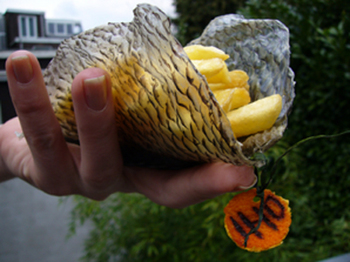
Image of street food packaging concept 'IHO', © Païvi Kovanen, Eva Arts and Caroline van Teeffelen 2006, used courtesy of the designers. Please respect student work, contact culiblog for updates.
The fish and chips sack is brilliant. Hand-sown dried fish skin imparts a nice fish aroma to the chips and you know how the Northern peoples love their (dried) fish. Katja and I are imagining a dusting of vinegar powder on the inside of the sack for a perfect flavour.
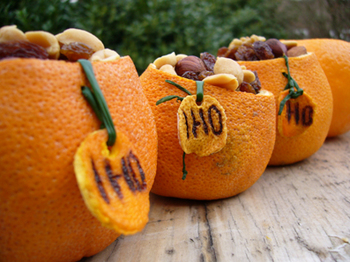
Image of street food packaging concept 'IHO', © Païvi Kovanen, Eva Arts and Caroline van Teeffelen 2006, used courtesy of the designers. Please respect student work, contact culiblog for updates.
Urban juice bars produce orange rind and pulp waste that is normally turned into silage to feed animals that us omnivores love to eat. Kovanen, Arts and van Teeffelen assured us that there's plenty of rind and pulp to go around and they dried the rinds into snack containers. The pulp they turned most amazingly into a palm plate that has a wonderful hand feel to it.
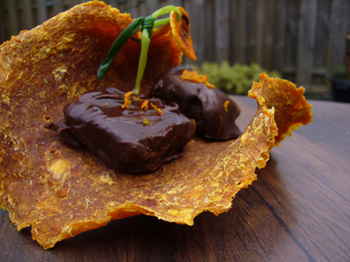
Image of street food packaging concept 'IHO', © Païvi Kovanen, Eva Arts and Caroline van Teeffelen 2006, used courtesy of the designers. Please respect student work, contact culiblog for updates.
As if this weren't enough for one half-term street food assignment, the ladies Kovanen, Arts and van Teeffelen developed a new ceramic material produced from eggshells and potato starch and that can be formed into any possible shape. Here, the material has been formed into a palm plate.
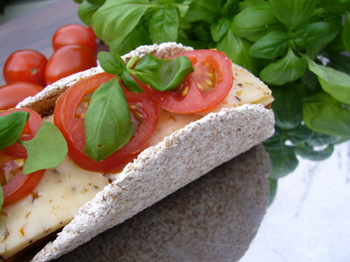
Fish and chips: image of street food packaging concept 'IHO', © Païvi Kovanen, Eva Arts and Caroline van Teeffelen 2006, used courtesy of the designers. Please respect student work, contact culiblog for updates.
IHO street food packaging concept by Kovanen, Arts and van Teeffelen.
Posted by debra at 11:06 AM | Comments (3) | post to del.icio.us
Street food collaborations: Streetberry!
April 24, 2006
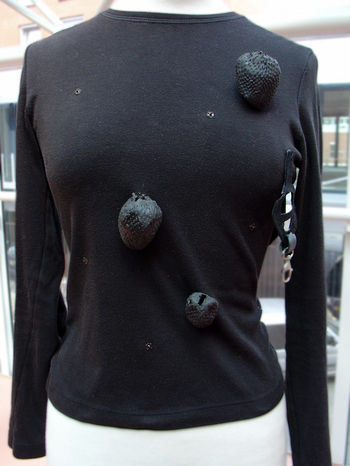
Streetberry design by Michou-Nanon de Bruyn, Milou Melis and Monica Ruiter. Please respect student work, contact culiblog for updates.
Nothing says wing-flapping like a subversive strawberry. Students Michou-Nanon de Bruyn, Milou Melis and Monica Ruiter have developed Streetberry as their final project for Katja Gruijters and my street food project. The collectible black rubber berries snap on to black t-shirts, rings, and necklaces made out of recycled bike tyres and representing the map of the city. The pieces smell like strawberries, but in a way that someone who is not a twenty-something woman can still appreciate.
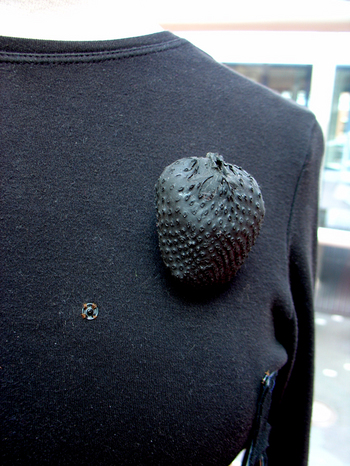
Streetberry design by Michou-Nanon de Bruyn, Milou Melis and Monica Ruiter. Please respect student work, contact culiblog for updates.
Since March, students from the HAS (Hoger Agrarische School, 's Hertogenbosch NL, Food Design) and the Design Academy Eindhoven (Atelier, Food) have been collaborating on a street food project that Katja Gruijters and I initiated. Last Friday they presented the conclusion to their R&D and in the next weeks I'll show a few of the best projects here on culiblog. Katja and I are most pleased with the results and think that the collaboration proves that the Design Academy and the HAS should work together on food-related projects in the future.
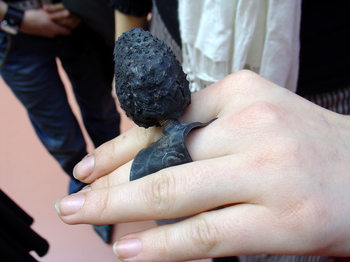
Streetberry design by Michou-Nanon de Bruyn, Milou Melis and Monica Ruiter. Please respect student work, contact culiblog for updates.
The assignment was to develop a a street food concept and in the course of 10 weeks develop this into a prototype. As you may already know, the NL is practically devoid of street food aside from the usual offerings of the Servex Group. Selling food on the street or at the train station is effectively illegal unless you are part of this horeca monopoly (HOtel, REstaurant, CAfé - another sexy Dutch acronym).

Streetberry design by Michou-Nanon de Bruyn, Milou Melis and Monica Ruiter. Please respect student work, contact culiblog for updates.
Katja and I wondered what future (food) and product designers, presented with a wealth of images and information about initiatives in other countries would come up with. Fortunately some students let their autonomous brains lead them away from the kitchen. A jewelry line based upon the map of the city, a new materials collection for street food packaging using the waste materials of commonly sold street food, and a conceptual art performance are some of the 12 fresh visions of what street food in the NL could become if it were allowed to flourish.

Streetberry design by Michou-Nanon de Bruyn, Milou Melis and Monica Ruiter. Please respect student work, contact culiblog for updates.
- Thank you Servex for convincing Dutch legislators that street food diversity is a hygiene issue!
- But seriously, thank you HAS for hosting this collaboration in your fabulous test kitchens!
- Thank you Design Academy Eindhoven (Kompas: Atelier) for being flexible and playful in terms of curriculum!
- Thank you Michou-Nanon de Bruyn, Milou Melis and Monica Ruiter for introducing us to Streetberry!
Posted by debra at 09:27 AM | Comments (0) | post to del.icio.us
Love difference,
as in we love difference
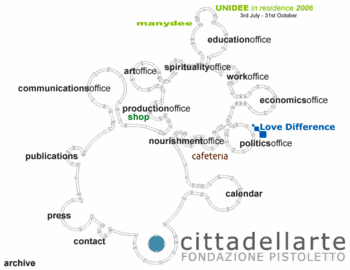
Of course the artistic movement for an intermediterranean politic is into food. And it sports a big fat Citta del Arte logo right on it's homepage. Which led me to click on the Ministry of Nourishment link because I always wonder what folks mean by the word nourishment.
I'm none the wiser, but the Love Difference folks did done organise a Food Market Festival in which food markets (and their organisers) from around the world met this weekend in Turin. I wonder what they've got cookin' for the next event, hopefully something megamaniacal. (Thank you, Julie Upmeyer, who sent this link on time.)
Posted by debra at 08:00 AM | Comments (0) | post to del.icio.us
Urban gardening lessons for Dutch children
April 21, 2006
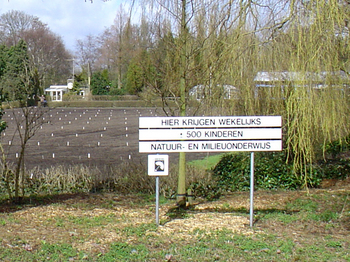
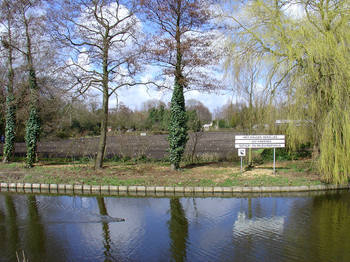
On an island in Amsterdam's Westerpark, a horizontal grid of 1m2 garden plots are being prepared for the children. The sign says that around 500 children will receive weekly education about nature and the environment on these plots. Although this garden grid offers an extreme image of mini-allotments filled with one carrot, one lettuce, one rhubarb, one sunflower, one fennel, one this and one that, I cannot say that I think this is a negative idea in terms of education. In fact, gardening in this way has the potential to teach children about density and clustering. It's like an MVRDV-isation of grammar school education. By this I am referring to educarion informed by architects MVRDV's notions of density and as explored in their publications FARMAX (floor area ratio) and KM3, (cubic kilometer) Excursions on Capacities from Actar Publishers. Next step, vertical gardening for urban children!
(The image has been enhanced to increase readability of the sign.)
Posted by debra at 07:13 AM | Comments (6) | post to del.icio.us
An improbable history: meal assembly centers
March 26, 2006

image of friendly community hugging © Super Suppers, used entirely without permission
Kim Severson and Julia Moskin's New York Times article about meal assembly centers has me all excited and flapping my wings. For other people. They report on Texan Judie Byrd's service called Super Suppers, based upon the concept of the communal kitchen.
Here's how it works: a suburban working person with family goes sans entourage to a central food preparation center where the food is prepped and waiting in a professionally stocked and staffed kitchen. Meandering from station to station (s)he assembles the week's family meals, takes them home in zip-lock baggies made from compostable potato starch, freezes the meal-sized portions and heats them up when it's time to get the grits on the table.
What is not to like about this practically utopian idea, for other people? As a predominately self-employed happily not married person with zero children, and as someone who finds almost all elements of food preparation thrilling, I realise this business model was not made with people like me in mind. But because I am insane and live in a bubble, here's what I'm imagining:
1. The meal assembly center would stock its food exclusively from local farmers and artisanal producers, procuring the highest quality seasonal and local produce at a fair price. The meal assembly center would develop enduring relationships with these folks and the community using the meal assembly center would feel secure knowing that all of the food products they are using are made or grown with their well-being in mind.
2. In a professional kitchen with sharp knives and a seemingly limitless amount of freshly ironed tea towels (made from locally grown hemp), the meal assembly center's assisting chefs have prepared cooking stations for an interesting range of recipes. This week there are cuts of meat from the local deer cull and some strange root vegetables, next week it's traditional holiday fare from one of the region's thirty-seven ethnic groups, the week after that, it's all about vegan haute cuisine.
Whale washed up on the beach? No problem. The meal assembly center is hip to the community and the kelp is already rinsed. Finally you're cooking as if you live where you live!
3. It used to be common to take homemade bread dough to a communal bakery for baking. Heq, it used to be common for a lot of people to be involved in the family's cooking, sharing the workload, but also sharing the how-to and the chit-chat. At the meal assembly center, labour intensive dishes involving lots of stuffing, rolling, stretching and braiding could be prepared by the organisation or by other folks sharing the kitchen with an interest in these dishes. It would be a community that cooks, just like it was way back when, in the Wabac Machine.

image of Peabody and Sherman using the WABAC Machine (that's pronounced 'way-back') © Jay Ward, used entirely without permission
4. The meal assembly center would be stocked with amazing community-tested equipment. Here's your chance to try cooking on a wood burning stove. Want to smoke up some trout, stuff some sausage, make cheese, brew a stout beer? It's all possible because the community would do it together.
If you have prepared food (for your family) in a food preparation center, I would really love to hear about your experience. But please do not burst my bubble and tell me it's about Thai Mac 'n Cheese and Turkamales.
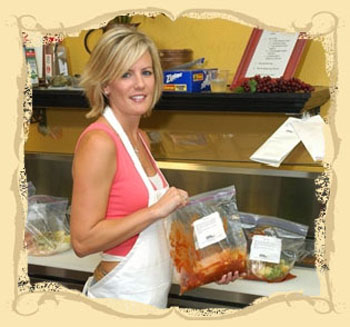
image of zip-lock wielding working yoga mom © Super Suppers, used entirely without permission
- Kim Severson and Julia Moskin's New York Times article on Super Suppers,food preparation centers
- Super Suppers
- Judie Byrd's website
- Sara Wilson at Entrepreneur dot com talks about the business concept of Super Suppers
- Peabody's Improbable History
- A blogger (let's call him Greg from Life's a Picnic) writes about his Super Suppers experience.
- Dream Dinners, just another meal assembly center
- Dr. Gurgles doesn't feel at ease with the concept
- Even more Gurgles from a time long past. Respect to the Gurgling Cod has followed this story in all its New York Times Magazine ugliness from the start.
technorati tags: food preparation centers, meal assembly centers, working moms, locative food, food trend, coommunity
Please read more... "An improbable history: meal assembly centers"
Posted by debra at 10:40 PM | Comments (15) | post to del.icio.us
Not cooking with flowers and leaves, a raw food recipe for marinated shitake mushrooms
March 21, 2006
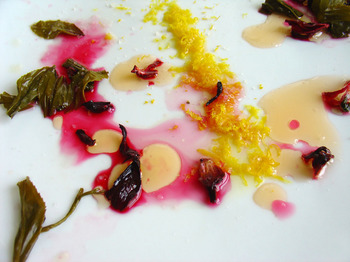
If I want to eat with my friends, I can't just serve up vegetables with the dirt still clinging to the rootball, the way I like it. I have to engage in some refining.
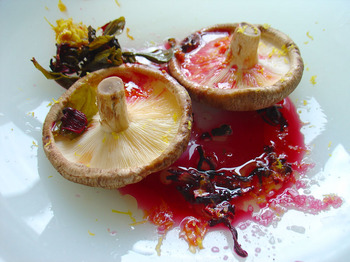
Hibiscus flower and green tea leaf marinated shitake mushrooms
(work: 7 minutes, wait: 1-4 hours)
- dried hibiscus flowers
- whole green tea leaves
- water
- fleur de sel
- lemon zest
- crayfish oil (vegetarians, relax)
- two shitake mushrooms
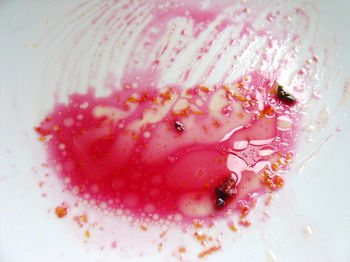
In the bottom of a cup, pour enough hot water to cover a layer of hibiscus flower and green tea leaves. You're going to make a highly aromatic and concentrated tea, something too strong to sip. Aim at producing four tablespoons.
(This year, hibisicus flowers seem to be my souring agent of choice. I find it hypnotising to watch the magenta colour leach out of the petals, and I just live for the 'powdery' aftertaste.)
Add to the 'tea' a big fluffy pinch of finely zested lemon peel, a goodly amount of fleur de sel, and a teaspoon or two of *crayfish oil.
Adjust the marinade and toss around with two large shitake mushrooms. Marinate for one to four hours before serving. Everytime you walk by, just toss the mushrooms lightly for fun.
You can keep the mushrooms for about a day without ruining the texture in or outside of the fridge. The marinade and juices leached out of the mushroom can be 'recycled', it's like bouillion for raw foodies. You know how I love the food recycling!
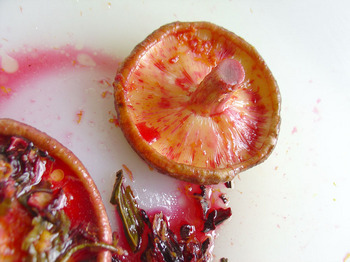
*A note on crayfish oil: you can't buy it. Mine was a cadeau made by my friend Marlein, to whom this recipe is dedicated. Possible (vegetarian) substitute: grape seed oil, barely warmed and barely covering half a fennel, star anise and a dried hibiscus petal. Leave to cool and sit for two days. Remove the 'stuff' and decant to a very clean jar. Store in a cool, dark and dry place.
*A note about using non-vegetarian, non-raw ingredients in this recipe: relax and enjoy delicious foods that have been made for you with love. Aromatic oils are like parfum, you need only a few drops. In this recipe you will need enough drops to fill a teaspoon or two.
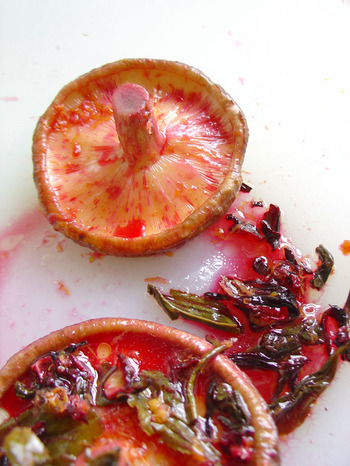
Both the green tea leaves and the crayfish oil have a powdery 'note' that compliments the woodiness of the shitake. This marinade smells like peonies. Shitake pivoine! My hands are parfumed from the shitake tossing.
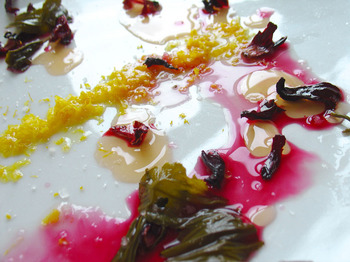
The recipe is dedicated to my dear friend Marlein Overakker, a chef who has turned me on to my favourite parfums and who is always a huge source of inspiration.
technorati tags: raw food recipes, vegetarian, shitake, mushrooms, cooking with flowers, cooking with tea, green tea
Posted by debra at 02:14 PM | Comments (9) | post to del.icio.us
Let the future begin, kimchi air conditioner is here
February 15, 2006
Romantic kimchi photo courtesy of "Do the Bart" Charlotte Yong San Gullach
Kimchi is pickled cabbage (or radish or mustard leaf or...) and I feel quite comfortable in reporting that it is one of the top five most delicious things you can put in your mouth. It is Gawd's own comfort food, made with generous amounts of fresh garlic, ginger and red peppers, it is crazy healthy. So healthy, that an entire nation and a large population of several other nations believe that kimchi can prevent illness. I belong to one of those nations. Kimchi Nation. Kimchi also has a farty smell, but regular culiblog readers know that I just live for that.
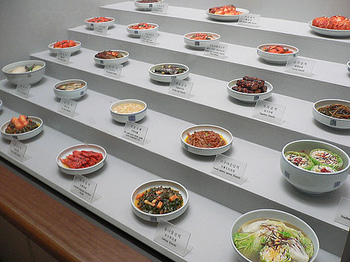
Museum of Kimchi photo courtesy of NihaoGirl
And if all that weren't reason enough to get a leg up on the kimchi altar, apparently kimchi can also kill the avian flu virus H5N1 and is soon to be used in the manufacture of air conditioners. No Fred, not hair conditioners, AIR conditioners.
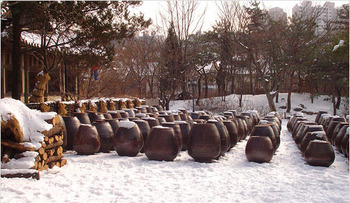
Snowy vats of kimchi fermenting in the park courtesy of Polish Sausage Queen
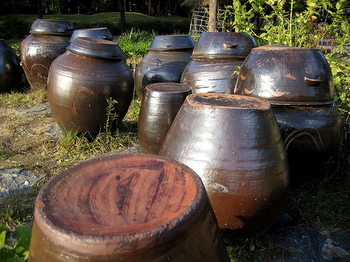
Kimchi pots in the public space by Bryan Hughes
Unfortunately the air conditioners will use only the enzyme from the kimchi and will not transmit its smell. This is a mistake waiting to happen and I would like to urge you to get on the horn immédiatement to let LG Electronics know how wrong that would be.
Thank you Willem for this culi tip. You know I love the kimchi.
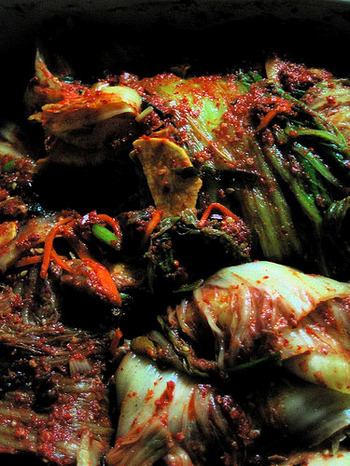
A list of links to images and air condioner manufacturers for Kimchi researchers and cultural activists.
- culiblog writes about kimchi
- Reuters on the Kimchi air conditioner
- Flickr kimchi tag
- LG Electronics online contact form in Dutch
- Romantic kimchi photo courtesy of "Do the Bart" Charlotte Yong San Gullach
- Museum of Kimchi photo courtesy of NihaoGirl
- Snowy vats of kimchi fermenting in the park courtesy of Polish Sausage Queen
- Kimchi pots in the public space by Bryan Hughes
- Glamour shot of kimchi courtesy of a person with wonderful photographic skills and whose name I cannot read because it is written in Korean
technorati tags: kimchi, avianflu, South Korea
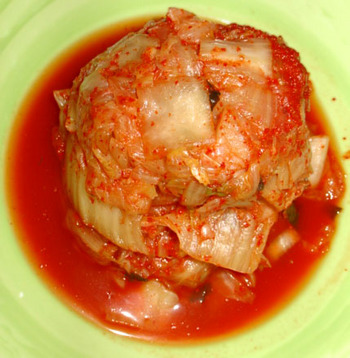
Kimchi, the comfort food of the gawds courtesy of culiblog
Posted by debra at 11:58 PM | Comments (8) | post to del.icio.us
Food-related film at the Berlin International Film Festival
February 09, 2006

Pack up your yurt, we're moving to the steppes of Berlin for a week, where it's much colder than it was in Rotterdam, and where a yurt will come in handy. The craziness begins today at the Berlinale, the Berlin International Film Festival. Culiblog will be attending the madness for an entire week, from Saturday the 11th until the 19th, reporting on all food-related films and presentations.
This year there is a glut of food-related film because aside from the regular programme, food, hunger and taste are the subject of the Berlinale Talent Campus, a platform within the Berlinale festival. The Berlinale Talent Campus creates opportunities for young filmmakers to meet with les eminences grises from the film industry and the folks from the more active side of food and food culture as well. Alice Waters, Vandana Shiva, Carlo Petrini will all be there.
Once again, I've created a culiblog food-related film selection culled form the entire Berlinale programme for those willing to move beyond Babette's Feast. Oh dear, it's 2006 and they're actually showing Babette's Feast!
The culiblog selection at the the 56th International Berlinale Film Festival:
Saturday, 11.02.2006:
23:00: - Harvest (Regain), a Marcel Pagnol classic! (Manon de la Source)Sunday, 12.02.2006
18:00: - Berlin Talent Campus Screening - Food For Thought: Origins: Tom Luddy will present all 32 Talent short films on "Hunger, Food and Taste" in three sessions, beginning at 18:00. Today's programme "Origins" will include eleven short films from seven different countries. In between the screenings, Tom Luddy will introduce the Talent directors and discuss their reflections on "Hunger, Food and Taste".
10:30: - Eat and Shoot the Indie Way, presentation with a.o. Alice Waters, Angie Lam, Vandana Shiva and Slow Food's Carlo Petrini
12:15: - Who Owns Life? Talk with Vandana Shiva and Renate Künast
16:30: - Talk with Peter Kubelka: Cooking as the Origin of Culture...
17:30: - One Way Boogie Woogie / 27 Years Later, James Benning
Monday, 13.02.2006
14:00: - The Case for Taste, lecture and screening of Nossiter's Mondovino with Carlo Petrini a.o.
18:00: - Berlin Talent Campus Screening -
Food For Thought: Delicious Revolution: Today's Food for Thought session is hosted by US-director Doug Hamilton. His film ALICE WATERS AND THE DELICIOUS REVOLUTION is a documentary about the ideas and ideals of natural food specialist Alice Waters, who has been practicing and sharing with the world her healthy and environmentally conscious principles for nearly thirty years. After the screening, director Doug Hamilton will answer questions.
20:30: - Mondovino, Jonathan NossiterTuesday, 14.02.2006
18:00: - Berlin Talent Campus Screening -
12:30: - Matthew Barney: No Restraint, Alison Chernick
18:00: - Berlin Talent Campus Screening - Food For Thought: "Kill or Die" is today's screening of a new round of shorts from the Campus competition "Films on Hunger, Food and Taste". Tom Luddy will present ten filmmakers from eight countries and talk about their cinematic stories about the relationship between food and death, about the often hidden fact that for some, eating means killing, and about food, fear and devotion.
18:45: - Drawing Restraint 9, Matthew Barney Wednesday, 15.02.2006
18:00: - Food For Thought: Lost Supper: A screening of the Berlinale Talent Campus films on "Hunger, Food and Taste" is dedicated to films that deal with hunger, starvation and poverty in the world. Eleven short film productions from eleven countries explore the unjust manner of food distribution in the world and the local effects of this problem. Tom Luddy will introduce all of this year's Talent filmmakers and talk about their productions.Friday, 17.02.2006
18:15: - 37 Uses for a Dead Sheep, Ben HopkinsSaturday, 18.02.2006
14:30: - Happy as One, Vanessa Jopp
You'll be needing these links as well:
- 56th Berlinale International Film Festival (programme search in English)
- Berlinale Talent Campus lineup of film on food, hunger and taste
- Berlinale Talent Campus (in English)
- Berlinale Talent Campus evening programme
- Berlinale Talent Campus lecture and presentation programme
- Slow Food and the Berlinale Talent Campus have teamed up. Here's the blurb.
- Jonathan Nossiter's Mondovino
- NYTimes film review of Marcel Pagnol's classic from 1937, Harvest (Regain)
- Marcel Pagnol filmography on the IMdb
- James Benning interview by Danni Zuvela on the Senses of Cinema website
- James Benning's filmography on Wikipedia
- Synopsis of Alison Chernick's Matthew Barney: No Restraint
- Ben Hopkins, 37 Uses of a Dead Sheep
- A list of food-related films, compiled by Rebecca Epstein for Gastronomica. Her dissertation titled, "Crime and Nourishment", focused on the food and foodways of Hollywood gangster films. Epstein's list needs a good tweaking and I don't agree with her about a lot of the titles, but it will serve us just fine for February.
- culiblog reviews Matthew Barney's Drawing Restraint 9
technorati tags: Berlinale International Film Festival, film, food-related film, cinema, Berlin, Drawing Restraint, Matthew Barney
Posted by debra at 02:12 PM | Comments (6) | post to del.icio.us
Eat off the floor? Get the facts...
September 23, 2004
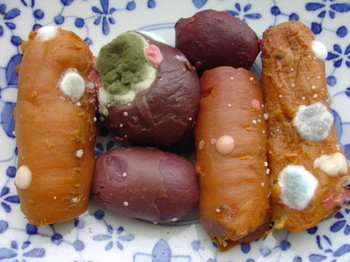
In Amsterdam if I drop food when I'm cooking I always just pick it up and pop it into my mouth. I eat off my floor - sometimes days after the 'fall'. And what you may ask are my criteria for scrapping or scarfing? With me it depends on whether the food was initially wet or dry. (See semi-unrelated picture above of some mould I grew in 3 weeks time on some wet food.) Foods that become wetter as they get older I tend to scrap. Yesterday I found some old almonds lying quite dryly on the floor of my bedroom. I picked 'em up and scarfed 'em right down in one clean hand motion.
Readymade Mag's Eat off the floor
In this old ReadyMade Mag issue there is a funny article about eating off the floor and whether it is unclean. If you have kids you probably have heard of the 5 second rule, 'don't anything that has been on the floor for more than 5 seconds.'
I always thought of this as the 15 second rule. Oops.
There was a Dutch telev�e ad in which one sees a woman bringing her clothes to the cleaners. With some difficulty she peels a piece of salt licorice (type muntje) out of a dirty jeans pocket and tosses it into her mouth. This much to the disgust of the guy behind the counter. It was a licorice ad. What would I have done? Oh, definitely scarf.
Posted by debra at 12:08 PM | Comments (0) | post to del.icio.us


