Anorexia, art,
war, rant
April 17, 2006
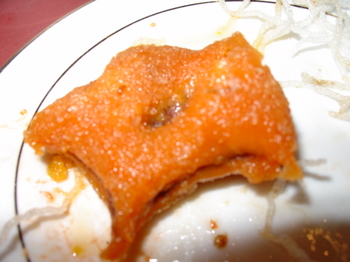
The pumpkin dumpling that I just couldn't finish.
A little less than a year ago I wrote an entry about SehnSucht, a restaurant for anorexics in Berlin that had opened up sometime in January 2005. Because I didn't have a picture of the restaurant, and because I hadn't visited it (and to this day can only get a robot on the phone), I did the logical thing and accompanied my entry with a blurry image of a greasy half-eaten pumpkin dumpling.
The dumpling image was a huge hit if i can believe my site meter referrals. And until last month, dumplin' was smack in the middle of a Google Images page for the search-string anorexics. Folks were clicking on the dumpling, and so doing finding culiblog, proving that it's not only horny old fat men that scour the anorexia sites for skeletal supermodels and thinspiration. Actual 'Anas' and 'Mias' were haulin' their boney tuchas over to culiblog to get a gander at the food porn.
Well this one's for you, Ladies!

LA Raeven at the Mediamatic War Salon, photo by Bea Correa, courtesy of Mediamatic
LA Raeven is the artist name for twins Liesbeth and Angelique Raeven, whose very subject matter is themselves. Their video installation work and performances are about the female body image and the behaviour dynamics of twins, especially when this dynamic expresses itself in psychologically nuanced eating habits.
LA Raeven were launched into fame in February 2002 when they created a huge kafuffle with Wild Zone 1 & 2, a video installation exhibited at the ICA London. It was the first time that the twins showed themselves in their work, lolling about and being overly skinny amidst half-drunk glasses of white wine and a floor littered with the occasional mini-nibble. The gallery was infused with the artists' own feral scent, reportedly concocted from their very own pee. Of course the bourgeois art press found it so scandalous that female artists with anorexia should be able to express themselves about body image, that they censured the artists' call for participation before the exhibition, and a goodly deal of the exhibition's press. Just like in China!
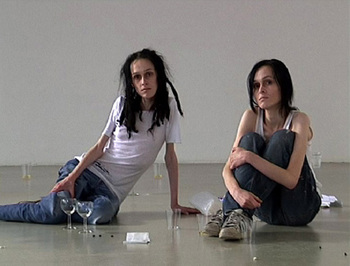
LA Raeven, video still from Wild Zone 1 (2001), courtesy of the artists
In a painful to watch BBC NewsNight interview, the Raeven sisters weren't contextualised primarily as artists, not even as kooky artists, but as eating-disorder victims. The 'feminist' psychotherapist Susie Orbach, author of Hunger Strike and ironically, Fat is a Feminist Issue (no potshots, please) was called in to moderate the discussion. Watching the interview, I was apalled at the insufferably intolerant BBC commentator. I believe that self-empowerment has many forms of expression, and that it is in fact medicalisation and consistently pathologising what is primarily women's behaviour, that is inherently anti-feminist. But that's just me, I'm a 3rd-wave feminist orthochondriac, not into rehearsing unhealthy scenarios, or encouraging others to practice theirs from haughty podia. And I'm talking about NewsNight, here.
The sisters told me recently, 'It was unbelieveable how we were treated at that time. Censured! When a Chinese artist eats a fetus, you don't see journalists calling psychoanalysts in to help. Instead, Western art journalists stumble over themselves trying to explain away (AiWeiWei!) this behaviour as an expression against an unhealthy regime."
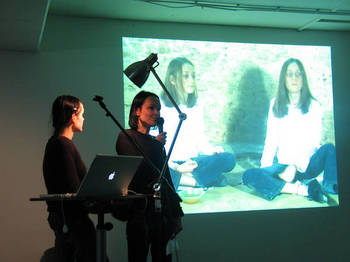
As part of Mediamatic's anti-war protest exhibition titled, le Mépris, (non-food-related, but go see it anyway), Mediamatic held a War Salon, (April 5th) at which the Sisters Raeven were invited to show some of their new work. The idea to put LA Raeven in a war and violence themed programme was an inspired one. Aside from new work by the ladies, highlights from the lineup included an analysis of the US Army recruitment game America's Army, and ended with a macabre audience participation karaoke with the songs of that very political body, Brigitte Bardot.
A goodly portion of the audience was represented by young male gamers from the nearby universities, there to listen to their friends, scientists David B. Nieborg and Jonas Hielscher speak about and demonstrate America's Army and Battlefield2, respectively. Gamers. That's a nice, socially acceptable term that we all use in contemporary cultural discourse. Gamers play games, in this case, war games on computers with lots of other gamers. Gamers at university study games and other gamers, and even write theses about these things. Well LA Raeven also play games.
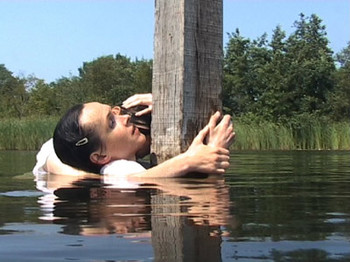
LA Raeven, video still from "Love knows many faces" (2005), courtesy of the artists
I disagree with those that would suggest that LA Raeven's presence and presentation at the Mediamatic War Salon represents a war on the body, or war against the body. Their oeuvre, and especially the new works, Prison in Me (2005) and Thin Line (2006) show an assault on individuality and a strategy to escape this assault. The image above is a still from the video, Love knows many faces (2005), in which the twins go for a swim and play a sisterly game of trying to drown eachother. Recovering from a symmetrical but futile attempt at individuation, they exhaust themselves into one big clump of Liebestod. Game on, Girls!
Thin Line (2006) shows one of LA Raeven's own food games, now in the hands of pre-pubescent twins. In a Bruxelles basement conjuring up horrific notions of Dutroux, the identically dressed twins flip a coin. The 'winner' is required to eat both sisters' dinner portions, and the loser gets nothing at all. The game is repeated through all the courses of a (continental European) meal, such that inevitably, one of the sisters ends up stuffing herself whilst the other is left to go hungry. Before you brush it off as childish, may I suggest that you play this game with your partner for an entire day, exploring the complex feelings that it generates. In fact it is not at all about waging war on one's own body. Pity that the body just gets in the way.
The hunger strike is male behaviour, a purposeful and politically engaged expression. The hunger artist is male, and is an artist above all. I left the war salon with even greater respect for LA Raeven's authenticity and artistic engagement. But I coudln't help wonder about the reasons why (female) anorexia should be considered to be more pathological and unspeakable than the (male) fear of terrorism whose effects are unleashed upon us every day. Why should an expression of the fear of fat, and/or the extreme expression of self-control that is anorexia be considered to be more offensive than the extreme societal control that is expressed by waging and playing at waging war?
- culiblog on SehnSucht, a restaurant for anorexics in Berlin
- Mediamatic War Salon wrap-up with photos by Bea Correa
- LA Raeven at Gallery Ellen de Bruijne Projects in Amsterdam
- le Mépris / Location: Mediamatic
POST CS Gebouw, ground floor
Oosterdokskade 5, Amsterdam
18.03.2006 - 30.04.2006
Thursday through Sunday 12.00 - 18.00. - Ellen de Bruijne Projects
- Fat is a Feminist Issue, by Susie Orbach
- Hunger Strike by Susie Orbach
- the Guardian article by Sean O'Hagan
- LA Raeven, Aesthetic Terrorists, by Sander Pleij, de Groene Amsterdammer. Unfortch in Dutch.
- Performance art in PRChina according to Wikipedia
- The Chinese Fuck Off art exhibition as opposition to the Shanghai Biennial in 2000. The title, 'Fuck Off' is considered by some to be a questionable translation for 'Uncooperative Attitude' in the Mandarin language.
- America's Army, a recruitment campaign and live, online computer game funded by private, Hollywood and ultimately US tax dollars, teaches children how to be ethnocentric and extremely violent. Apparently it's a fun game, and US Army soldiers actually train with it. You can play individually or as a team. The 3rd largest 'national' team, is Dutch.
- Stedelijk Museum, Post CS
Next Level - Art, Games & Reality
10.03.06 - 18.06.06
"Work by artists and designers who make the vocabulary of games their own, and provide us with their personal reflection on it." [so that the curatorial staff of the Stedelijk doesn't have to.-editor] - Thinspiration according to the very sane Wikipedia
- For the readers of German, a January 2005 review of the restaurant for anorexics, SehnSucht. Here's the telephone number, please give it a go. (Stadtteil: Tiergarten / Adresse: Dortmunder Straße 12, 10555 Berlin / Telefon: +49 (0)30 3995 266)

LA Raeven, video still from "Prison in Me" (2005), courtesy of the artists
technorati tags: anorexia, art, war, chinese performance art, restaurant for anorexics, twins, feminism, war, computer games, American Army, LA Raeven, Mediamatic, ICA London, SehnSucht, Susie Orbach, twin love,
Posted by debra at 07:10 PM | Comments (9) | post to del.icio.us
Episode 1, emergency food distribution and the role of the cameras
March 19, 2006
- This entry refers to food distribution as discussed in yesterday's entry about the World Food Programme's computer game, Food Force.
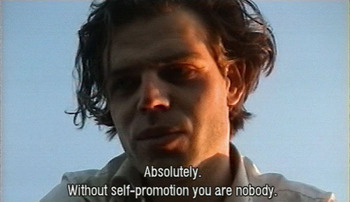
video still from Episode 1, © Renzo Martens
In January 2004, Dutch artist Renzo Martens produced his forty-four minute art film, Episode 1, a documentation of an extensive art performance. Martens travelled to the hottest hot spot war that he could find at the time of making the film (Chechnya, 2002), and in this 'setting' he pointed the camera, not at the war's victims and/or perpetrators like most (news) cameras do, but back upon himself. In Episode 1, Martens asks his Chechen and Russian Federation subjects, 'What do you think about me?'
Enough about you, let's talk about what you think about me.
Martens subjects are the normal cast of characters in every war; heavily armed soldiers on border patrol, civilians lining up for food, civilians trying to get on with it, civilians suffering before their destroyed homes and lives, refugees, but also all manner of NGO employees with their food programmes and journalists with their stories. Within minutes we understand that this is not simply a film about war, but a film about the role of the camera in war, about ethics, the dehumanising effect of pointing the camera and about what is so humanising about turning the camera back around at one's self.
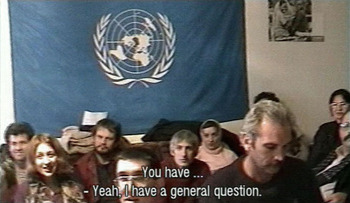
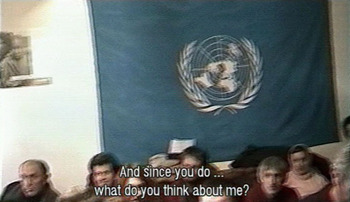
video stills from Episode 1, © Renzo Martens
In the tense environment of a Chechen UN press conference, in territories under fire, the conference moderator asks a group of journalists, NGO employees and UN workers, 'Does anyone have any questions?' Martens pipes up, 'Yes, I have a question!' 'What do you think about me?' Peals of laughter, no one can believe their ears. Ultimatey Martens' question is ignored and the journalists and NGO employees disband to their SUV convoys, rushing off to yet another 'opening' of a milk powder storage facility. Martens interviews the director of the operation, and together they quickly establish the fact that where there are cameras, there can be food relief. No cameras, no aid. In light of this, how could the World Food Programme build its computer game Food Force without even one single PR tier?
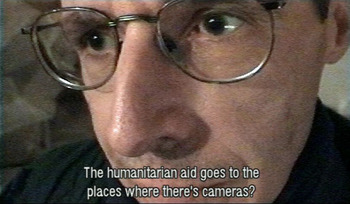
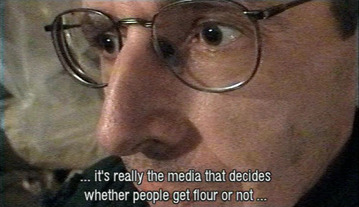
video still from Episode 1, © Renzo Martens
Episode 1 takes us through many such media-laden scenarios. In an open market destroyed no more than thirty minutes ago by Russian Federation soldiers with tanks and heavy artillery, a woman recounts how she and the other market women formed a human shield to halt the execution of a group of Chechen boys. Speaking to the camera, in an oddly well-rehearsed role of who stands where and who says what to the camera, the woman is still shaking from the experience. The scene ends with Martens staring shamefaced at the ground, unable to gather enough gumption to ask her what she thinks of him.
At a food distribution centre, Martens addresses a group of women lined up to receive rations of oil and flour. 'I just want to ask you what you think of me!' and this time there is an answer. The grim situation of lining up to receive basic foodstuffs, fades in the face of humanising laughter and warm sparkling eyes, women just being women. For a moment the food queue has all but disappeared. 'Boy, I think you're handsome, with your blue eyes!' 'What's your theme?' 'Are you a journalist?' 'No, he's an artist.' 'I think he's a journalist.'
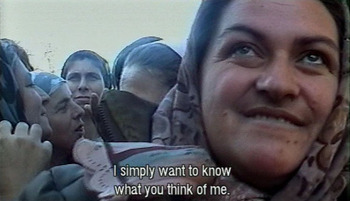
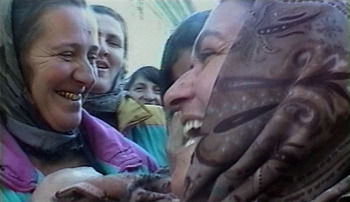
video stills from Episode 1, © Renzo Martens
Ultimately Martens 'act' of showing up with his camera and popping the question brings humanity to every situation that he creates. When he meets a young woman in a refugee camp (who bears an uncanny resemblance to his true love back in Belgium), his question changes, 'How should a man let a woman know that he loves her?' the woman's answer, delivered with beaming smile and sparkling eyes, dissolves the miserable tent landscape and suddenly it's just two people (and their translators) talking about love and life.
Of course Martens created this film for an art context, and the film articulately addresses contemporary art issues. Quite possibly Martens would be appalled that I consider his film to be 'useful', not just for artists and an art public, but as a tool to talk about the causes of war, hunger and the politics of emergency food distribution. And the question that Martens dares to ask amidst flying bullets, UN press conferences, annoyed Russian soldiers, women in food queues and refugees living in tent camps, the initial struggle that it initiates in the interviewee and in me, the audience, as I am simultaneously embarrassed by this question, but know that it is a question that can air-lift all of us actors out of the immediate and into a larger, more important discussion. Complexity is not complicated. Episode 1 brings us to the next tier, where a complex situation can be discussed with the nuance it deserves.
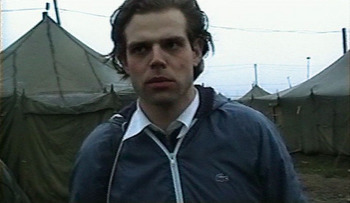
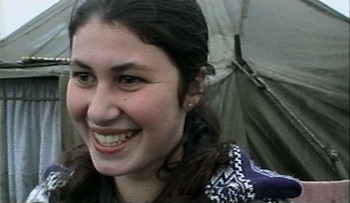
video still from Episode 1, © Renzo Martens
technorati tags: food-related film, Episode 1, Renzo Martens, Chechnya, cinema, emergency food distribution, Food Force
Posted by debra at 11:17 AM | Comments (3) | post to del.icio.us
Drawing Restraint, dragging ambergris
February 05, 2006

Occidental Guest (bride), production still from Matthew Barney's Drawing Restraint 9, copyright Matthew Barney, used without permission
Filled with expectation unsuitable for the company of friends, clutching a fat wad of tickets between fingers reeking of quickly eaten, mediocre sushi, it is unwise to view the best film of the festival first. It just ruins everything, and this is exactly what happened to me on January 30th when, in the exquisite 'old' Luxor cinema in Rotterdam, I saw Drawing Restraint 9.

Shimenawa, production still from Matthew Barney's Drawing Restraint 9, copyright Matthew Barney, used without permission
Drawing Restraint is artist Matthew Barney's 2006 film entry in the International Film Festival Rotterdam and as well the Berlinale Film Festival, where he is a member of the jury. Avant-pop artist, composer and girlfriend Björk composed the soundtrack. Their collaboration is astounding on all levels; the film will make you cry, it is that beautiful. Aside from being culiblog's favourite at this year's festival, the film is exemplary of food-related film in the culiblog sense of the word; food, food culture, food as culture and the culture that grows our food.
Matthew Barney is the Lance Armstrong of contemporary art. In my opinion, no chef can yet lay claim to this position. Drawing Restraint 9 is also the best food-related film ever made, a lavish display of sensuality and ritual.
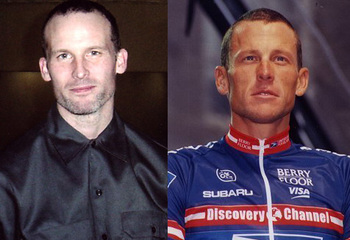
Barney on the left, Armstrong on the right
Drew Daniel of Matmos wrote this stellar description of Barney's art practice on Björk's DR9 website:
Barney is a visual artist whose ambitious, rigorous multimedia work encodes esoteric meanings while providing lushly immediate aesthetic rewards. Best known for The Cremaster Cycle, the sprawling sequence of five films made over ten years which was the subject of a recent Guggenheim retrospective, Matthew Barney's work is multimedia in execution but singularly focused in conception: tightly unified fusions of sculpture, performance, architecture, set design, music, computer generated effects and prosthetics, Barney's films deploy the full range of cinematic resources in the service of a hermetic vision rich with densely layered networks of meaning drawn from mythology, history, sports, music, and biology.
This is a sexy way of saying that Barney's work is based upon his own elaborate and logical cosmology. In Drawing Restraint he playfully turns materials, forms, geometries and processes (e.g. petroleum jelly, silicone, whale blubber, ambergris, other marine excretions and accretions), cultural-historical narratives and geographic trajectories (e.g. the architecture, interior and machinery of a whaling ship, the culture of whaling, the history of a specific ship) and the experience of time (e.g. pearl oyster divers holding their breath under water, the migration of whales, a Japanese tea ceremony), into a luscious weave of deeply connected meaning and narrative.
This is where chefs tend to slack off.
But this is Barney's demarrage, an escape or breakaway that gives him an advantage over the rest of the 'field'. Whereas it is common for a chef to create a 'richly organized set of aesthetics' (as Drew Daniel describes Barney's approach to making art), I know of no example within the culture of contemporary haute cuisine in which a chef recontextualises elements on this level to form a total experience beyond the formal boundaries of restaurant culture. Perhaps I'm not going to the right sort of parties. I long for an haute cuisine that is less 'applied' and more autonomous.
Please read more... "Drawing Restraint, dragging ambergris"
Posted by debra at 08:51 PM | Comments (4) | post to del.icio.us
Grow your own dang food
January 30, 2006
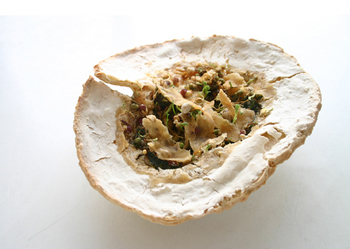
Back in the eighties, as a student at the University California at Santa Cruz, I lived in a vegetarian commune with a bunch of hippies. As hippies, we produced our own sprouts, yoghurt and salsa fresca for the entire commune, approximately thirty people. I had all but forgotten this part of my life until recently, when my Food Atelier students at the Design Academy Eindhoven started working on ways to grow their own food. The work of two enthusiastic students got my wings flapping enough for me to dare revisit my past. These are the images from the first trials, theirs and mine.
After initial attempts at growing mung sprouts in bread (see above), Cygalle Shapiro is successfully growing a ready-made 'salad on salad'.
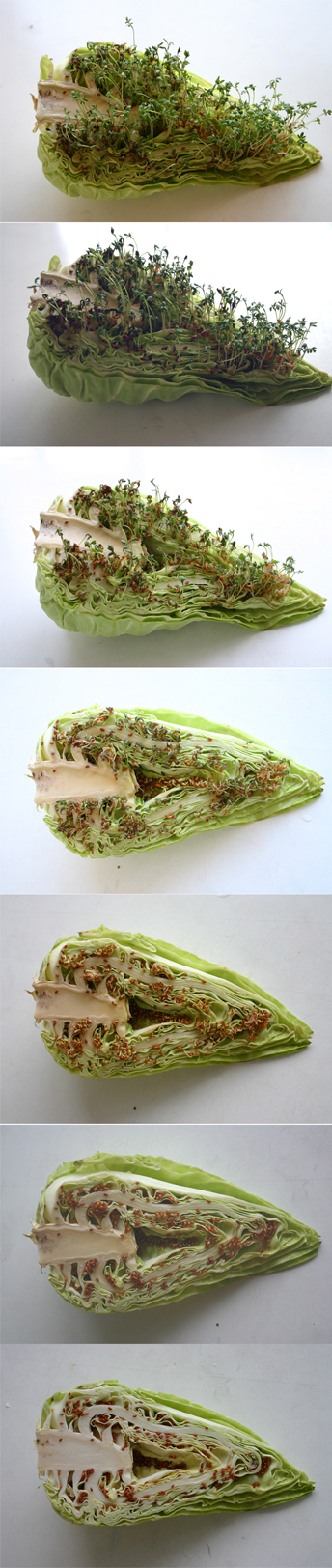
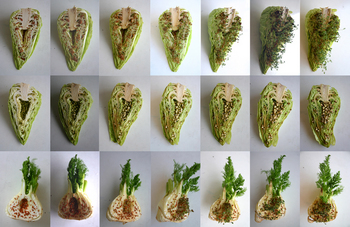
images top to bottom: sprouts in bread, salad on salad, sprouting experiments courtesy of Cygalle Shapiro, copyright Cygalle Shapiro 2005 - 2006. Contact culiblog for further information.
Liora Rosin is growing sprouts in labneh, a fresh yoghurt cheese, commonly made at home. For Rosin it is important that the seeds are grown within the labneh in order to transmit the flavour of the sprouted seed into the delicately tangy cheese.
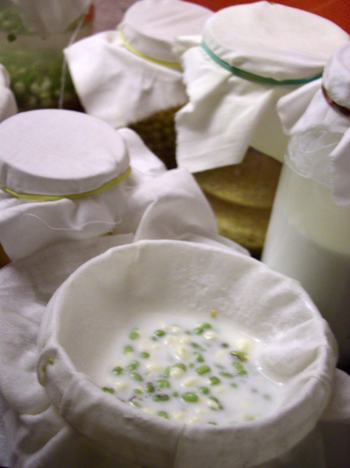
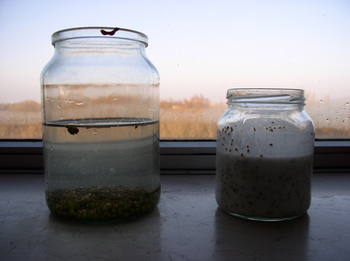
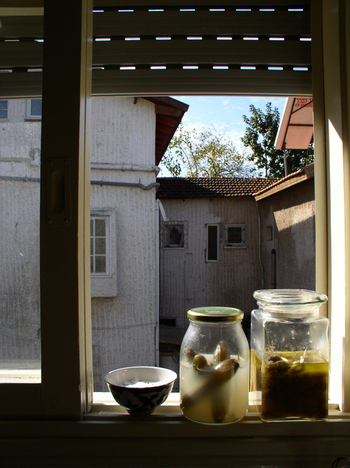
images top to bottom: home sprouting installation, soaking, lactic fermentation sill; courtesy of Liora Rosin, copyright Liora Rosin 2005 - 2006
Wouldn't the world be a better place if we all had a designated windowsill for lactic fermentation?
Having resolved to practice what I preach in 2006, I am also working on growing sprouts on labneh and find that the experiments coördinate nicely with my developing a good recipe for yoghurt ravioli.
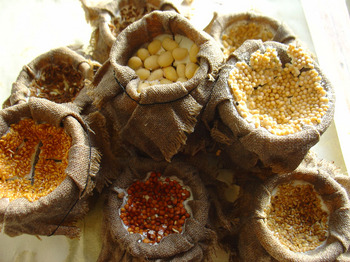
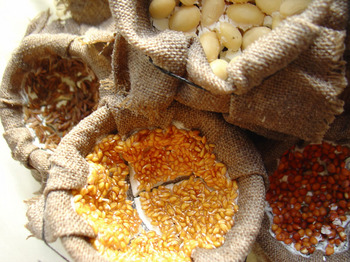
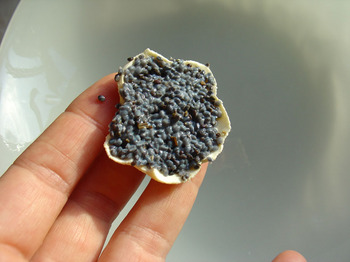
This is a cute disaster of basil seeds rotting into overly dry labneh. Seeds that become gelatinous when they are moistened (e.g., basil, buckwheat, watercress) are poor candidates for immediate immersion on or in the yoghurt medium.
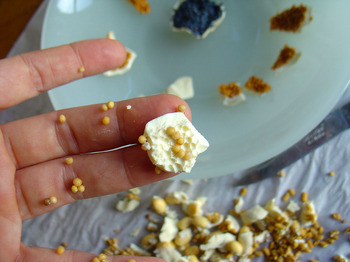
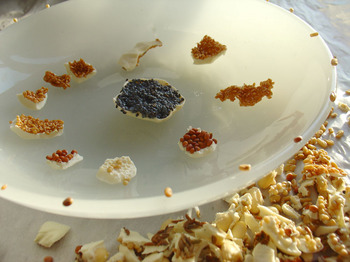
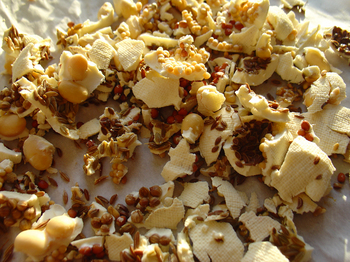
images top to bottom: sprout collection 2x, basil on labneh, playing with mistakes, pretending sampler, curd seed brittle; Debra Solomon
The results of an unsuccessful attempt at growing woody spice seeds (dill, coriander, cumin, kummel) in yoghurt medium with the intention of flavouring the labneh were not especially delicious, although visually exciting. The linen and the seeds texture the labneh beautifully and I look forward to spin a few successful recipes from these experiments soon.
Lori Alden's cheese definition site
N55: Manual for city farming plant modules
N55: Manual for home hydroponic unit
Sproutman's sprout bag. Any idiot can make one, but Sproutman is somehow selling them! My experience is that growing sprouts on wet linen works much better than growing them in jars. I have never tried sprouting in a linen bag.
Here are other urban gardening solutions, mostly rooftop gardening related:
- Rooftop Gardening link hub. Yes, it's a trend!
- Plant vegetables on your rooftops, like they do in Egyptian cities
- Toronto rooftop gardening project
- Greening Gothan Project, NYC also on the roof
- BLDG blog on rooftop farming in London
- Treehugger reports on Toronto rooftop gardening facts and figures
technorati tags: rooftop gardening, urban gardening, food security, sustainability, farming, food-related design, agricultural diversification
Posted by debra at 11:52 AM | Comments (8) | post to del.icio.us
Rural design conference scheduled for September 2006
January 21, 2006
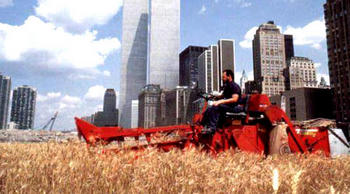
(above: Wheatfield, a large public work by Agnes Denes, image copyright Agnes Denes)
Chapeau to John Thackara at the Doors of Perception blog who reports today about a rural design conference scheduled to take place September 4-7 2006 (somewhere) in the UK. Just have a look at what's being developed for the programme! I am pleased to see that it is all about establishing and strengthening real connections between (urban) cultural producers and rural agriculture producers to the benefit of both.
In a conference forerunner in July of 2005, this is what they were talking about: farmers as curators - an international Rural Biennale for 2007, sustainable farm diversification, rural tourism, food marketing initiatives and staging the Rural Biennale as an integral part of a European Region of Rural Cultures and Farmer Creativity celebration.
To the list of interesting subjects already discussed and in the planning for September 2006, I would like to add: 'rural farmer to urban farmer advisory partnerships for urban gardening/farming initiatives'. I can't help but wonder if the experience and knowledge of the rural farmer can help urban farming inititives such as this wonderful urban farming project in East L.A from being under threat of closure due to urban land-use issues. Injecting (cultural) life into family farms suffering brunt of (European) Agricultural Policy might be just the ticket for rejuvenating a way of life under threat of extinction. Might not the urban farmer benefit from being part of this discussion and network?
- European Rural Culture events page
- Littoral - new zones for critical art practice. An excellent organisation website, with informative links on everything from an extremely mixed bag of individual artists and designers that use nature / agriculture / landscape as a creative platform, to cultural documents on foot and mouth disease!
- Cultural Documents of the Foot and Mouth Crisis in the UK
- Urban food gleaning project by Fallen Fruit
- The South Central Farms website is good reading if you want to get fired up!
- Pruned, weblog on landscape architecture and related fields.
- Pruned blog entry about South Central Farms in L.A.
- Pruned on artist Agnes Denes
- Brilliant films by Raymond Depardon about the demise of French farming communities in the Lozere were shown at the 2005 Int'l Documentary Film Festival in Amsterdam (IDFA) as part of a special tribute programme.
- Farming as a a landscaping trend in suburbia! (Landscaping is responsible for more than 80% of water use in the suburbs.)
- Doors of Perception review of urban farming proposal by Dutch architect Winy Maas
- Non-sanctioned urban gardening in Istanbul, entry in culiblog
- Innovation Network Rural Areas and Agricultural Systems
technorati tags: rural design, food security, sustainability, farming, food-related art, food-related design, food-related film, Raymond Depardon, agricultural diversification, agricultural policy, urban gardening
Posted by debra at 11:47 AM | Comments (1) | post to del.icio.us
Vegetation and art
January 13, 2006
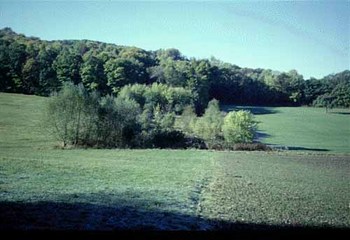
(image: herman's meadow, copyright herman de vries)
This is an image of a meadow surrounded by farmland. Left to it's own devices, the meadow has developed it's own ecology, separate from the agricultural land surrounding it. The meadow is also an artwork by herman de vries, artist/botanist/publisher, who spells his name with small letters on purpose. As a land artist using the natural world as his medium, edible and medicinal plants feature frequently in his oeuvre. In an art in the public space work in the Netherlands, he planted a suburban neighbourhood with more than thirty-six species of heirloom pear and apple trees.
de vries' work aims to create a heightened awareness with our 'life-space'. A botanist trained in applied biology, his innovative publications frame natural products such as rose petals, thistledown, barks, mosses and roots, provoke a response far from scientific detachment. Think of an encyclopedaeic herbaria, dripping with passion and scribbles in Sanskrit, and you will have a good idea of his 'Natural Relations, eine Skizze'. The herbarium includes more than two thousand plants and herbs, collected and logged, but the selection comes from de vries' own memory! How's about them apples!
The text below is de vries' 10 theses on vegetation and art that I plucked from a book titled, 'Transplant, Living vegetation in contemporary art', edited by Barbara Nemitz.
vegetation and art
10 theses
* living things should be treated with repsect for their own message.
* nature is our primary reality. the experience of nature is a universal human value. vegetation is the basis of our existence.
*in art, nature becomes revolution.
* bonsai, constricted and malformed trees or plants are not art. they are perversion.
* in dealing wtih vegetation of plants in art, the artist needs in-depth knowledge about what he is working with.
* to bring plants and art together is a challenge for art.
* art in nature is totally superfluous. art can add nothing of significance to nature. the statements of nature are perfect.
* the restoration of natural relationships can be an artistic act.
* in view of what we imagine nature would do without human intervention, a park is, generally speaking, culturally impoverished nature.
* the ideals of the zen garden - asymmetry, simplicity, spontaneity, the absence of formalism - are nowhere as clearly accessible to visual experience as in naturally flourishing vegetation.
what wonderful things are "abandoned lots", terrain vague, where mugwort, blackberries, thistles and wasteland take over.
- herman de vries
(used without permission from the publication; Transplant, Living Vegetation in Contemporary Art, edited by Barbara Nemitz / Hatje Cantz Publishers, ISBN 3-89322-971-X) www.hatjecantz.de
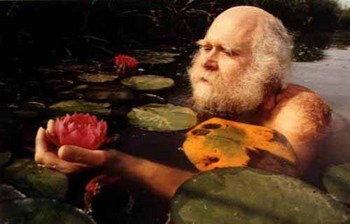
(image of herman de vries, copyright herman de vries)
- Michael Fehr on herman de vries' meadow
- about herman de vries, Visual Research Centre, University of Dundee
- herman de vries, Sculpture Projects in Munster DE, 1997
- Dutch Foundation for Art in the Public Space, herman de vries, North of Overijssel Water Estate
- Dutch Foundation for Art in the Public Space, herman de vries, the Garden Village Collections
- October, February, June, a 1977 work by herman de vries translated into hypertext
- Individual Editions, artist editions of plant-related work
- Transplant, Living Vegetation in Contemporary Art, edited by Barbara Nemitz
Posted by debra at 09:56 PM | Comments (3) | post to del.icio.us
Salad Song
August 26, 2005
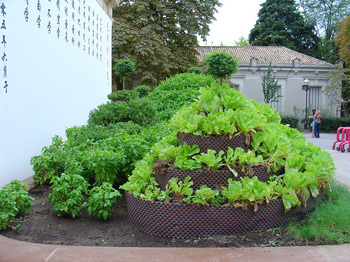 By now we are all well aware of the profound relationship between the citizens of Bejing and Montpellier. Therefore it should come as no surprise when the Occitanian cultural powers that be deem it high time for an 'international biennial' of Chinese contemporary art in their fair city. And why the heq not, if every other city can have one why shouldn't Montpellier?
Of particular interest to me was Song Dong's (Beijing, PRC) leafy greens installation at the entrance of the Pavillon du Musée Fabre. The work is titled, 'Art after Da Zhai' and I have done my best translating the programme description thusly:
By now we are all well aware of the profound relationship between the citizens of Bejing and Montpellier. Therefore it should come as no surprise when the Occitanian cultural powers that be deem it high time for an 'international biennial' of Chinese contemporary art in their fair city. And why the heq not, if every other city can have one why shouldn't Montpellier?
Of particular interest to me was Song Dong's (Beijing, PRC) leafy greens installation at the entrance of the Pavillon du Musée Fabre. The work is titled, 'Art after Da Zhai' and I have done my best translating the programme description thusly:
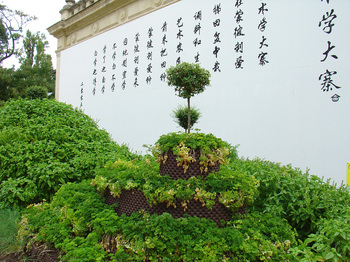 Song Dong uses one of Maoist China's most important political catchphrases, "Agriculture takes example from DaZhai." In the Sixties, the peasants of this village of Shanxi multiplied their grain production by seven and Mao Zedong presented Da Zhai with the 'red banner'. The mountains carved in terraces by the farmers became a political emblem.
Please read more... "Salad Song"
Posted by debra at 01:06 PM | Comments (0) | post to del.icio.us
Art is, art was fluid last Sunday
June 08, 2005
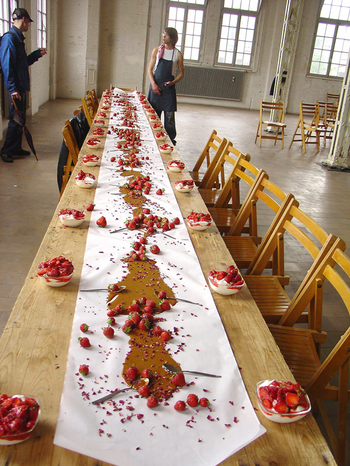
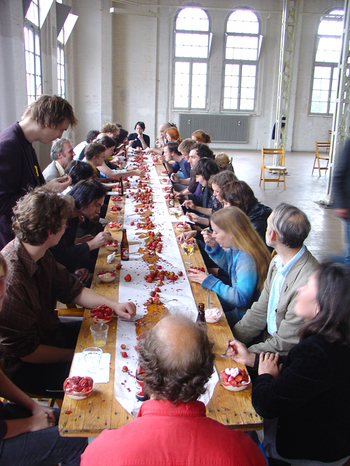
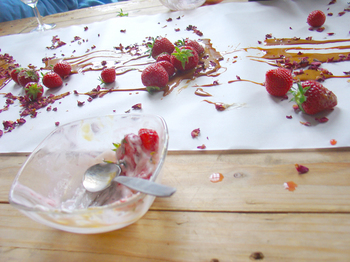
Due to the good company and delightfully engaged audience, artist initiative Artis in Den Bosch showed this Sunday (05.06.2005) that they really know how to throw a happening. Margriet Kemper opened the salon with a presentation of her book, Speak, Image! (unfortunately only in Dutch) in which she talks about how the image is actually a performer. Kemper cited Allan Kaprow, the Daddy of the Happening, explaining to us the choice of the title of the event, Art Fluid.
A.K.: 'I want the line between art and life to be as fluid as possible'.
A presentation of culiblog was next on the menu followed by a breathtaking poetry reading by Robert Gray (AU) and the Dutch translator of Gray's work, Maarten Elzinga. Wafts of rosey caramel in-the-make were the only distraction as both Gray and Elzinga read for the better part of 42 minutes to a rapt audience.
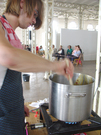
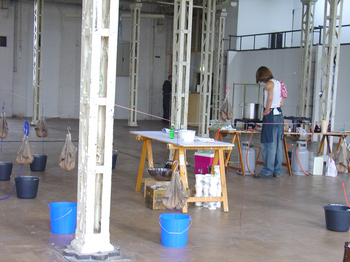
Now there's only so much reflection and interior thought that an audience can take, and just when we thought we would forever be living inside of our heads, the shy noise band, SPASM performed invisibly from the guts of the cavernous gallery. It was just the lightness that the moment needed and everyone started to beam with smiles so broad they barely fit on their faces. Everyone except the young children who ran around annoyed with fingers in their ears.
What could be a better follow-up to a poetry reading and a concert of noise than a cookery presentation! Together with my fabulous assistants, Stefano and Kaj, I rejoiced in showing other Dutch people how to make the traditional Dutch 'hang-op'. The hang-op had been dripping whey all the livelong day in linen bags hanging from pink string, defining the space of the kitchen. Stefano removed the linen bags from meathooks and helped Kaj scrape out the 'hung' yogurt from within. Kaj then proceeded to beat to a satiny smooth consistency, the yogurt with rose flavoured whipped cream. I know, it was very, very sexy.
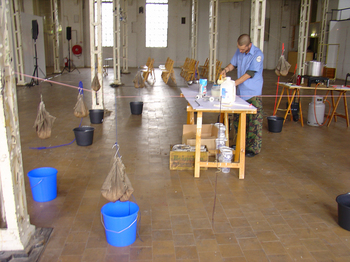
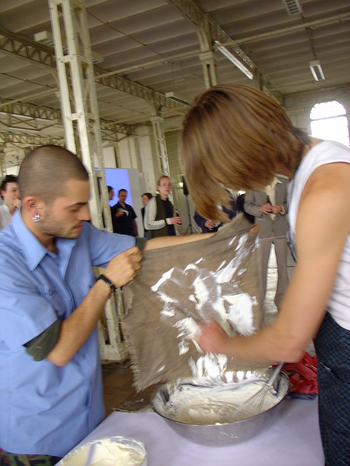
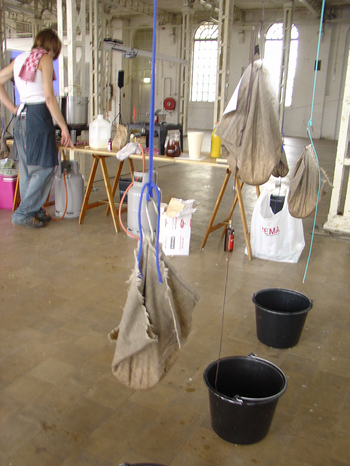
While the audience enjoyed a film by Annika Ström and a presentation of Jan van Toorn's (re)releases from the oldies but goodies of avant-garde sound-art, Kaj and Stefano prepared the banquet table with rose petals, rosey caramel, organic local strawberries and little bowls of hang-op.
Aan tafel, I sort of whispered into the microphone.
Please read more... "Art is, art was fluid last Sunday"
Posted by debra at 09:57 AM | Comments (4) | post to del.icio.us
Re-enact creaming
December 13, 2004
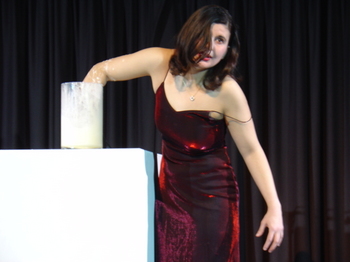
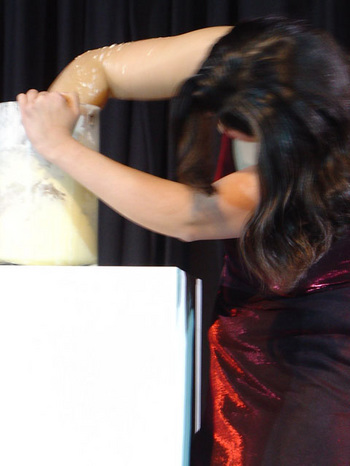
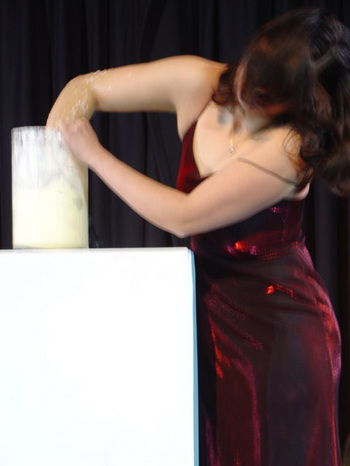
Mediamatic and CASCO's performance night titled Re-enact was rife with food related performance art. My absolute favourite performer was Nezaket Ekici who oh so diva-liciously turned cream into butter with her bare right hand. It took 24 minutes or thereabouts. Everyone was aswoon!
Please read more... "Re-enact creaming"
Posted by debra at 01:47 PM | Comments (0) | post to del.icio.us
A Single Grain of Rice
April 25, 2004
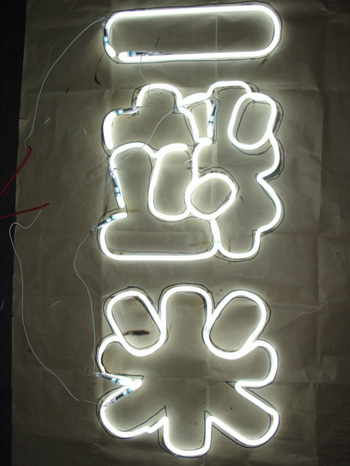
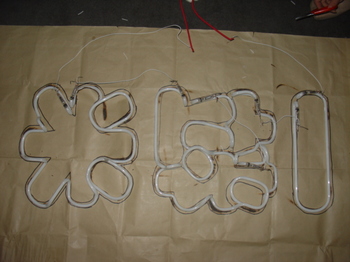
Yi Li Mi = A Single Grain of Rice in mandarin neon. A Single Grain of Rice is a project for a culinarily oriented fasting restaurant that I am initiating. Future entries in 2006 will explain this project in greater depth, but at least I've got the neon sign.
technorati tags: fasting, China, neon
Posted by debra at 12:49 PM | Comments (1) | post to del.icio.us


