Shorts in Bra
Slow Food on Film
April 15, 2006
And by shorts I mean short films. And by bra I mean Bra, Italy, where the short film festival, Corto in Bra will host a programme titled Slow Food on Film. How fine it is to see one's sensibilities well represented, in a country that no longer has a vile mo fo as elected head of state.
As the Slow Food Movement's spokesperson and founder Carlo Petrini promised at this year's Berlinal Talent Campus, a number of short films at the BTC would be chosen and placed prominently within the Corto in Bra programme. This is great news, also because culiblog found quite a few of these films to be well worth watching. Nice to see my cinematic tastes reflected in the message of the Movement.
Although there's nothing short about them, both the Future of Food, by Deborah Koons Garcia, and Taggert Siegel's the Real Dirt on Farmer John will also be screened. Ms. Koons Garcia is the Slow Food on Film documentary jury chairperson and I'm pleased that this festival doesn't even pretend to be non-partisan like the big film festivals do. Amen.
You can start brushing up your conversational Italian by downloading the Corto in Bra Film Festival programme here.
The culiblog selection from the Slow Food in Film programme is here:
Wednesday - 26.04.2006
- 22.45h
CONCORSO SLOW FOOD ON FILM DOC
LA VIDA DULCE / La vita dolce / Sweet Life di Rouven Rech
& Bettina Blimner (Cuba/ Germany, 2004, BetaSP, 15’, col.)
(also screening at 16.30h on Sunday 30.04.2006)
An almost slapstick documetary short about Cuban subsidised cake distribution. If you're a Cuban mother on Mother's Day, you will get yer dang cake. After watching the short several times, it still confounds me that even though cake boxes are used in the transport of these generously frosted creations, no one puts the cake in the box, preferring instead to keep it on display, exposing the cake to all manner of dangers. Hilarious and sweet.
- Thursday - 27.04.2006
- 21.00h
DOÑA ANA / La signora Ana / Mrs. Ana
di Marlon Vasquez (Colombia, 2004, DV, 1’44’’, col.)
(Incontro con gli autori / Meet the directors)
(also titled STRAWBERRY EATING WOMAN) Marlon Vasquez Silva, Colombia: This was by far the most unique film of the BTC, an animation comprised of beautifully created watercolours and collages addressing the plight of displaced farmers in Colombia. Without being overtly political, Strawberry Eating Woman lays bare the loss of cultural capital that occurs when small agricultural communities are destroyed. Surprising and refreshing, like an excellent little strawberry.- 21.45h
THE FUTURE OF FOOD / Il futuro del cibo
di Deborah Koons Garcia (U.S.A., 2004, Beta SP, 90’, col.)
- Friday - 28.04.2006
- 21.00h
THE REAL DIRT ON FARMER JOHN / La sporca verità sul
contadino John di Taggart Siegel (USA, 2005, DV/Super8, 58’, col.)
(also screening at 16.30h on Saturday, 29.04)- 23.00h
LE PRIX D’UN PLAT / Il costo di una cena
The Cost of Dinner di Malam Saguirou (Nigeria)
- Incontro con gli autori / Meet the directors
- Saturday - 29.04.2006
- 21.45h
CONCORSO SLOW FOOD ON FILM DOC
THE SOUP PEDDLER / Il venditore ambulante di zuppe
di Lisa Kaselak (USA, 2005, DV, 30’, col.)
I have not seen this film, but I am curious.
- Sunday - 30.04.2006
- 22.30h
LA VENDEMMIA / The Grape Harvest
di Esther Koohan Paik (USA, 2006, DV, 21’, col.)
I have not seen this film, but I am curious.- 22.50h
MALENKAYA KATERINA / La piccola Katerina /
Tiny Katerina di Ivan Golovnev (Russian Federation, 2004, DV, 5’, col.)
(also screening Monday at 12.30h)
TINY KATERINA. Ivan Golovnev, Russian Federation: Golonev admits readily that Tiny Katerina is a film about changing lifestyle more than about food. It documents the youngest member of a Northwest Siberian family that lives in a felt tent in near isolation. Katerina can't be more than two years old, but it is confusing whether she is playing at being an adult or is actually participating in the rigourous family chores! We see her lugging blocks of firewood around and cooking for the family's dogs. Two years old! Golovnev's camera is completely unobserved, offering an intimate view of a life that will soon vanish in the petrol politics currently plaguing this region. The documentary short has a distrubing ending that places the film within a larger political context.
- Short Film Festival in Bra, english language website
- Slow Food on Film in Bra
- Wikipedia on the Slow Food Movement
- culiblog film review of the Real Dirt on Farmer John and the 'green' programming of the 2005 IDFA
- culiblog film reviews of the 2006 Berlinale Talent Campus short films
- The Future of Food by Deborah Koons Garcia
Posted by debra at 12:26 PM | Comments (0) | post to del.icio.us
37 uses for a dead sheep, a film review and a re-count
April 01, 2006

image used courtesy of Ben Hopkins and Tiger Lily Films, © Nikki Parrott
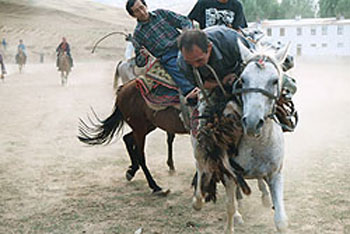
One of my favourite films at this year's Berlinale (Forum), was Ben Hopkins magnificent meta-documentary, 37 Uses for a Dead Sheep. As far as I'm concerned, you really can't go wrong with a film about yurts, yoghurt, nomadic tribes and the shifting borders of the 'Stans' in Central Asia. I put my pants on one leg at a time.
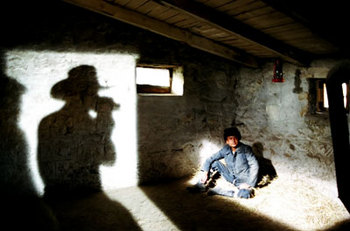
37 Uses, is not so much Hopkins' film but a collaborative work, made with the Pamir Kirghiz tribe, a splendid historical document. The film begins in the 19th c. with the Super Powers divying up Central Asia, a region that since the inventions of salt, silk, and opium remains one of the hottest properties on earth. We watch as beautiful nostalgic footage is fabricated through the tribe's reenactment, aided by the expert Kirghiz art direction of Muhammet Ekber Kutlu, son of the last Kirghizian khan, Rahman Qul.
In case you weren't paying attention during Central Asian History, the Pamir Mountains are the North Westernmost range of the Greater Himalaya, but are the feather in the cap of what is now known as 'the Stans'. Pakistan, Afghanistan, Turkmenistan, Uzbekistan, Tadjikistan, Kirghizstan and Kazachstan. Did I forget anyone? It's all about where you think the centre of the world is situated, and that is what has been keeping the Kirghizians on the move, beyond their normal pasturalisations. The Pamir Kirghiz, no strangers to hardship inflicted by Super Powers, have (partially) avoided ethnic cleansing by doing what they do best, being nomadic.
Nomadic pastoralists have a greater need for pastures than borders, but when in 1979 the sheep trade with Kabul became impossible, Khan Rahman Qul moved his entire tribe all the way down to Gilgit in Pakistan. There he tried to find a suitable homeland for his people, at one point applying for 1000 visas to move the entire kit and kaboodle to Alaska!
Since 1982, the Pamir Kirghiz live in Ullapamir. Pamir yes, Kirghizstan, no. Ullapamir is in Eastern Turkey, where the Kirghiz live in cement houses, not yak felt yurts, sedentary, no longer nomadic. People born after 1982 have no knowledge of the traditional Kirghiz lifestyle, and Hopkins' film ends with the story of a very urban young Kirghizian nurse living in Istanbul. When you see this educated woman, you can't imagine her, or even wish upon her, the task of milking a yak or a sheep, and seeing to the fermentation of dairy products. Although...
37 Uses for a Dead Sheep is larded with Hopkins trying to get his head around what seems to be an endless amount of things that you can do with Kirghzian livestock. These were for me the funniest scenes, and not just because they were talking a lot about yoghurt. The only disappointing thing about this wonderful film is that there aren't really 37 uses for a dead sheep, but only 36. And while I'll be the first to admit that dung is useful, the old man counted it twice. Bring down the total to 35!
Yoghurt features prominently in the history of the Pamir Kirghiz tribe. There is a hilariously acted scene in which the young Rahman Qul is saved from Russian poison by tucking into a bowl of yoghurt. Because 7 of the 35 uses of a dead sheep are yoghurt-related, I would like to remind Hopkins that you don't actually need to kill a sheep to extract its precious yoghurt. But I cede that the film's title wouldn't have the same ring to it.
37 Uses for a Dead Sheep is an excellent film about people making history, making film, and a little bit about making yoghurt.
37 Uses for a Dead Sheep's Production Company, Tiger Lily Films
Sales Agent, Electric Sky
Nazif Shahrani, scholar, filmmaker of the 'splendid historical document', the ethnographic film, the Kirghiz of Afghanistan
Excellent abbreviated history of the Pamir Kirghiz people by Iraj Bashiri!
Location, location, location! Here's a map of the Stans
Yurt porn galore and a smidgeon of academic orientalism at Turkotek
The Red Book of the Peoples of the Russian Empire
Ethnology and language resource for Central Asia
Pamir, the roof of the world
Understanding the Geographies of China
An assemblage of pieces by Robert McColl
Kirghizstan, the real deal
Please read more... "37 uses for a dead sheep, a film review and a re-count"
Posted by debra at 06:10 PM | Comments (0) | post to del.icio.us
A definitive list? 37 Uses for a Dead Sheep
According to the Pamir Kirghiz tribe, this is a list of the 37 (pronounced 35, and possibly 34) things you can do with a (dead) sheep:
1. ayran (yoghurt)
2. qurut (boiled ayran)
3. kurtap (sun dried qurut)
4. susme (thickened ayran mixed with qurut)
5. ajigey (cream heated to thicken)
6. kaymac (cream)
7. byshteq (pressed and cut qurtap?)
8. charity
9. wool
10. milk
11. dung
12. karen (?)
13. meshgeh (?)
14. sari mai (?)
15. nakhtan mai (?)
16. meat
17. leather
18. clothes
19. bedding
20. as money
21. tumaq (hat)
22. takta pos (?)
23. akui (yurt!)
24. kop (?)
25. kurchun (?)
26. kalkma (?)
27. palas (?)
28. bol (?)
29. arkan (?)
30. dung AGAIN!
31. amanat (charity of lent livestock - isn't that the same as # 8?)
32. toi (birth son sacrifice?)
33. wedding
34. kurban eid (?)
35. when the bride comes (?)
36. military service (?)
Posted by debra at 11:40 AM | Comments (0) | post to del.icio.us
Episode 1, emergency food distribution and the role of the cameras
March 19, 2006
- This entry refers to food distribution as discussed in yesterday's entry about the World Food Programme's computer game, Food Force.
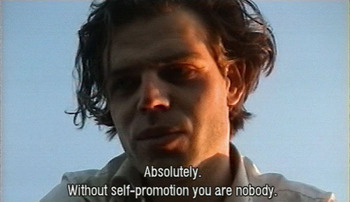
video still from Episode 1, © Renzo Martens
In January 2004, Dutch artist Renzo Martens produced his forty-four minute art film, Episode 1, a documentation of an extensive art performance. Martens travelled to the hottest hot spot war that he could find at the time of making the film (Chechnya, 2002), and in this 'setting' he pointed the camera, not at the war's victims and/or perpetrators like most (news) cameras do, but back upon himself. In Episode 1, Martens asks his Chechen and Russian Federation subjects, 'What do you think about me?'
Enough about you, let's talk about what you think about me.
Martens subjects are the normal cast of characters in every war; heavily armed soldiers on border patrol, civilians lining up for food, civilians trying to get on with it, civilians suffering before their destroyed homes and lives, refugees, but also all manner of NGO employees with their food programmes and journalists with their stories. Within minutes we understand that this is not simply a film about war, but a film about the role of the camera in war, about ethics, the dehumanising effect of pointing the camera and about what is so humanising about turning the camera back around at one's self.
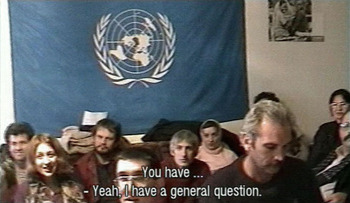
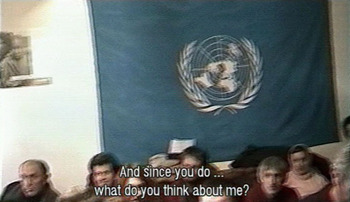
video stills from Episode 1, © Renzo Martens
In the tense environment of a Chechen UN press conference, in territories under fire, the conference moderator asks a group of journalists, NGO employees and UN workers, 'Does anyone have any questions?' Martens pipes up, 'Yes, I have a question!' 'What do you think about me?' Peals of laughter, no one can believe their ears. Ultimatey Martens' question is ignored and the journalists and NGO employees disband to their SUV convoys, rushing off to yet another 'opening' of a milk powder storage facility. Martens interviews the director of the operation, and together they quickly establish the fact that where there are cameras, there can be food relief. No cameras, no aid. In light of this, how could the World Food Programme build its computer game Food Force without even one single PR tier?
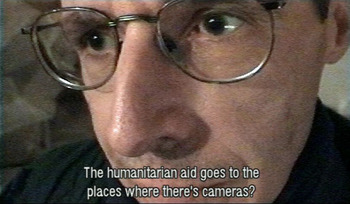
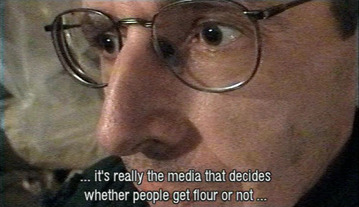
video still from Episode 1, © Renzo Martens
Episode 1 takes us through many such media-laden scenarios. In an open market destroyed no more than thirty minutes ago by Russian Federation soldiers with tanks and heavy artillery, a woman recounts how she and the other market women formed a human shield to halt the execution of a group of Chechen boys. Speaking to the camera, in an oddly well-rehearsed role of who stands where and who says what to the camera, the woman is still shaking from the experience. The scene ends with Martens staring shamefaced at the ground, unable to gather enough gumption to ask her what she thinks of him.
At a food distribution centre, Martens addresses a group of women lined up to receive rations of oil and flour. 'I just want to ask you what you think of me!' and this time there is an answer. The grim situation of lining up to receive basic foodstuffs, fades in the face of humanising laughter and warm sparkling eyes, women just being women. For a moment the food queue has all but disappeared. 'Boy, I think you're handsome, with your blue eyes!' 'What's your theme?' 'Are you a journalist?' 'No, he's an artist.' 'I think he's a journalist.'
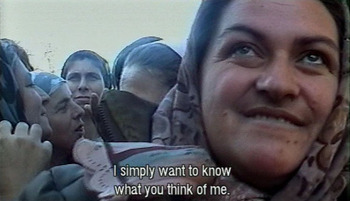
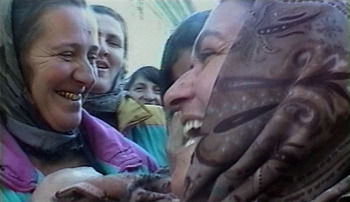
video stills from Episode 1, © Renzo Martens
Ultimately Martens 'act' of showing up with his camera and popping the question brings humanity to every situation that he creates. When he meets a young woman in a refugee camp (who bears an uncanny resemblance to his true love back in Belgium), his question changes, 'How should a man let a woman know that he loves her?' the woman's answer, delivered with beaming smile and sparkling eyes, dissolves the miserable tent landscape and suddenly it's just two people (and their translators) talking about love and life.
Of course Martens created this film for an art context, and the film articulately addresses contemporary art issues. Quite possibly Martens would be appalled that I consider his film to be 'useful', not just for artists and an art public, but as a tool to talk about the causes of war, hunger and the politics of emergency food distribution. And the question that Martens dares to ask amidst flying bullets, UN press conferences, annoyed Russian soldiers, women in food queues and refugees living in tent camps, the initial struggle that it initiates in the interviewee and in me, the audience, as I am simultaneously embarrassed by this question, but know that it is a question that can air-lift all of us actors out of the immediate and into a larger, more important discussion. Complexity is not complicated. Episode 1 brings us to the next tier, where a complex situation can be discussed with the nuance it deserves.
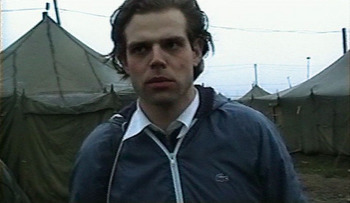
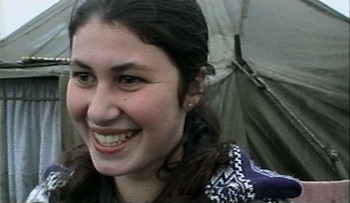
video still from Episode 1, © Renzo Martens
technorati tags: food-related film, Episode 1, Renzo Martens, Chechnya, cinema, emergency food distribution, Food Force
Posted by debra at 11:17 AM | Comments (3) | post to del.icio.us
Food-related film at the 4th Berlinale Talent Campus
February 23, 2006
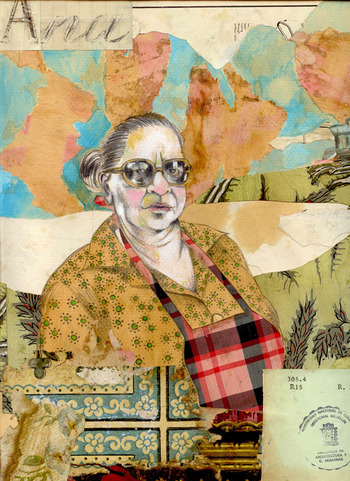
'Doña Ana', watercolour and collage that inspired Marlon Vasquez Silva's animation film Strawberry Eating Woman. 'Doña Ana' © Marlon Vasquez Silva, digital image courtesy of the artist
Apparently the director of the Berlinale International Film Festival, Dieter Kosslick, is obsessed with food and cooking. This explains why one of the six programmes had as its theme Food, Hunger and Taste. The 4th edition of the Berlinale Talent Campus (BTC), a section for young-ish filmmakers (when young means under 40), was dedicated to a heavily-worked relationship between food and film. Aside from my interest in the subjects, this was the most coherent and well-organised programme within the Berlinale. The Talent Campus offered young filmmakers a chance to meet, show their films, attend presentations, workshops and in general become indoctrinated I mean introduced to the film industry.
Although the evenings' big-screens at the BTC lamentably included worn out choices of food-related film like Babette's Feast, Eat Drink Man Woman, (how to ruin great films with unimaginative programming) and the dreaded 'Food + Romantic Comedy' genre piece, 'Bella Martha' by Sandra Nettelbeck, the programmers were wise enough to screen historical gems like Marcel Pagnol's 'Harvest (Regain)', informative documentaries like Hal Erickson's 'Alice Waters and her Delicious Revolution' (2003) and the most sensual cinematic food chain and materials exploration ever made, 'Drawing Restraint 9' by Matthew Barney.
This year, thirty-two young filmmakers were spotlighted in the Berlinale Talent Campus and divided into a five part programme titled unoriginally, 'Food for Thought'. From the selection, the films on the subject of hunger tended to suffer most from ill-research and moralist pedantics.
But when the films were good, they were very very good. Here is the culiblog selection of the eight best films on Food, Hunger and Taste from this year's Berlinale Talent Campus (in alphabetical order):
- A LOVE SUPREME. Nilesh Patel, UK: A hyper-rhythmic black and white short supposedly inspired by Raging Bull, but I see it as a sexy visualisation of a samosa recipe. I love the film's changing sense of time, concentrated detail shots and the stolen moments of materials pleasure. Bravo.
- CAKE IN THE FACE. Katarina Hellberg, Sweden: At a Talent Campus laden with moralistic expressions, one of the most refreshingly humorous films was Hellberg's CAKE IN THE FACE. Hellberg interviews the head of the international 'pie-ing' movement, who says, 'Every time I pie someone it is a total orgasm.' The international movement throws soft cream pies in the faces of the offensively powerful as a political expression. This film is indicative of the acitivist undercurrent in the world of food at the moment, and would programme well alongside feature length documentaries. It offers the audience a light-hearted answer to combat the gloom that is the contemporary food and agriculture documentary.
- It is noteworthy that of all the BTC short films, only those dealing with pies and cakes were funny. Short pause for thought.
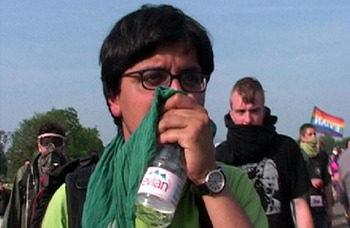
EviannaÏve image still © Verena Vargas, used courtesy of e|x|il Film
- EVIANNAÏVE. Verena Vargas, Germany: Lengthy but good, but lengthy. Eviannaïve documents a group of activists as they travel by train from Berlin to a small town near Geneva to disrupt the 2004 meeting of the G8. Civil disobediance and youthful enthusiasm are their only weapons. The title's palindrome hints at how difficult it is for the anarchists to mobilise politically, but somehow they do. (Maintaining the values of civil disobedience in the face of violent police action is not for the faint of heart.) It's the hippy in me that can't help but identify with activists that pick up their trash upon returning from the demo. This is a worthy historical document, lengthy, but good. But lengthy.The Eviannaïve website
- HUNGER. Maia Burduli, Georgia: Shrieking babies, tightly bundled up in blankets. One is worried that a fumbling nurse, insisting on carrying three newborns at a time, will drop one on its noggin. Ms. Burduli exlained after the screening that in Georgia, a baby's screams for its first mouthful of breast milk is a positive thing, a sign of thriving. In the film, once the nipples show up, we see what babies and mamas see, right up close and personal. Intense sucking is followed by a blissed-out milk coma.
- LA VIDA DULCE. Rouven Rech, Germany: An almost slapstick documetary short about Cuban subsidised cake distribution. If you're a Cuban mother on Mother's Day, you will get yer dang cake. After watching the short several times, it still confounds me that even though cake boxes are used in the transport of these generously frosted creations, no one puts the cake in the box, preferring instead to keep it on display, exposing the cake to all manner of dangers. Hilarious and sweet.
- STRAWBERRY EATING WOMAN. Marlon Vasquez Silva, Colombia: This was by far the most unique film of the BTC, an animation comprised of beautifully created watercolours and collages addressing the plight of displaced farmers in Colombia. Without being overtly political, Strawberry Eating Woman lays bare the loss of cultural capital that occurs when small agricultural communities are destroyed. Surprising and refreshing, like an excellent little strawberry.
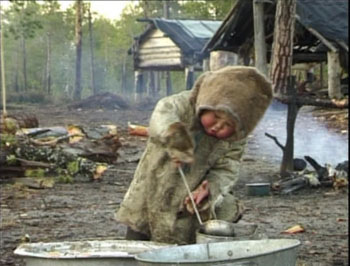
Tiny Katerina serves food to the dogs, image still © Ivan Golovnev, used courtesy of Golvnev Film
- TINY KATERINA. Ivan Golovnev, Russian Federation: Golonev admits readily that Tiny Katerina is a film about changing lifestyle more than about food. It documents the youngest member of a Northwest Siberian family that lives in a felt tent in near isolation. Katerina can't be more than two years old, but it is confusing whether she is playing at being an adult or is actually participating in the rigourous family chores! We see her lugging blocks of firewood around and cooking for the family's dogs. Two years old! Golovnev's camera is completely unobserved, offering an intimate view of a life that will soon vanish in the petrol politics currently plaguing this region. The documentary short has a distrubing ending that places the film within a larger political context.
- WASTE NOT, WANT NOT (CHICKEN A LA CARTE) Ferdinand DeMadura, Philippines: Just because I included this film on my list does not mean that I liked it. But Chicken a la Carte's subject has deeply interested me ever since I encountered it in PRChina: food-recycling. DeMadura follows a supply chain in which food travels from an urban food court in Anywhereville, South East Asia, to the kitchen where waste food is sorted, placed in a bag, in a bucket on a bike. I do not like green eggs and ham. Later the recyclist distributes the food amongst village children and the choicest of gleanings land ultimately on the family table of the food-recyclist himself. The practice is widespread all over... everywhere. Better film next time, DeMadura, but chapeau, your subject matter is rivetting.
technorati tags: Berlinale Talent Campus, Berlinale International Film Festival, film, food-related film, cinema, Berlin
Posted by debra at 03:25 PM | Comments (0) | post to del.icio.us
When fish fall in love
February 13, 2006
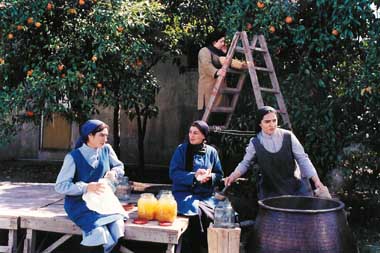
film still from When Fish Fall in Love, shows main character Atieh, her daughter and sisters preparing orange syrup in the garden. Image used without permission
When it comes to food-related film, I couldn't have made a better start at the Rotterdam International Film Festival. Drawing Restraint 9 had me reeling for days. Good for Drawing Restraint, bad for all the others that I saw directly afterwards. I had all but given up hope for finding a new approach to the genre, when I went to see the last film on my list.
When Fish Fall in Love saved me from being mired in bourgeois feel-good movies, films that are little more than romantic comedies with chefs and kitchens, gratuitous food porn, films that make audiences twitter at the thought of eating bull's testicles. Fish Fall in Love is Iranian theatre director Ali Raffi'i's first feature about two lovers being reunited after a twenty-year separation, and a new generation of about-to-be lovers, about to be separated.
Ex-political prisoner and Iranian émigré Aziz returns to his home at a Caspian Sea coastal village, where he finds that his former beloved Atieh, her daughter and two sisters have appropriated his family home and turned it into a restaurant. The film is shot like an old postcard from your grandparents' seaside holiday, complete with long images of regional specialities. In this film, no dish leaves the kitchen without making a cameo. Can you imagine jewelled rice doing the red-carpet walk at Cannes?
Ali Raffi'i spoke to the audience before the screening, explaining that this film was about the difference between the way his and the generation now in their twenties, express love for one another. His intricately developed characters convey the complicated situation of a generation (Aziz and Atieh) whose political passion (may have necessarily) precedes their passion for each other. This contrasts sharply with the generation of Atieh's daughter Touka and her Teheran beloved Reza, who are even driven to criminal acts in the hope of supporting their love.
Admirably, Raffi'i endeavoured to show a different view of woman than what he described as 'ordinarily portrayed in Iranian cinema'; a woman whose destiny is not dependent on the presence or hope for presence of a man in her life. Not being sufficiently familiar with Iranian cinema to judge, I had to think, 'Heq, come on over here, that's a hole in the market!' Until now, the art installation videos of Shirin Neshat and the British documentary filmmaker Kim Longinotto's Divorce Iranian Style were until now, my sole influences.
While Atieh is a strong character, supporting her daughter, two of her sisters and herself by running a small restaurant, she is also always really nervous about this role. Preparing lunch and dinner for only twenty, though she's been doing it for years, seems to be a monumental feat for her. Among the many kitchen shots of brilliantly presented 'home-style' cooking, the viewer is treated to beads of sweat on noses and upper lips, the wiping off of sweat from brows and the drenched backs of clothing. I'm thinking, 'Sister, what you need is a smaller menu.' But Atieh's unwieldy menu seems to represent traditional culture and her uncomfortable relationship with it.
The film's ending is deliciously open, giving few clues as to how Aziz and Atieh will give shape to their deep love and respect for one another in the future.This combined with Raffi'i's rich characters have given me room to identify completely with love's consequences for Atieh and Aziz. All that I am willing to give away, is that there is a cottage involved. I know that the next time I make orange syrup, this film will be the first thing on my mind.
- Film review of When Fish Fall in Love on Teheran Avenue
- Iranian Food Photos on Flickr
- Film Festival Rotterdam entry about When Fish Fall in Love
- Forget Martha's Vineyard, I'm going to Iran
- Women Make Movies on Kim Longinotto
- About Ali Rafi'i as a theatre director
technorati tags: International Film Festival Rotterdam, film, food-related film, cinema, Rotterdam, When Fish Fall in Love, Ali Rafi'i
Posted by debra at 02:01 PM | Comments (0) | post to del.icio.us
Food-related film at the Berlin International Film Festival
February 09, 2006

Pack up your yurt, we're moving to the steppes of Berlin for a week, where it's much colder than it was in Rotterdam, and where a yurt will come in handy. The craziness begins today at the Berlinale, the Berlin International Film Festival. Culiblog will be attending the madness for an entire week, from Saturday the 11th until the 19th, reporting on all food-related films and presentations.
This year there is a glut of food-related film because aside from the regular programme, food, hunger and taste are the subject of the Berlinale Talent Campus, a platform within the Berlinale festival. The Berlinale Talent Campus creates opportunities for young filmmakers to meet with les eminences grises from the film industry and the folks from the more active side of food and food culture as well. Alice Waters, Vandana Shiva, Carlo Petrini will all be there.
Once again, I've created a culiblog food-related film selection culled form the entire Berlinale programme for those willing to move beyond Babette's Feast. Oh dear, it's 2006 and they're actually showing Babette's Feast!
The culiblog selection at the the 56th International Berlinale Film Festival:
Saturday, 11.02.2006:
23:00: - Harvest (Regain), a Marcel Pagnol classic! (Manon de la Source)Sunday, 12.02.2006
18:00: - Berlin Talent Campus Screening - Food For Thought: Origins: Tom Luddy will present all 32 Talent short films on "Hunger, Food and Taste" in three sessions, beginning at 18:00. Today's programme "Origins" will include eleven short films from seven different countries. In between the screenings, Tom Luddy will introduce the Talent directors and discuss their reflections on "Hunger, Food and Taste".
10:30: - Eat and Shoot the Indie Way, presentation with a.o. Alice Waters, Angie Lam, Vandana Shiva and Slow Food's Carlo Petrini
12:15: - Who Owns Life? Talk with Vandana Shiva and Renate Künast
16:30: - Talk with Peter Kubelka: Cooking as the Origin of Culture...
17:30: - One Way Boogie Woogie / 27 Years Later, James Benning
Monday, 13.02.2006
14:00: - The Case for Taste, lecture and screening of Nossiter's Mondovino with Carlo Petrini a.o.
18:00: - Berlin Talent Campus Screening -
Food For Thought: Delicious Revolution: Today's Food for Thought session is hosted by US-director Doug Hamilton. His film ALICE WATERS AND THE DELICIOUS REVOLUTION is a documentary about the ideas and ideals of natural food specialist Alice Waters, who has been practicing and sharing with the world her healthy and environmentally conscious principles for nearly thirty years. After the screening, director Doug Hamilton will answer questions.
20:30: - Mondovino, Jonathan NossiterTuesday, 14.02.2006
18:00: - Berlin Talent Campus Screening -
12:30: - Matthew Barney: No Restraint, Alison Chernick
18:00: - Berlin Talent Campus Screening - Food For Thought: "Kill or Die" is today's screening of a new round of shorts from the Campus competition "Films on Hunger, Food and Taste". Tom Luddy will present ten filmmakers from eight countries and talk about their cinematic stories about the relationship between food and death, about the often hidden fact that for some, eating means killing, and about food, fear and devotion.
18:45: - Drawing Restraint 9, Matthew Barney Wednesday, 15.02.2006
18:00: - Food For Thought: Lost Supper: A screening of the Berlinale Talent Campus films on "Hunger, Food and Taste" is dedicated to films that deal with hunger, starvation and poverty in the world. Eleven short film productions from eleven countries explore the unjust manner of food distribution in the world and the local effects of this problem. Tom Luddy will introduce all of this year's Talent filmmakers and talk about their productions.Friday, 17.02.2006
18:15: - 37 Uses for a Dead Sheep, Ben HopkinsSaturday, 18.02.2006
14:30: - Happy as One, Vanessa Jopp
You'll be needing these links as well:
- 56th Berlinale International Film Festival (programme search in English)
- Berlinale Talent Campus lineup of film on food, hunger and taste
- Berlinale Talent Campus (in English)
- Berlinale Talent Campus evening programme
- Berlinale Talent Campus lecture and presentation programme
- Slow Food and the Berlinale Talent Campus have teamed up. Here's the blurb.
- Jonathan Nossiter's Mondovino
- NYTimes film review of Marcel Pagnol's classic from 1937, Harvest (Regain)
- Marcel Pagnol filmography on the IMdb
- James Benning interview by Danni Zuvela on the Senses of Cinema website
- James Benning's filmography on Wikipedia
- Synopsis of Alison Chernick's Matthew Barney: No Restraint
- Ben Hopkins, 37 Uses of a Dead Sheep
- A list of food-related films, compiled by Rebecca Epstein for Gastronomica. Her dissertation titled, "Crime and Nourishment", focused on the food and foodways of Hollywood gangster films. Epstein's list needs a good tweaking and I don't agree with her about a lot of the titles, but it will serve us just fine for February.
- culiblog reviews Matthew Barney's Drawing Restraint 9
technorati tags: Berlinale International Film Festival, film, food-related film, cinema, Berlin, Drawing Restraint, Matthew Barney
Posted by debra at 02:12 PM | Comments (6) | post to del.icio.us
Drawing Restraint, dragging ambergris
February 05, 2006

Occidental Guest (bride), production still from Matthew Barney's Drawing Restraint 9, copyright Matthew Barney, used without permission
Filled with expectation unsuitable for the company of friends, clutching a fat wad of tickets between fingers reeking of quickly eaten, mediocre sushi, it is unwise to view the best film of the festival first. It just ruins everything, and this is exactly what happened to me on January 30th when, in the exquisite 'old' Luxor cinema in Rotterdam, I saw Drawing Restraint 9.

Shimenawa, production still from Matthew Barney's Drawing Restraint 9, copyright Matthew Barney, used without permission
Drawing Restraint is artist Matthew Barney's 2006 film entry in the International Film Festival Rotterdam and as well the Berlinale Film Festival, where he is a member of the jury. Avant-pop artist, composer and girlfriend Björk composed the soundtrack. Their collaboration is astounding on all levels; the film will make you cry, it is that beautiful. Aside from being culiblog's favourite at this year's festival, the film is exemplary of food-related film in the culiblog sense of the word; food, food culture, food as culture and the culture that grows our food.
Matthew Barney is the Lance Armstrong of contemporary art. In my opinion, no chef can yet lay claim to this position. Drawing Restraint 9 is also the best food-related film ever made, a lavish display of sensuality and ritual.
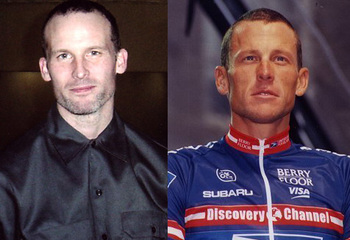
Barney on the left, Armstrong on the right
Drew Daniel of Matmos wrote this stellar description of Barney's art practice on Björk's DR9 website:
Barney is a visual artist whose ambitious, rigorous multimedia work encodes esoteric meanings while providing lushly immediate aesthetic rewards. Best known for The Cremaster Cycle, the sprawling sequence of five films made over ten years which was the subject of a recent Guggenheim retrospective, Matthew Barney's work is multimedia in execution but singularly focused in conception: tightly unified fusions of sculpture, performance, architecture, set design, music, computer generated effects and prosthetics, Barney's films deploy the full range of cinematic resources in the service of a hermetic vision rich with densely layered networks of meaning drawn from mythology, history, sports, music, and biology.
This is a sexy way of saying that Barney's work is based upon his own elaborate and logical cosmology. In Drawing Restraint he playfully turns materials, forms, geometries and processes (e.g. petroleum jelly, silicone, whale blubber, ambergris, other marine excretions and accretions), cultural-historical narratives and geographic trajectories (e.g. the architecture, interior and machinery of a whaling ship, the culture of whaling, the history of a specific ship) and the experience of time (e.g. pearl oyster divers holding their breath under water, the migration of whales, a Japanese tea ceremony), into a luscious weave of deeply connected meaning and narrative.
This is where chefs tend to slack off.
But this is Barney's demarrage, an escape or breakaway that gives him an advantage over the rest of the 'field'. Whereas it is common for a chef to create a 'richly organized set of aesthetics' (as Drew Daniel describes Barney's approach to making art), I know of no example within the culture of contemporary haute cuisine in which a chef recontextualises elements on this level to form a total experience beyond the formal boundaries of restaurant culture. Perhaps I'm not going to the right sort of parties. I long for an haute cuisine that is less 'applied' and more autonomous.
Please read more... "Drawing Restraint, dragging ambergris"
Posted by debra at 08:51 PM | Comments (4) | post to del.icio.us
Rural design conference scheduled for September 2006
January 21, 2006
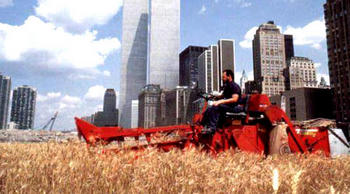
(above: Wheatfield, a large public work by Agnes Denes, image copyright Agnes Denes)
Chapeau to John Thackara at the Doors of Perception blog who reports today about a rural design conference scheduled to take place September 4-7 2006 (somewhere) in the UK. Just have a look at what's being developed for the programme! I am pleased to see that it is all about establishing and strengthening real connections between (urban) cultural producers and rural agriculture producers to the benefit of both.
In a conference forerunner in July of 2005, this is what they were talking about: farmers as curators - an international Rural Biennale for 2007, sustainable farm diversification, rural tourism, food marketing initiatives and staging the Rural Biennale as an integral part of a European Region of Rural Cultures and Farmer Creativity celebration.
To the list of interesting subjects already discussed and in the planning for September 2006, I would like to add: 'rural farmer to urban farmer advisory partnerships for urban gardening/farming initiatives'. I can't help but wonder if the experience and knowledge of the rural farmer can help urban farming inititives such as this wonderful urban farming project in East L.A from being under threat of closure due to urban land-use issues. Injecting (cultural) life into family farms suffering brunt of (European) Agricultural Policy might be just the ticket for rejuvenating a way of life under threat of extinction. Might not the urban farmer benefit from being part of this discussion and network?
- European Rural Culture events page
- Littoral - new zones for critical art practice. An excellent organisation website, with informative links on everything from an extremely mixed bag of individual artists and designers that use nature / agriculture / landscape as a creative platform, to cultural documents on foot and mouth disease!
- Cultural Documents of the Foot and Mouth Crisis in the UK
- Urban food gleaning project by Fallen Fruit
- The South Central Farms website is good reading if you want to get fired up!
- Pruned, weblog on landscape architecture and related fields.
- Pruned blog entry about South Central Farms in L.A.
- Pruned on artist Agnes Denes
- Brilliant films by Raymond Depardon about the demise of French farming communities in the Lozere were shown at the 2005 Int'l Documentary Film Festival in Amsterdam (IDFA) as part of a special tribute programme.
- Farming as a a landscaping trend in suburbia! (Landscaping is responsible for more than 80% of water use in the suburbs.)
- Doors of Perception review of urban farming proposal by Dutch architect Winy Maas
- Non-sanctioned urban gardening in Istanbul, entry in culiblog
- Innovation Network Rural Areas and Agricultural Systems
technorati tags: rural design, food security, sustainability, farming, food-related art, food-related design, food-related film, Raymond Depardon, agricultural diversification, agricultural policy, urban gardening
Posted by debra at 11:47 AM | Comments (1) | post to del.icio.us
Food-related film at the Rotterdam International Film Festival
January 20, 2006
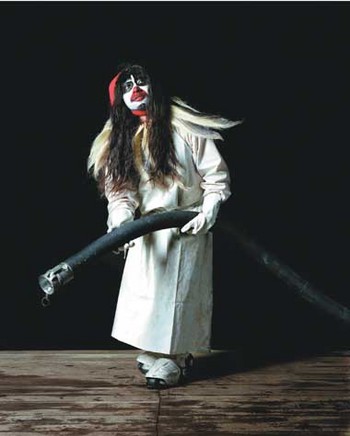
Petrolatum Spirit, film still from Matthew Barney's Drawing Restraint 9, copyright Matthew Barney, used without permission
Pack up your yurt, we're moving to Rotterdam for a little more than a week. January 25 - February 5, 2006 is the Rotterdam International Film Festival. The programming is dazzling, but I've created a short food-related film selection for anyone that believes it's time to move beyond Tampopo. Having not yet seen these films, I am hoping that their content can be interpreted as food-related, in the culiblog sense of the word: food, food culture, food AS culture, and the culture that grows our food.
Tickets are available from Saturday January 21, 2006 at 09.00 hrs until Saturday February 4, 2006 at 21.00 hrs at the Festival Box Office located in 'de Doelen' (entrance Kruisplein), Rotterdam and, by telephone through +31 0(10) 890 9000
The culiblog food-related film selection for the International Film Festival Rotterdam 2006:
Sunday 29.1
10.30h - Kitchen
14.30h - Fish Fall in Love, culiblog review of Ali Rafi'i's When Fish Fall in Love
Monday 30.1
19.00h - Drawing Restraint, culiblog review of Matthew Barney's Drawing Restraint 9
21.45h - Eden
Tuesday 31.1
16.00h - Poulet poulet
17.30h - Mother of the Mother and also the Mother of the Mother's Mother and Her Daughter
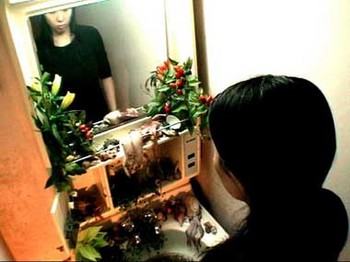
film still from Mother of the Mother and also the Mother of the Mother's Mother and Her Daughter, copyright IFFRotterdam, used without permission
From Wednesday 01.2 until the festival's end, I shall attend as many films as I please regardless of their food-related content. If you're coming, drop me a line so that we can meet up and tuck into some excellent Rotterdam food.

technorati tags: International Film Festival Rotterdam, film, food-related film
Please read more... "Food-related film at the Rotterdam International Film Festival"
Posted by debra at 10:40 PM | Comments (0) | post to del.icio.us
Occupied Olive Tree Territories
December 10, 2005
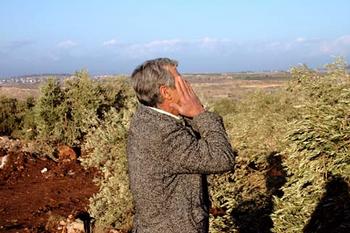
(A Palestinian farmer weeps at the bulldozing of his olive trees, photo by Gary Fields)
Because culiblog is a culinary weblog about food, food cultures, food as culture and so on, I feel obliged to breach the subject of olives, olive trees, olive tree culture, and olive trees as culture. In the past month I have seen Osama Qashoo's documentary, My Dear Olive Tree, (at the IDFA), and Khalil Rabah's installation piece (at the 9th International Istanbul Biennale), the Palestinian Museum of Natural History and Humankind. The olive tree as a symbol of Palestinian identity is used in both Rabah's and Qashoo's work.
Osama Qashoo is a recently exiled Palestinian film maker living and working in the UK. My Dear Olive Tree is his documentation of the destruction of the olive tree that he tended since childhood. The film depicts Qashoo as he witnesses the demolition of his olive tree and surrounding olive orchard, his own unwilling journey from Palestine to London, where he is reunited with a residual form of his dear olive tree on sale in an airport gift shop. At the beginning of the film Qashoo warns us that this is the last time he will see the olive tree, one tree of an entire grove in the Occupied Territories, a grove that sustained more than twenty families for generations with income from the olive oil.
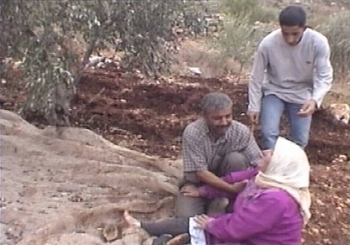
still from My Dear Olive Tree, courtesy of Osama Qashoo
The eighteen-minute documentary shifts swiftly from registering the small community's warm familial bond with the land, to an extremely tense situation in which Israeli Army bulldozers move in to uproot the olive trees. The film shows Palestinian women in a state of utter hysteria as they are forced to bear witness to an act nothing short of an amputation. The film ends with a visit to an airport gift shop presumably en route to the UK, where, in some twisted form of fundraising, olive wood pendants cut into peace doves are being sold. Filmmaker Qashoo buys one of the trinkets and in the mean time the audience seems to have scratched deep grooves into the arm rests of their seats.
Khalil Rabah is an internationally acclaimed artist working in the field of conceptual art, installation and performance. Together with Zvi Goldstein he was the recipient of the Lennon-Oko Grant for Peace in 2003. His work reminds me quite strongly of the Neue Slovenische Kunst style of re-claiming and re-writing one's own history with regard to cultural identity. Rabah's Palestine before Palestine museum exhibit uses the olive tree and the installation-form to parody the history-writing effect that such a museum institution wields by its very presence. Rabah embeds the present-day context of Palestine and Palestinian identity within the context of a natural history museum, by describing the entire natural world in terms of the (occupied) olive tree.

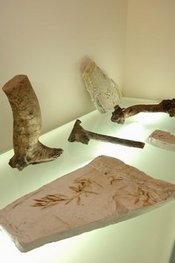
In typical museum-style, the Palestinian Museum of Natural History and Humankind (PMNHH) opens cans of experts, declares facts and exhibits it's acquisitions policy, manifest in projects such as the 3rd Annual Wall Zone Sale, an auction which took place at the Khalil Sakakini Cultural Centre in Ramallah in March of 2004. By auctioning off lots of material from around the wall zone, artist Rabah lobbied awareness of the social and ecological implications of the ~670km West Bank Barrier that Israel is currently building. The PMNHH also has a café and a giftshop, complete with very helpful attendents ready and waiting to attend. But when one asks in all earnestness for a cup of tea, or if there is something to buy in the giftshop, the attendant just shakes her head and smiles. 'Sorry, we have nothing to sell.'
Please read more... "Occupied Olive Tree Territories"
Posted by debra at 07:03 PM | Comments (11) | post to del.icio.us
And the answer is... community supported agriculture
November 30, 2005
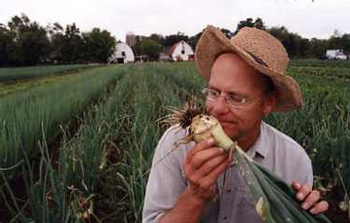
image courtesy of the Real Dirt on Farmer John website
Well, at least that is one of the most positive answers to the questions that came to my mind after watching Erwin Wagenhofer’s We Feed the World (Austria 2005) Saturday night at the IDFA. Although reviews and film descriptions already abound, here's culiblog's quick take on the films The Real Dirt on Farmer John, We Feed the World and Bullshit.
Context is everything, although this hadn't occurred to me weeks ago when I reserved my tickets for the IDFA and Shadow Festivals. It was pure coincidence that I chose Taggert Siegel’s The Real Dirt on Farmer John (US 2005) instead of We Feed the World as my first IDFA film. But the documentary about John Peterson (I heart him) is such a poignant portrayal of his pursuit of agricultural viability on a very personal level, that the film armed me with an outlook positive enough to take on the eloquent doom and gloom of the other documentaries. I wish my fellow audience members had been so lucky, because their anger and disillusionment about the realities sketched in Wagenhofer's, We Feed the World and even Holmquist's Bullshit was palpable.
Please read more... "And the answer is... community supported agriculture"
Posted by debra at 11:17 AM | Comments (1) | post to del.icio.us
Food-related film, art, design and culture in Amsterdam
November 17, 2005
Starting next week culiblog is feeding itself with food-related films from the Shadow and IDFA documentary film festivals. Themes such as the family farm, food distribution, foodstore owners, olive trees, Japanese home cooking and of course globalisation, feature prominently in my selection.
The Netherlands has two film seasons each year. In November and December it's documentary season with the Shadow Film Festival and the International Documentary Festival Amsterdam (IDFA). In January it's the International Film Festival Rotterdam. I have known couples that, when they broke up, had to decide who would get to go to which film festival. Seriously. Big stars like artist Allan Sekula, who presented his documentary Fish Story at the Shadow Festival in 2002, show up for these events in our dark but cosy Polar Circle villages.
The culiblog programme of food-related documentary film (Nov 25-Dec 03, 2005, Amsterdam NL)
Friday 25.11
12.30h Film Museum: Meat Vegetables and Dessert
14.45h City 7: My Dear Olive Tree
18.30h Calypso: The Real Dirt on Farmer John
20.20h Cinerama 1: Profils Paysans (Profiles of Farmers: Daily Life)
Saturday 26.11
12.00h City 1: Bullshit
21.00h City 1: We Feed the World
22:00h Uitkijk: Autumn
Sunday 27.11
16.00h Melkweg: Taimagura Grandma
Monday 28.11
11.00h Cinerama 1: The Real Dirt on Farmer John
14.30h City 7: Het is een Schone Dag Geweest (It's been a lovely day)
21.45h Cinerama 1: Our Daily Bread
22.00h Uitkijk: Alimentation Generale
Tuesday 29.11
20.00h City 5: Bullshit
21.30 City 1: We Feed the World
Wednesday 30.11
19.00h City 1: Our Daily Bread
Thursday 01.12
10.45 City 7: My Dear Olive Tree
Friday 02.12
20.15 City 3: Meat Vegetables and Dessert
Saturday 03.12
12.45h Calypso 1: We Feed the World
14.15h Film Museum: Profils Paysans
17.30h City 2: Our Daily Bread
19.00h City 3: Bullshit
19.15h City 7: Het is een schone dag geweest
For IDFA reservations:
IDFA +31 (0)20 4277452 (open from 12-17h)
http://www.idfa.nl/
For Shadow Festival reservations, contact the locations:
de Melkweg +31 (0)20 53 18181
Lijnbaansgracht 234/A
de Uitkijk +31 (0)20 6237 460
Prinsengracht 452
Please read more... "Food-related film, art, design and culture in Amsterdam"
Posted by debra at 11:46 AM | Comments (0) | post to del.icio.us


