Street food waste =
street food packaging
April 29, 2006
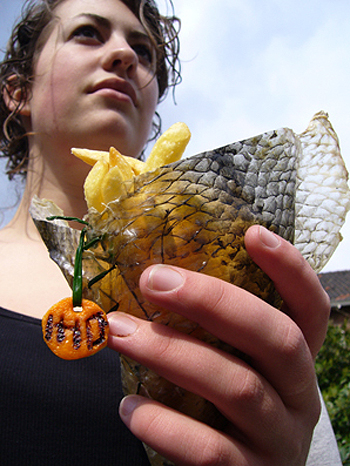
Fish and chips: image of street food packaging concept 'IHO', © Païvi Kovanen, Eva Arts and Caroline van Teeffelen 2006, used courtesy of the designers. Please respect student work, contact culiblog for updates.
(This is the second in a series of entries about the Street Food Workshop developed and conducted together with Katja Gruitjers for our students from the Design Academy Eindhoven and the HAS den Bosch.)
Just the simple fact of making street food creates tonnes of food waste. Students Païvi Kovanen, Eva Arts and Caroline van Teeffelen used food waste materials to develop packaging for street food. Katja and I were really impressed with their packaging concept IHO, which means skin in Finnish. Even mo' bettah, when you turn the letters around to spell OHI, you get the Finnish word for leftovers.
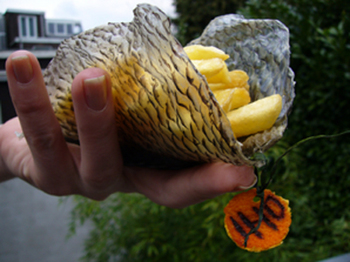
Image of street food packaging concept 'IHO', © Païvi Kovanen, Eva Arts and Caroline van Teeffelen 2006, used courtesy of the designers. Please respect student work, contact culiblog for updates.
The fish and chips sack is brilliant. Hand-sown dried fish skin imparts a nice fish aroma to the chips and you know how the Northern peoples love their (dried) fish. Katja and I are imagining a dusting of vinegar powder on the inside of the sack for a perfect flavour.
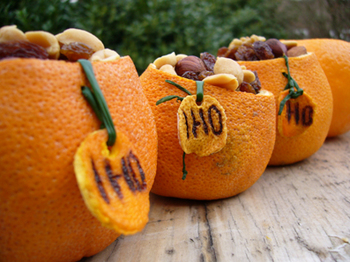
Image of street food packaging concept 'IHO', © Païvi Kovanen, Eva Arts and Caroline van Teeffelen 2006, used courtesy of the designers. Please respect student work, contact culiblog for updates.
Urban juice bars produce orange rind and pulp waste that is normally turned into silage to feed animals that us omnivores love to eat. Kovanen, Arts and van Teeffelen assured us that there's plenty of rind and pulp to go around and they dried the rinds into snack containers. The pulp they turned most amazingly into a palm plate that has a wonderful hand feel to it.
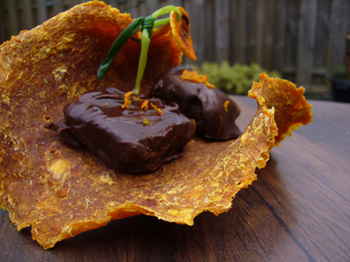
Image of street food packaging concept 'IHO', © Païvi Kovanen, Eva Arts and Caroline van Teeffelen 2006, used courtesy of the designers. Please respect student work, contact culiblog for updates.
As if this weren't enough for one half-term street food assignment, the ladies Kovanen, Arts and van Teeffelen developed a new ceramic material produced from eggshells and potato starch and that can be formed into any possible shape. Here, the material has been formed into a palm plate.
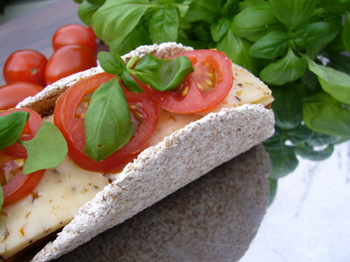
Fish and chips: image of street food packaging concept 'IHO', © Païvi Kovanen, Eva Arts and Caroline van Teeffelen 2006, used courtesy of the designers. Please respect student work, contact culiblog for updates.
IHO street food packaging concept by Kovanen, Arts and van Teeffelen.
Posted by debra at 11:06 AM | Comments (3) | post to del.icio.us
Street food collaborations: Streetberry!
April 24, 2006
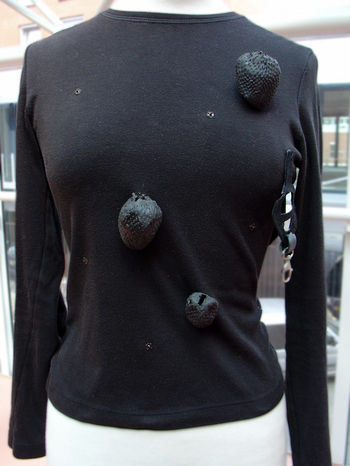
Streetberry design by Michou-Nanon de Bruyn, Milou Melis and Monica Ruiter. Please respect student work, contact culiblog for updates.
Nothing says wing-flapping like a subversive strawberry. Students Michou-Nanon de Bruyn, Milou Melis and Monica Ruiter have developed Streetberry as their final project for Katja Gruijters and my street food project. The collectible black rubber berries snap on to black t-shirts, rings, and necklaces made out of recycled bike tyres and representing the map of the city. The pieces smell like strawberries, but in a way that someone who is not a twenty-something woman can still appreciate.
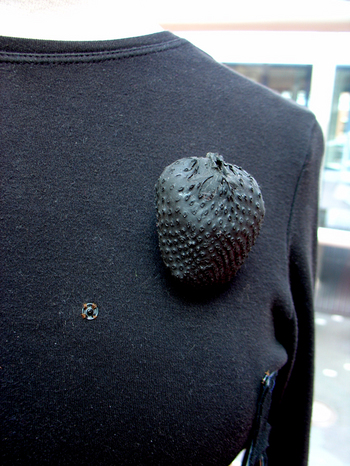
Streetberry design by Michou-Nanon de Bruyn, Milou Melis and Monica Ruiter. Please respect student work, contact culiblog for updates.
Since March, students from the HAS (Hoger Agrarische School, 's Hertogenbosch NL, Food Design) and the Design Academy Eindhoven (Atelier, Food) have been collaborating on a street food project that Katja Gruijters and I initiated. Last Friday they presented the conclusion to their R&D and in the next weeks I'll show a few of the best projects here on culiblog. Katja and I are most pleased with the results and think that the collaboration proves that the Design Academy and the HAS should work together on food-related projects in the future.
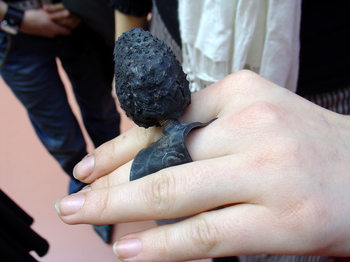
Streetberry design by Michou-Nanon de Bruyn, Milou Melis and Monica Ruiter. Please respect student work, contact culiblog for updates.
The assignment was to develop a a street food concept and in the course of 10 weeks develop this into a prototype. As you may already know, the NL is practically devoid of street food aside from the usual offerings of the Servex Group. Selling food on the street or at the train station is effectively illegal unless you are part of this horeca monopoly (HOtel, REstaurant, CAfé - another sexy Dutch acronym).
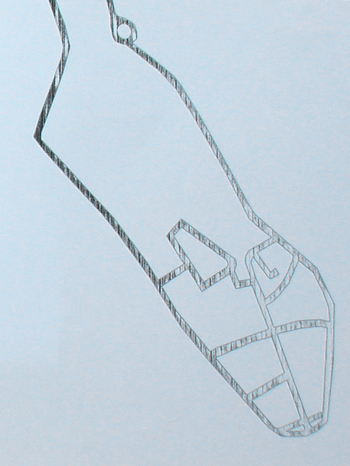
Streetberry design by Michou-Nanon de Bruyn, Milou Melis and Monica Ruiter. Please respect student work, contact culiblog for updates.
Katja and I wondered what future (food) and product designers, presented with a wealth of images and information about initiatives in other countries would come up with. Fortunately some students let their autonomous brains lead them away from the kitchen. A jewelry line based upon the map of the city, a new materials collection for street food packaging using the waste materials of commonly sold street food, and a conceptual art performance are some of the 12 fresh visions of what street food in the NL could become if it were allowed to flourish.
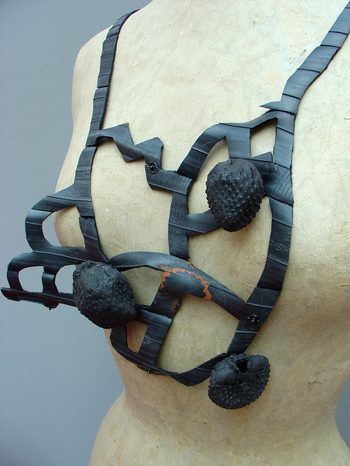
Streetberry design by Michou-Nanon de Bruyn, Milou Melis and Monica Ruiter. Please respect student work, contact culiblog for updates.
- Thank you Servex for convincing Dutch legislators that street food diversity is a hygiene issue!
- But seriously, thank you HAS for hosting this collaboration in your fabulous test kitchens!
- Thank you Design Academy Eindhoven (Kompas: Atelier) for being flexible and playful in terms of curriculum!
- Thank you Michou-Nanon de Bruyn, Milou Melis and Monica Ruiter for introducing us to Streetberry!
Posted by debra at 09:27 AM | Comments (0) | post to del.icio.us
Lace, about face
Ander Kant
April 06, 2006
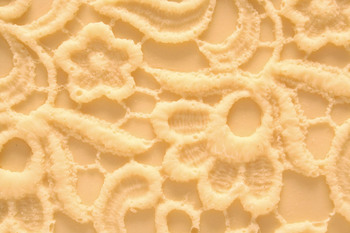
image of white chocolate lace detail, © Katja Gruijters, courtesy of the designer
Aren't these edible lace tiles by food designer Katja Gruijters exquisite? She makes them out of caramel, white and milk chocolate and sand tart. They feature prominently in an exhibition on contemporary lace design titled, 'Ander Kant', (literally 'other lace', or 'other side') at the Boijmans van Beuningen Museum in Rotterdam.
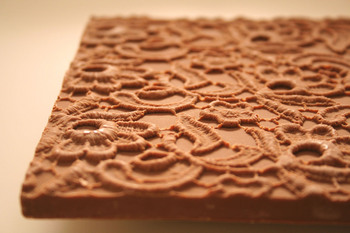
image of a milk chocolate tile, © Katja Gruijters, courtesy of the designer
The collection is on sale at the Boijmans van Beuningen Museum shop but you can also find out more about them at Katja's website.
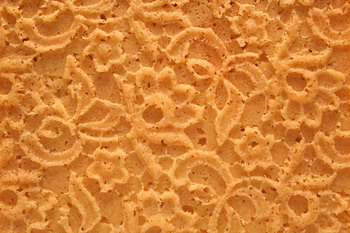
image of a sand tart tile, © Katja Gruijters, courtesy of the designer
Katja Gruijters, food designer
Ander Kant/Other Lace at the Boijmans van Beuningen Museum, Rotterdam until April 30, 2006
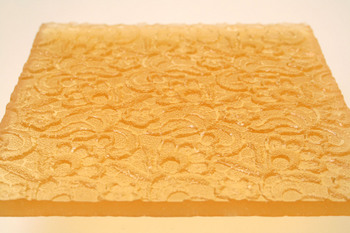
image of a caramel tile, © Katja Gruijters, courtesy of the designer
Please read more... "Lace, about face
Ander Kant"
Posted by debra at 01:47 AM | Comments (4) | post to del.icio.us
Will swap saliva for a home, the problem with bird nest soup
April 04, 2006
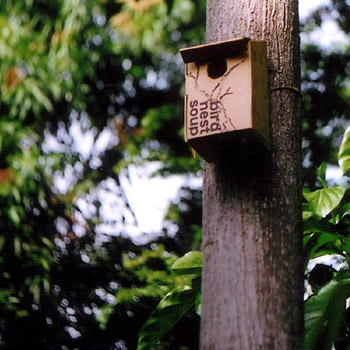
image from Hoko Studio design collaborative, cropped and used entirely without permission
If you were a bird living in a cave in Thailand, would you rather
1. live in a house of your own making constructed from spit and twigs?
or
2. live in a gifted house made out of recycled cardboard?
Bad question. Here comes a better one.
If your house was under threat of confiscation, would you rather
1. be given a house built out of recycled cardboard?
or
2. be left to your own devices to emotionalise enough angry bile and spit to produce a new casa de saliva?
It may be yesterday's news to some, but I was surprised to read that swiftlets are suffering forced eviction due to gourmand greed! Swiftlets are the little birds whose nests are prized for bird nest soup. Some varieties of Thai swiftlet construct nests comprised of 80% lugie! Homelessness seems like a poor reward for resourcefullness.
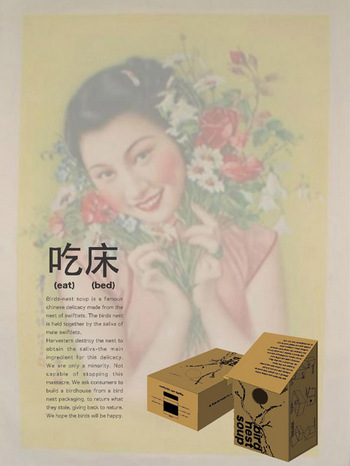
image from Hoko Studio design collaborative, cropped and used entirely without permission
Design collaborative Hoko Studio has a partial solution. And by 'partial', I mean partial. Use birdhouses to package and distribute the nests. When the cook is done leaching the saliva out of the nest, the customer can hang the packaging on a tree (or high up in a cave in Thailand) and commence slurping with a partially clean conscience!
Partial solutions are only half the beauty of critical design.
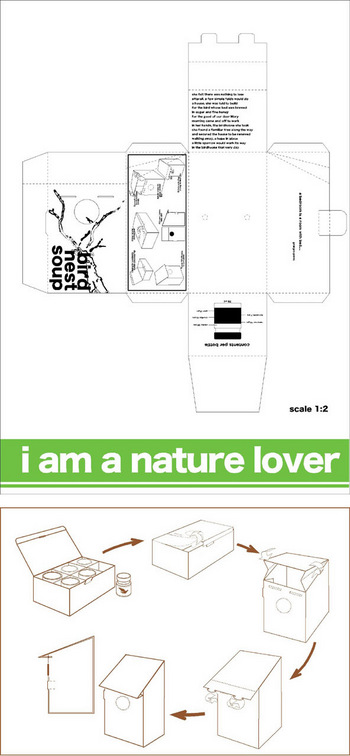
image from Hoko Studio design collaborative, cropped and used entirely without permission
Know your bird nest
Know your birds' nests even more
Hoko Studio's 'Eat Bed' bird nest proposal at Platform 21
Meet Hoko Studio Design Collaborative, the designers of 'Eat Bed'
Wikipedia bird's nest soup page with a cool picture of a saliva nest
Hoko Studio's proposal titled 'Eat Bed' is one of several 'critical design' projects exhibited at the Platform 21 website under the title, Positive Alarm (fixing what is wrong without making it wronger). Platform 21 is a newish venue for design situated in Amsterdam's newish city center, de Zuidas, (pronounced South Central).
Here's the Platform 21 culture blurb: 'the domain of creation is not something professionals have a monopoly on. We are interested in creative developments in fashion and design, including amateur initiatives.'
Huh. Platform 21 does seem like an OK initiative, although their website is probably the most annoying surf you'll have this week. Indeed a platform for Dutch and international design initiatives has been sorely missing ever since the nest known as the Vormgevings Instituut (pronounced Netherlands Design Institute) was confiscated by barbaric xenophobes back in the '90's. Maybe Platform 21 will provide a new place for design to alight. The director is ethnic Dutch, always a good starting point. Soup is on!
Hoko Studio's 'Eat Bed'
Platform 21 a design nest in Amsterdam's Zuidas
Platform 21's online exhibition Positive Alarm
Posted by debra at 08:58 PM | Comments (0) | post to del.icio.us
Food Force computer game: force-feeding inaccurate notions of the causes of hunger
March 17, 2006
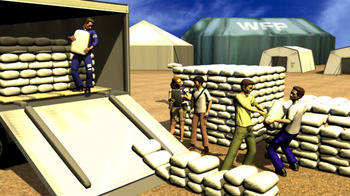
images courtesy of Food Force, © United Nations World Food Programme - all rights reserved
Two weeks ago I sat dumbfounded watching a French TV report in which journalism students practiced reporting a fictional national emergency. I couldn't help but think that what's cool about practice is that it makes perfect. If you practice having enough crises, you might actually get really good at having one! This hackle-raising report about teaching young adults to respond positively to crisis, just didn't seem to me like a simple exercise on getting prepared. The TV experience was absolutely colouring my thinking when I came across the UN's World Food Programme (WFP) website and discovered a new computer game for school kids called 'Food Force'.
'A major crisis has developed in the Indian Ocean, on the island of Sheylan. We're sending in a new team to step up the World Food Programme's presence there and help feed millions of hungry people.'
That's pronounced 'shay-lawn' by the way. The Food Force computer game is essentially a communications campaign of the UN's WFP, cleverly disguised as an educational tool. Although the game really does teach kids about mid-crisis food distribution, its purported goal, teaching students about the causes of hunger, is framed exclusively in the short term and completely ignores all of the long term causes.
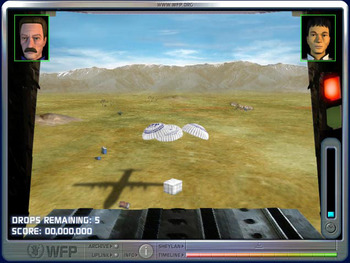
images courtesy of Food Force, © United Nations World Food Programme - all rights reserved
Food Force has six game tiers reflecting the basic elements of emergency food distribution: air surveillance (helicopter reconnaissance, counting clumps of roving refugees), energy packs (achieving nutritional and economic balance from rice, beans, vegetable oil, sugar and iodized salt), food drop (aim and drop those rations), locate and dispatch (Tetris-like global food collection), the food run (choosing the right route through hostile territory), and future farming (dealing with a combination of long term hunger solving factors).
Predictably my favourite game tier was 'future farming', where I was taught that paying people in food to attend job training programmes and so investing in the community, was the straightest path to community self-sufficiency and societal well-being. Together with the food pack nutritional assembly tier, this was the game tier with the highest educational value, going beyond point and drop and mouse dragging I mean racing.
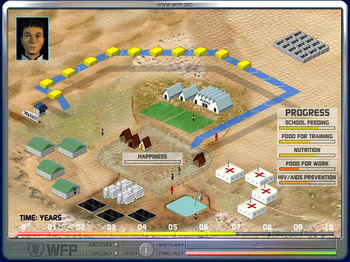
images courtesy of Food Force, © United Nations World Food Programme - all rights reserved
Food Force has a website chock-full with extra video, images and an educational package enabling teachers to work this computer game seamlessly into the curriculum. I pored over the WFP site in search of information addressing what I believe to be the long term causes of hunger and the long-term perspectives on solving the problems. Alas, I could find none. According to Food Force, hunger is caused by drought and civil war.
Of course I find no fault with the WFP's symptomatic relief efforts per se, nor do I see intentional evil with a communication strategy that illustrates this practice to children in the form of a computer game. But I do have a problem with placing this game in a curriculum that teaches children that the cause of hunger is simply drought and war. What are the some of the causes of drought? What are the some of the causes of war? What causes such a lack of food security that climactic fluctuations can take out several million people? Food Force offers no macro vision, and I do find fault with weaning children of the notion that food security is rested in global food politics. The macro vision of many commonly accepted causes of hunger, such as the small farm community-destroying effects of large-scale agricultural practice and the methods of monoculture, are left completely unaddressed by the WFP's computer game.
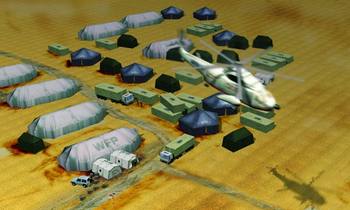
images courtesy of Food Force, © United Nations World Food Programme - all rights reserved
I often wonder if teaching children about hunger couldn't happen in a more nuanced way. Wouldn't it be more productive than training them to throw a little money at the problem? Well, maybe not with the 'throwing a little money at it' method of famine-control being so lucrative.
Tomorrow, I'll give an example of a solution.
I promise.
technorati tags: World Food Programme, Food Force, computer game, emergency food distribution
Posted by debra at 06:26 PM | Comments (2) | post to del.icio.us
Git yer frites on! What we'll probably all be wearing this Fall
February 24, 2006
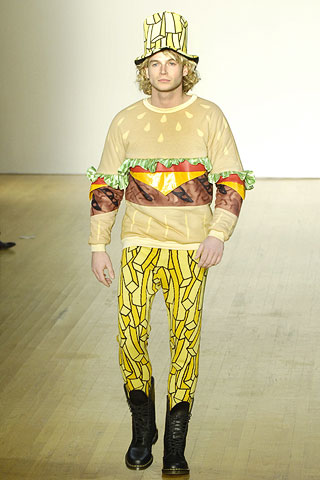
Daddy's favourite outfit from the Jeremy Scott Fall 2006 collection, image used entirely without permission
This is no time to bitch I mean kvetch about healthier alternatives. Just plunk down a honqin' load o' dosh and git yer dang frites on, bi-haa-whoa. It's New York designer Jeremy Scott's Fall 2006 collection, and I'm sort of all over it.
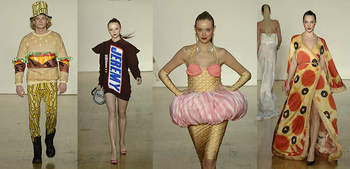
From the Jeremy Scott Fall 2006 collection, image used entirely without permission
Really dig the pizza robe, but unless I keep the yurt up all winter, I just don't see it fitting into my lifestyle. It is mind-boggling though how well haute couture goes with a yurt. I keep telling everyone it was a practical choice, but you just have to keep the bigger picture in mind for that to become clear. Jeremy Scott is part of that bigger picture.
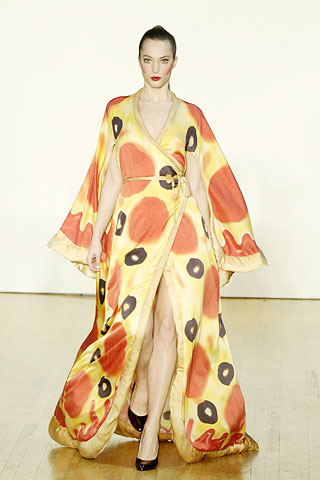
My new lounge-about-the-yurt robe from the Jeremy Scott Fall 2006 collection, used entirely without permission, although, soon I'll take my own dang pictures
Who wears Jeremy Scott besides me? Björk, Cammy Diaz, Chrissie Aguilera, Kylie Minogue, the artist formerly known as Esthertje and the geologist formerly known as my Dad.
- Check out Jeremy Scott's 2006 Fall collection in NY Mag
- Elle mag on Jeremy Scott Fall 2006
- FlyPaper on Jeremy Scott's high glycaemic fashion
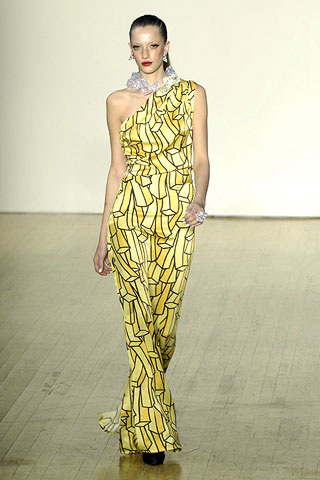
From the Jeremy Scott Fall 2006 collection used entirely without permission
Posted by debra at 12:24 AM | Comments (0) | post to del.icio.us
Drawing Restraint, dragging ambergris
February 05, 2006

Occidental Guest (bride), production still from Matthew Barney's Drawing Restraint 9, copyright Matthew Barney, used without permission
Filled with expectation unsuitable for the company of friends, clutching a fat wad of tickets between fingers reeking of quickly eaten, mediocre sushi, it is unwise to view the best film of the festival first. It just ruins everything, and this is exactly what happened to me on January 30th when, in the exquisite 'old' Luxor cinema in Rotterdam, I saw Drawing Restraint 9.

Shimenawa, production still from Matthew Barney's Drawing Restraint 9, copyright Matthew Barney, used without permission
Drawing Restraint is artist Matthew Barney's 2006 film entry in the International Film Festival Rotterdam and as well the Berlinale Film Festival, where he is a member of the jury. Avant-pop artist, composer and girlfriend Björk composed the soundtrack. Their collaboration is astounding on all levels; the film will make you cry, it is that beautiful. Aside from being culiblog's favourite at this year's festival, the film is exemplary of food-related film in the culiblog sense of the word; food, food culture, food as culture and the culture that grows our food.
Matthew Barney is the Lance Armstrong of contemporary art. In my opinion, no chef can yet lay claim to this position. Drawing Restraint 9 is also the best food-related film ever made, a lavish display of sensuality and ritual.

Barney on the left, Armstrong on the right
Drew Daniel of Matmos wrote this stellar description of Barney's art practice on Björk's DR9 website:
Barney is a visual artist whose ambitious, rigorous multimedia work encodes esoteric meanings while providing lushly immediate aesthetic rewards. Best known for The Cremaster Cycle, the sprawling sequence of five films made over ten years which was the subject of a recent Guggenheim retrospective, Matthew Barney's work is multimedia in execution but singularly focused in conception: tightly unified fusions of sculpture, performance, architecture, set design, music, computer generated effects and prosthetics, Barney's films deploy the full range of cinematic resources in the service of a hermetic vision rich with densely layered networks of meaning drawn from mythology, history, sports, music, and biology.
This is a sexy way of saying that Barney's work is based upon his own elaborate and logical cosmology. In Drawing Restraint he playfully turns materials, forms, geometries and processes (e.g. petroleum jelly, silicone, whale blubber, ambergris, other marine excretions and accretions), cultural-historical narratives and geographic trajectories (e.g. the architecture, interior and machinery of a whaling ship, the culture of whaling, the history of a specific ship) and the experience of time (e.g. pearl oyster divers holding their breath under water, the migration of whales, a Japanese tea ceremony), into a luscious weave of deeply connected meaning and narrative.
This is where chefs tend to slack off.
But this is Barney's demarrage, an escape or breakaway that gives him an advantage over the rest of the 'field'. Whereas it is common for a chef to create a 'richly organized set of aesthetics' (as Drew Daniel describes Barney's approach to making art), I know of no example within the culture of contemporary haute cuisine in which a chef recontextualises elements on this level to form a total experience beyond the formal boundaries of restaurant culture. Perhaps I'm not going to the right sort of parties. I long for an haute cuisine that is less 'applied' and more autonomous.
Please read more... "Drawing Restraint, dragging ambergris"
Posted by debra at 08:51 PM | Comments (4) | post to del.icio.us
Grow your own dang food
January 30, 2006
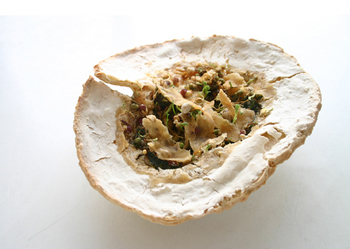
Back in the eighties, as a student at the University California at Santa Cruz, I lived in a vegetarian commune with a bunch of hippies. As hippies, we produced our own sprouts, yoghurt and salsa fresca for the entire commune, approximately thirty people. I had all but forgotten this part of my life until recently, when my Food Atelier students at the Design Academy Eindhoven started working on ways to grow their own food. The work of two enthusiastic students got my wings flapping enough for me to dare revisit my past. These are the images from the first trials, theirs and mine.
After initial attempts at growing mung sprouts in bread (see above), Cygalle Shapiro is successfully growing a ready-made 'salad on salad'.
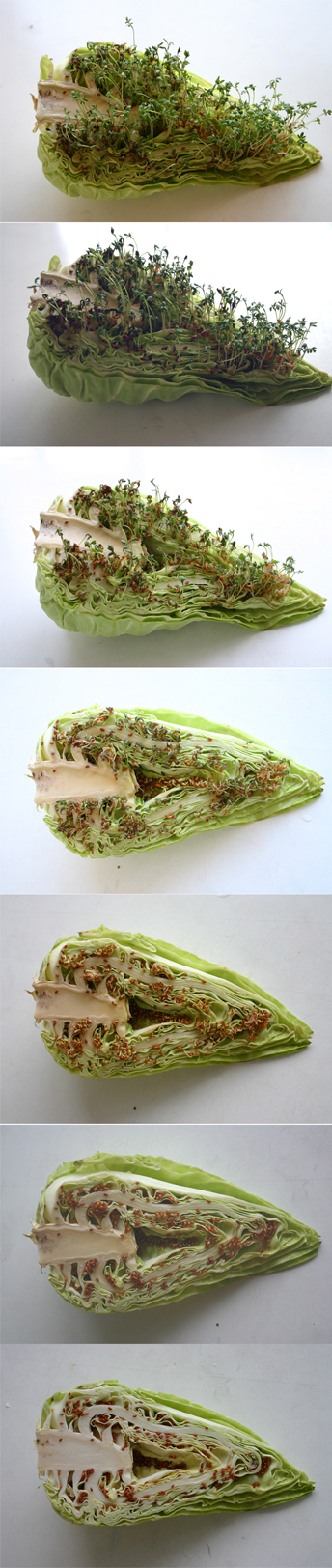
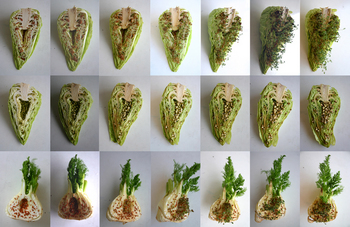
images top to bottom: sprouts in bread, salad on salad, sprouting experiments courtesy of Cygalle Shapiro, copyright Cygalle Shapiro 2005 - 2006. Contact culiblog for further information.
Liora Rosin is growing sprouts in labneh, a fresh yoghurt cheese, commonly made at home. For Rosin it is important that the seeds are grown within the labneh in order to transmit the flavour of the sprouted seed into the delicately tangy cheese.
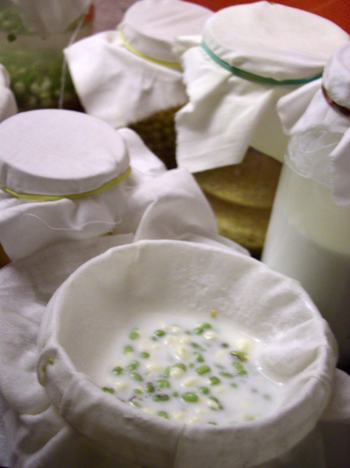
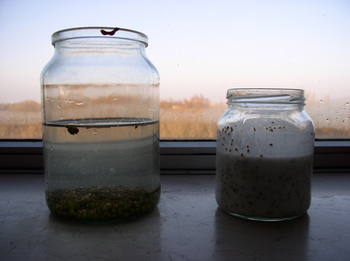
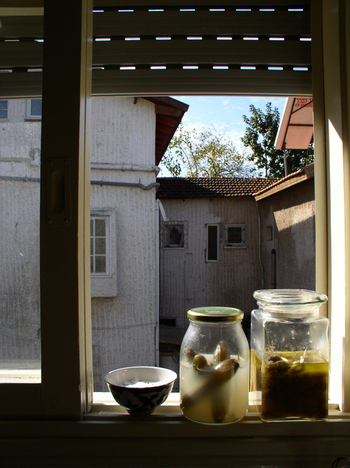
images top to bottom: home sprouting installation, soaking, lactic fermentation sill; courtesy of Liora Rosin, copyright Liora Rosin 2005 - 2006
Wouldn't the world be a better place if we all had a designated windowsill for lactic fermentation?
Having resolved to practice what I preach in 2006, I am also working on growing sprouts on labneh and find that the experiments coördinate nicely with my developing a good recipe for yoghurt ravioli.
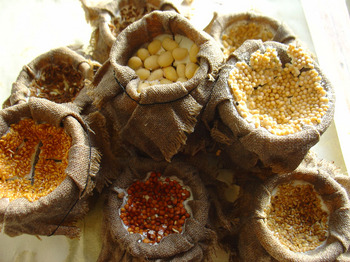
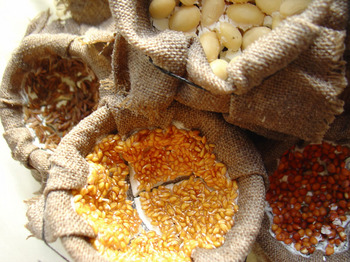
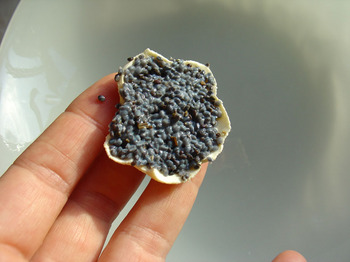
This is a cute disaster of basil seeds rotting into overly dry labneh. Seeds that become gelatinous when they are moistened (e.g., basil, buckwheat, watercress) are poor candidates for immediate immersion on or in the yoghurt medium.
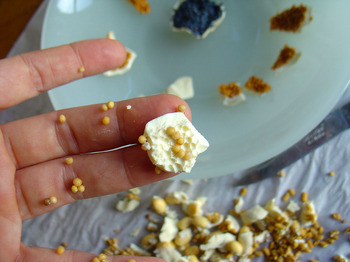
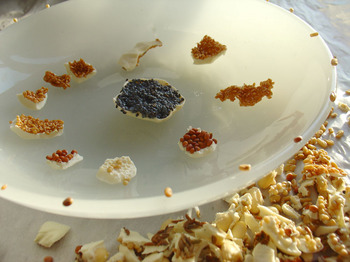
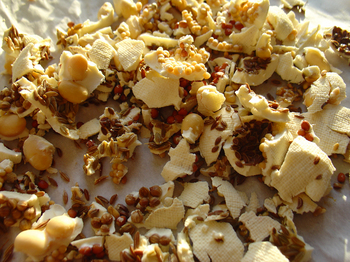
images top to bottom: sprout collection 2x, basil on labneh, playing with mistakes, pretending sampler, curd seed brittle; Debra Solomon
The results of an unsuccessful attempt at growing woody spice seeds (dill, coriander, cumin, kummel) in yoghurt medium with the intention of flavouring the labneh were not especially delicious, although visually exciting. The linen and the seeds texture the labneh beautifully and I look forward to spin a few successful recipes from these experiments soon.
Lori Alden's cheese definition site
N55: Manual for city farming plant modules
N55: Manual for home hydroponic unit
Sproutman's sprout bag. Any idiot can make one, but Sproutman is somehow selling them! My experience is that growing sprouts on wet linen works much better than growing them in jars. I have never tried sprouting in a linen bag.
Here are other urban gardening solutions, mostly rooftop gardening related:
- Rooftop Gardening link hub. Yes, it's a trend!
- Plant vegetables on your rooftops, like they do in Egyptian cities
- Toronto rooftop gardening project
- Greening Gothan Project, NYC also on the roof
- BLDG blog on rooftop farming in London
- Treehugger reports on Toronto rooftop gardening facts and figures
technorati tags: rooftop gardening, urban gardening, food security, sustainability, farming, food-related design, agricultural diversification
Posted by debra at 11:52 AM | Comments (8) | post to del.icio.us
Rural design conference scheduled for September 2006
January 21, 2006
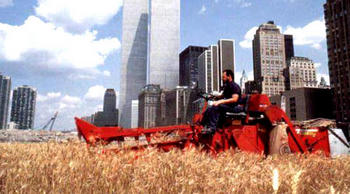
(above: Wheatfield, a large public work by Agnes Denes, image copyright Agnes Denes)
Chapeau to John Thackara at the Doors of Perception blog who reports today about a rural design conference scheduled to take place September 4-7 2006 (somewhere) in the UK. Just have a look at what's being developed for the programme! I am pleased to see that it is all about establishing and strengthening real connections between (urban) cultural producers and rural agriculture producers to the benefit of both.
In a conference forerunner in July of 2005, this is what they were talking about: farmers as curators - an international Rural Biennale for 2007, sustainable farm diversification, rural tourism, food marketing initiatives and staging the Rural Biennale as an integral part of a European Region of Rural Cultures and Farmer Creativity celebration.
To the list of interesting subjects already discussed and in the planning for September 2006, I would like to add: 'rural farmer to urban farmer advisory partnerships for urban gardening/farming initiatives'. I can't help but wonder if the experience and knowledge of the rural farmer can help urban farming inititives such as this wonderful urban farming project in East L.A from being under threat of closure due to urban land-use issues. Injecting (cultural) life into family farms suffering brunt of (European) Agricultural Policy might be just the ticket for rejuvenating a way of life under threat of extinction. Might not the urban farmer benefit from being part of this discussion and network?
- European Rural Culture events page
- Littoral - new zones for critical art practice. An excellent organisation website, with informative links on everything from an extremely mixed bag of individual artists and designers that use nature / agriculture / landscape as a creative platform, to cultural documents on foot and mouth disease!
- Cultural Documents of the Foot and Mouth Crisis in the UK
- Urban food gleaning project by Fallen Fruit
- The South Central Farms website is good reading if you want to get fired up!
- Pruned, weblog on landscape architecture and related fields.
- Pruned blog entry about South Central Farms in L.A.
- Pruned on artist Agnes Denes
- Brilliant films by Raymond Depardon about the demise of French farming communities in the Lozere were shown at the 2005 Int'l Documentary Film Festival in Amsterdam (IDFA) as part of a special tribute programme.
- Farming as a a landscaping trend in suburbia! (Landscaping is responsible for more than 80% of water use in the suburbs.)
- Doors of Perception review of urban farming proposal by Dutch architect Winy Maas
- Non-sanctioned urban gardening in Istanbul, entry in culiblog
- Innovation Network Rural Areas and Agricultural Systems
technorati tags: rural design, food security, sustainability, farming, food-related art, food-related design, food-related film, Raymond Depardon, agricultural diversification, agricultural policy, urban gardening
Posted by debra at 11:47 AM | Comments (1) | post to del.icio.us
Guixégasbord Food Facility
October 29, 2005
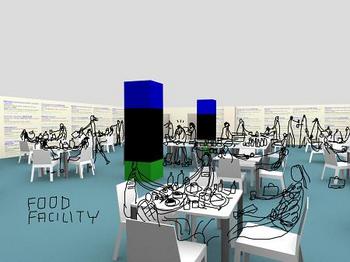
If you haven't already made a reservation for the opening of Marti Guixé's Food Facility at Mediamatic (Post CS) this Sunday evening, you are plum out of luck because I just made the last one. You can still make reservations for every Friday and Saturday evening between the 4th of November and the 11th of December. This is one conceptual restaurant you could never visit too often.
Food Facility, the title of Guixé's working prototype restaurant, has no kitchen. Instead the central kitchen is replaced by kitchens of existing take-out restaurants in the area. Talk about locative eating! As a guest you can choose menu items compiled from Guixé gleaned take-out restaurants and consume the order at the glammy Food Facility. Of course there are already existing restaurant hubs on the web. Waiters on Wheels representative Sharad Agarwal told me that although it is possible to order one entree from one take-away restaurant and desserts and entremets from others, Delhi's Waiters on Wheels customers never seem to do this. Food Facility marks the first time that diners can experience their urban menu in performance format at one dining location. (Rectification: the above statement is wholly untrue! Read about it here.)
Food Facility open Friday and Saturday from 18.00h - 22.00h
November 4 - December 11, 2005 at Post CS, Amsterdam.
Read Mediamatic's announcement here or call +31 (0)6 3376 8810 for reservations.
Posted by debra at 01:10 PM | Comments (2) | post to del.icio.us
Oh to utter the words, food design...
September 28, 2005
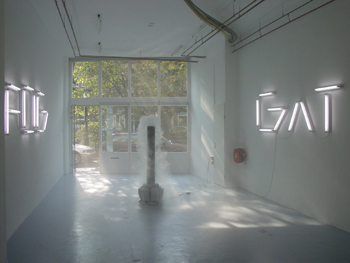
Well it's about bloody time! Coinciding with all manner of design events going on right now in Amsterdam, the Stedelijk Museum hosted a symposium titled Food Design at the ubiquitous Club 11, featuring three speakers and three completely different interpretations.
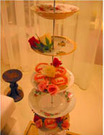
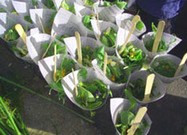
Marije Vogelzang (Proef) is doing some very interesting work from her studio slash catering laboratory and counts the stars of Dutch design (such as the Ladies Hella Jongerius, Marlies Dekkers and Li Edelkoort) amongst her clients. After a stunning portfolio presentation, I can't wait to visit Vogelzang's restaurant in Rotterdam Proef and get down to the business of tasting and nibbling. (Proef means 'taste' or 'taste it', in Dutch.) Vogelzang's work is all about engaging the eater in the underlying concept of the food and its presentation. I loved her daring in a recent catering project in which she used WWII ration ingredients to invoke memories about this bleak period. She elegantly walks the fine line between being thought provoking and utterly disarming when she stated, 'It's design that someone puts in their mouth, and absorbs into their body. It's all very intimate'. That's what I call a laudable attitude!
Although it wasn't the most pleasant message to hear, I can't stop thinking about the corporate presentation by Hans van Trijp from Unilever. Food design according to the multinational means designing the market context in which a food product exists, and has very little to do with actual food. Van Trijp described Honig's SpongeBob pasta as the perfect marriage of food design and marketing. Predictably, I found van Trijp's take and food and food design extremely disturbing, but I am so very eager to get in touch with him to hear more of what he has to say about how multinationals, even when we wouldn't dream of buying their products, influence our every day life right down to the iggly niggly bit of designing a country's infrastructure. This means that while Marije Vogelzang is designing a lunch using 'forgotten vegetables', Unilever, by the very virtue of it's market share, is determining which races of grains farmers will be growing and how food will be manufactured and distributed in decades to come. I just can't help but think it's a wise idea to keep in close contact with the suits. I'm just as much a stakeholder as the next Lady, right?
Ex-designer and unwitting stand-up comedian Marti Guixé as per usual wowwed the audience with a portfolio presentation of more than a decade's worth of food-related projects. He is the well-known Catalunian ex-designer that has worked extensively with shoe brand Camper, and ultimately designed their flagship restaurant, Foodball, in Barcelona. Balls are something of a leitmotif in Marti G's gastro-design as you can see from this author's review. It might have been just the unfortunate lighting, but while presenting images of his 'corporate sponsored food', (in this case an omelette with a sauce-stamped Calvin Klein logo), Guixé claims to have noticed van Trijp's lip twitch.
Although I'm not willing to spill the beans just yet, I am looking forward to Guixé's collaboration with Mediamatic in just a few week's time. Guixé and Mediamatic will be opening up a temporary restaurant in the basement of the former TPG builiding where you'll... read about it in culiblog.
images from l to r: Vogelzang's salad course of city leafy greens (served with grilled pigeon breast), hanging etagères made of 2nd hand plates designed by Vogelzang for Dutch fabric producer de Ploeg, Gin and Tonic Fog Party by Marti Guixé (artificial indoor fog made of gin and tonic at Casco, Utrecht). The above images are from the (ex-)designers' websites, © and hopefully also courtesy of Vogelzang and Guixé.
Posted by debra at 09:03 AM | Comments (6) | post to del.icio.us
Products without words
July 01, 2005
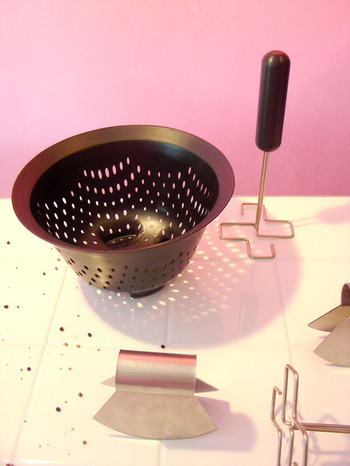
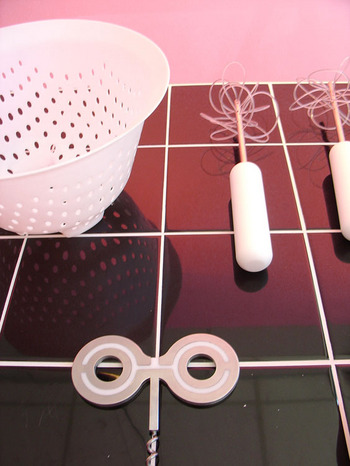
The kitchen line, KLOP by freshly graduated product designer, Sharon Geschiere from Arnhem. Klop in Dutch means to beat or whip (as in whipping cream). These products instruct the user in how to use them. Plus they're black. And white.
Posted by debra at 04:32 PM | Comments (0) | post to del.icio.us
Lolly Lab
June 28, 2005
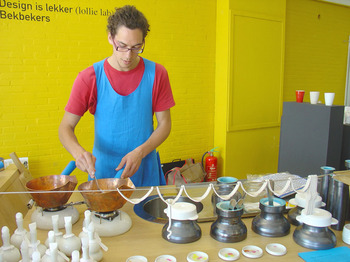
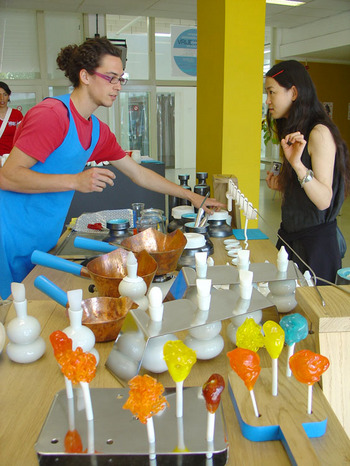
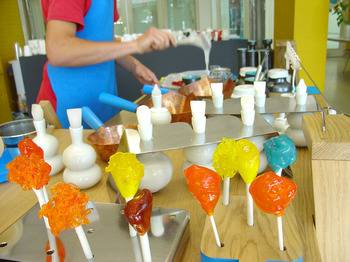
Imagine my delight last Sunday when the very first work I see at Arnhem's exam show is Bas Kools' Lolly Lab. Kools is a freshly graduated designer with fine prospects for the future. He'll attend the RCA in London next year.
What I loved most about Kools' setup was that he put the prototypes into a playful context. He seemed to have thought of everything; the playful array of lolly sticks, sugar melting copper pans, ceramic pots and recepticals, the vessels containing the flavours and colours, palet dishes, a working lab unit with gas burners (water?), air blowers, lolly holders in metal and rubber, bottle stops, display, etc... Kools has an interest in finding ways to make 'design' 'accessible'. But some of the sexier shapes of the lolly holders and the rubber slings reminded me immediately of the details hidden (and thus showcased) in a Matthew Barney work. Not bad.
And this leads me to my wee critique of the work. Kools designed a lolly laboratory, a perfect context for his range, so where are the experimental lollies? It is a pity that in this instance, Bas used standard flavours, colours and non-designed shapes for the lollies themselves. It would be worthwhile investigating working with a chef or someone with a developed and outspoken culinary aesthetic to create flavours, colours, textures and shapes as alluring and expressive as the other parts of this lab and installation. The well-designed utensils, if they are meant to be accessible, should serve and even contribute to the experimentation that is going on in the lab. There is still plenty of space for this to happen in the future. I certainly would be willing to give it a go; the Lolly Lab gave me itchy fingers.
Please read more... "Lolly Lab"
Posted by debra at 10:21 AM | Comments (4) | post to del.icio.us
The most beautiful teapot in the world
April 11, 2005
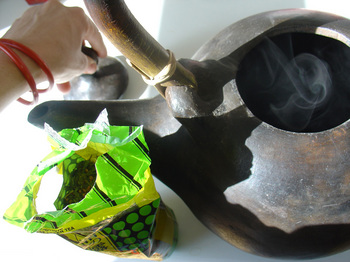
Finally I can sit quietly with the several thousand images from my trip to Delhi and reflect.
WIth a pot of tea.
A giant pot of tea.
In a teapot from Bihar.
Bought at a craftsmarket in Delhi.
Made from dark clay, neither fired very hot, nor glazed.
Looks like it was fashioned by a caveman with a large extended family.
The lid doesn't fit.
It's perfect.
Posted by debra at 01:36 PM | Comments (5) | post to del.icio.us
Joe Colombo is dead as a doornail
December 01, 2004
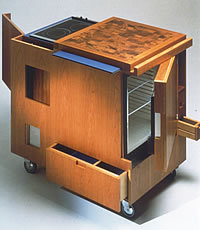
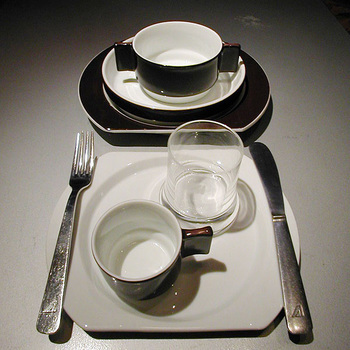
Here is the amazingly efficient Joe Colombo designed mini-kitchen. R.vT. tipped me to him a few days ago as I lamented giving up my superflous spoon collection. As my most informative blog-reader to date, R noted that Joe Colombo designed the Alitalia tableware in 1970.
Apparently the 'MINI-KITCHEN' designed in the year of my birth and produced in the year of my brother's birth contains 'all the electrical appliances and necessary features one needs to cook for and accommodate six people, in just one-half of a cubic meter'.
Well, both the rice-maker and the staff-mixer are nowhere to be seen and I don't see where one would stow them in the mini-kitchen, but the MK remains an inspiration. Joe Colombo died on his 41st birthday of heart failure.
technorati tags: Joe Colombo, design, kitchen, serviceware
Please read more... "Joe Colombo is dead as a doornail"
Posted by debra at 06:41 PM | Comments (10) | post to del.icio.us


