
Second to last walk of the year
December 29, 2005
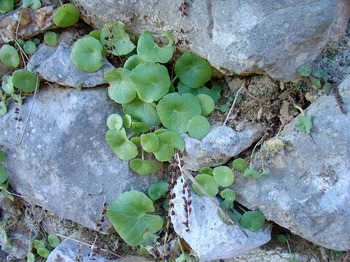
*Without a prayer of an internet connection in sight, I have been enjoying my friends, the garden and the splendid but freezing environs. Today's hike up the mountain led us past miner's lettuce growing in the maze of thick stone walls. And while talking of lettuces and of mines, there was gunshot all around us. It's hunting season, and I had left my orange cap at home.
The walk turned into a real adventure when, by chance, we met a bear of a mountain man, in his other life, an oceanographer. Our new acquaintance generously asked us in for some mountain style coffee on his homemade terrace which had irises **somehow hardy enough to bloom. Our new aquaintence has a two hundred degree view of both valleys, and is set up to maximise every minute of sunshine. He told us, that usually when the weather gets like this, (three weeks a year) he simply goes into hibernation, eating dinner at 15h and going to bed by 17h! An interesting man though, and we are pleased to have finally met an inhabitant of this mountain.
* - Merci, Wanadoo et France Neuf, both of whom treat their Mac customers very poorly.
** - My hopes of turning the soil before returning to the Pays Bas have been dashed by the cold.
Posted by debra at 01:28 PM | Comments (1) | post to del.icio.us
What smell is this, so strong and good?
December 28, 2005
Shih ching, in C. Birch and D. Keene (eds.) Anthology of Chinese Literature (1965), pb 1967 pp. 37-8.
High we load the stands,
The stands of wood and earthenware.
As soon as the smell rises
God on high is very pleased:
'What smell is this, so strong and good?'
A text from the Shih ching, (Book of Songs), a collection of traditional ballads and fragments gathered after 600 BCE describing the life of the warrior farmers of the north western highlands of Shanxi (Shensi). This text is being quoted nowadays on websites hocking everything from garlic to hemp.
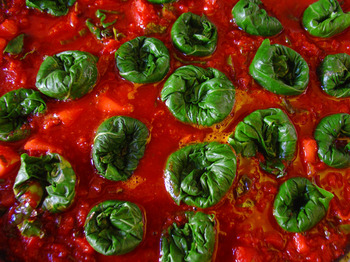
image: a closeup of kale farci
Posted by debra at 01:52 PM | Comments (0) | post to del.icio.us
Birthday picnic au plein air
December 24, 2005
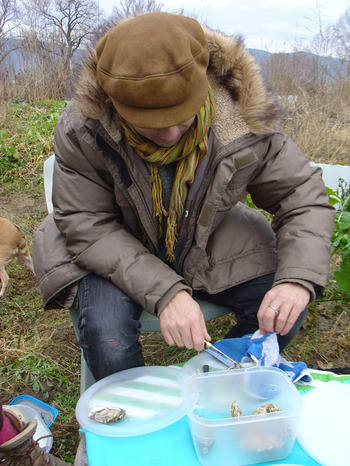
With a small group of friends we celebrated my birthday with a fresh and freezing garden picnic in the painfully crisp air. Champagne, oysters and a sorrel quiche, in the case of the sorrel, eaten one meter away from the very plant that grew it. New neighbours, new but wonderful friends, all kicking the frozen ground and sipping champagne. We unanimously are longing for summer, or at least the spring planting.
Still, the leaves of the bruxelles sprouts are very sweet and the kale is abundant. In the case of the kale, the plants came from seeds that spilled unto the ground whilst moving the cabane, all so very sweet.
Posted by debra at 01:13 PM | Comments (0) | post to del.icio.us
Winter BBQ practice down at the kitchen gardens
December 23, 2005
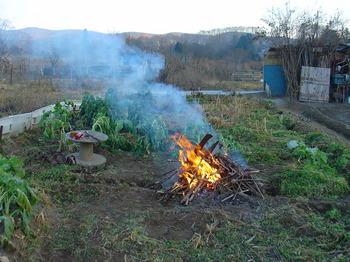
Can kitchen garden soil ever really have enough potash? A quick look around the environs and the answer is a resounding 'no'. It's fire lighting time, again!
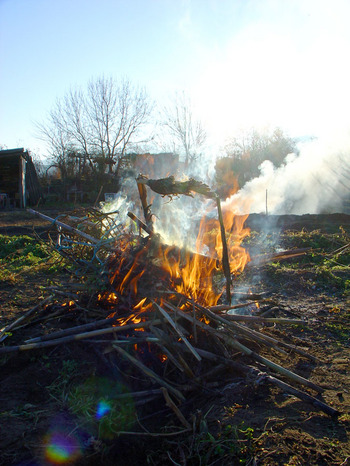
All the guys are doing it. Really. Every single last one of them.
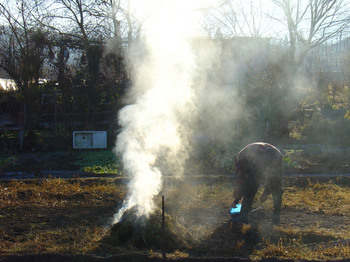
Because lighting fires is like youth serum.
technorati tags: garden, winter, kitchen garden, sustainablility, Lanquedoc, Occitanie, potager, fire
Please read more... "Winter BBQ practice down at the kitchen gardens"
Posted by debra at 03:25 PM | Comments (0) | post to del.icio.us
My kitchen garden at midwinter
December 21, 2005
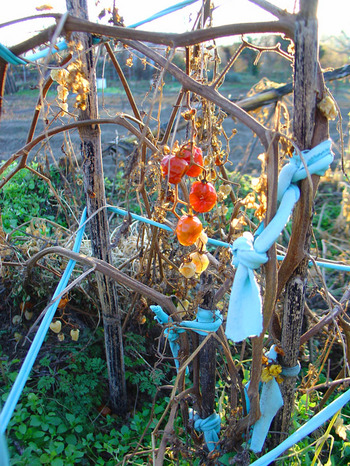
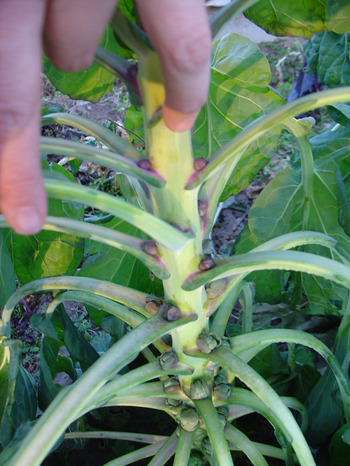
Granted, mine is the ugliest of all the kitchen gardens here, which is why it's unbelieveable that upon my return to Occitania, I was able to pluck leafy greens at midwinter! I fully expected to find nothing, bugs and more nothing, but to my great surprise there are sun dried tomatoes, sorrel, sweet raddichio, leaf cabbage, red cabbage, beets, beet greens, sage, rosemary, mint, broccoli, and soon... bruxelles sprouts. Gleaning is yielding enough food for a birthday party luncheon on the 24th!
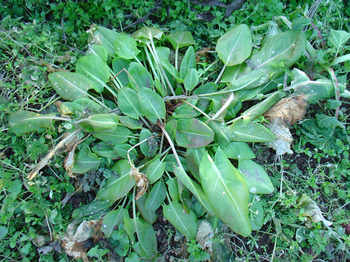
Please read more... "My kitchen garden at midwinter"
Posted by debra at 12:54 PM | Comments (5) | post to del.icio.us
Healing Foods Pyramid is sickmaking
December 17, 2005
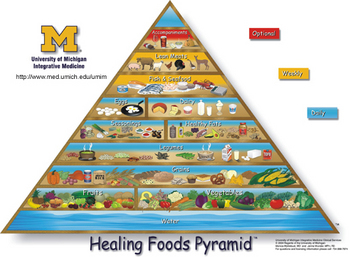
Never say never, but I never get sick. And according to the University of Michigan's Healing Foods Pyramid, the reason I never get sick is that it seems I primarily eat 'healing foods'. That, in and of itself is sickmaking.
The smart folks at the Uni emphasize:
* Healing Foods
- Only foods known to have healing benefits or essential nutrients are included
* Plant-based choices
- Plant foods create the base and may be accented by animal foods
* Variety & balance
- Balance and variety of color, nutrients, and portion size celebrate abundance
* Support of a healthful environment
- Our food, and we in turn, reflect the health of our earth
* Mindful eating
- Truly savor, enjoy and focus on what you are eating
(spotted on: Slashfood)
technorati tags: health, nutrition, food, food pyramids,
Posted by debra at 03:34 PM | Comments (2) | post to del.icio.us
Chaat Pack for street nibbles
December 16, 2005
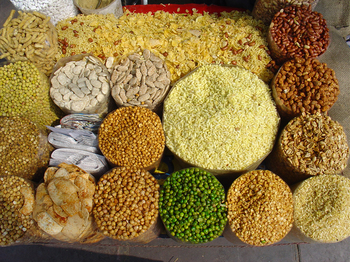
Here is a chaat array being sold on the streets of Delhi. Check out the packaging stuffed in between the sacks of chaat.
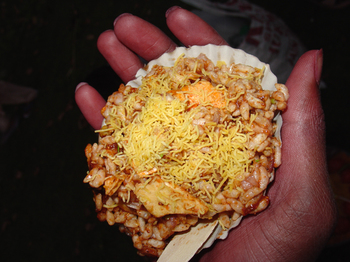
You buy some chaat, the vendor mixes it up with some piquante sauce, and you're good to go.
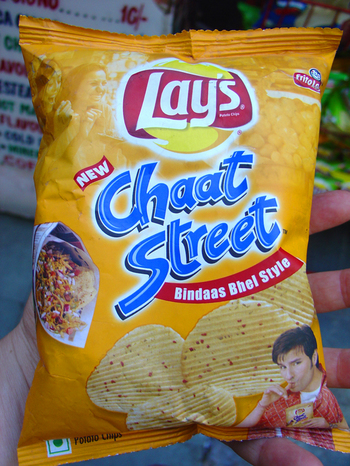
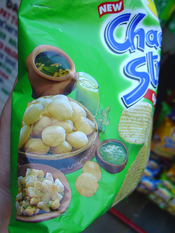
This is an example of how a food manufacturer together with a forward-thinking food designer used street food to inspire a new product for its street food-appreciative market in India. The chips are flavoured and (loosely) styled to reference ‘chaat’, a term describing all manner of street food snacks. If you look closely on the packaging, you'll see an image of the traditional street chaat packaging on the left side. Within 10 metres of the stand where I photographed this package, there were five different traditional chaat vendors selling proper chaat.
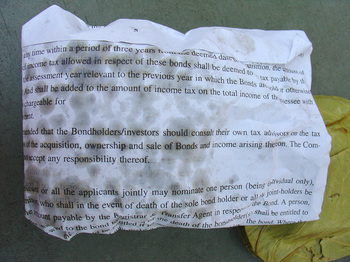
Packaging for chaat is usually a bag made from old newspaper, a neatly cut piece of recycled paper, or a leaf plate. This bag was made from some terribly interesting literature about bonds, you can see the imprint of the peas (and the grease in which they were deep-fried) absorbed through the paper. Grease shadows, or oily pea portraits, if you will.
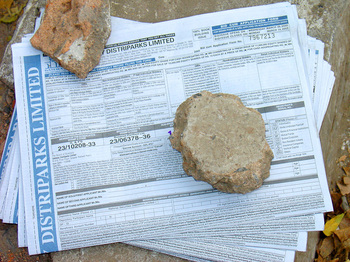
In this image you see a stack of paper left on the street as an offering to the gods of the recycled chaat-bag-makers.
Posted by debra at 09:16 AM | Comments (4) | post to del.icio.us
Chaat Street, Indian chips mimic street food golgappa
December 13, 2005
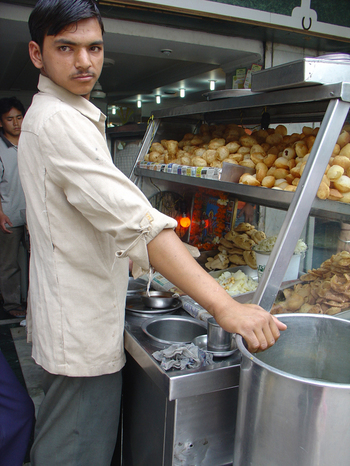
Nine months ago I was in Delhi and not in the Polar Circle at midwinter, and it was there that I was introduced to golgappa, one of the top ten amazing things you could ever hope to put into your mouth. The more I re-peruse the images of food from ElBulliFatDuckAlineaMoto and the likes, the more I can’t get this unpretentious street food out of my mind.
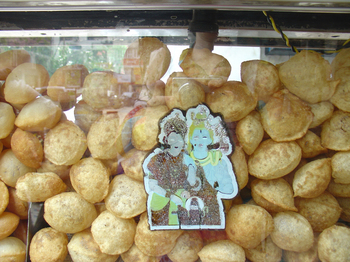
Golgappa is a deep-fried pastry pillow, neither sweet nor savoury, which is served up in a most intimate way. The street vendor pokes a hole in the deep-fried puff, gives you a metal or leafenware bowl and then asks you if you are ‘ready’.
Ready? you say, *lifting one eyebrow.
And he takes that as a 'yes'.
The vendor proceeds to ladle a liquid into the golgappa that quite strongly resembles brackish pond water. In actuality it is a tasty, thirst-quenching tamarind drink with crispy puffs and bits of melon or turnip floating around in it. Neither sweet nor savoury, this soupy mixture is best described as ‘refreshing’.
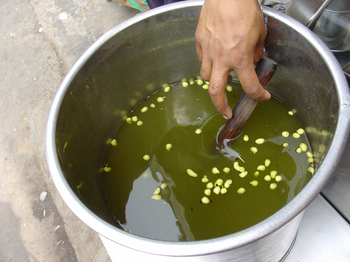
The vendor then hands you an about-to-drip-and-disintegrate golgappa filled with the liquid and you have to pop the entire thing into your mouth where it implodes instantly, crunch and rinse, and you can do nothing but laugh and sop up the dribble on the shoulder of your friend's blouse.
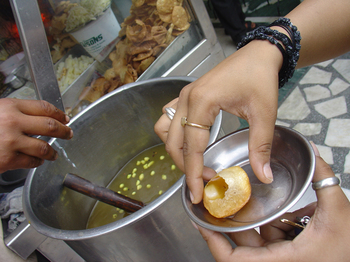
By this time the vendor has already started to dish up another one, (pop, crush, rinse and swallow) and another one, and another one. The idea is that you are popping golgappa into your mouth as fast as you can until you beg him to stop by motioning with your tamarindily dripping fingers. A recent study on street food has proved that ninety-four percent of first-time eaters of golgappa say ‘wowwy’ in response to the experience.
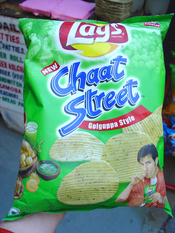
How wise it is then that Frito-Lay should be inspired by golgappa for their Street Chaat line of chips in India. Poke-free. Drip-free.
* - Poetic license. I can't lift only one eyebrow.
Posted by debra at 06:04 PM | Comments (7) | post to del.icio.us
Occupied Olive Tree Territories
December 10, 2005
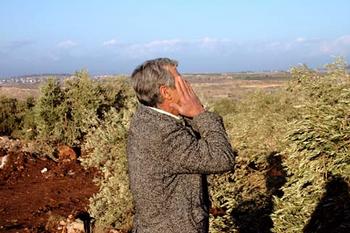
(A Palestinian farmer weeps at the bulldozing of his olive trees, photo by Gary Fields)
Because culiblog is a culinary weblog about food, food cultures, food as culture and so on, I feel obliged to breach the subject of olives, olive trees, olive tree culture, and olive trees as culture. In the past month I have seen Osama Qashoo's documentary, My Dear Olive Tree, (at the IDFA), and Khalil Rabah's installation piece (at the 9th International Istanbul Biennale), the Palestinian Museum of Natural History and Humankind. The olive tree as a symbol of Palestinian identity is used in both Rabah's and Qashoo's work.
Osama Qashoo is a recently exiled Palestinian film maker living and working in the UK. My Dear Olive Tree is his documentation of the destruction of the olive tree that he tended since childhood. The film depicts Qashoo as he witnesses the demolition of his olive tree and surrounding olive orchard, his own unwilling journey from Palestine to London, where he is reunited with a residual form of his dear olive tree on sale in an airport gift shop. At the beginning of the film Qashoo warns us that this is the last time he will see the olive tree, one tree of an entire grove in the Occupied Territories, a grove that sustained more than twenty families for generations with income from the olive oil.
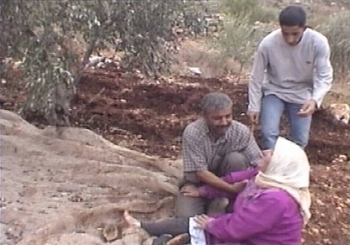
still from My Dear Olive Tree, courtesy of Osama Qashoo
The eighteen-minute documentary shifts swiftly from registering the small community's warm familial bond with the land, to an extremely tense situation in which Israeli Army bulldozers move in to uproot the olive trees. The film shows Palestinian women in a state of utter hysteria as they are forced to bear witness to an act nothing short of an amputation. The film ends with a visit to an airport gift shop presumably en route to the UK, where, in some twisted form of fundraising, olive wood pendants cut into peace doves are being sold. Filmmaker Qashoo buys one of the trinkets and in the mean time the audience seems to have scratched deep grooves into the arm rests of their seats.
Khalil Rabah is an internationally acclaimed artist working in the field of conceptual art, installation and performance. Together with Zvi Goldstein he was the recipient of the Lennon-Oko Grant for Peace in 2003. His work reminds me quite strongly of the Neue Slovenische Kunst style of re-claiming and re-writing one's own history with regard to cultural identity. Rabah's Palestine before Palestine museum exhibit uses the olive tree and the installation-form to parody the history-writing effect that such a museum institution wields by its very presence. Rabah embeds the present-day context of Palestine and Palestinian identity within the context of a natural history museum, by describing the entire natural world in terms of the (occupied) olive tree.
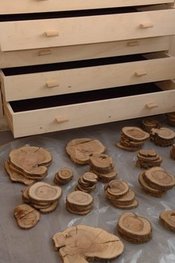
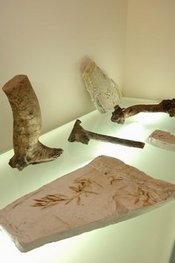
In typical museum-style, the Palestinian Museum of Natural History and Humankind (PMNHH) opens cans of experts, declares facts and exhibits it's acquisitions policy, manifest in projects such as the 3rd Annual Wall Zone Sale, an auction which took place at the Khalil Sakakini Cultural Centre in Ramallah in March of 2004. By auctioning off lots of material from around the wall zone, artist Rabah lobbied awareness of the social and ecological implications of the ~670km West Bank Barrier that Israel is currently building. The PMNHH also has a café and a giftshop, complete with very helpful attendents ready and waiting to attend. But when one asks in all earnestness for a cup of tea, or if there is something to buy in the giftshop, the attendant just shakes her head and smiles. 'Sorry, we have nothing to sell.'
Please read more... "Occupied Olive Tree Territories"
Posted by debra at 07:03 PM | Comments (11) | post to del.icio.us


