
An improbable history: meal assembly centers
March 26, 2006

image of friendly community hugging © Super Suppers, used entirely without permission
Kim Severson and Julia Moskin's New York Times article about meal assembly centers has me all excited and flapping my wings. For other people. They report on Texan Judie Byrd's service called Super Suppers, based upon the concept of the communal kitchen.
Here's how it works: a suburban working person with family goes sans entourage to a central food preparation center where the food is prepped and waiting in a professionally stocked and staffed kitchen. Meandering from station to station (s)he assembles the week's family meals, takes them home in zip-lock baggies made from compostable potato starch, freezes the meal-sized portions and heats them up when it's time to get the grits on the table.
What is not to like about this practically utopian idea, for other people? As a predominately self-employed happily not married person with zero children, and as someone who finds almost all elements of food preparation thrilling, I realise this business model was not made with people like me in mind. But because I am insane and live in a bubble, here's what I'm imagining:
1. The meal assembly center would stock its food exclusively from local farmers and artisanal producers, procuring the highest quality seasonal and local produce at a fair price. The meal assembly center would develop enduring relationships with these folks and the community using the meal assembly center would feel secure knowing that all of the food products they are using are made or grown with their well-being in mind.
2. In a professional kitchen with sharp knives and a seemingly limitless amount of freshly ironed tea towels (made from locally grown hemp), the meal assembly center's assisting chefs have prepared cooking stations for an interesting range of recipes. This week there are cuts of meat from the local deer cull and some strange root vegetables, next week it's traditional holiday fare from one of the region's thirty-seven ethnic groups, the week after that, it's all about vegan haute cuisine.
Whale washed up on the beach? No problem. The meal assembly center is hip to the community and the kelp is already rinsed. Finally you're cooking as if you live where you live!
3. It used to be common to take homemade bread dough to a communal bakery for baking. Heq, it used to be common for a lot of people to be involved in the family's cooking, sharing the workload, but also sharing the how-to and the chit-chat. At the meal assembly center, labour intensive dishes involving lots of stuffing, rolling, stretching and braiding could be prepared by the organisation or by other folks sharing the kitchen with an interest in these dishes. It would be a community that cooks, just like it was way back when, in the Wabac Machine.
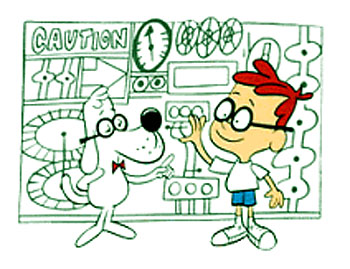
image of Peabody and Sherman using the WABAC Machine (that's pronounced 'way-back') © Jay Ward, used entirely without permission
4. The meal assembly center would be stocked with amazing community-tested equipment. Here's your chance to try cooking on a wood burning stove. Want to smoke up some trout, stuff some sausage, make cheese, brew a stout beer? It's all possible because the community would do it together.
If you have prepared food (for your family) in a food preparation center, I would really love to hear about your experience. But please do not burst my bubble and tell me it's about Thai Mac 'n Cheese and Turkamales.
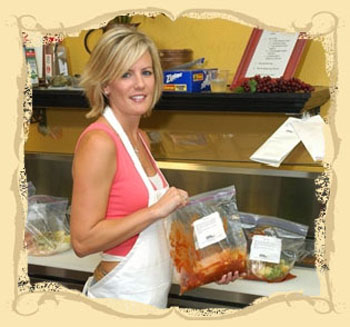
image of zip-lock wielding working yoga mom © Super Suppers, used entirely without permission
- Kim Severson and Julia Moskin's New York Times article on Super Suppers,food preparation centers
- Super Suppers
- Judie Byrd's website
- Sara Wilson at Entrepreneur dot com talks about the business concept of Super Suppers
- Peabody's Improbable History
- A blogger (let's call him Greg from Life's a Picnic) writes about his Super Suppers experience.
- Dream Dinners, just another meal assembly center
- Dr. Gurgles doesn't feel at ease with the concept
- Even more Gurgles from a time long past. Respect to the Gurgling Cod has followed this story in all its New York Times Magazine ugliness from the start.
technorati tags: food preparation centers, meal assembly centers, working moms, locative food, food trend, coommunity
Please read more... "An improbable history: meal assembly centers"
Posted by debra at 10:40 PM | Comments (15) | post to del.icio.us
Not cooking with flowers and leaves, a raw food recipe for marinated shitake mushrooms
March 21, 2006
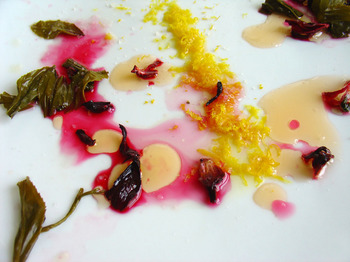
If I want to eat with my friends, I can't just serve up vegetables with the dirt still clinging to the rootball, the way I like it. I have to engage in some refining.
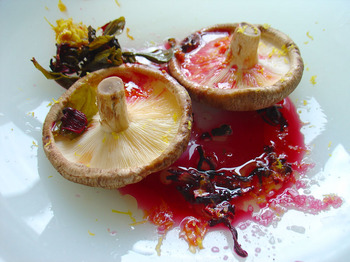
Hibiscus flower and green tea leaf marinated shitake mushrooms
(work: 7 minutes, wait: 1-4 hours)
- dried hibiscus flowers
- whole green tea leaves
- water
- fleur de sel
- lemon zest
- crayfish oil (vegetarians, relax)
- two shitake mushrooms
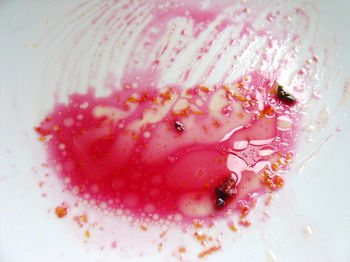
In the bottom of a cup, pour enough hot water to cover a layer of hibiscus flower and green tea leaves. You're going to make a highly aromatic and concentrated tea, something too strong to sip. Aim at producing four tablespoons.
(This year, hibisicus flowers seem to be my souring agent of choice. I find it hypnotising to watch the magenta colour leach out of the petals, and I just live for the 'powdery' aftertaste.)
Add to the 'tea' a big fluffy pinch of finely zested lemon peel, a goodly amount of fleur de sel, and a teaspoon or two of *crayfish oil.
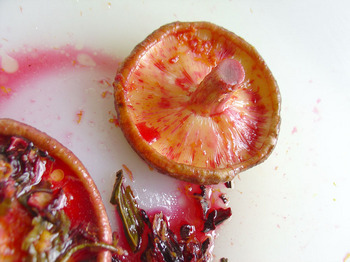
Adjust the marinade and toss around with two large shitake mushrooms. Marinate for one to four hours before serving. Everytime you walk by, just toss the mushrooms lightly for fun.
You can keep the mushrooms for about a day without ruining the texture in or outside of the fridge. The marinade and juices leached out of the mushroom can be 'recycled', it's like bouillion for raw foodies. You know how I love the food recycling!
*A note on crayfish oil: you can't buy it. Mine was a cadeau made by my friend Marlein, to whom this recipe is dedicated. Possible (vegetarian) substitute: grape seed oil, barely warmed and barely covering half a fennel, star anise and a dried hibiscus petal. Leave to cool and sit for two days. Remove the 'stuff' and decant to a very clean jar. Store in a cool, dark and dry place.
*A note about using non-vegetarian, non-raw ingredients in this recipe: relax and enjoy delicious foods that have been made for you with love. Aromatic oils are like parfum, you need only a few drops. In this recipe you will need enough drops to fill a teaspoon or two.
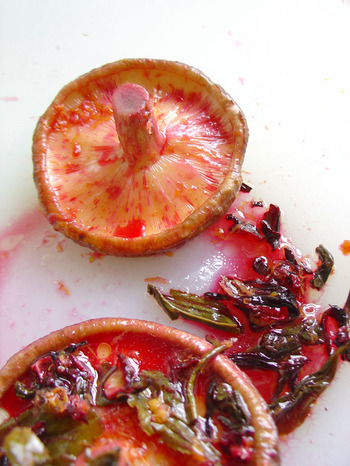
Both the green tea leaves and the crayfish oil have a powdery 'note' that compliments the woodiness of the shitake. This marinade smells like peonies. Shitake pivoine! My hands are parfumed from the shitake tossing.
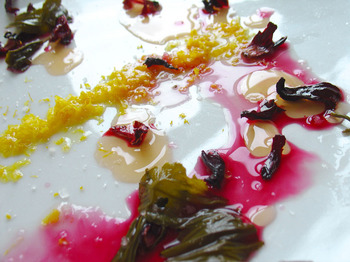
The recipe is dedicated to my dear friend Marlein Overakker, a chef who has turned me on to my favourite parfums and who is always a huge source of inspiration.
technorati tags: raw food recipes, vegetarian, shitake, mushrooms, cooking with flowers, cooking with tea, green tea
Posted by debra at 02:14 PM | Comments (9) | post to del.icio.us
Episode 1, emergency food distribution and the role of the cameras
March 19, 2006
- This entry refers to food distribution as discussed in yesterday's entry about the World Food Programme's computer game, Food Force.
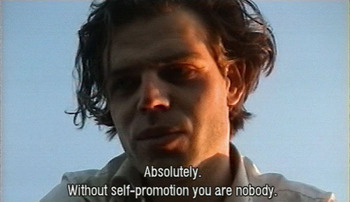
video still from Episode 1, © Renzo Martens
In January 2004, Dutch artist Renzo Martens produced his forty-four minute art film, Episode 1, a documentation of an extensive art performance. Martens travelled to the hottest hot spot war that he could find at the time of making the film (Chechnya, 2002), and in this 'setting' he pointed the camera, not at the war's victims and/or perpetrators like most (news) cameras do, but back upon himself. In Episode 1, Martens asks his Chechen and Russian Federation subjects, 'What do you think about me?'
Enough about you, let's talk about what you think about me.
Martens subjects are the normal cast of characters in every war; heavily armed soldiers on border patrol, civilians lining up for food, civilians trying to get on with it, civilians suffering before their destroyed homes and lives, refugees, but also all manner of NGO employees with their food programmes and journalists with their stories. Within minutes we understand that this is not simply a film about war, but a film about the role of the camera in war, about ethics, the dehumanising effect of pointing the camera and about what is so humanising about turning the camera back around at one's self.
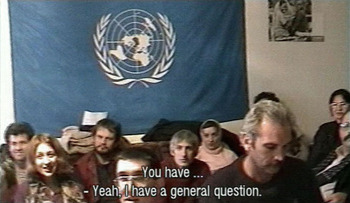

video stills from Episode 1, © Renzo Martens
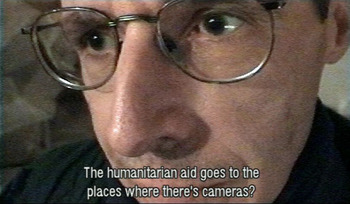
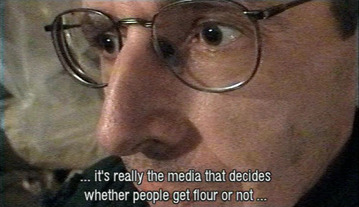
In the tense environment of a Chechen UN press conference, in territories under fire, the conference moderator asks a group of journalists, NGO employees and UN workers, 'Does anyone have any questions?' Martens pipes up, 'Yes, I have a question!' 'What do you think about me?' Peals of laughter, no one can believe their ears. Ultimatey Martens' question is ignored and the journalists and NGO employees disband to their SUV convoys, rushing off to yet another 'opening' of a milk powder storage facility. Martens interviews the director of the operation, and together they quickly establish the fact that where there are cameras, there can be food relief. No cameras, no aid. In light of this, how could the World Food Programme build its computer game Food Force without even one single PR tier?
video still from Episode 1, © Renzo Martens
Episode 1 takes us through many such media-laden scenarios. In an open market destroyed no more than thirty minutes ago by Russian Federation soldiers with tanks and heavy artillery, a woman recounts how she and the other market women formed a human shield to halt the execution of a group of Chechen boys. Speaking to the camera, in an oddly well-rehearsed role of who stands where and who says what to the camera, the woman is still shaking from the experience. The scene ends with Martens staring shamefaced at the ground, unable to gather enough gumption to ask her what she thinks of him.
At a food distribution centre, Martens addresses a group of women lined up to receive rations of oil and flour. 'I just want to ask you what you think of me!' and this time there is an answer. The grim situation of lining up to receive basic foodstuffs, fades in the face of humanising laughter and warm sparkling eyes, women just being women. For a moment the food queue has all but disappeared. 'Boy, I think you're handsome, with your blue eyes!' 'What's your theme?' 'Are you a journalist?' 'No, he's an artist.' 'I think he's a journalist.'
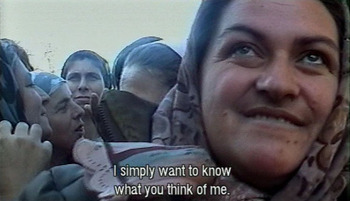

video stills from Episode 1, © Renzo Martens
Ultimately Martens 'act' of showing up with his camera and popping the question brings humanity to every situation that he creates. When he meets a young woman in a refugee camp (who bears an uncanny resemblance to his true love back in Belgium), his question changes, 'How should a man let a woman know that he loves her?' the woman's answer, delivered with beaming smile and sparkling eyes, dissolves the miserable tent landscape and suddenly it's just two people (and their translators) talking about love and life.
Of course Martens created this film for an art context, and the film articulately addresses contemporary art issues. Quite possibly Martens would be appalled that I consider his film to be 'useful', not just for artists and an art public, but as a tool to talk about the causes of war, hunger and the politics of emergency food distribution. And the question that Martens dares to ask amidst flying bullets, UN press conferences, annoyed Russian soldiers, women in food queues and refugees living in tent camps, the initial struggle that it initiates in the interviewee and in me, the audience, as I am simultaneously embarrassed by this question, but know that it is a question that can air-lift all of us actors out of the immediate and into a larger, more important discussion. Complexity is not complicated. Episode 1 brings us to the next tier, where a complex situation can be discussed with the nuance it deserves.

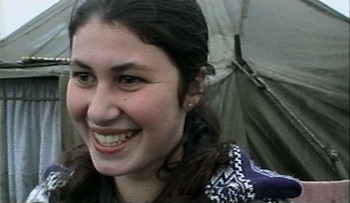
video still from Episode 1, © Renzo Martens
technorati tags: food-related film, Episode 1, Renzo Martens, Chechnya, cinema, emergency food distribution, Food Force
Posted by debra at 11:17 AM | Comments (3) | post to del.icio.us
Food Force computer game: force-feeding inaccurate notions of the causes of hunger
March 17, 2006
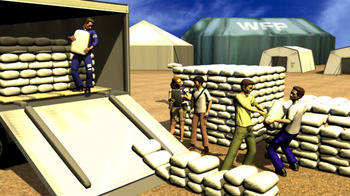
images courtesy of Food Force, © United Nations World Food Programme - all rights reserved
Two weeks ago I sat dumbfounded watching a French TV report in which journalism students practiced reporting a fictional national emergency. I couldn't help but think that what's cool about practice is that it makes perfect. If you practice having enough crises, you might actually get really good at having one! This hackle-raising report about teaching young adults to respond positively to crisis, just didn't seem to me like a simple exercise on getting prepared. The TV experience was absolutely colouring my thinking when I came across the UN's World Food Programme (WFP) website and discovered a new computer game for school kids called 'Food Force'.
'A major crisis has developed in the Indian Ocean, on the island of Sheylan. We're sending in a new team to step up the World Food Programme's presence there and help feed millions of hungry people.'
That's pronounced 'shay-lawn' by the way. The Food Force computer game is essentially a communications campaign of the UN's WFP, cleverly disguised as an educational tool. Although the game really does teach kids about mid-crisis food distribution, its purported goal, teaching students about the causes of hunger, is framed exclusively in the short term and completely ignores all of the long term causes.
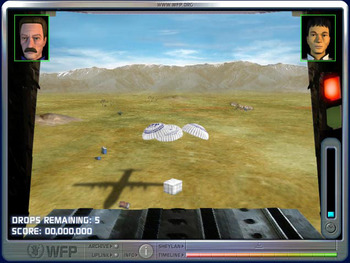
images courtesy of Food Force, © United Nations World Food Programme - all rights reserved
Food Force has six game tiers reflecting the basic elements of emergency food distribution: air surveillance (helicopter reconnaissance, counting clumps of roving refugees), energy packs (achieving nutritional and economic balance from rice, beans, vegetable oil, sugar and iodized salt), food drop (aim and drop those rations), locate and dispatch (Tetris-like global food collection), the food run (choosing the right route through hostile territory), and future farming (dealing with a combination of long term hunger solving factors).
Predictably my favourite game tier was 'future farming', where I was taught that paying people in food to attend job training programmes and so investing in the community, was the straightest path to community self-sufficiency and societal well-being. Together with the food pack nutritional assembly tier, this was the game tier with the highest educational value, going beyond point and drop and mouse dragging I mean racing.
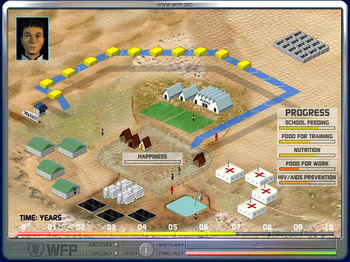
images courtesy of Food Force, © United Nations World Food Programme - all rights reserved
Food Force has a website chock-full with extra video, images and an educational package enabling teachers to work this computer game seamlessly into the curriculum. I pored over the WFP site in search of information addressing what I believe to be the long term causes of hunger and the long-term perspectives on solving the problems. Alas, I could find none. According to Food Force, hunger is caused by drought and civil war.
Of course I find no fault with the WFP's symptomatic relief efforts per se, nor do I see intentional evil with a communication strategy that illustrates this practice to children in the form of a computer game. But I do have a problem with placing this game in a curriculum that teaches children that the cause of hunger is simply drought and war. What are the some of the causes of drought? What are the some of the causes of war? What causes such a lack of food security that climactic fluctuations can take out several million people? Food Force offers no macro vision, and I do find fault with weaning children of the notion that food security is rested in global food politics. The macro vision of many commonly accepted causes of hunger, such as the small farm community-destroying effects of large-scale agricultural practice and the methods of monoculture, are left completely unaddressed by the WFP's computer game.
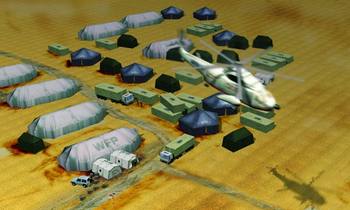
images courtesy of Food Force, © United Nations World Food Programme - all rights reserved
I often wonder if teaching children about hunger couldn't happen in a more nuanced way. Wouldn't it be more productive than training them to throw a little money at the problem? Well, maybe not with the 'throwing a little money at it' method of famine-control being so lucrative.
Tomorrow, I'll give an example of a solution.
I promise.
technorati tags: World Food Programme, Food Force, computer game, emergency food distribution
Posted by debra at 06:26 PM | Comments (2) | post to del.icio.us
When good salami happens to bad people
March 13, 2006
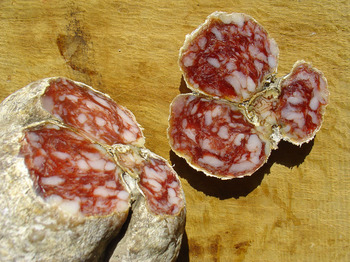
You know how you sometimes get a song in your brain that has absolutely no reason being there?
'Jesus is just all right, Oh yeah.'
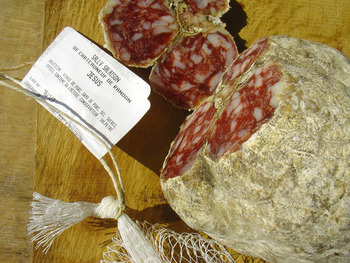
Well, I'm just glad I wasn't responsible for naming this Languedocian kilo of pork product as big as your head.
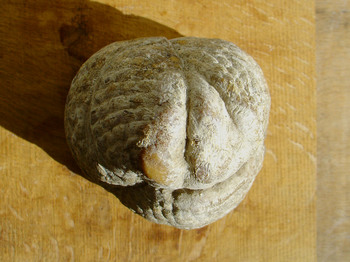
Dang the Salaison de Chateauneuf de Randon! In a time of (staging) the torching of embassies, this seems to me a rather subversive name for a salami.
Do, do, do, do, do, do, do.
Do, do, do, do, do, do, do.
Do, do, do, do, do, do, do.
Do, do, do, do, do, do, do.
On the bright side, the Netherlands has shrugged off the shackles of right-wing popular support. Lordee!

Posted by debra at 02:38 PM | Comments (1) | post to del.icio.us
Soy vey is mir
March 06, 2006
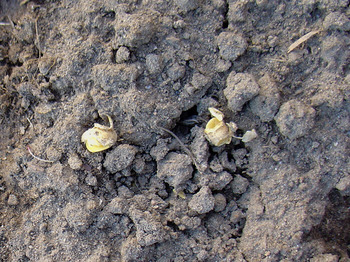
Dang birds, eating my beans! If you're going to kill a sprouting soy bean plant, the least you could do is eat the whole bean. Note to self: Next time make a scarecrow.
Tomorrow I return to the Netherlands. Hope the snows will have cleared...
technorati tags: allotment, kitchen garden>
Posted by debra at 11:28 PM | Comments (5) | post to del.icio.us
Note to self: alfalfa, mustard, buckwheat, red night kidney, adzuki, soy, soy, soy
March 02, 2006
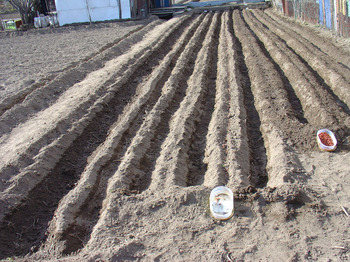
This is the planting order when facing the lower allotment. The acronym is AMBRASSS, which could stand for the the English embarass, if the cover crops once again fail to thrive. If the cover crops survive my handling and the weather, I can pronounce the acronym in French as in je t'embrace, which translates into a summer garden cocktail party with homegrown edamame as the cameo snack.
Note to self: I Innoculated the mustard seeds with dirt to form broadcastable seed pills. Narrowcasting is a more accurate description of what actually took place. Hopefully the mixing action didn't disturb the sprouted seed too much.
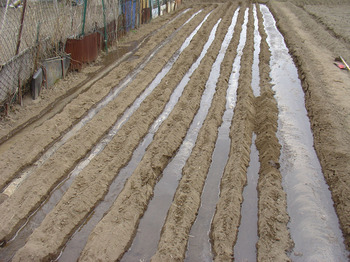
First irrigation run goes awry. Lowered irrigation pipe, made a huge mess of the footpath.
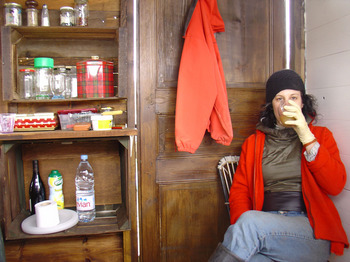
Digital photo of author drinking soup in KvR's new shed
It appears that I'm the first guest in Ktje's new cabane. JT remarked that we've started to dress like the 'Turnip Ladies' in a fairy tale and excepting the fact that neither one of us has actually grown a turnip, it's hard to disagree. For fun, we're going to wash and wear urban clothing for dinner from now on. Starting tomorrow.
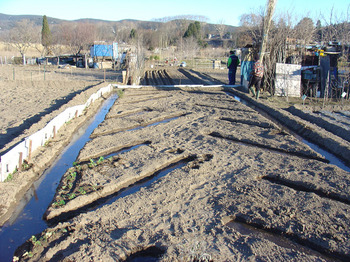
Each day the gents come to marvel at what seems to them to be a unique form of gardening. Today's crowd got a buckwheat sowing performance and a taste of buckwheat sprouts. I tried explaining that I was growing buckwheat (and alfalfa, mustard...) to improve soil condition by fixing nitrates and increasing the organic matter in my soil, but this didn't translate very well. In fact it didn't translate at all. Trick is to leave the explaining to Sidi AlGouche, the allotment's alpha male.
technorati tags: allotment, kitchen garden, irrigation
Posted by debra at 10:22 PM | Comments (6) | post to del.icio.us


