Street food waste =
street food packaging
April 29, 2006
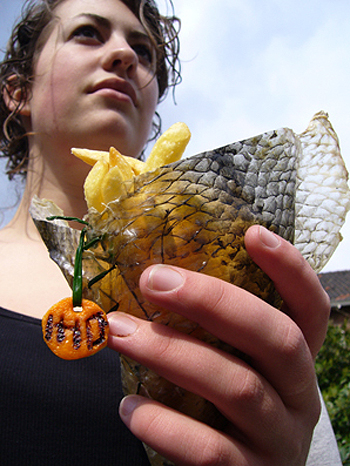
Fish and chips: image of street food packaging concept 'IHO', © Païvi Kovanen, Eva Arts and Caroline van Teeffelen 2006, used courtesy of the designers. Please respect student work, contact culiblog for updates.
(This is the second in a series of entries about the Street Food Workshop developed and conducted together with Katja Gruitjers for our students from the Design Academy Eindhoven and the HAS den Bosch.)
Just the simple fact of making street food creates tonnes of food waste. Students Païvi Kovanen, Eva Arts and Caroline van Teeffelen used food waste materials to develop packaging for street food. Katja and I were really impressed with their packaging concept IHO, which means skin in Finnish. Even mo' bettah, when you turn the letters around to spell OHI, you get the Finnish word for leftovers.
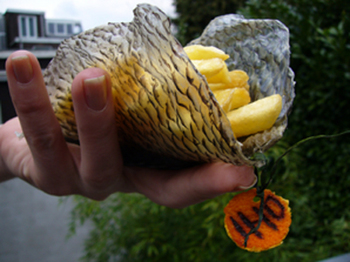
Image of street food packaging concept 'IHO', © Païvi Kovanen, Eva Arts and Caroline van Teeffelen 2006, used courtesy of the designers. Please respect student work, contact culiblog for updates.
The fish and chips sack is brilliant. Hand-sown dried fish skin imparts a nice fish aroma to the chips and you know how the Northern peoples love their (dried) fish. Katja and I are imagining a dusting of vinegar powder on the inside of the sack for a perfect flavour.
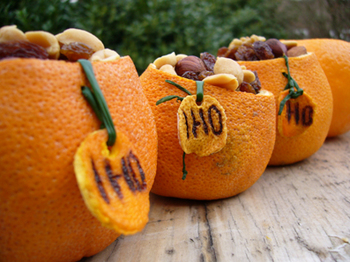
Image of street food packaging concept 'IHO', © Païvi Kovanen, Eva Arts and Caroline van Teeffelen 2006, used courtesy of the designers. Please respect student work, contact culiblog for updates.
Urban juice bars produce orange rind and pulp waste that is normally turned into silage to feed animals that us omnivores love to eat. Kovanen, Arts and van Teeffelen assured us that there's plenty of rind and pulp to go around and they dried the rinds into snack containers. The pulp they turned most amazingly into a palm plate that has a wonderful hand feel to it.
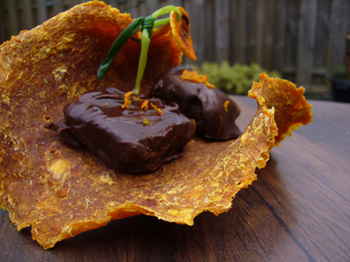
Image of street food packaging concept 'IHO', © Païvi Kovanen, Eva Arts and Caroline van Teeffelen 2006, used courtesy of the designers. Please respect student work, contact culiblog for updates.
As if this weren't enough for one half-term street food assignment, the ladies Kovanen, Arts and van Teeffelen developed a new ceramic material produced from eggshells and potato starch and that can be formed into any possible shape. Here, the material has been formed into a palm plate.
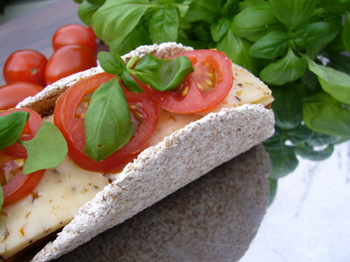
Fish and chips: image of street food packaging concept 'IHO', © Païvi Kovanen, Eva Arts and Caroline van Teeffelen 2006, used courtesy of the designers. Please respect student work, contact culiblog for updates.
IHO street food packaging concept by Kovanen, Arts and van Teeffelen.
Posted by debra at 11:06 AM | Comments (3) | post to del.icio.us
Street food collaborations: Streetberry!
April 24, 2006
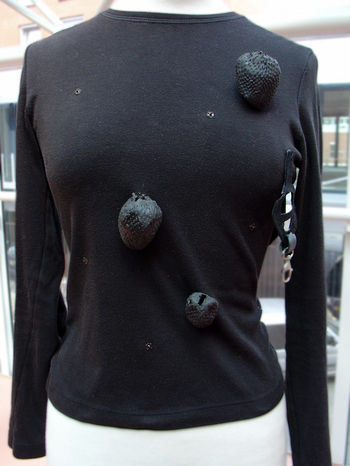
Streetberry design by Michou-Nanon de Bruyn, Milou Melis and Monica Ruiter. Please respect student work, contact culiblog for updates.
Nothing says wing-flapping like a subversive strawberry. Students Michou-Nanon de Bruyn, Milou Melis and Monica Ruiter have developed Streetberry as their final project for Katja Gruijters and my street food project. The collectible black rubber berries snap on to black t-shirts, rings, and necklaces made out of recycled bike tyres and representing the map of the city. The pieces smell like strawberries, but in a way that someone who is not a twenty-something woman can still appreciate.
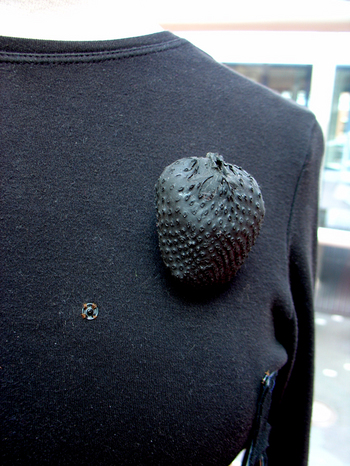
Streetberry design by Michou-Nanon de Bruyn, Milou Melis and Monica Ruiter. Please respect student work, contact culiblog for updates.
Since March, students from the HAS (Hoger Agrarische School, 's Hertogenbosch NL, Food Design) and the Design Academy Eindhoven (Atelier, Food) have been collaborating on a street food project that Katja Gruijters and I initiated. Last Friday they presented the conclusion to their R&D and in the next weeks I'll show a few of the best projects here on culiblog. Katja and I are most pleased with the results and think that the collaboration proves that the Design Academy and the HAS should work together on food-related projects in the future.
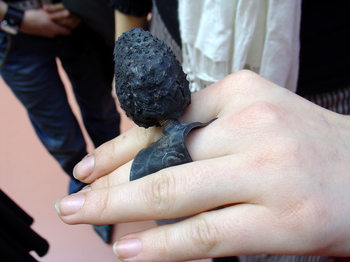
Streetberry design by Michou-Nanon de Bruyn, Milou Melis and Monica Ruiter. Please respect student work, contact culiblog for updates.
The assignment was to develop a a street food concept and in the course of 10 weeks develop this into a prototype. As you may already know, the NL is practically devoid of street food aside from the usual offerings of the Servex Group. Selling food on the street or at the train station is effectively illegal unless you are part of this horeca monopoly (HOtel, REstaurant, CAfé - another sexy Dutch acronym).
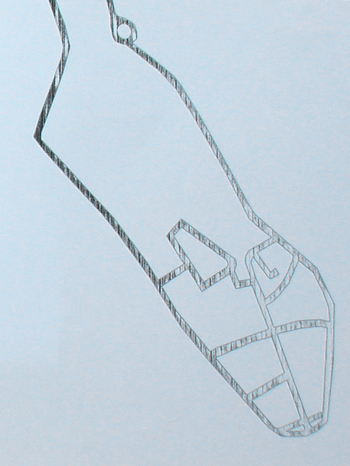
Streetberry design by Michou-Nanon de Bruyn, Milou Melis and Monica Ruiter. Please respect student work, contact culiblog for updates.
Katja and I wondered what future (food) and product designers, presented with a wealth of images and information about initiatives in other countries would come up with. Fortunately some students let their autonomous brains lead them away from the kitchen. A jewelry line based upon the map of the city, a new materials collection for street food packaging using the waste materials of commonly sold street food, and a conceptual art performance are some of the 12 fresh visions of what street food in the NL could become if it were allowed to flourish.
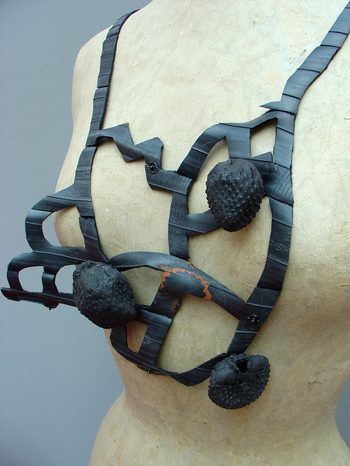
Streetberry design by Michou-Nanon de Bruyn, Milou Melis and Monica Ruiter. Please respect student work, contact culiblog for updates.
- Thank you Servex for convincing Dutch legislators that street food diversity is a hygiene issue!
- But seriously, thank you HAS for hosting this collaboration in your fabulous test kitchens!
- Thank you Design Academy Eindhoven (Kompas: Atelier) for being flexible and playful in terms of curriculum!
- Thank you Michou-Nanon de Bruyn, Milou Melis and Monica Ruiter for introducing us to Streetberry!
Posted by debra at 09:27 AM | Comments (0) | post to del.icio.us
Love difference,
as in we love difference
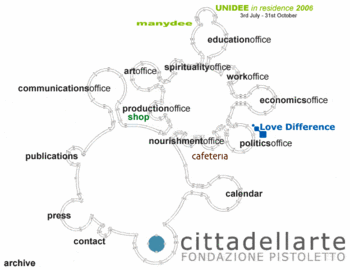
Of course the artistic movement for an intermediterranean politic is into food. And it sports a big fat Citta del Arte logo right on it's homepage. Which led me to click on the Ministry of Nourishment link because I always wonder what folks mean by the word nourishment.
I'm none the wiser, but the Love Difference folks did done organise a Food Market Festival in which food markets (and their organisers) from around the world met this weekend in Turin. I wonder what they've got cookin' for the next event, hopefully something megamaniacal. (Thank you, Julie Upmeyer, who sent this link on time.)
Posted by debra at 08:00 AM | Comments (0) | post to del.icio.us
Urban gardening lessons for Dutch children
April 21, 2006
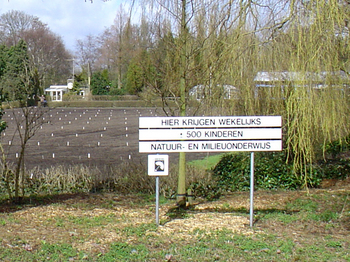
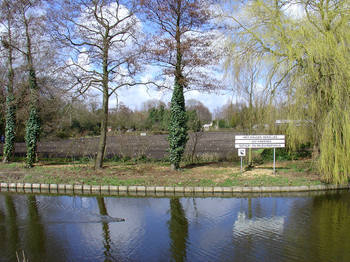
On an island in Amsterdam's Westerpark, a horizontal grid of 1m2 garden plots are being prepared for the children. The sign says that around 500 children will receive weekly education about nature and the environment on these plots. Although this garden grid offers an extreme image of mini-allotments filled with one carrot, one lettuce, one rhubarb, one sunflower, one fennel, one this and one that, I cannot say that I think this is a negative idea in terms of education. In fact, gardening in this way has the potential to teach children about density and clustering. It's like an MVRDV-isation of grammar school education. By this I am referring to educarion informed by architects MVRDV's notions of density and as explored in their publications FARMAX (floor area ratio) and KM3, (cubic kilometer) Excursions on Capacities from Actar Publishers. Next step, vertical gardening for urban children!
(The image has been enhanced to increase readability of the sign.)
Posted by debra at 07:13 AM | Comments (6) | post to del.icio.us
Locative eating in Overijssel at the end of the Hungry Gap
April 19, 2006
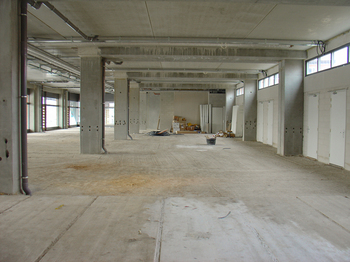
Image of a shopping centre under contruction in Enschede, NL. Soon to be a banquet location
Speaking of starving oneself, although it seems like it's spring, crop-wise we're right in the middle of the Hungry Gap, the period before the spring crops have come in, and when foodstocks stored from fall and winter are beginning to wain and look rather cruddy. Way back in January I wrote about how surprised I was that even though I had let my garden go to pot, there was still more than I could eat growing in the frozen ground. Now that it's no longer necessary to wear two pairs of woolen pants, there's not a lot of calories in my Occitanian kitchen garden.
Back up here in the Polar Circle, the cold weather lingers on and on and I'm in the throes of organising a banquet for ca. 70 people in May, right in the middle of the Hungry Gap (plus 2 cocktail parties, a breakfast and 2 lunches). The occasion is that the Dutch Art Institute where I teach, is hosting a 2 day international symposium titled, Here as the centre of the world (May 23-24, 2006 in Enschede, NL). The subject of the symposium is the position of artists, art initiatives and all their entourage operating at what is considered to be the 'periphery'. The reason that I have been saddled with what I prefer to call the 'art direction' of these feedings, is that I have a big mouth. And a heightened sensitivity for good aesthetics and sustainable practices. And I think that an art institute should set a good example for its students. And I happened to express these sentiments at an organisational meeting.
Often at cultural events in the NL, folks just throw a bunch of fluffy sandwiches smeared with margarine and factory made young cheese on an aluminium platter and call it a day. Although there are clear exceptions to the rule, I just couldn't bear the thought of the bad food jokes from our illustrious guests travelling all the way from Damascus, Beirut, Khartoum and Taipei. Also, as a member of the teaching staff and moderator of at least one of the talks, the thought of 2 days of bad food catapulted me into a state of action. In fact this is the perfect opportunity to investigate the wealth of organic (and organic-enough) produce in and around the easternmost bulge of the Netherlands. I'll be posting about it here.
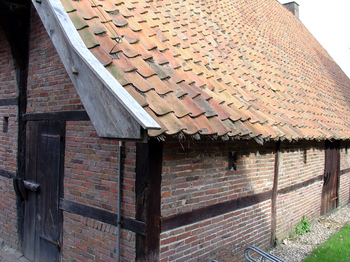
Image of the Los Hoes historical farm building in Enschede, NL. Soon to be breakfast location
This is what I've gleaned so far in terms of promising producers of delicious regional food, beer and wine:
- Vegetables - Boerderij de Ketel / Het Groene Spoor in Rossum will most likely have: spitskool, cauliflower, broccoli, beetroot, carrots, lettuces, pak soy, kohlrabi and potatoes from last year if we're lucky.
http://www.deketel.nl - Vegetables -Landgoedtuinderij De Witte Raaf in Denekamp is hoping to have: spinach, raapstelen, and radishes
http://www.dewitteraafgroente.nl - Fruit - Düvelshöfke in Oldenzaal will not yet have harvested its newest crop of berry fruit. We'll just have to make do with frozen berries (cassis, barberries, gooseberries, blackberries) from last year's crop.
http://www.duvelshofke.nl - Fruit - Fruitboerderij Oold Bleank in Rossum will have some apples and pears left over from the winter. Pity their strawberries won't be in until June.
Oddly, no website - Fruit - De Manderveense Aardbei in Maanderveen won't have any strawberries yet. Maybe some strawberry liqueur?
Strangely, no website - Organic ice cream - Biologisch Roomijs Nieuwe Weme in Weerselo will have plenty of ice cream (vanilla, giandouille, caramel, strawberry) and will likely be able to supply us with dairy products.
- Wine - Hof van Twente in Bentelo has whites and rosés from 2004, even award winners, but the reds are all drunk up. Hungry Gap!
http://www.twentewijn.nl - Beer - Bierbrouwerij Mommeriete in Holthone has a brand new lente bok (spring beer) ready for us. Madame Brewer told me it's like a triple and is even better than last year's. That's how you survive the hungry gap.
http://www.mommeriete.nl - Meat - De Bourgondische boer in Denekamp has very beefy looking Limousin beef for the omnivores. I am an omnivore.
http://www.boergondisch.nl/index1.html
I'm still looking for producers of honey, cheese and a bread if you know of anything.
- A culiblog winter story about abundance
- A culiblog entry about freezing in the spring (don't believe the hype about the South of France)
- Culiblog irrigating and ice skating in February
- The Dutch Art Institute cordially wishes to invite you to Here as the Centre of the World, a conference about all things peripheral.
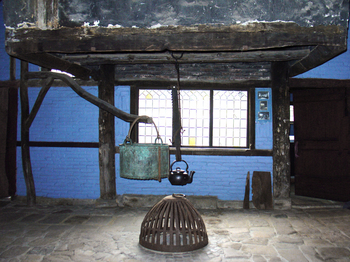
Image of the hearth in the Los Hoes a historical farm building in Enschede, NL. Soon to be a breakfast location.
technorati tags: hungry gap , locative food, Here as the centre of the world
Posted by debra at 08:57 PM | Comments (6) | post to del.icio.us
Anorexia, art,
war, rant
April 17, 2006
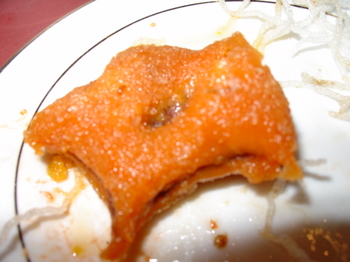
The pumpkin dumpling that I just couldn't finish.
A little less than a year ago I wrote an entry about SehnSucht, a restaurant for anorexics in Berlin that had opened up sometime in January 2005. Because I didn't have a picture of the restaurant, and because I hadn't visited it (and to this day can only get a robot on the phone), I did the logical thing and accompanied my entry with a blurry image of a greasy half-eaten pumpkin dumpling.
The dumpling image was a huge hit if i can believe my site meter referrals. And until last month, dumplin' was smack in the middle of a Google Images page for the search-string anorexics. Folks were clicking on the dumpling, and so doing finding culiblog, proving that it's not only horny old fat men that scour the anorexia sites for skeletal supermodels and thinspiration. Actual 'Anas' and 'Mias' were haulin' their boney tuchas over to culiblog to get a gander at the food porn.
Well this one's for you, Ladies!

LA Raeven at the Mediamatic War Salon, photo by Bea Correa, courtesy of Mediamatic
LA Raeven is the artist name for twins Liesbeth and Angelique Raeven, whose very subject matter is themselves. Their video installation work and performances are about the female body image and the behaviour dynamics of twins, especially when this dynamic expresses itself in psychologically nuanced eating habits.
LA Raeven were launched into fame in February 2002 when they created a huge kafuffle with Wild Zone 1 & 2, a video installation exhibited at the ICA London. It was the first time that the twins showed themselves in their work, lolling about and being overly skinny amidst half-drunk glasses of white wine and a floor littered with the occasional mini-nibble. The gallery was infused with the artists' own feral scent, reportedly concocted from their very own pee. Of course the bourgeois art press found it so scandalous that female artists with anorexia should be able to express themselves about body image, that they censured the artists' call for participation before the exhibition, and a goodly deal of the exhibition's press. Just like in China!
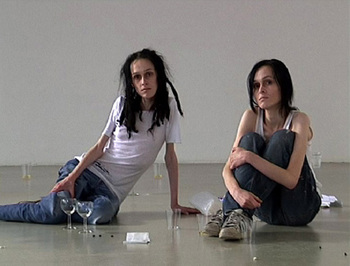
LA Raeven, video still from Wild Zone 1 (2001), courtesy of the artists
In a painful to watch BBC NewsNight interview, the Raeven sisters weren't contextualised primarily as artists, not even as kooky artists, but as eating-disorder victims. The 'feminist' psychotherapist Susie Orbach, author of Hunger Strike and ironically, Fat is a Feminist Issue (no potshots, please) was called in to moderate the discussion. Watching the interview, I was apalled at the insufferably intolerant BBC commentator. I believe that self-empowerment has many forms of expression, and that it is in fact medicalisation and consistently pathologising what is primarily women's behaviour, that is inherently anti-feminist. But that's just me, I'm a 3rd-wave feminist orthochondriac, not into rehearsing unhealthy scenarios, or encouraging others to practice theirs from haughty podia. And I'm talking about NewsNight, here.
The sisters told me recently, 'It was unbelieveable how we were treated at that time. Censured! When a Chinese artist eats a fetus, you don't see journalists calling psychoanalysts in to help. Instead, Western art journalists stumble over themselves trying to explain away (AiWeiWei!) this behaviour as an expression against an unhealthy regime."
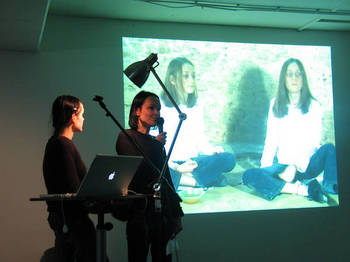
As part of Mediamatic's anti-war protest exhibition titled, le Mépris, (non-food-related, but go see it anyway), Mediamatic held a War Salon, (April 5th) at which the Sisters Raeven were invited to show some of their new work. The idea to put LA Raeven in a war and violence themed programme was an inspired one. Aside from new work by the ladies, highlights from the lineup included an analysis of the US Army recruitment game America's Army, and ended with a macabre audience participation karaoke with the songs of that very political body, Brigitte Bardot.
A goodly portion of the audience was represented by young male gamers from the nearby universities, there to listen to their friends, scientists David B. Nieborg and Jonas Hielscher speak about and demonstrate America's Army and Battlefield2, respectively. Gamers. That's a nice, socially acceptable term that we all use in contemporary cultural discourse. Gamers play games, in this case, war games on computers with lots of other gamers. Gamers at university study games and other gamers, and even write theses about these things. Well LA Raeven also play games.
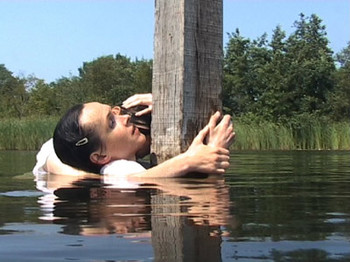
LA Raeven, video still from "Love knows many faces" (2005), courtesy of the artists
I disagree with those that would suggest that LA Raeven's presence and presentation at the Mediamatic War Salon represents a war on the body, or war against the body. Their oeuvre, and especially the new works, Prison in Me (2005) and Thin Line (2006) show an assault on individuality and a strategy to escape this assault. The image above is a still from the video, Love knows many faces (2005), in which the twins go for a swim and play a sisterly game of trying to drown eachother. Recovering from a symmetrical but futile attempt at individuation, they exhaust themselves into one big clump of Liebestod. Game on, Girls!
Thin Line (2006) shows one of LA Raeven's own food games, now in the hands of pre-pubescent twins. In a Bruxelles basement conjuring up horrific notions of Dutroux, the identically dressed twins flip a coin. The 'winner' is required to eat both sisters' dinner portions, and the loser gets nothing at all. The game is repeated through all the courses of a (continental European) meal, such that inevitably, one of the sisters ends up stuffing herself whilst the other is left to go hungry. Before you brush it off as childish, may I suggest that you play this game with your partner for an entire day, exploring the complex feelings that it generates. In fact it is not at all about waging war on one's own body. Pity that the body just gets in the way.
The hunger strike is male behaviour, a purposeful and politically engaged expression. The hunger artist is male, and is an artist above all. I left the war salon with even greater respect for LA Raeven's authenticity and artistic engagement. But I coudln't help wonder about the reasons why (female) anorexia should be considered to be more pathological and unspeakable than the (male) fear of terrorism whose effects are unleashed upon us every day. Why should an expression of the fear of fat, and/or the extreme expression of self-control that is anorexia be considered to be more offensive than the extreme societal control that is expressed by waging and playing at waging war?
- culiblog on SehnSucht, a restaurant for anorexics in Berlin
- Mediamatic War Salon wrap-up with photos by Bea Correa
- LA Raeven at Gallery Ellen de Bruijne Projects in Amsterdam
- le Mépris / Location: Mediamatic
POST CS Gebouw, ground floor
Oosterdokskade 5, Amsterdam
18.03.2006 - 30.04.2006
Thursday through Sunday 12.00 - 18.00. - Ellen de Bruijne Projects
- Fat is a Feminist Issue, by Susie Orbach
- Hunger Strike by Susie Orbach
- the Guardian article by Sean O'Hagan
- LA Raeven, Aesthetic Terrorists, by Sander Pleij, de Groene Amsterdammer. Unfortch in Dutch.
- Performance art in PRChina according to Wikipedia
- The Chinese Fuck Off art exhibition as opposition to the Shanghai Biennial in 2000. The title, 'Fuck Off' is considered by some to be a questionable translation for 'Uncooperative Attitude' in the Mandarin language.
- America's Army, a recruitment campaign and live, online computer game funded by private, Hollywood and ultimately US tax dollars, teaches children how to be ethnocentric and extremely violent. Apparently it's a fun game, and US Army soldiers actually train with it. You can play individually or as a team. The 3rd largest 'national' team, is Dutch.
- Stedelijk Museum, Post CS
Next Level - Art, Games & Reality
10.03.06 - 18.06.06
"Work by artists and designers who make the vocabulary of games their own, and provide us with their personal reflection on it." [so that the curatorial staff of the Stedelijk doesn't have to.-editor] - Thinspiration according to the very sane Wikipedia
- For the readers of German, a January 2005 review of the restaurant for anorexics, SehnSucht. Here's the telephone number, please give it a go. (Stadtteil: Tiergarten / Adresse: Dortmunder Straße 12, 10555 Berlin / Telefon: +49 (0)30 3995 266)

LA Raeven, video still from "Prison in Me" (2005), courtesy of the artists
technorati tags: anorexia, art, war, chinese performance art, restaurant for anorexics, twins, feminism, war, computer games, American Army, LA Raeven, Mediamatic, ICA London, SehnSucht, Susie Orbach, twin love,
Posted by debra at 07:10 PM | Comments (9) | post to del.icio.us
Sugar and tea
April 16, 2006
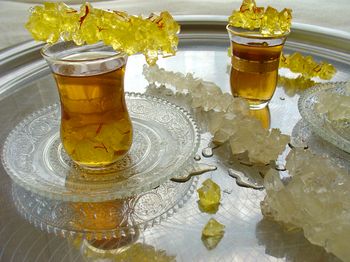
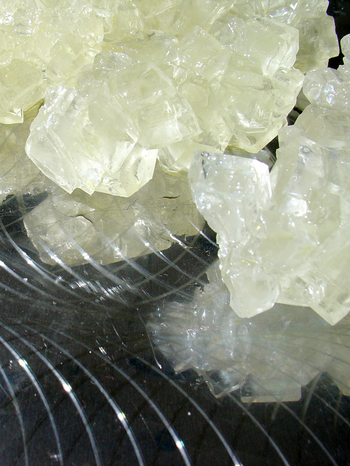
A smokey lapsang souchong, my favourite afternoon tea, served with plain and saffron flavoured sugar crystals from a Persian supermarket in Amsterdam.
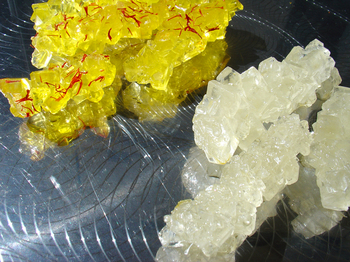
Growing up in my family, sugar was called white death. Until recently I didn't have much of a taste for sweets or sweetend things. Even one year ago, in the throes of low glycaemic cooking experiments, I never would have added sugar to my tea let alone, tea to my sugar.
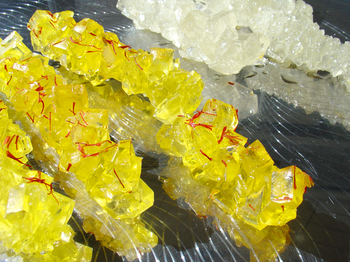
But these sugars are so pretty, and the crystals flavoured with saffron are aromatic, combining nicely with smoke and bergamot, that everyone who sips tea flavoured in this way just closes their eyes in pleasure.
Posted by debra at 02:59 PM | Comments (0) | post to del.icio.us
Shorts in Bra
Slow Food on Film
April 15, 2006
And by shorts I mean short films. And by bra I mean Bra, Italy, where the short film festival, Corto in Bra will host a programme titled Slow Food on Film. How fine it is to see one's sensibilities well represented, in a country that no longer has a vile mo fo as elected head of state.
As the Slow Food Movement's spokesperson and founder Carlo Petrini promised at this year's Berlinal Talent Campus, a number of short films at the BTC would be chosen and placed prominently within the Corto in Bra programme. This is great news, also because culiblog found quite a few of these films to be well worth watching. Nice to see my cinematic tastes reflected in the message of the Movement.
Although there's nothing short about them, both the Future of Food, by Deborah Koons Garcia, and Taggert Siegel's the Real Dirt on Farmer John will also be screened. Ms. Koons Garcia is the Slow Food on Film documentary jury chairperson and I'm pleased that this festival doesn't even pretend to be non-partisan like the big film festivals do. Amen.
You can start brushing up your conversational Italian by downloading the Corto in Bra Film Festival programme here.
The culiblog selection from the Slow Food in Film programme is here:
Wednesday - 26.04.2006
- 22.45h
CONCORSO SLOW FOOD ON FILM DOC
LA VIDA DULCE / La vita dolce / Sweet Life di Rouven Rech
& Bettina Blimner (Cuba/ Germany, 2004, BetaSP, 15’, col.)
(also screening at 16.30h on Sunday 30.04.2006)
An almost slapstick documetary short about Cuban subsidised cake distribution. If you're a Cuban mother on Mother's Day, you will get yer dang cake. After watching the short several times, it still confounds me that even though cake boxes are used in the transport of these generously frosted creations, no one puts the cake in the box, preferring instead to keep it on display, exposing the cake to all manner of dangers. Hilarious and sweet.
- Thursday - 27.04.2006
- 21.00h
DOÑA ANA / La signora Ana / Mrs. Ana
di Marlon Vasquez (Colombia, 2004, DV, 1’44’’, col.)
(Incontro con gli autori / Meet the directors)
(also titled STRAWBERRY EATING WOMAN) Marlon Vasquez Silva, Colombia: This was by far the most unique film of the BTC, an animation comprised of beautifully created watercolours and collages addressing the plight of displaced farmers in Colombia. Without being overtly political, Strawberry Eating Woman lays bare the loss of cultural capital that occurs when small agricultural communities are destroyed. Surprising and refreshing, like an excellent little strawberry.- 21.45h
THE FUTURE OF FOOD / Il futuro del cibo
di Deborah Koons Garcia (U.S.A., 2004, Beta SP, 90’, col.)
- Friday - 28.04.2006
- 21.00h
THE REAL DIRT ON FARMER JOHN / La sporca verità sul
contadino John di Taggart Siegel (USA, 2005, DV/Super8, 58’, col.)
(also screening at 16.30h on Saturday, 29.04)- 23.00h
LE PRIX D’UN PLAT / Il costo di una cena
The Cost of Dinner di Malam Saguirou (Nigeria)
- Incontro con gli autori / Meet the directors
- Saturday - 29.04.2006
- 21.45h
CONCORSO SLOW FOOD ON FILM DOC
THE SOUP PEDDLER / Il venditore ambulante di zuppe
di Lisa Kaselak (USA, 2005, DV, 30’, col.)
I have not seen this film, but I am curious.
- Sunday - 30.04.2006
- 22.30h
LA VENDEMMIA / The Grape Harvest
di Esther Koohan Paik (USA, 2006, DV, 21’, col.)
I have not seen this film, but I am curious.- 22.50h
MALENKAYA KATERINA / La piccola Katerina /
Tiny Katerina di Ivan Golovnev (Russian Federation, 2004, DV, 5’, col.)
(also screening Monday at 12.30h)
TINY KATERINA. Ivan Golovnev, Russian Federation: Golonev admits readily that Tiny Katerina is a film about changing lifestyle more than about food. It documents the youngest member of a Northwest Siberian family that lives in a felt tent in near isolation. Katerina can't be more than two years old, but it is confusing whether she is playing at being an adult or is actually participating in the rigourous family chores! We see her lugging blocks of firewood around and cooking for the family's dogs. Two years old! Golovnev's camera is completely unobserved, offering an intimate view of a life that will soon vanish in the petrol politics currently plaguing this region. The documentary short has a distrubing ending that places the film within a larger political context.
- Short Film Festival in Bra, english language website
- Slow Food on Film in Bra
- Wikipedia on the Slow Food Movement
- culiblog film review of the Real Dirt on Farmer John and the 'green' programming of the 2005 IDFA
- culiblog film reviews of the 2006 Berlinale Talent Campus short films
- The Future of Food by Deborah Koons Garcia
Posted by debra at 12:26 PM | Comments (0) | post to del.icio.us
Lace, about face
Ander Kant
April 06, 2006
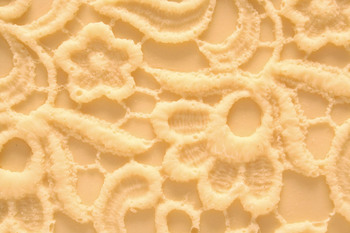
image of white chocolate lace detail, © Katja Gruijters, courtesy of the designer
Aren't these edible lace tiles by food designer Katja Gruijters exquisite? She makes them out of caramel, white and milk chocolate and sand tart. They feature prominently in an exhibition on contemporary lace design titled, 'Ander Kant', (literally 'other lace', or 'other side') at the Boijmans van Beuningen Museum in Rotterdam.
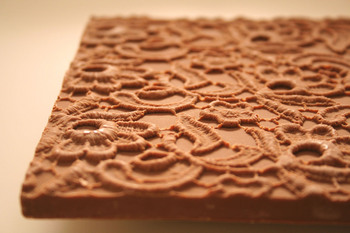
image of a milk chocolate tile, © Katja Gruijters, courtesy of the designer
The collection is on sale at the Boijmans van Beuningen Museum shop but you can also find out more about them at Katja's website.
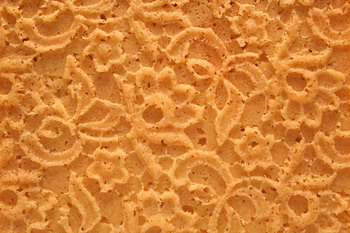
image of a sand tart tile, © Katja Gruijters, courtesy of the designer
Katja Gruijters, food designer
Ander Kant/Other Lace at the Boijmans van Beuningen Museum, Rotterdam until April 30, 2006
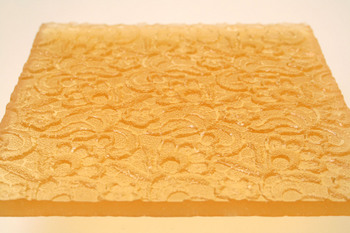
image of a caramel tile, © Katja Gruijters, courtesy of the designer
Please read more... "Lace, about face
Ander Kant"
Posted by debra at 01:47 AM | Comments (4) | post to del.icio.us
Will swap saliva for a home, the problem with bird nest soup
April 04, 2006
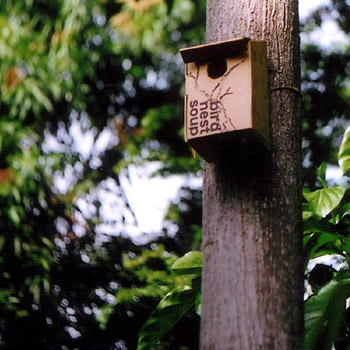
image from Hoko Studio design collaborative, cropped and used entirely without permission
If you were a bird living in a cave in Thailand, would you rather
1. live in a house of your own making constructed from spit and twigs?
or
2. live in a gifted house made out of recycled cardboard?
Bad question. Here comes a better one.
If your house was under threat of confiscation, would you rather
1. be given a house built out of recycled cardboard?
or
2. be left to your own devices to emotionalise enough angry bile and spit to produce a new casa de saliva?
It may be yesterday's news to some, but I was surprised to read that swiftlets are suffering forced eviction due to gourmand greed! Swiftlets are the little birds whose nests are prized for bird nest soup. Some varieties of Thai swiftlet construct nests comprised of 80% lugie! Homelessness seems like a poor reward for resourcefullness.

image from Hoko Studio design collaborative, cropped and used entirely without permission
Design collaborative Hoko Studio has a partial solution. And by 'partial', I mean partial. Use birdhouses to package and distribute the nests. When the cook is done leaching the saliva out of the nest, the customer can hang the packaging on a tree (or high up in a cave in Thailand) and commence slurping with a partially clean conscience!
Partial solutions are only half the beauty of critical design.
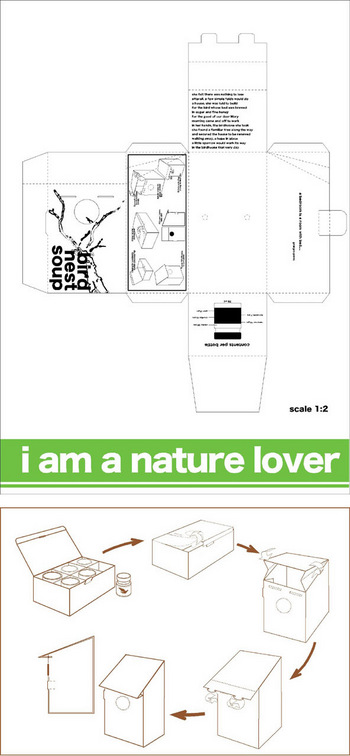
image from Hoko Studio design collaborative, cropped and used entirely without permission
Know your bird nest
Know your birds' nests even more
Hoko Studio's 'Eat Bed' bird nest proposal at Platform 21
Meet Hoko Studio Design Collaborative, the designers of 'Eat Bed'
Wikipedia bird's nest soup page with a cool picture of a saliva nest
Hoko Studio's proposal titled 'Eat Bed' is one of several 'critical design' projects exhibited at the Platform 21 website under the title, Positive Alarm (fixing what is wrong without making it wronger). Platform 21 is a newish venue for design situated in Amsterdam's newish city center, de Zuidas, (pronounced South Central).
Here's the Platform 21 culture blurb: 'the domain of creation is not something professionals have a monopoly on. We are interested in creative developments in fashion and design, including amateur initiatives.'
Huh. Platform 21 does seem like an OK initiative, although their website is probably the most annoying surf you'll have this week. Indeed a platform for Dutch and international design initiatives has been sorely missing ever since the nest known as the Vormgevings Instituut (pronounced Netherlands Design Institute) was confiscated by barbaric xenophobes back in the '90's. Maybe Platform 21 will provide a new place for design to alight. The director is ethnic Dutch, always a good starting point. Soup is on!
Hoko Studio's 'Eat Bed'
Platform 21 a design nest in Amsterdam's Zuidas
Platform 21's online exhibition Positive Alarm
Posted by debra at 08:58 PM | Comments (0) | post to del.icio.us
37 uses for a dead sheep, a film review and a re-count
April 01, 2006

image used courtesy of Ben Hopkins and Tiger Lily Films, © Nikki Parrott
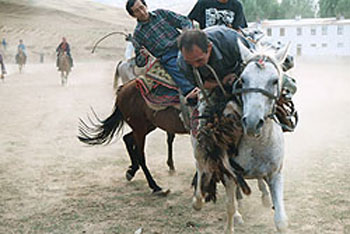
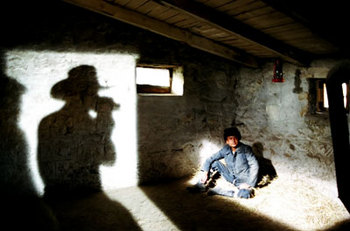
One of my favourite films at this year's Berlinale (Forum), was Ben Hopkins magnificent meta-documentary, 37 Uses for a Dead Sheep. As far as I'm concerned, you really can't go wrong with a film about yurts, yoghurt, nomadic tribes and the shifting borders of the 'Stans' in Central Asia. I put my pants on one leg at a time.
37 Uses, is not so much Hopkins' film but a collaborative work, made with the Pamir Kirghiz tribe, a splendid historical document. The film begins in the 19th c. with the Super Powers divying up Central Asia, a region that since the inventions of salt, silk, and opium remains one of the hottest properties on earth. We watch as beautiful nostalgic footage is fabricated through the tribe's reenactment, aided by the expert Kirghiz art direction of Muhammet Ekber Kutlu, son of the last Kirghizian khan, Rahman Qul.
In case you weren't paying attention during Central Asian History, the Pamir Mountains are the North Westernmost range of the Greater Himalaya, but are the feather in the cap of what is now known as 'the Stans'. Pakistan, Afghanistan, Turkmenistan, Uzbekistan, Tadjikistan, Kirghizstan and Kazachstan. Did I forget anyone? It's all about where you think the centre of the world is situated, and that is what has been keeping the Kirghizians on the move, beyond their normal pasturalisations. The Pamir Kirghiz, no strangers to hardship inflicted by Super Powers, have (partially) avoided ethnic cleansing by doing what they do best, being nomadic.
Nomadic pastoralists have a greater need for pastures than borders, but when in 1979 the sheep trade with Kabul became impossible, Khan Rahman Qul moved his entire tribe all the way down to Gilgit in Pakistan. There he tried to find a suitable homeland for his people, at one point applying for 1000 visas to move the entire kit and kaboodle to Alaska!
Since 1982, the Pamir Kirghiz live in Ullapamir. Pamir yes, Kirghizstan, no. Ullapamir is in Eastern Turkey, where the Kirghiz live in cement houses, not yak felt yurts, sedentary, no longer nomadic. People born after 1982 have no knowledge of the traditional Kirghiz lifestyle, and Hopkins' film ends with the story of a very urban young Kirghizian nurse living in Istanbul. When you see this educated woman, you can't imagine her, or even wish upon her, the task of milking a yak or a sheep, and seeing to the fermentation of dairy products. Although...
37 Uses for a Dead Sheep is larded with Hopkins trying to get his head around what seems to be an endless amount of things that you can do with Kirghzian livestock. These were for me the funniest scenes, and not just because they were talking a lot about yoghurt. The only disappointing thing about this wonderful film is that there aren't really 37 uses for a dead sheep, but only 36. And while I'll be the first to admit that dung is useful, the old man counted it twice. Bring down the total to 35!
Yoghurt features prominently in the history of the Pamir Kirghiz tribe. There is a hilariously acted scene in which the young Rahman Qul is saved from Russian poison by tucking into a bowl of yoghurt. Because 7 of the 35 uses of a dead sheep are yoghurt-related, I would like to remind Hopkins that you don't actually need to kill a sheep to extract its precious yoghurt. But I cede that the film's title wouldn't have the same ring to it.
37 Uses for a Dead Sheep is an excellent film about people making history, making film, and a little bit about making yoghurt.
37 Uses for a Dead Sheep's Production Company, Tiger Lily Films
Sales Agent, Electric Sky
Nazif Shahrani, scholar, filmmaker of the 'splendid historical document', the ethnographic film, the Kirghiz of Afghanistan
Excellent abbreviated history of the Pamir Kirghiz people by Iraj Bashiri!
Location, location, location! Here's a map of the Stans
Yurt porn galore and a smidgeon of academic orientalism at Turkotek
The Red Book of the Peoples of the Russian Empire
Ethnology and language resource for Central Asia
Pamir, the roof of the world
Understanding the Geographies of China
An assemblage of pieces by Robert McColl
Kirghizstan, the real deal
Please read more... "37 uses for a dead sheep, a film review and a re-count"
Posted by debra at 06:10 PM | Comments (0) | post to del.icio.us
A definitive list? 37 Uses for a Dead Sheep
According to the Pamir Kirghiz tribe, this is a list of the 37 (pronounced 35, and possibly 34) things you can do with a (dead) sheep:
1. ayran (yoghurt)
2. qurut (boiled ayran)
3. kurtap (sun dried qurut)
4. susme (thickened ayran mixed with qurut)
5. ajigey (cream heated to thicken)
6. kaymac (cream)
7. byshteq (pressed and cut qurtap?)
8. charity
9. wool
10. milk
11. dung
12. karen (?)
13. meshgeh (?)
14. sari mai (?)
15. nakhtan mai (?)
16. meat
17. leather
18. clothes
19. bedding
20. as money
21. tumaq (hat)
22. takta pos (?)
23. akui (yurt!)
24. kop (?)
25. kurchun (?)
26. kalkma (?)
27. palas (?)
28. bol (?)
29. arkan (?)
30. dung AGAIN!
31. amanat (charity of lent livestock - isn't that the same as # 8?)
32. toi (birth son sacrifice?)
33. wedding
34. kurban eid (?)
35. when the bride comes (?)
36. military service (?)
Posted by debra at 11:40 AM | Comments (0) | post to del.icio.us


