
A nut cheese nut case
June 25, 2006
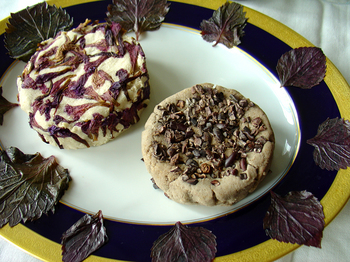
On the left, homemade pine nut paté with borage flowers. One the right, walnut paté with raw cocoa nibs. Normally this sort of food preparation is reserved for vegans, hippies and raw foodists. I am none of the above, a red-blooded porkatarian, I am. One of my readers disclosed that she thought that I was a man until a friend told her differently!
Anywho, this year I became an enthousiast of slightly fermented nuts, and I know, that’s just plain faggy. Not that there’s anything wrong with that! The nut flavours are delicate and would certainly go well with dairy cheeses. Note how I didn’t say, ‘real’ cheese?
(The leaves at plate’s edge are rose and mirin pickled shiso or perilla.)
To make these cheeses, follow the recipe for cashew cheese here, and substitute pine nuts or walnuts for cashews. Do not omit the sea salt, but do leave out the kimchi juice. Kimchi juice will make the cheese really cheesy - and these cheeses deserve to be a little sweeter than that. Instead, add a few glugs of maple syrup or a slab of honeycomb whilst blending.
Posted by debra at 12:06 PM | post to del.icio.us
Catchy, but not contagious
June 23, 2006
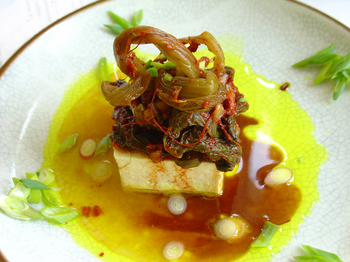
It was recently revealed in an offical report out of the Kimchi Nation that there are exactlly one zillion sorts of kimchi. Kimchi is a falsely generic term for the Korean national pickle and katchi is the mustard green variety pictured here.
Catchy Tofu
recipe described vertically, from bottom to top:
a puddle of saffron oil
stray scallions, strewn about
a block of fresh tofu
a stack of katchi
a drizzle of nama shoyu
Stack the ingredients voluptuously. Leak a few drizzles of nama shoyu over the lot until it starts to pool at the base of the tofu.
Serve.
- culiblog reports on the kimchi air conditioner
- culiblog recipe for kimchi comfort food
- culiblog recipe for kimchi monkfish en papillot
Posted by debra at 03:12 AM | post to del.icio.us
A midsummer garden dinner at Marlein's
June 20, 2006
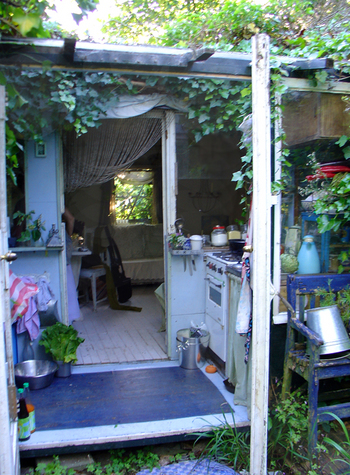 Marlein's tuinhuis rhymes with town house but means garden house or cottage
On an island between the Amsterdam-Rhine Canal and the IJ inland shipping lands, sandwiched between harbours, dubious car re-painting garages and tucked under a freeway flyover, there is a hidden paradise that I was totally unaware existed until last Saturday, when Marlein invited me to dinner at her garden house. It hadn't occured to me that in the midst of all this bustle and crud that there could be a place of such lush beauty and serenity, a place where nature takes over and you can't imagine or even glimpse anything but the burgeoning surrounds that envelop you.
Marlein's tuinhuis rhymes with town house but means garden house or cottage
On an island between the Amsterdam-Rhine Canal and the IJ inland shipping lands, sandwiched between harbours, dubious car re-painting garages and tucked under a freeway flyover, there is a hidden paradise that I was totally unaware existed until last Saturday, when Marlein invited me to dinner at her garden house. It hadn't occured to me that in the midst of all this bustle and crud that there could be a place of such lush beauty and serenity, a place where nature takes over and you can't imagine or even glimpse anything but the burgeoning surrounds that envelop you.
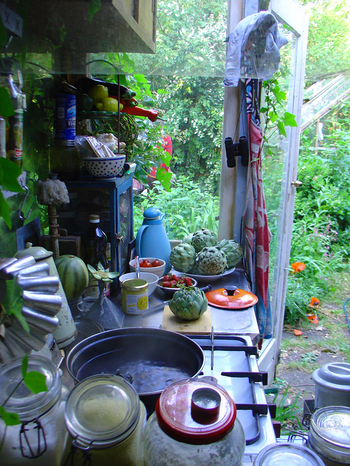 View from inside the indoor-outdoor kitchen to the front garden
Marlein, Joost and I lazily drank mint tea with saffron sugar crystals, chitchatting, enjoying the evening light. Magically Marlein produced dinner and we supped on greens and succulent things, sort of lowish on the food chain.
View from inside the indoor-outdoor kitchen to the front garden
Marlein, Joost and I lazily drank mint tea with saffron sugar crystals, chitchatting, enjoying the evening light. Magically Marlein produced dinner and we supped on greens and succulent things, sort of lowish on the food chain.
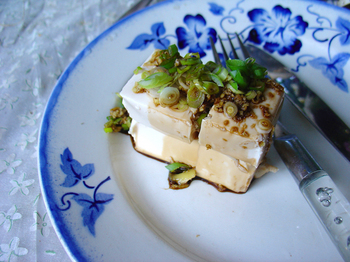 Silken tofu with spring onions and drizzled with nama shoyu is an elegant start to our dinner
It stays light until almost eleven!
Silken tofu with spring onions and drizzled with nama shoyu is an elegant start to our dinner
It stays light until almost eleven!
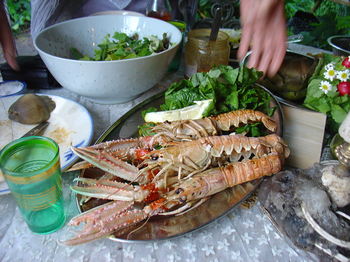 When the water insects arrived, we sucked them inside out.
And when it got too dark and a little bit chilly, we retired to the great indoors for a dessert of elder flower tempura dusted with powdered sugar, chocolate, dates and Pakistani burfi.
When the water insects arrived, we sucked them inside out.
And when it got too dark and a little bit chilly, we retired to the great indoors for a dessert of elder flower tempura dusted with powdered sugar, chocolate, dates and Pakistani burfi.
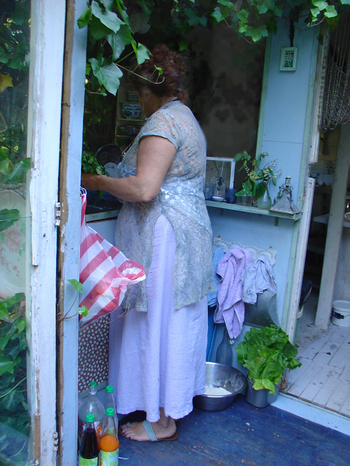 This sort of garden house is typical of the Dutch style allotments, although usually these locations have long socialist histories and are highly regulated, Marlein's garden is in a non-sanctioned area, and unfortunately one that will be devoured by a land development project starting in 2008. Pick your battles, there two full summers to enjoy before Marlein and her garden neighbours find the next fabulous and secret place.
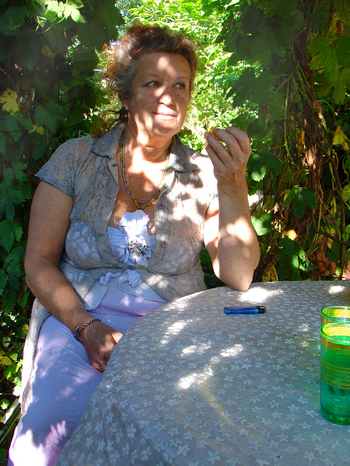 Lady Marlein
Posted by debra at 01:24 PM | post to del.icio.us
Spring cabbage and cashew cheese terrine, not just
(but also)
for raw food freaks,
vegans and hippies
June 17, 2006
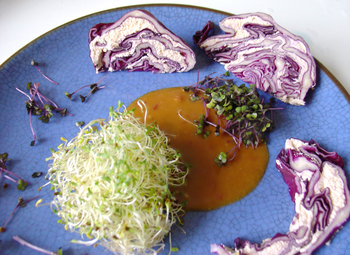
Not counting nut loaf and enema, does an uglier word exist than cashew cheese? Overexposure to Cheech and Chong while growing up has affected my sensibilities such that I can't even hear the word loaf without chuckling silently like an eleven year old. And the word cashew cheese makes me think of all the cheeses we produce with our very own bodies. I know, I'm immature. Still.
The cashew hummus recipe (mo better?) I'm working on is finally getting really cheeesy thanks to the discovery that you can ferment anything if you just forget about it long enough. Last batch I let the cashews grow a sentient microbial film that was capable of speaking short sentences in Esperanto. Then I rinsed them, (tasted them to see if they were palatable, kaj lo kaj rigard and turned them into... cheese. That's what you get for learning Esperanto. Cashew fromaĝo estas ni! (Cashew cheese is us!)
Cut the cabbage in half, remove the core (and toss that into the chipper-shredder that is my mouth), spread layers of the cashew in between the leaves, put the cabbage back together, smoosh and slice. My kind of recipe. Are young cabbages looser than old cabbages? Are cabbages like me? Look for a 'loose' cabbage.
The puddle is a dressing made with miso, sesame oil, rice wine vinegar, sambal djeroek and a dash of maple syrup. Not a local ingredient in the lot, though I'm preparing for a career in miso making when I'm in my 80's to compensate. Seriously.
Posted by debra at 05:10 PM | post to del.icio.us
Let farmers be bygones
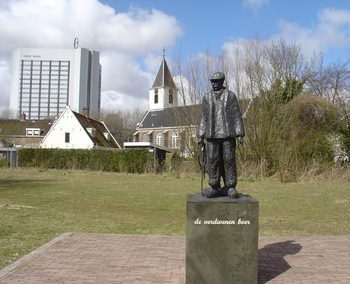
Let bygones be farmers? On the other side of my neighbourhood park there is a monument in honour of the 'lost farmer', farmers lost to change. The text on the back of the pedestal says, The Bygone Farmer by artist Henk Gomes commemorates the farmers that for thousands of years lived and worked in the fens to the west of Amsterdam's city limits. Until the 1950's this was the border between city and the country. In the 2nd half of the 20th century this border was pushed back to the peripheral waterway beyond the Haarlemmermeer.
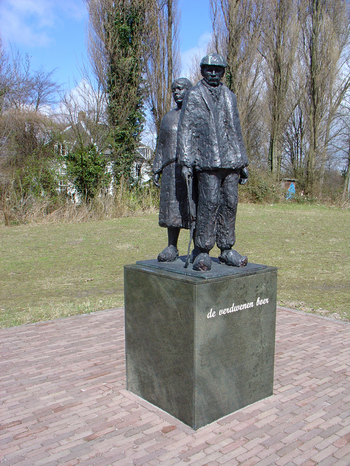
The placement of this statue has been made possible by funding from private donations and with donations from the Amsterdam borrough of Bos en Lommer, the Amsterdam Foundation for Visual Arts, the Amsterdam Rabobank and also the Foundation for the Bygone Farmer.
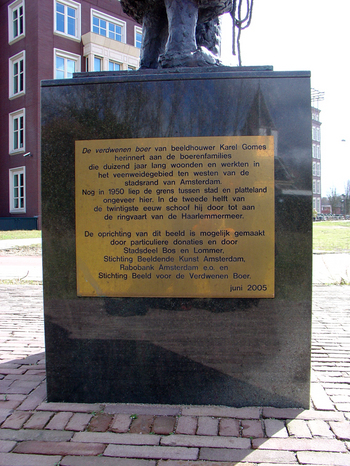
The task of translating the Dutch verb verdwenen has been preventing me from writing this entry since I took these pictures back in April. Verdwenen can mean a lot of things, and none of which sound particularly as poetic in English as Verdwenen Boer does in Dutch.
Lost,
extinct,
vanished,
disappeared.
They used to be here.
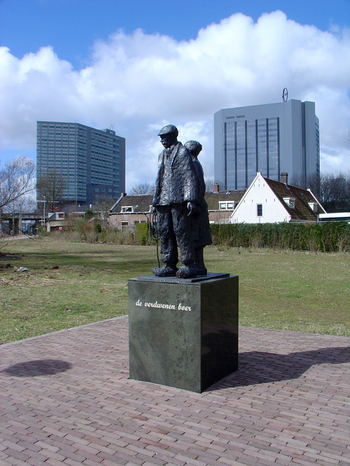
Nice that the artist included the boerin in the actual sculpture, although he left her out of the title. In Dutch, the female farmer has her own word. Maybe Gomes was using the term boer as a general term.
Speaking of Dutch public art commissions, check out the iron line drawing on top of the tax building.
Posted by debra at 06:48 AM | post to del.icio.us
Master cleanser, for juice fasters and thirsty people
June 14, 2006
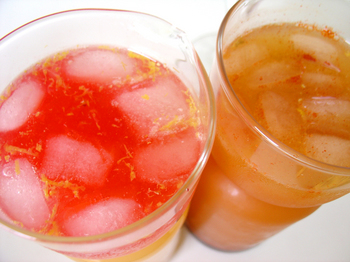
If you just think of this as lemonade, you might actually drink it. Master cleanser is the unfortunate name for a cayenne-spiked ginger lemonade, sweetened with maple syrup and sprinkled with sea salt. When you fast or do sports or simply exist in warm weather, it's wise to drink liquids that don't make you pee immediately. Most softdrinks, alcoholic drinks and all caffeinated liquids do this, removing the benefit of drinking for the purpose of hydration in the first place.
In this lemonade, the maple syrup and the fleur de sel allow the liquid to hydrate the body more thoroughy than if they weren't part of the mix. As a master cleanser, the cayenne and ginger are vasodialators and gently invigorate the gut.
If you're fasting, Master Cleanser is the sort of drink that you take with you and sip throughout the day. But if you just want a refreshing summer drink, call this Super Spicy Lemonade or rosé and do the exact same thing. You can even pretend you're fasting and be holier-than-thou, always a refreshing feeling and one of the least mentioned benefits of juice fasting.
Picture recipe after the jump.
Please read more... "Master cleanser, for juice fasters and thirsty people"
Posted by debra at 04:49 PM | post to del.icio.us
Juice fasting recipes, start with forgotten vegetables and then forget them again
June 13, 2006
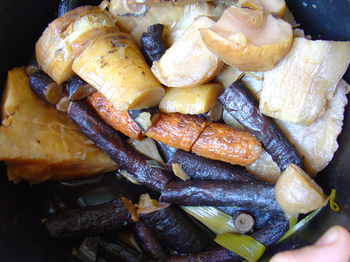
I'm the kind of gal that likes to pad her New Year's resolutions with seemingly achievable ambitions like, 'Improve handwriting' and 'Find ways to enjoy ancient root vegetables', but 5 months into the year, I haven't exactly achieved success in integrating parsnips and burdock into my winter diet in any significant way. When I returned home from Saturday's farmers' market loaded with fresh ingredients for a 5-day juice fast, I was confronted with a fridge half-full with ancient burdock, celeriac, carrots, parsnips, and a window sill of dried apples. The produce was definitely local, but in the course of some hecticity the past few months, had inadvertently become non-seasonal. I had created forgotten vegetables.
In the spirit of 'once a year whether you need it or not', I set to thoroughly cleaning out the fridge to make room for the new arrivals. Oddly, the pile of veg that didn't make the cut consisted predominantly of root veg, species hardy enough to survive extreme neglect. Not wanting to waste not, I gave the ancient grub a scrub and placed it in a large pot of water a'simmering over a low flame. Re-visiting the theme of forgotten vegetables, I simply forgot these vegetables anew. When every now and again I happened to remember them in the course of the next day, I just added some water or annointed them with a pinch of sea salt. I didn't even stir.
Yesterday I poured off the liquid, which left to its own devices had transformed itself into an aromatic vegetable bouillon, so delicious that VN and I felt positively blessed drinking it chilled from gold-rimmed shot glasses. Although I am not certain as to the nutritional value of this drink, I am certain that the initial slow-aging of the vegetables and the slow-drying of the apples is the reason that it ended up so flavourful. If you aren't forgetful, you could probably achieve this self-same result with fresh vegetables and a dehydrator, reducing the simmering time to boot. But I prefer to forget and let the soup just make itself.
Forgotten vegetable bouillon
2 kilos of mixed root vegetables; celeriac, parsnips, burdock, carrot)
4 wrinkly old apples, not rotten, just wrinkly and old
1 leek, very old but not rotten
big 'ol pinch of the sea salt
water straight out of the tap
Give the veg and fruit a good scrubbing. If it has been in the fridge for a few months, it really needs it. By the by, leaving the dirt on root veg (and even storing it in sand) keeps it fresher longer. That said, it's the optimism of washing off the dirt that caused these vegetables to dry so perfectly in the fridge over several months time that they retained all of their sugars.
Cut the root veg and apples with skin an all in a large pot filled to the brim with cold water and a big pinch of sea salt. Put the flame on low and if you must, cover the pot no more than half-way. Every four hours check to see what's going on, you may need to add water if you've evaporated too much. After at least two times of adding water and letting simmer, turn off the flame and let the liquid cool, lid off. Pour off the bouillon and use it as vegetable stock or as an ingredient in a root vegetable stock cocktail.
Posted by debra at 11:08 AM | post to del.icio.us
CPULs
when bad acronyms
happen to good people
June 09, 2006
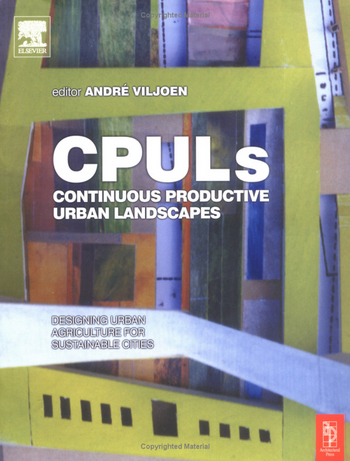
It's pronounced 'SEE, PULSE' and stands for Continous Productive Urban Landscapes. Architects Viljoen, Bohn and Howe's postively radical notion of combining productive urban landscapes with continuous landscapes, proposes a new urban design strategy that would change the appearance of contemporary cities towards an unprecedented naturalism. Think urban agriculture, allotment gardens, increased biodiversity, decreased carbon emissions and strategically connected green space - and you will start to get an idea of what the authors are suggesting. Although this is in no way within the scope of the book, never have I encountered a more holistic approach to urban planning that so thoroughly takes into account our imminent plunge into energy descent and the extreme effect that this will have on our food supply.
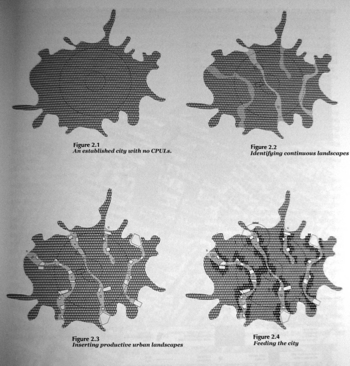
Diagrams showing a projected development of CPULs © Bohn & Viljoen Architects, reformatted for culiblog and used entirely without permission
Despite sporting a singularly unsexy title and a graphic design utterly devoid of charm, CPULs is a compelling vision for urban planners and (landscape) architects. The book is loaded with truly useful facts and case studies yet somehow remains a rivetting read for layfolk, comme moi. The authors were wise enough to begin the book with a succinct glossary defining all of the concepts so that within five pages you're already an adept at juggling terminology like vertical and horizontal intensification and you know the difference between an organiponico and a heurto intensivo.
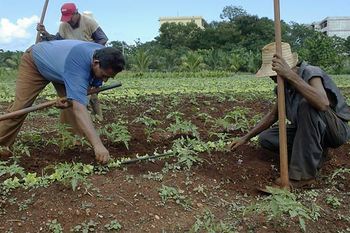
According to people who are in a position to compare, CPULs offers a rich documentation of UK allotment history and vivid reports of successful urban agriculture in contemporary Cuba, one of the few countries to have yet experienced peak oil. In 1990 when Cuba stopped receiving cheap juice from the Mothership and subsequently lost its largest client for agricultural produce, Havana citizens suddenly found themselves without access to sufficient food as expressed in 30% fewer calories in their diet! Instead of engaging in some futile rioting, they took up gardening en masse, and by gardening, I mean organic gardening. Later the government jumped on the bandwagon and started facilitating the urban agricultural effort in the form of responsible planning and infrastructure development. Presently Cuba is considered to be a living laboratory of how small urban farms and gardening collectives can successfully provide a significant portion of the urban food supply in spite of energy descent. Listen up, everybody! The CPULs authors were enlightened enough to note that a population accustomed to collectivism is more likely to be successful at community projects and that Northern European urban agricultural initiatives of the future will need to develop a native form to ensure their success.
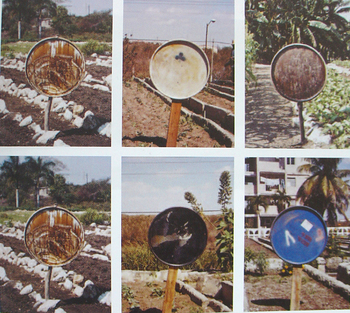
Oil drum lids used as markers in Havana organiponicos. Photos by Tom Phillips from CPULs used entirely without permission
CPULs' authors articulate the benefits and obstacles to their proposal and offer cogent strategies for creating city land use policy in which urban green and brown are treated as productive space, considering the unbuilt as an event of equal intensity as the built. A vision of a thriving CPULs in London 2045 provides a powerful scenario that I can imagine myself being a part of at any stage in my life. This is something I would not characterise as a common feature in most urban planning. In CPULs city planning the well-being of people is a central and distinguishing factor. In fact, its completely seductive.

A map of London expanded to accomodate mini- and SUPER-market gardens, from a 1998 study © Viljoen and Bohn Architects, photographed from the book and used entirely without permission
Robert Hopkins from Transition Culture weblog notes, 'It is only in the last 30 or so years that we have perfected the art of creating totally useless landscapes. New industrial estates and business parks typify this, planted with 'low maintenance' shrubs, specifically bred to be entirely unproductive.' Bohn and Viljoen point out that though European cities have planned for a variety of approaches to open space including urban parks, urban river fronts, urban squares, urban stages, urban forests and urban beaches, there are as yet no urban fields. 'Living and growing food in the contemporary urban space, CPULs could formally be similar to urban parks.' I am inspired by the notion that landscape architecture could be pivotal in designing for a future in which peak oil will have tremendous impact on the urban food supply.
As someone who writes about food and culture and as an an art and design educator, I cannot recommend this book highly enough. I hope that its concepts are embraced by those who are in a position to implement urban planning of this nature. The notion of CPULS deserves to feature prominently in design and architecture curricula, informing a new generation of people designing our cities and potentially our well-being through our access to healthy food.
CPULs do not yet exist.
In type, they will be new,
in type they will be productive.
See, pulse, with a silent meow at the end.
- Continuous Productive Urban Landscapes. Designing Urban Agriculture for Sustainable Cities. Andre Viljoen (ed) 2005. Architectural Press
- Biography of Andre Viljoen at the Royal Institute of British Architects website
- Robert Hopkins' brilliant Transition Culture review of CPULs. The review also questions why Viljoen doesn't use the term permaculture when the ideas in this book are so clearly informed by it. Hopkins points out that THIS book is exactly where permaculture needs to be. Although CPULs author Graeme Sherriff addresses permaculture rather thoroughly in Chapter 22 (Permaculture and Prodcutive Urban Landscapes) I can imagine that editor Viljoen felt a need for a new definition (and therefore produced that unfortunate acronym) because the notion of permaculture does not specifically address urban planning and land use policy.
- Permaculture according to Wikipedia
- Permaculture according to CPULs authors - quoting Robert Hopkins!: 'Permaculture has evolved into a system for the conscious design of sustainable productive systems which integrate housing, people, plants, energy and water with sustainable financial and political structures.' (Robert Hopkins, 2000, p.203)
- CPULs according to wikipedia. Oh how odd, there is as of yet no entry.
- Energy descent
- James Howard Kunstler, author of the Long Emergency
- Eat the suburbs - an Energy Descent Primer
- Some of the more positive aspects of peak oil:
Healthier food
More active lifestyles
Greater self-reliance
A sense of connection to place and products
The re-emergence of local identity
An emphasis on quality over quantity
A means of overcoming addictive behaviours such as over-consumption - Permaculture Activist, the magazine - excellent read!
- Energy Descent Primer
- An MP3 of permaculture 'proponent' David Holmgren lecturing on permaculture and peak oil
- Robert Newman's History of Oil (stand-up comedy) on Google Video. Hilarious and not-so-hilarious at the same time.
Posted by debra at 01:51 PM | post to del.icio.us
Here as the Centre of the World, in terms of food
June 03, 2006
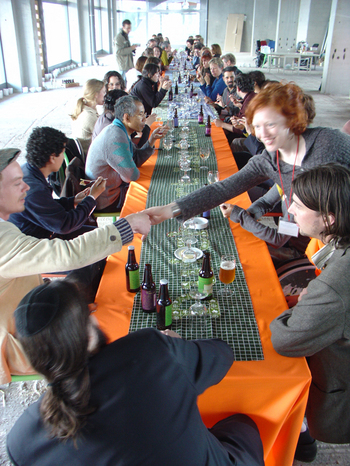
Here as the Centre of the World banquet with local food from Twente and Overijssel. Guests getting giggly on the bubbly.
A week and a half ago, my colleagues and I at the Dutch Art Institute (DAI), were in the throes of an international symposium on 'all things periferal' for artists and mediators. Illustrious guests from Overijssel and the 'rest of the world' were invited to discuss this (contemporary art) subject for two solid days in the Rijksmuseum Twenthe. Early in planning phase of this event, I decided that the symposium would be more coherent if, during the the event, we attempted to eat food grown and produced from within the province, a Twente tasting menu. In a huge gesture of over-confidence, I took upon myself the task of organising the symposium's food side, in particular a sit-down banquet for fifty, on the 23rd of May. All of the food for the banquet and incidental feedings would come from within the province of Overijssel, within a 60 kilometre radius of the event epicentre.
- Here as the Centre of the World Banquet Menu
- fork -local pickled beet with smoked herring, and strips of rhubarb
spoon - turnip green mash with goat cheese
knife - lumps of bread - Kruudmoes: barley, buttermilk and fatback porridge served with ground up local greens including: ground elder (zevenblad), white deadnettle (dovenetel), kohlrabi leaves, applemint, spearmint, peppermint, curly leaf parsley, beet greens, spinach, sorrel and 'Roman' chervil
- Hangop served with caramel sauce and berry coulis
- Wines from the Hof van Twente Winery
- Meibok, Witbier, Vrouwe van gramsbergen and Blond beers from the Mommeriete Brewery
Please read more... "Here as the Centre of the World, in terms of food"
Posted by debra at 02:35 PM | post to del.icio.us


