


Restaurant for anorexics
May 5, 2005
Sehnsucht, (means longing in German) is the name of a Berlin restaurant for anorexics. Owner Katja Eichbaum, formely anorexic, started this project with private funding (only her father would lend her money) as a therapy for her own condition. The chef is anorexic as are several members of staff. Sehnsucht’s menu items have names that don’t include words for food to avoid confronting anorexics with the fact that they are about to eat. ‘Hallo’ (lobster bisque), ‘Pirate’s Eye’ (2 fishfingers and a fried egg), and ‘Heissehunger’ (ravenous hunger = rack of lamb) are all dishes that non-anorexics might order in ‘normal’ restaurants. But one item on the menu consists simply of a fork, knife, and an empty plate. It is titled ‘Thieves Platter’ and facilitates the anorexic diner to steal (or share) from those dining with her.
As expected the restaurant has received a huge amount of international publicity. And although I have not yet eaten at there, relying solely on restaurant reviews to inform myself, if Sehnsucht is an attempt to create a location for anorexia patients in the guise of a regular restaurant for the people that love them, it is also a wasted opportunity.
Why not revel in anorexia? Why not serve food items so refined and ’stretched’ like anorexics themselves create on the spot each night at the family dinner table? Anorexics are master chefs and food stylists when placed in the harsh context of the family; hardboiled eggs with the yolks surgically removed, crackers deconstructed so that their total surface area has been increased twenty-fold, slices of bread with each visible grain extracted and displayed on the edge of the plate, utterly dissected broccoli. I say this without having seen Sehnsucht’s menu but hope sincerely that it is not just another do-gooder resto in which the real food on the menu functions only to lure the paying and eating guests.
(Please read more… )
debra at 8:38 | Comments (12) | post to del.icio.us
Far away is the new *onrein
May 3, 2005
Maybe it comes from the fact that I’m reading up on dietary law combined with reading John Thackara’s book, In the Bubble about sustainability and design, but I’m starting to wonder if distance is the new unkosher. In Patrick Faas’ Volkskrant article titled, The prophet Mohammed’s favourite dish, (18.02.1997) about Islam’s flexible standpoint on whether one may eat ostrich and camel, I couldn’t help but wrinkle up my nose at the thought of ostrich farms far far away and poor slabs of beef having to travel first by air and then by freight truck to get to the supermarket and then our tables. According to In the Bubble we spend more time transporting ourselves to our grocery shopping than actually doing our grocery shopping. And I don’t want to bring down any wrath upon myself, but it seems that a lot of religious dietary law is based upon cultural food preferences and taboos rather than hygiene. Proof? Both Jewish and Islamic law are quite arbitrary about which foods are considered clean and unclean. I can’t help but wonder why in this day and age hygiene should have preference over sustainability when it comes to dietary law.
*Onrein means unclean in Dutch, unclean in the religious sense of the word.
debra at 5:59 | Comments (1) | post to del.icio.us
Hors d’oeuvre of affliction
April 27, 2005
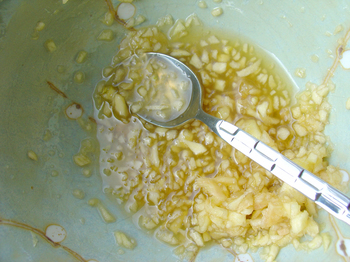
Some years ago a friend of mine waxing rabbinic told me that during Pesach week, whilst eating charoset one must never say, ‘Mmmmm, I love charoset!”, because charoset, a delicious mixture of apples, honey, and/or nuts, dates figs, symbolises the mortar used by slaves to build the buildings of the fill in the blank here, and don’t take things too literally, you!
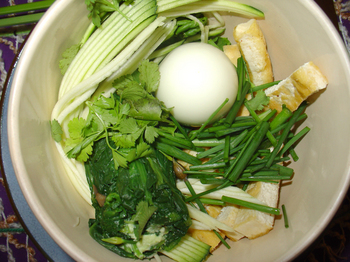
That sounded like a quirky but plausible Jewiish behaviourism to me and I decided to incorporate it into my narrative.
Yesterday evening, two friends of mine from Kampala were back in the Heimatt and fortune placed them at my dinner table. Oddly I didn’t feel much like cooking when I wrenched myself away from my work at 19h and I don’t know how I did, but I did somehow manage to slap something together for us to eat. It just wasn’t me not to want to cook for dear friends and somehow I convinced myself that it was OK to serve a ritual combination of matzah, charoset and bitter herbs (horseradish) as an hors d’oeuvre!
I show Alice and Lee how to do like the Jews do, make a little sandwich by piling the charoset and bitter herbs onto the matzah, how you take enough horseradish so that it causes you to shed at least one tear for the slaves that once were, for the slaves that still are, and finally, that even if you like the taste of the mixture, you’re not supposed to say so. Charoset stands for the mortar of the enslaved and we’re supposed to act like we hate it.
After the lengthy explanation I space out and Alice and Lee get to work making their own hors d’oeuvres with the materials provided, all the while telling me funny stories about the Amakula International Film Festival that they set up in Kampala last year. Alice takes a bite of her d’oeuvre, and with a pleading look on her face grasps her throat, pounds on her chest, shudders, starts looking frantically for her napkin as if she wants to spit in it, is barely able to swallow the mouthfull, slams her hand down hard on the table with a resounding BAM and pronounces, ‘YHhUCK!’
I am completely shocked. The combination of witnessing a cherished friend intensely dislike something that I’ve dished up, plus all the guilty feelings for not giving it my all earlier that evening, plus a little bit of wonderment thrown in because I’d never actually heard of someone not liking the ritual combination. It’s all just a bit too much. ‘What, you don’t like my cooking?’
Alice and Lee look at me with these puzzled looks on their faces and finally Alice musters, ‘But, didn’t you just say that…’
(Please read more… )
debra at 9:42 | Comments (10) | post to del.icio.us


