


Occupied Olive Tree Territories
December 10, 2005
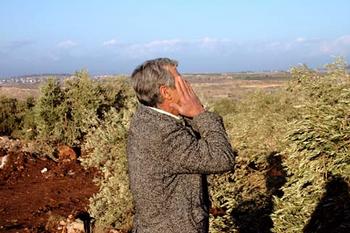
(A Palestinian farmer weeps at the bulldozing of his olive trees, photo by Gary Fields)
Because culiblog is a culinary weblog about food, food cultures, food as culture and so on, I feel obliged to breach the subject of olives, olive trees, olive tree culture, and olive trees as culture. In the past month I have seen Osama Qashoo’s documentary, My Dear Olive Tree, (at the IDFA), and Khalil Rabah’s installation piece (at the 9th International Istanbul Biennale), the Palestinian Museum of Natural History and Humankind. The olive tree as a symbol of Palestinian identity is used in both Rabah’s and Qashoo’s work.
Osama Qashoo is a recently exiled Palestinian film maker living and working in the UK. My Dear Olive Tree is his documentation of the destruction of the olive tree that he tended since childhood. The film depicts Qashoo as he witnesses the demolition of his olive tree and surrounding olive orchard, his own unwilling journey from Palestine to London, where he is reunited with a residual form of his dear olive tree on sale in an airport gift shop. At the beginning of the film Qashoo warns us that this is the last time he will see the olive tree, one tree of an entire grove in the Occupied Territories, a grove that sustained more than twenty families for generations with income from the olive oil.
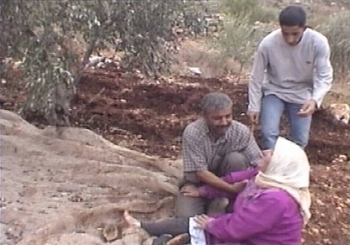
still from My Dear Olive Tree, courtesy of Osama Qashoo
The eighteen-minute documentary shifts swiftly from registering the small community’s warm familial bond with the land, to an extremely tense situation in which Israeli Army bulldozers move in to uproot the olive trees. The film shows Palestinian women in a state of utter hysteria as they are forced to bear witness to an act nothing short of an amputation. The film ends with a visit to an airport gift shop presumably en route to the UK, where, in some twisted form of fundraising, olive wood pendants cut into peace doves are being sold. Filmmaker Qashoo buys one of the trinkets and in the mean time the audience seems to have scratched deep grooves into the arm rests of their seats.
Khalil Rabah is an internationally acclaimed artist working in the field of conceptual art, installation and performance. Together with Zvi Goldstein he was the recipient of the Lennon-Oko Grant for Peace in 2003. His work reminds me quite strongly of the Neue Slovenische Kunst style of re-claiming and re-writing one’s own history with regard to cultural identity. Rabah’s Palestine before Palestine museum exhibit uses the olive tree and the installation-form to parody the history-writing effect that such a museum institution wields by its very presence. Rabah embeds the present-day context of Palestine and Palestinian identity within the context of a natural history museum, by describing the entire natural world in terms of the (occupied) olive tree.
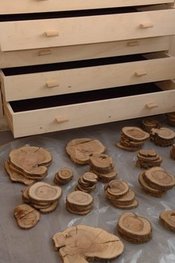
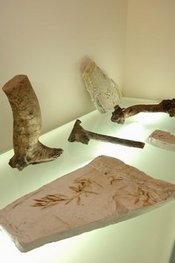
In typical museum-style, the Palestinian Museum of Natural History and Humankind (PMNHH) opens cans of experts, declares facts and exhibits it’s acquisitions policy, manifest in projects such as the 3rd Annual Wall Zone Sale, an auction which took place at the Khalil Sakakini Cultural Centre in Ramallah in March of 2004. By auctioning off lots of material from around the wall zone, artist Rabah lobbied awareness of the social and ecological implications of the ~670km West Bank Barrier that Israel is currently building. The PMNHH also has a cafĂ© and a giftshop, complete with very helpful attendents ready and waiting to attend. But when one asks in all earnestness for a cup of tea, or if there is something to buy in the giftshop, the attendant just shakes her head and smiles. ‘Sorry, we have nothing to sell.’
(Please read more… )
debra at 19:03 | Comments (11) | post to del.icio.us
Culiblog nominated in Gridskipper’s weblog awards
November 30, 2005
How cool is it that I regularly read all of my competitors!
debra at 18:01 | No comments | post to del.icio.us
And the answer is… community supported agriculture
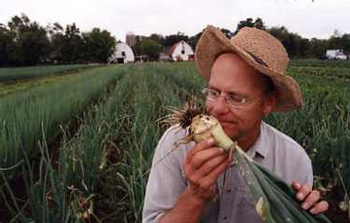
image courtesy of the Real Dirt on Farmer John website
Well, at least that is one of the most positive answers to the questions that came to my mind after watching Erwin Wagenhofer’s We Feed the World (Austria 2005) Saturday night at the IDFA. Although reviews and film descriptions already abound, here’s culiblog’s quick take on the films The Real Dirt on Farmer John, We Feed the World and Bullshit.
Context is everything, although this hadn’t occurred to me weeks ago when I reserved my tickets for the IDFA and Shadow Festivals. It was pure coincidence that I chose Taggert Siegel’s The Real Dirt on Farmer John (US 2005) instead of We Feed the World as my first IDFA film. But the documentary about John Peterson (I heart him) is such a poignant portrayal of his pursuit of agricultural viability on a very personal level, that the film armed me with an outlook positive enough to take on the eloquent doom and gloom of the other documentaries. I wish my fellow audience members had been so lucky, because their anger and disillusionment about the realities sketched in Wagenhofer’s, We Feed the World and even Holmquist’s Bullshit was palpable.
debra at 11:17 | Comments (2) | post to del.icio.us


