







Let the future begin, kimchi air conditioner is here
February 15, 2006
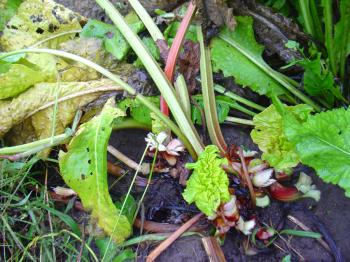
Romantic kimchi photo courtesy of “Do the Bart” Charlotte Yong San Gullach
Kimchi is pickled cabbage (or radish or mustard leaf or…) and I feel quite comfortable in reporting that it is one of the top five most delicious things you can put in your mouth. It is Gawd’s own comfort food, made with generous amounts of fresh garlic, ginger and red peppers, it is crazy healthy. So healthy, that an entire nation and a large population of several other nations believe that kimchi can prevent illness. I belong to one of those nations. Kimchi Nation. Kimchi also has a farty smell, but regular culiblog readers know that I just live for that.
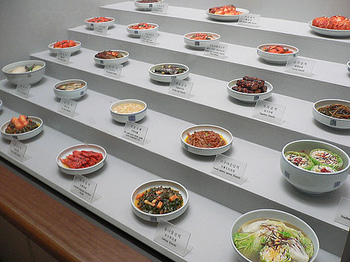
Museum of Kimchi photo courtesy of NihaoGirl
And if all that weren’t reason enough to get a leg up on the kimchi altar, apparently kimchi can also kill the avian flu virus H5N1 and is soon to be used in the manufacture of air conditioners. No Fred, not hair conditioners, AIR conditioners.
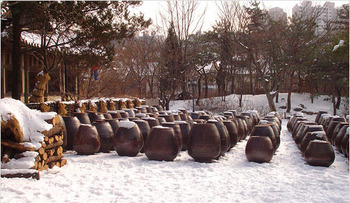
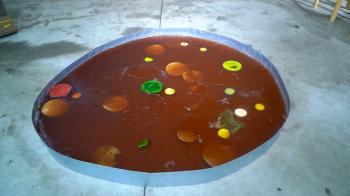
Snowy vats of kimchi fermenting in the park courtesy of Polish Sausage Queen
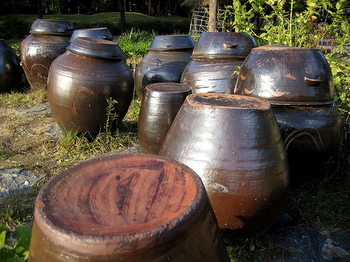
Kimchi pots in the public space by Bryan Hughes
Unfortunately the air conditioners will use only the enzyme from the kimchi and will not transmit its smell. This is a mistake waiting to happen and I would like to urge you to get on the horn immédiatement to let LG Electronics know how wrong that would be.
Thank you Willem for this culi tip. You know I love the kimchi.
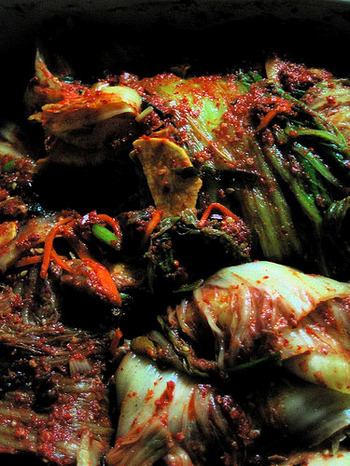
A list of links to images and air condioner manufacturers for Kimchi researchers and cultural activists.
- culiblog writes about kimchi
- Reuters on the Kimchi air conditioner
- Flickr kimchi tag
- LG Electronics online contact form in Dutch
- Romantic kimchi photo courtesy of “Do the Bart” Charlotte Yong San Gullach
- Museum of Kimchi photo courtesy of NihaoGirl
- Snowy vats of kimchi fermenting in the park courtesy of Polish Sausage Queen
- Kimchi pots in the public space by Bryan Hughes
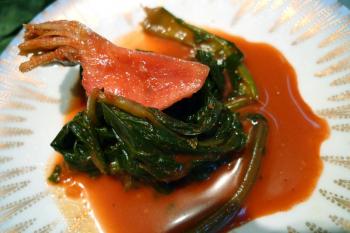
- Glamour shot of kimchi courtesy of a person with wonderful photographic skills and whose name I cannot read because it is written in Korean
technorati tags: kimchi, avianflu, South Korea
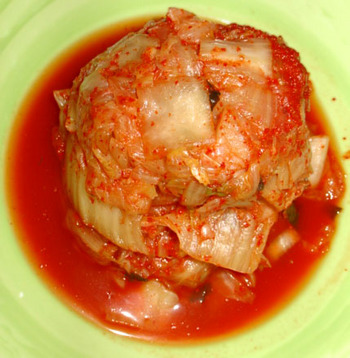
Kimchi, the comfort food of the gawds courtesy of culiblog
debra at 23:58 | Comments (10) | post to del.icio.us
When fish fall in love
February 13, 2006
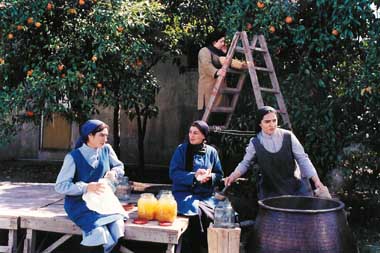
film still from When Fish Fall in Love, shows main character Atieh, her daughter and sisters preparing orange syrup in the garden. Image used without permission
When it comes to food-related film, I couldn’t have made a better start at the Rotterdam International Film Festival. Drawing Restraint 9 had me reeling for days. Good for Drawing Restraint, bad for all the others that I saw directly afterwards. I had all but given up hope for finding a new approach to the genre, when I went to see the last film on my list.
When Fish Fall in Love saved me from being mired in bourgeois feel-good movies, films that are little more than romantic comedies with chefs and kitchens, gratuitous food porn, films that make audiences twitter at the thought of eating bull’s testicles. Fish Fall in Love is Iranian theatre director Ali Raffi’i’s first feature about two lovers being reunited after a twenty-year separation, and a new generation of about-to-be lovers, about to be separated.
Ex-political prisoner and Iranian émigré Aziz returns to his home at a Caspian Sea coastal village, where he finds that his former beloved Atieh, her daughter and two sisters have appropriated his family home and turned it into a restaurant. The film is shot like an old postcard from your grandparents’ seaside holiday, complete with long images of regional specialities. In this film, no dish leaves the kitchen without making a cameo. Can you imagine jewelled rice doing the red-carpet walk at Cannes?
Ali Raffi’i spoke to the audience before the screening, explaining that this film was about the difference between the way his and the generation now in their twenties, express love for one another. His intricately developed characters convey the complicated situation of a generation (Aziz and Atieh) whose political passion (may have necessarily) precedes their passion for each other. This contrasts sharply with the generation of Atieh’s daughter Touka and her Teheran beloved Reza, who are even driven to criminal acts in the hope of supporting their love.
Admirably, Raffi’i endeavoured to show a different view of woman than what he described as ‘ordinarily portrayed in Iranian cinema’; a woman whose destiny is not dependent on the presence or hope for presence of a man in her life. Not being sufficiently familiar with Iranian cinema to judge, I had to think, ‘Heq, come on over here, that’s a hole in the market!’ Until now, the art installation videos of Shirin Neshat and the British documentary filmmaker Kim Longinotto’s Divorce Iranian Style were until now, my sole influences.
While Atieh is a strong character, supporting her daughter, two of her sisters and herself by running a small restaurant, she is also always really nervous about this role. Preparing lunch and dinner for only twenty, though she’s been doing it for years, seems to be a monumental feat for her. Among the many kitchen shots of brilliantly presented ‘home-style’ cooking, the viewer is treated to beads of sweat on noses and upper lips, the wiping off of sweat from brows and the drenched backs of clothing. I’m thinking, ‘Sister, what you need is a smaller menu.’ But Atieh’s unwieldy menu seems to represent traditional culture and her uncomfortable relationship with it.
The film’s ending is deliciously open, giving few clues as to how Aziz and Atieh will give shape to their deep love and respect for one another in the future.This combined with Raffi’i’s rich characters have given me room to identify completely with love’s consequences for Atieh and Aziz. All that I am willing to give away, is that there is a cottage involved. I know that the next time I make orange syrup, this film will be the first thing on my mind.
- Film review of When Fish Fall in Love on Teheran Avenue
- Iranian Food Photos on Flickr
- Film Festival Rotterdam entry about When Fish Fall in Love
- Forget Martha’s Vineyard, I’m going to Iran
- Women Make Movies on Kim Longinotto
- About Ali Rafi’i as a theatre director
technorati tags: International Film Festival Rotterdam, film, food-related film, cinema, Rotterdam, When Fish Fall in Love, Ali Rafi’i
debra at 14:01 | Comments (0) | post to del.icio.us
Food-related film at the Berlin International Film Festival
February 9, 2006

Pack up your yurt, we’re moving to the steppes of Berlin for a week, where it’s much colder than it was in Rotterdam, and where a yurt will come in handy. The craziness begins today at the Berlinale, the Berlin International Film Festival. Culiblog will be attending the madness for an entire week, from Saturday the 11th until the 19th, reporting on all food-related films and presentations.
This year there is a glut of food-related film because aside from the regular programme, food, hunger and taste are the subject of the Berlinale Talent Campus, a platform within the Berlinale festival. The Berlinale Talent Campus creates opportunities for young filmmakers to meet with les eminences grises from the film industry and the folks from the more active side of food and food culture as well. Alice Waters, Vandana Shiva, Carlo Petrini will all be there.
Once again, I’ve created a culiblog food-related film selection culled form the entire Berlinale programme for those willing to move beyond Babette’s Feast. Oh dear, it’s 2006 and they’re actually showing Babette’s Feast!
The culiblog selection at the the 56th International Berlinale Film Festival:
Saturday, 11.02.2006:
23:00: - Harvest (Regain), a Marcel Pagnol classic! (Manon de la Source)Sunday, 12.02.2006
18:00: - Berlin Talent Campus Screening - Food For Thought: Origins: Tom Luddy will present all 32 Talent short films on “Hunger, Food and Taste” in three sessions, beginning at 18:00. Today’s programme “Origins” will include eleven short films from seven different countries. In between the screenings, Tom Luddy will introduce the Talent directors and discuss their reflections on “Hunger, Food and Taste”.
10:30: - Eat and Shoot the Indie Way, presentation with a.o. Alice Waters, Angie Lam, Vandana Shiva and Slow Food’s Carlo Petrini
12:15: - Who Owns Life? Talk with Vandana Shiva and Renate Künast
16:30: - Talk with Peter Kubelka: Cooking as the Origin of Culture…
17:30: - One Way Boogie Woogie / 27 Years Later, James Benning
Monday, 13.02.2006
18:00: - Berlin Talent Campus Screening -
14:00: - The Case for Taste, lecture and screening of Nossiter’s Mondovino with Carlo Petrini a.o.
Food For Thought: Delicious Revolution: Today’s Food for Thought session is hosted by US-director Doug Hamilton. His film ALICE WATERS AND THE DELICIOUS REVOLUTION is a documentary about the ideas and ideals of natural food specialist Alice Waters, who has been practicing and sharing with the world her healthy and environmentally conscious principles for nearly thirty years. After the screening, director Doug Hamilton will answer questions.
20:30: - Mondovino, Jonathan NossiterTuesday, 14.02.2006
18:00: - Berlin Talent Campus Screening -
12:30: - Matthew Barney: No Restraint, Alison Chernick
18:00: - Berlin Talent Campus Screening - Food For Thought: “Kill or Die” is today’s screening of a new round of shorts from the Campus competition “Films on Hunger, Food and Taste”. Tom Luddy will present ten filmmakers from eight countries and talk about their cinematic stories about the relationship between food and death, about the often hidden fact that for some, eating means killing, and about food, fear and devotion.
18:45: - Drawing Restraint 9, Matthew Barney Wednesday, 15.02.2006
18:00: - Food For Thought: Lost Supper: A screening of the Berlinale Talent Campus films on “Hunger, Food and Taste” is dedicated to films that deal with hunger, starvation and poverty in the world. Eleven short film productions from eleven countries explore the unjust manner of food distribution in the world and the local effects of this problem. Tom Luddy will introduce all of this year’s Talent filmmakers and talk about their productions.Friday, 17.02.2006
18:15: - 37 Uses for a Dead Sheep, Ben HopkinsSaturday, 18.02.2006
14:30: - Happy as One, Vanessa Jopp
And what will I be doing in my mornings and on Wednesday and Thursday? Lolling about and slacking off? Why I’ll be re-viewing the thirty-two (32!) short films on food, hunger and taste at the Berlinale Talent Campus, chit-chatting with the directors, watching the odd non food-related film.
You’ll be needing these links as well:
- 56th Berlinale International Film Festival (programme search in English)
- Berlinale Talent Campus lineup of film on food, hunger and taste
- Berlinale Talent Campus (in English)
- Berlinale Talent Campus evening programme
- Berlinale Talent Campus lecture and presentation programme
- Slow Food and the Berlinale Talent Campus have teamed up. Here’s the blurb.
- Jonathan Nossiter’s Mondovino
- NYTimes film review of Marcel Pagnol’s classic from 1937, Harvest (Regain)
- Marcel Pagnol filmography on the IMdb
- James Benning interview by Danni Zuvela on the Senses of Cinema website
- James Benning’s filmography on Wikipedia
- Synopsis of Alison Chernick’s Matthew Barney: No Restraint
- Ben Hopkins, 37 Uses of a Dead Sheep
- A list of food-related films, compiled by Rebecca Epstein for Gastronomica. Her dissertation titled, “Crime and Nourishment”, focused on the food and foodways of Hollywood gangster films. Epstein’s list needs a good tweaking and I don’t agree with her about a lot of the titles, but it will serve us just fine for February.
- culiblog reviews Matthew Barney’s Drawing Restraint 9
technorati tags: Berlinale International Film Festival, film, food-related film, cinema, Berlin, Drawing Restraint, Matthew Barney
debra at 14:12 | Comments (6) | post to del.icio.us


