




Kitchen garden before Ice Saints
May 2, 2006
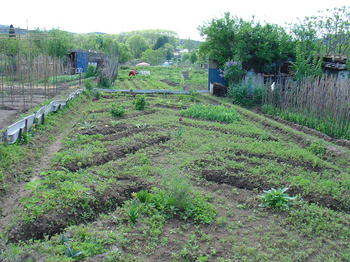
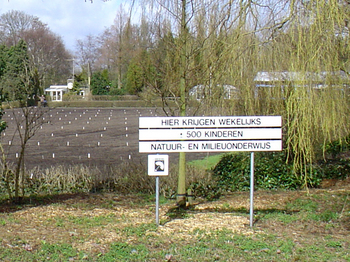
My kitchen garden on the 27th of April
Some people grow up with socialist folk songs, others grow up with Catholic weather knowledge. Until now, I’d never even heard about Ice Saints, but that was before I had a kitchen garden. Ice Saints refers to the 11th, 12th, and 13th May, the feast days of St. Mamertus, St. Pancras, and St. Gervais, purportedly the cut-off date for night frost. And the date after which you can start wearing cut-offs when you potter about with summer crops in the potager.
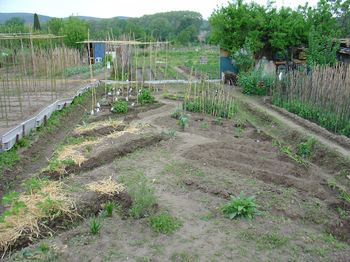
My kitchen garden on the 1st of May
Oddly, these May dates are the same from the Netherlands, way up in the Polar Circle, all the way down to Occitania. The cut-off town is Beziers, 100km from here, where its warmer and they have different days, different saints and they can grow meyer lemons outside. No cut-offs though.
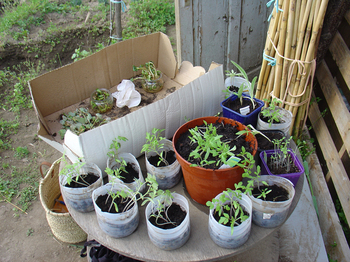
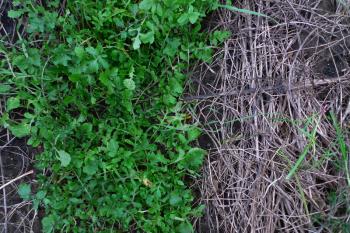
Tomato foetuses bracing themselves for a rigourous session of acclimatisation
I’m not having any of it, and even though it seems like Occitania lost a month of growing season this year due to the cooling effects of global warming, my sunflowers and lupines are growing visibly each day. But the men of the kitchen gardens are laughing at us Ladies-who-put-our-tomato-foetuses-out-early. Thursday, the gents will really split a gut watching me sow cantaloup, galia melon, cukes, luffah, gourds, pumpkins, spaghetti squash, courgette and watermelon into the bare naked ground. As a tribute to the Saints I’ll repurpose some plastic ice cream containers into little hot houses. See ya later Propagator.
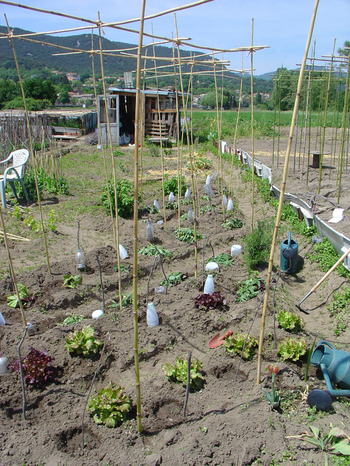
Lettuce and tomato section sorted
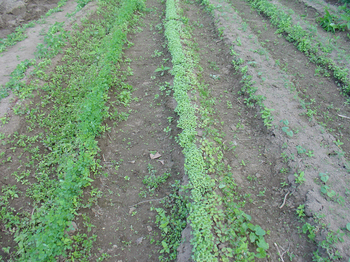
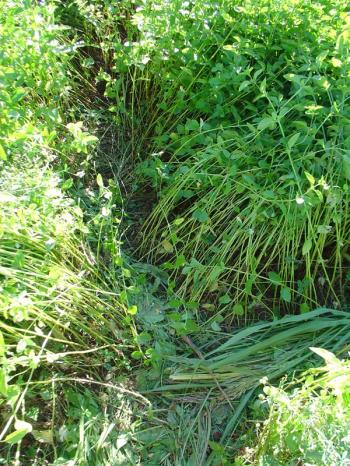
Covercrops before being plowed into seed beds
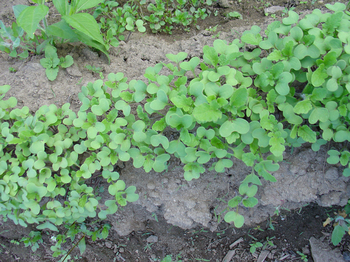
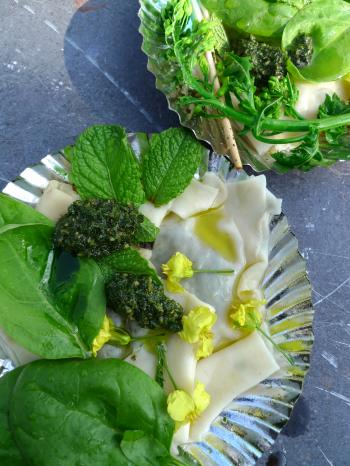
Mustard microsalad
- Dutch language Wikipedia article on Ice Saints
- English language snippet about Ice Saints. Odd, no Wikipedia article. Guess it’s up to me to at least translate for the free encyclopedia!
- Wikipedia (great article!) on Ice Saints in French. Just 100 kilometres from here there are different Ice Saints because the cut-off for night frost is two weeks earlier! Consolation for the fact that the folks living below Beziers can grow lemons is that they have a drier climate and don’t have clean river water flowing into their kitchen gardens.
debra at 13:49 | Comments (8) | post to del.icio.us
Street food waste = street food packaging
April 29, 2006
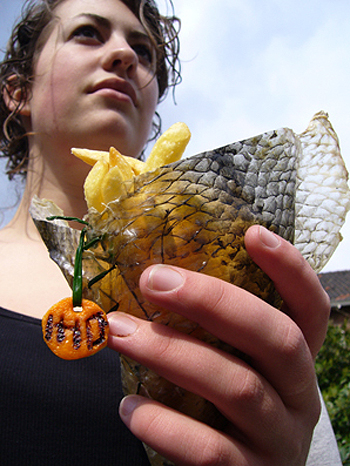
Fish and chips: image of street food packaging concept ‘IHO’, © Païvi Kovanen, Eva Arts and Caroline van Teeffelen 2006, used courtesy of the designers. Please respect student work, contact culiblog for updates.
(This is the second in a series of entries about the Street Food Workshop developed and conducted together with Katja Gruitjers for our students from the Design Academy Eindhoven and the HAS den Bosch.)
Just the simple fact of making street food creates tonnes of food waste. Students Païvi Kovanen, Eva Arts and Caroline van Teeffelen used food waste materials to develop packaging for street food. Katja and I were really impressed with their packaging concept IHO, which means skin in Finnish. Even mo’ bettah, when you turn the letters around to spell OHI, you get the Finnish word for leftovers.
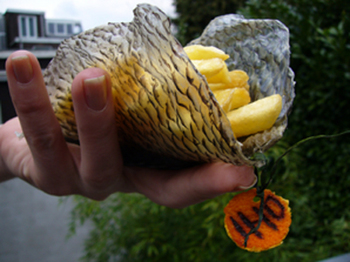
Image of street food packaging concept ‘IHO’, © Païvi Kovanen, Eva Arts and Caroline van Teeffelen 2006, used courtesy of the designers. Please respect student work, contact culiblog for updates.
The fish and chips sack is brilliant. Hand-sown dried fish skin imparts a nice fish aroma to the chips and you know how the Northern peoples love their (dried) fish. Katja and I are imagining a dusting of vinegar powder on the inside of the sack for a perfect flavour.
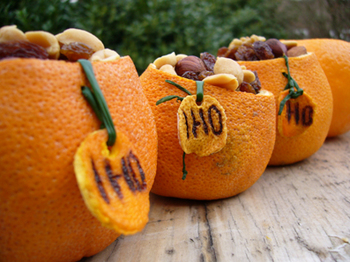
Image of street food packaging concept ‘IHO’, © Païvi Kovanen, Eva Arts and Caroline van Teeffelen 2006, used courtesy of the designers. Please respect student work, contact culiblog for updates.
Urban juice bars produce orange rind and pulp waste that is normally turned into silage to feed animals that us omnivores love to eat. Kovanen, Arts and van Teeffelen assured us that there’s plenty of rind and pulp to go around and they dried the rinds into snack containers. The pulp they turned most amazingly into a palm plate that has a wonderful hand feel to it.
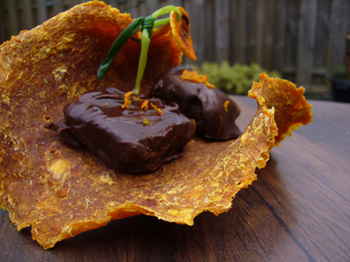
Image of street food packaging concept ‘IHO’, © Païvi Kovanen, Eva Arts and Caroline van Teeffelen 2006, used courtesy of the designers. Please respect student work, contact culiblog for updates.
As if this weren’t enough for one half-term street food assignment, the ladies Kovanen, Arts and van Teeffelen developed a new ceramic material produced from eggshells and potato starch and that can be formed into any possible shape. Here, the material has been formed into a palm plate.
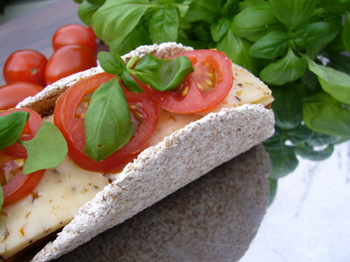
Fish and chips: image of street food packaging concept ‘IHO’, © Païvi Kovanen, Eva Arts and Caroline van Teeffelen 2006, used courtesy of the designers. Please respect student work, contact culiblog for updates.
IHO street food packaging concept by Kovanen, Arts and van Teeffelen.
debra at 11:06 | Comments (3) | post to del.icio.us
Street food collaborations: Streetberry!
April 24, 2006
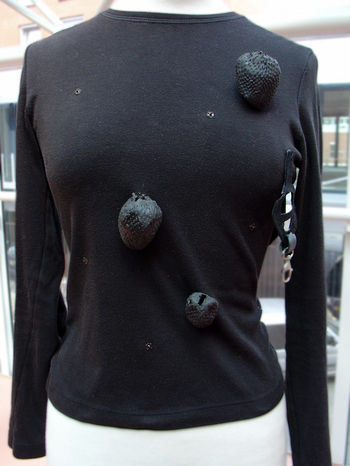
Streetberry design by Michou-Nanon de Bruyn, Milou Melis and Monica Ruiter. Please respect student work, contact culiblog for updates.
Nothing says wing-flapping like a subversive strawberry. Students Michou-Nanon de Bruyn, Milou Melis and Monica Ruiter have developed Streetberry as their final project for Katja Gruijters and my street food project. The collectible black rubber berries snap on to black t-shirts, rings, and necklaces made out of recycled bike tyres and representing the map of the city. The pieces smell like strawberries, but in a way that someone who is not a twenty-something woman can still appreciate.
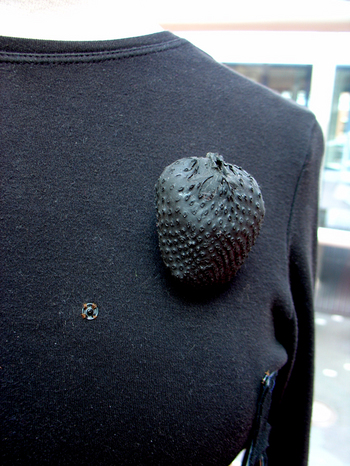
Streetberry design by Michou-Nanon de Bruyn, Milou Melis and Monica Ruiter. Please respect student work, contact culiblog for updates.
Since March, students from the HAS (Hoger Agrarische School, ’s Hertogenbosch NL, Food Design) and the Design Academy Eindhoven (Atelier, Food) have been collaborating on a street food project that Katja Gruijters and I initiated. Last Friday they presented the conclusion to their R&D and in the next weeks I’ll show a few of the best projects here on culiblog. Katja and I are most pleased with the results and think that the collaboration proves that the Design Academy and the HAS should work together on food-related projects in the future.
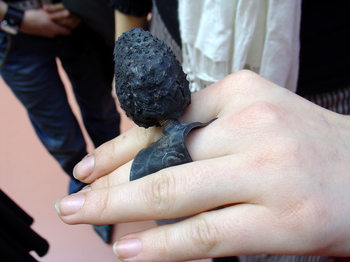
Streetberry design by Michou-Nanon de Bruyn, Milou Melis and Monica Ruiter. Please respect student work, contact culiblog for updates.
The assignment was to develop a a street food concept and in the course of 10 weeks develop this into a prototype. As you may already know, the NL is practically devoid of street food aside from the usual offerings of the Servex Group. Selling food on the street or at the train station is effectively illegal unless you are part of this horeca monopoly (HOtel, REstaurant, CAfé - another sexy Dutch acronym).
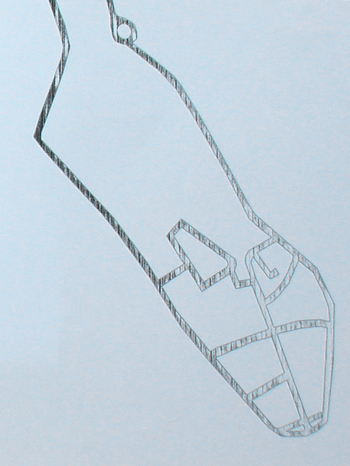
Streetberry design by Michou-Nanon de Bruyn, Milou Melis and Monica Ruiter. Please respect student work, contact culiblog for updates.
Katja and I wondered what future (food) and product designers, presented with a wealth of images and information about initiatives in other countries would come up with. Fortunately some students let their autonomous brains lead them away from the kitchen. A jewelry line based upon the map of the city, a new materials collection for street food packaging using the waste materials of commonly sold street food, and a conceptual art performance are some of the 12 fresh visions of what street food in the NL could become if it were allowed to flourish.
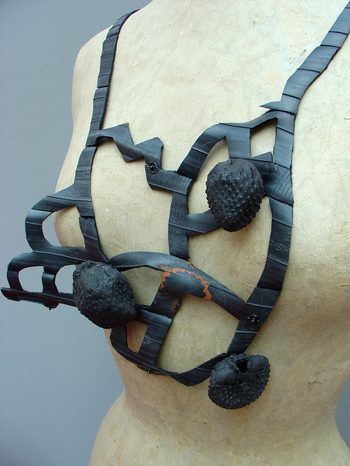
Streetberry design by Michou-Nanon de Bruyn, Milou Melis and Monica Ruiter. Please respect student work, contact culiblog for updates.
- Thank you Servex for convincing Dutch legislators that street food diversity is a hygiene issue!
- But seriously, thank you HAS for hosting this collaboration in your fabulous test kitchens!
- Thank you Design Academy Eindhoven (Kompas: Atelier) for being flexible and playful in terms of curriculum!
- Thank you Michou-Nanon de Bruyn, Milou Melis and Monica Ruiter for introducing us to Streetberry!
debra at 9:27 | Comments (0) | post to del.icio.us


