






Drawing Restraint, dragging ambergris
February 5, 2006

Occidental Guest (bride), production still from Matthew Barney’s Drawing Restraint 9, copyright Matthew Barney, used without permission
Filled with expectation unsuitable for the company of friends, clutching a fat wad of tickets between fingers reeking of quickly eaten, mediocre sushi, it is unwise to view the best film of the festival first. It just ruins everything, and this is exactly what happened to me on January 30th when, in the exquisite ‘old’ Luxor cinema in Rotterdam, I saw Drawing Restraint 9.

Shimenawa, production still from Matthew Barney’s Drawing Restraint 9, copyright Matthew Barney, used without permission
Drawing Restraint is artist Matthew Barney’s 2006 film entry in the International Film Festival Rotterdam and as well the Berlinale Film Festival, where he is a member of the jury. Avant-pop artist, composer and girlfriend Björk composed the soundtrack. Their collaboration is astounding on all levels; the film will make you cry, it is that beautiful. Aside from being culiblog’s favourite at this year’s festival, the film is exemplary of food-related film in the culiblog sense of the word; food, food culture, food as culture and the culture that grows our food.
Matthew Barney is the Lance Armstrong of contemporary art. In my opinion, no chef can yet lay claim to this position. Drawing Restraint 9 is also the best food-related film ever made, a lavish display of sensuality and ritual.

Barney on the left, Armstrong on the right
Drew Daniel of Matmos wrote this stellar description of Barney’s art practice on Björk’s DR9 website:
Barney is a visual artist whose ambitious, rigorous multimedia work encodes esoteric meanings while providing lushly immediate aesthetic rewards. Best known for The Cremaster Cycle, the sprawling sequence of five films made over ten years which was the subject of a recent Guggenheim retrospective, Matthew Barney’s work is multimedia in execution but singularly focused in conception: tightly unified fusions of sculpture, performance, architecture, set design, music, computer generated effects and prosthetics, Barney’s films deploy the full range of cinematic resources in the service of a hermetic vision rich with densely layered networks of meaning drawn from mythology, history, sports, music, and biology.
This is a sexy way of saying that Barney’s work is based upon his own elaborate and logical cosmology. In Drawing Restraint he playfully turns materials, forms, geometries and processes (e.g. petroleum jelly, silicone, whale blubber, ambergris, other marine excretions and accretions), cultural-historical narratives and geographic trajectories (e.g. the architecture, interior and machinery of a whaling ship, the culture of whaling, the history of a specific ship) and the experience of time (e.g. pearl oyster divers holding their breath under water, the migration of whales, a Japanese tea ceremony), into a luscious weave of deeply connected meaning and narrative.
This is where chefs tend to slack off.
But this is Barney’s demarrage, an escape or breakaway that gives him an advantage over the rest of the ‘field’. Whereas it is common for a chef to create a ‘richly organized set of aesthetics’ (as Drew Daniel describes Barney’s approach to making art), I know of no example within the culture of contemporary haute cuisine in which a chef recontextualises elements on this level to form a total experience beyond the formal boundaries of restaurant culture. Perhaps I’m not going to the right sort of parties. I long for an haute cuisine that is less ‘applied’ and more autonomous.
(Please read more… )
debra at 20:51 | Comments (7) | post to del.icio.us
Yesterday’s news: anti-advertgames
February 3, 2006

“Making money in a corporation like McDonald’s is not simple at all. Behind every sandwich there is a complex process you must learn to manage: from the creation of pastures to the slaughter, from the restaurant management to the branding. You’ll discover all the dirty secrets that made us one of the biggest companies of the world.”
So state the Italian artist-activist makers of the McDonalds anti-advertgame, Molleindustria. I don’t know if the fact that the rainforest is being destroyed to grow soy beans for hamburger meat or that cows are fattened with industrial garbage in feed lots is a secret anymore, but playing the online game illustrates that it definitely is a challenge balancing the economic factors of selling a burger without turning into a blood sucking evil-ass. After playing McDonalds for an hour, I had not once succeeded in making a profit and in fact I caused the company to go bankrupt every few minutes.
And if you’re thinking, ‘couldn’t happen to a nicer bunch of guys’, have a go.
The tip off is from Regine at we-make-money-not-art, a trend and technology blog. Thank you!
- Eric Schlosser’s must-read investigation on the fast food industry is titled Fast Food Nation
- NYTimes review of Fast Food Nation
- If you’re fluent in Dutch, you’ll love de Keuringsdienst van Waarde’s humourous yet disturbing consumer investigations streaming from the KVW website
- The only English subtitled de Keuringsdienst van Waarde broadcasts are about the development, design and production of a slave-free chocolate bar. Turns out, producing chocolate in which slave (yes, slave) labour is not part and parcel to the production practice is hard as can be.
debra at 9:21 | Comments (1) | post to del.icio.us
Grow yer own dang food
(part 1)
January 30, 2006
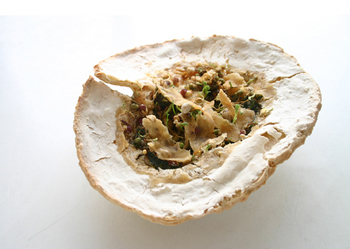
Image of sprouting bread courtesy of Cygalle Shapiro
Back in the eighties, as a student at the University California at Santa Cruz, I lived in a vegetarian commune with a bunch of hippies. As hippies, we produced our own sprouts, yoghurt and salsa fresca for the entire commune, approximately thirty people. I had all but forgotten this part of my life until recently, when my Food Atelier students at the Design Academy Eindhoven started working on ways to grow their own food. The work of two enthusiastic students got my wings flapping enough for me to dare revisit my past. These are the images from the first trials, theirs and mine.
After initial attempts at growing mung sprouts in bread (see above), Cygalle Shapiro is successfully growing a ready-made ’salad on salad’.
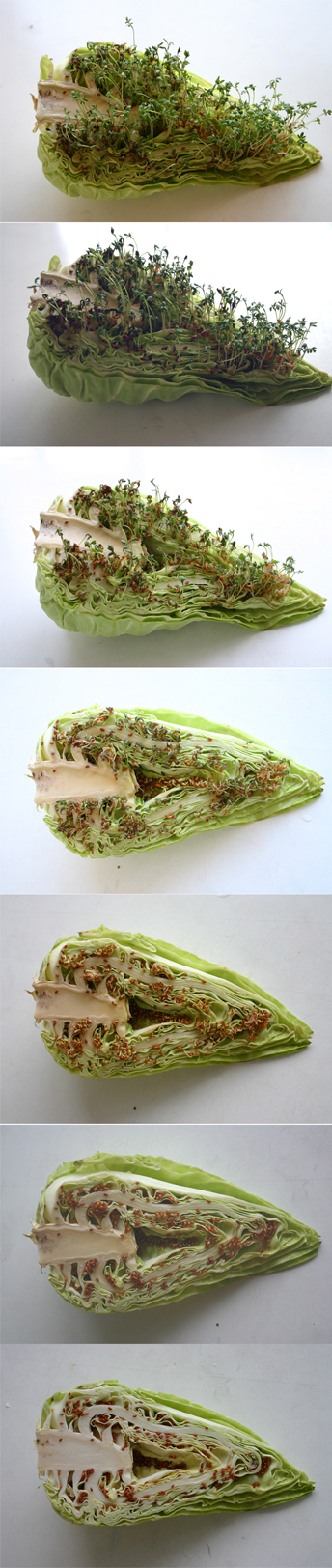
Images courtesy Cygalle Shapiro
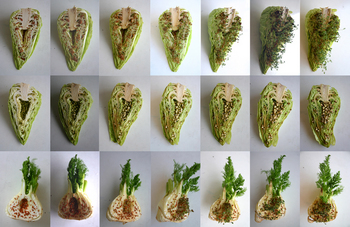
images top to bottom: sprouts in bread, salad on salad, sprouting experiments courtesy of Cygalle Shapiro, copyright Cygalle Shapiro 2005 - 2006. Contact culiblog for further information.
Liora Rosin is growing sprouts in labneh, a fresh yoghurt cheese, commonly made at home. For Rosin it is important that the seeds are grown within the labneh in order to transmit the flavour of the sprouted seed into the delicately tangy cheese.
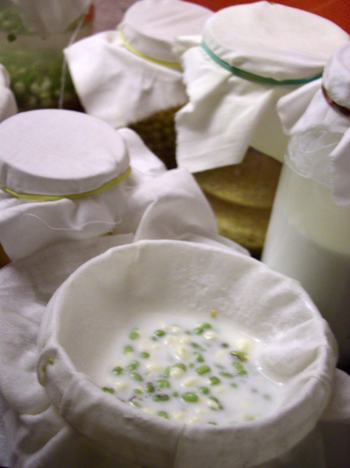
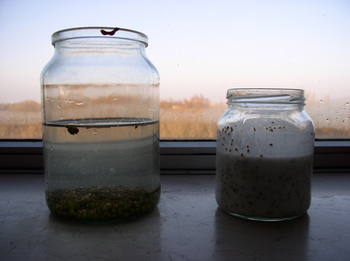
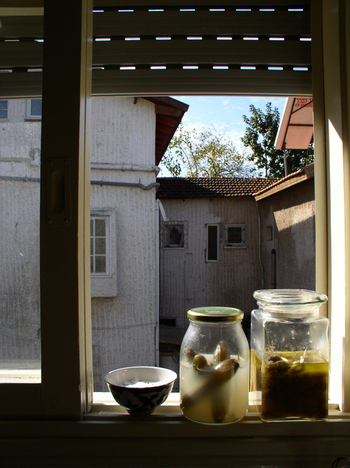
images top to bottom: home sprouting installation, soaking, lactic fermentation sill; courtesy of Liora Rosin, copyright Liora Rosin 2005 - 2006
Wouldn’t the world be a better place if we all had a designated windowsill for lactic fermentation?
Having resolved to practice what I preach in 2006, I am also working on growing sprouts on labneh and find that the experiments coördinate nicely with my developing a good recipe for yoghurt ravioli.
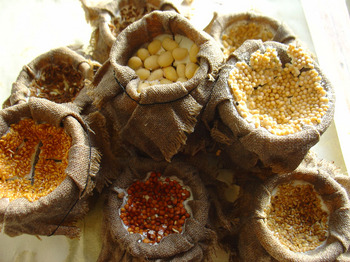
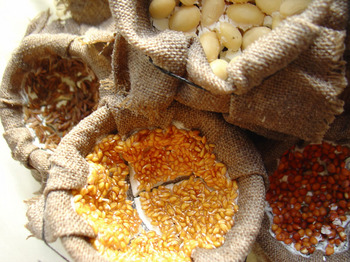
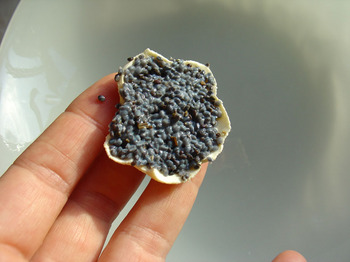
This is a cute disaster of basil seeds rotting into overly dry labneh. Seeds that become gelatinous when they are moistened (e.g., basil, buckwheat, watercress) are poor candidates for immediate immersion on or in the yoghurt medium.
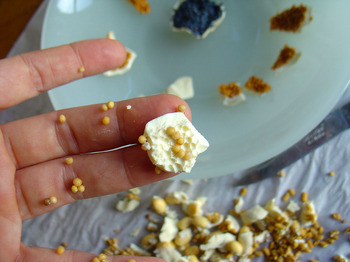
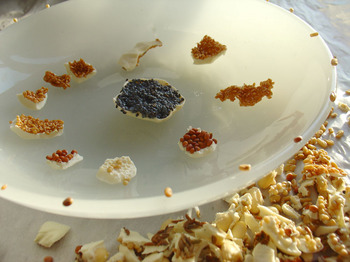
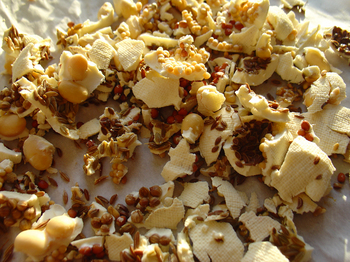
images top to bottom: sprout collection 2x, basil on labneh, playing with mistakes, pretending sampler, curd seed brittle; Debra Solomon
The results of an unsuccessful attempt at growing woody spice seeds (dill, coriander, cumin, kummel) in yoghurt medium with the intention of flavouring the labneh were not especially delicious, although visually exciting. The linen and the seeds texture the labneh beautifully and I look forward to spin a few successful recipes from these experiments soon.
- Lori Alden’s cheese definition site
- N55: Manual for city farming plant modules
- N55: Manual for home hydroponic unit
- Sproutman’s sprout bag. Any idiot can make one, but Sproutman is somehow selling them! My experience is that growing sprouts on wet linen works much better than growing them in jars. I have never tried sprouting in a linen bag.
Here are other urban gardening solutions, mostly rooftop gardening related:
- Rooftop Gardening link hub. Yes, it’s a trend!
- Plant vegetables on your rooftops, like they do in Egyptian cities
- Toronto rooftop gardening project
- Greening Gothan Project, NYC also on the roof
- BLDG blog on rooftop farming in London
- Treehugger reports on Toronto rooftop gardening facts and figures
technorati tags: rooftop gardening, urban gardening, food security, sustainability, farming, food-related design, agricultural diversification
debra at 11:52 | Comments (10) | post to del.icio.us


